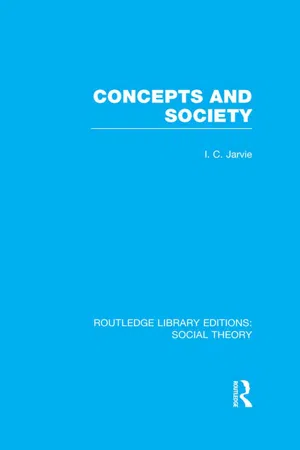
The main concern of Dr Jarvie's book is the relation of belief to action. He argues that people act in society because of beliefs, because of 'the way they see things'. There is the world of physical and social conditioning – where fixed roles, tropisms, adaptations seem to operate; there is the world of mind – where action, alternatively, seems to originate; but then there is Karl Popper's 'third world' – where dwell the objects of thought (ideals, theories, beliefs, values) which 'directly affect how people act, and thus affect the way the world is'. Reform, change, improvement, modification, all proceed from the competitive interaction between our private beliefs about the world, and their 'third world' brothers. Jarvie contends that the struggle of privately held beliefs to realize themselves in the world through the actions of their believers is a fundamental force behind social change.
- 228 pages
- English
- ePUB (mobile friendly)
- Available on iOS & Android
eBook - ePub
Concepts and Society (RLE Social Theory)
About this book
Information
part one Preliminaries
1 The logic of the situation1
DOI: 10.4324/9781315763682-1
What do the social sciences explain?
It is a mistake, to which careless expressions by social scientists often give countenance, to believe that their aim is to explain conscious action. This, if it can be done at all, is a different task, the task of psychology…. The problems [the social sciences] try to answer arise only insofar as the conscious actions of many men produce undesigned results….Hayek (1952), p. 39
Human action has consequences, especially unintended consequences, including patterned structures of relationships which we call institutions, and, while these are the results of human action, they are not the results of human design. Gellner remarks (1956) that the proper study of mankind is human groups and institutions.
When human beings act, including speak, there emerges from their behaviour entities like groups, marriage, morals and knowledge which transcend them, which are products of their actions but not necessarily of their intentions. This idea, presaged if not anticipated by Weber, Cooley, Thomas and Mead, has been worked out most interestingly by Hayek and Popper. In this chapter, I want to use it to discuss the question of how the social sciences explain what they do explain. One might say that the question of what they explain is one of emphasis: are the social sciences concerned to explain action or the results of action? By and large action is to be explained by reasons, and often these are very simple and straightforward. Those philosophers who identify such giving of reasons with the activity of doing social science really miss the whole point. The problems of the social sciences begin where the giving of reasons ends. For some social events like birth and suicide rates cannot be explained by giving reasons (whose?) at all. While other social events, being unintended (traffic accidents, stock market crashes, the breakdown of institutions), have no reasons of an individual kind at all. Sometimes a sociologist or an historian may venture to explain an event for which reasons apparently can be adduced. The outbreak of a war would be an example, as would labour unrest. But here the presumption is that neither one individual’s reasons (‘Why did you declare war, Mr Chamberlain?’ or ‘Why are you on strike, Joe?’) nor the sum of the reasons of all the individuals concerned suffice to explain the event. This claim amounts to an affirmation of the legitimacy of the social sciences as separate disciplines contributing something novel to the stock of human knowledge.
(The notion of reasons is not one I shall employ much in this volume because it fails to discriminate means from ends, goals from circumstances. A reason for crossing the road may be to go to a shop. This is an aim. A reason for carrying an umbrella may be to avoid a soaking on the way to the shop. While there is no sharp demarcation between means and ends, it is a useful distinction, and I shall therefore employ the terminology of aims and circumstances rather than reasons.)
This chapter contends that the basic explanatory model underlying the social sciences reads as follows.
A man, for the purposes of the social sciences, can be viewed as in pursuit of certain goals or aims, within a framework of natural, social, psychological and ethical circumstances. These circumstances constitute both means of achieving his aims and constraints on that achievement. A man’s conscious or unconscious appraisal of how he can achieve his aims within these circumstances might be called sorting out the logic of the situation he is in (or his situational logic). ‘Logic’ because he tries to find out the best and most effective means, within the situation, to realize his aims. There is no suggestion that there exists some perfect scrutiny of the situation which yields a uniquely effective move: most often several moves may be indicated, although it is unlikely the actor will be emotionally and morally indifferent between them. The actor’s ideas are part of his situation in a complicated way. It is assumed that the situation, if objectively appraised, should favour certain means which are more effective than others and that the measure of rationality consists in the success in approaching such an ‘objective’ appraisal. The logic of the situation, then, is an empirical description of the procedure of explanation which goes on in the social sciences; it is also a normative prescription for reform of what does not fit the description, particularly holistic and psychologistic social science; it is also, finally, a logical analysis of what underlies plausible social science explanations. The logic of the situation is a special case of the deductive analysis of causal explanation in general and illustrates the unity of method in the sciences.
Introduction to situational logic
Description plus examples
This chapter is an attempt systematically to explore what I understand to be the notion of the logic of the situation. It seems to me one of Sir Karl Popper’s most powerful yet simple philosophical ideas, and with the help of it one can sort out a great many issues in the methodology of the social sciences. Unfortunately it is nowhere fully explained outside of lectures.2
Yet it is not hard to do so. In a nutshell the idea is this. Situational logic (1) is explanation (2) of human behaviour (3) as attempts to achieve (4) goals or aims (5) with limited means (6). Each of the numbered key terms in this sentence will have a subsequent section of the chapter devoted to it.3 Before plunging into this I want to give some illustrative examples of how problems can be tackled in accordance with the logic of the situation. I want to take problems displaying the following characteristics: one stemming from the interaction of an individual quirk and the social situation, involving someone whose aims (or reasons) are clear but who has misappreciated the changing situation; one where the action is unremarkably typical but nevertheless puzzling because it is not clear if conscious aims (or reasons) are involved and if so what; and finally, one where a society-wide problem cannot be explained directly as a result of anyone aiming at the problematic state of affairs or of failing to appreciate what the situation is. The first is satisfied by explaining the case of a cautious driver who has nevertheless caused a multiple collision; the second is satisfied by the problem of explaining why a gentleman raises his hat to a lady; the third is satisfied by explaining the apparent erosion of the social fabric in Libya despite strongly conservative forces—Islam and the monarchy.
Example 1 How could an otherwise cautious, even blameless, driver suddenly find himself the cause of a serious multiple collision? It was an accident, we say. But is that the best we can do to explain it? Let us try further inquiry. The accident happened on a freeway. Cautious Mr X had never driven on a freeway before and did not realize that it is a completely different driving situation from that in a typical urban main street. Let us expand this further.
Learning to drive parallels in significant ways learning to live in a society. Traffic and its institutions surround us, but until the statutory age we are not allowed to enter the driving situation and master its logic. One observable consequence of doing so, when we get around to it, is that our behaviour as pedestrians improves. Knowing what it is like to drive a vehicle on a road, we can as pedestrians anticipate some of the dangers and act accordingly. I developed this hypothesis in Hong Kong to explain the apparently careless, even kamikaze, behaviour of the pedestrians. Never having sat behind a wheel, therefore trusting naïvely in the ability of cars to stop for them, the pedestrians act as though they were oblivious to danger. It says much for the skill of Hong Kong drivers, and the slow speeds they are forced to go, that the accident rate is as low as it is.
Take now this newish situation on the roads—freeways (called ‘motorways’ in Britain). Freeways organize traffic somewhat differently from ordinary roads and as a consequence quite new kinds of accidents occur. Cars collide even in cases where, quite clearly, there is no obstruction of vision involved. Multiple collisions occur. Why? For different reasons on different sections. Take first the freeway entry ramp. One is ordinarily trained to enter a transverse traffic stream by stopping the car, waiting for a gap in the oncoming traffic, then swinging out into it. On a freeway one is expected to behave quite differently, in fact to speed up and slip into the stream. Why? Because at freeway speeds a gap in the oncoming traffic would have to be very big to give one time to spot it, react to it and then accelerate from rest. In fact, much correct freeway behaviour consists in travelling at a speed comparable to that of the other traffic and then changing lanes when wanting to speed up or to slow down and get off. The cautious driver we are considering who tries to enter the freeway in the same manner that he turns into his local main street would cause a multiple back-up collision if he stopped on the feeder ramp, and another in the oncoming traffic lanes were he to try to accelerate from rest into a gap he has spotted, for this would force oncoming cars drastically to slow down. And yet, in behaving this way he might well imagine he has proceeded with exemplary caution.
Take now exiting from the freeway. Driving along a main street and wanting to exit you proceed slowly, spot the turn you are looking for, then signal, slow down and turn off. On the freeway, slowing down may again cause a multiple back-up collision if the traffic is dense. The problem is that, because of the speed on the freeway, exit signs are posted well in advance of turn-offs, so that, without loss of speed, the driver can anticipate his exit and move across to the inside lane in time to slip into the exit ramp, without slowing down or interfering with through traffic; he slows only when he has been fed off the main traffic lanes.
Take, lastly, simply cruising along. Normally, on a main street cars proceed slowly and bunched together. There is small danger in this, for they can almost stop dead, and at low speeds little harm is done by a rear-end bump. On the freeway, however, bunching is extremely dangerous. It prevents lane-changing, and makes reaction to sudden slow-downs very difficult. Result, more collisions.
Learning about traffic is a model for learning about society. A network of institutions (road signs, lanes, laws), customs (keeping your distance), expectations (that others know the rules), and ideas about all these, and people working together more or less in harmony. In addition to strictly correct driving, there is also courteous, defensive and unselfish driving. There are also vices like over-cautiousness, and competitiveness. The decisive simplification involved in comparing society to traffic is that, whereas in society people and their aims are diverse, on the freeway most people share one aim: to get safely and swiftly from A to B. Special problems arise, like the case of our cautious driver, as unintended consequences of the building of the freeways, and these problems can be understood by contrasting the logic of the freeway situation as experienced by the cautious but experienced driver with that of the cautious but inexperienced driver. Their aims are identical. Their situations are objectively identical. Only their appreciation of the situation, their expectations, their grasp of its logic, are different.
Example 2 A man raises his hat to a lady. Why? Answer: a ritual gesture of respect observed only by those who know the received ritual and who wish to express their respect. Unlike handshaking upon introduction, which seems to have lost any significance it may have had, hat-raising is sufficiently uncommon (decline of hats?) yet known, to be significant. Refusing to shake hands or averting one’s face in the street remain significant; not raising the hat is hardly noticeable.
Much of social life turns on arbitrary but significant gestures of this sort. The significance is sometimes clear, sometimes less so. Japanese audiences hiss: it is not at once apparent to the outsider that this is appreciative; many cultures take the burp after a meal as a mandatory gesture of satisfaction, others as rude. Social usages of this kind are peculiar in that most of those performing them could not explain their origin, even tentatively. In the hat-raising example it is unclear whether any aim is involved, except perhaps in the most attenuated sense. Refusing to shake hands upon introduction is not problematic in the same way. What, then, are we to make of these apparently aimless social usages? The logic of the situation seems to be this. Those who follow the usages are members of a society who have learned its conventions and who either accept them, or do not feel strongly enough to wish to flout them. Given this attitude they, on occasion, may find themselves wishing to indicate or communicate their respect for a certain woman. Their knowledge of the society tells them that raising the hat, rather than kissing the feet, is the correct gesture. Alternatively, they know it to be de rigueur in the society to express respect for women by raising the hat and they do not wish to be regarded as gauche; in fact they aim to integrate their behaviour into the society.
Example 3 ‘Libya’s Oil Riches Erode Simple Life.’4 This is a case of the unintended and, it would seem, unwanted consequences of oil wealth. (Subsequently, the monarchy has been overthrown in a coup d’état.) Into Libyan society came wealth; then (1) alcohol; (2) shepherds drive fast cars to clandestine bars and get into fatal crashes when driving home drunk; (3) the newly rich, able to afford the pious pilgrimage to Mecca, are also able to seek diversion in the fleshpots of Athens, Rome, and Cairo; (4) the King, as spiritual counsellor, is overwhelmed by citizens asking how to reconcile their dissolute new life with Islam. So the exploitation of oil is having a feedback on religious, social and political mores. None of these effects was intended by anyone, and yet no one seems to be able to do anything about it—the King stays out of town and inaccessible, trying to negotiate a middle course.
So the oil producers may not aim to change the society, the King may aim to minimize change, the shepherds aim to enjoy their new wealth and to follow their religion of Islam. Into this confusion of aims comes the factor of enormous wealth. The monarch finds it impossible to carry out his religious duty to answer all problems and questions; he has only one wife, although he encourages other men to have more; his wife is not veiled, although most wives of orthodox men are. And the newly wealthy shepherds behave erratically.
Clearly, we are seeing here a certain incompatibility of aims. The aim to have and enjoy wealth is conflicting severely with the aim to be religious, and the latter is suffering. What everyone is avoiding is the making of some sensible choices between these conflicting aims. As a result, what no one is aiming at, the erosion of the simple good life, is happening.
Sources in economics, Weber and Popper
Popper describes how (Popper, 1957a, historical note), after the original publication in German of his classic, The Logic of Scientific Discovery, he turned his attention to the social sciences to see if and how they differed methodologically. In concentrating on economics, he was in fact concerned to see if he could criticize his own theory of science as progressing by means of conjectures and refutations. Economics was, and is, the most developed social science, and he analysed its explanations of, for example, the determination of price in a free market, as involving aims (maximizing profit, minimizing loss), situation (conditions in production and in the market, the nature of their institutions), and the most efficacious means of gaining the former in the latter (pure economic theory). The price in a free market is an unintended outcome of sellers and buyers attempting to minimize their outgoings and maximize their incomings, given the degree of competition, the elasticity of supply, and the ‘perfection’ of the market. Popper seems to have generalized this analysis to see if it would serve for the social sciences as a whole. Bureaucratic delays, road accidents, train timetables, the rise of philosophical schools, the breakdown of democracy—explanations of all these could be analysed in terms of the same methodological model. Of course, some social phenomena could be explained simply by aims and the fact that the situation did not thwart attempts to achieve them. My being a passenger on a train can be explained by the lack of impediments to my aiming to be such. This sort of case is relatively unproblematic. What is more problematic is when large-scale events, like the breakdown of democracy in Germany, are explained solely by reference to someone, or some group’s aim. General recourse to this mode of explanation Popper calls ‘the conspiracy theory of society’. In general, while conspiracies do exist, by definition they are dedicated to controversial caus...
Table of contents
- Cover Page
- Half-Title Page
- Title Page
- Copyright Page
- Original Title Page
- Original Copyright Page
- Table Of Contents
- Epigraph
- Preface
- Acknowledgments
- Part One Preliminaries
- Part Two Case studies
- Part Three Concepts and society
- Appendix The methodological individualism debate
- References
- Bibliography
- Name index
- Subject index
Trusted by 375,005 students
Access to over 1.5 million titles for a fair monthly price.
Study more efficiently using our study tools.
Frequently asked questions
Yes, you can cancel anytime from the Subscription tab in your account settings on the Perlego website. Your subscription will stay active until the end of your current billing period. Learn how to cancel your subscription
No, books cannot be downloaded as external files, such as PDFs, for use outside of Perlego. However, you can download books within the Perlego app for offline reading on mobile or tablet. Learn how to download books offline
Perlego offers two plans: Essential and Complete
- Essential is ideal for learners and professionals who enjoy exploring a wide range of subjects. Access the Essential Library with 800,000+ trusted titles and best-sellers across business, personal growth, and the humanities. Includes unlimited reading time and Standard Read Aloud voice.
- Complete: Perfect for advanced learners and researchers needing full, unrestricted access. Unlock 1.5M+ books across hundreds of subjects, including academic and specialized titles. The Complete Plan also includes advanced features like Premium Read Aloud and Research Assistant.
We are an online textbook subscription service, where you can get access to an entire online library for less than the price of a single book per month. With over 1.5 million books across 990+ topics, we’ve got you covered! Learn about our mission
Look out for the read-aloud symbol on your next book to see if you can listen to it. The read-aloud tool reads text aloud for you, highlighting the text as it is being read. You can pause it, speed it up and slow it down. Learn more about Read Aloud
Yes! You can use the Perlego app on both iOS and Android devices to read anytime, anywhere — even offline. Perfect for commutes or when you’re on the go.
Please note we cannot support devices running on iOS 13 and Android 7 or earlier. Learn more about using the app
Please note we cannot support devices running on iOS 13 and Android 7 or earlier. Learn more about using the app
Yes, you can access Concepts and Society (RLE Social Theory) by Ian C. Jarvie in PDF and/or ePUB format, as well as other popular books in Social Sciences & Sociology. We have over 1.5 million books available in our catalogue for you to explore.