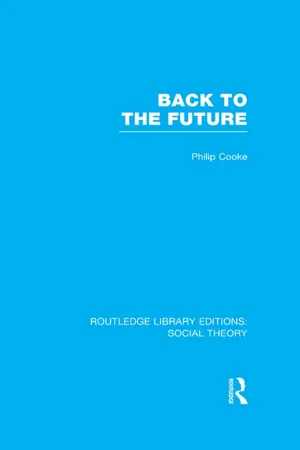
Is modernity being replaced by an opposite culture of postmodernity, or is postmodernism simply an internal critique of modernist culture? This key question is central to this stimulating book which explores the transformations taking place in social life, cultural preferences, economic organization and political attitudes, particularly in the context of the contemporary city as a lived or written experience. This book contains accounts of the development of modern ways of life and their erosion in the 20th century. The author argues that a whole set of modern institutions, from the corporation to the novel, are being exposed to internal critique and external competition. As a result, new ways of seeing and thinking are moving us into what some observers see as postmodern culture. However, these tendencies may in fact be the continuation of modernity by other means.
eBook - ePub
Back to the Future (RLE Social Theory)
Modernity, Postmodernity and Locality
- 212 pages
- English
- ePUB (mobile friendly)
- Available on iOS & Android
eBook - ePub
About this book
Information
CHAPTER ONE
The question of modernity
Modern life
We all think we know what it is to be modern. To have a modern kitchen means to have a number of machines and gadgets to do what our parents or grandparents used to do by hand. A washing machine is the perfect emblem of modernity. Previously clothes had to be collected, water had to be boiled, stains had to be rubbed out energetically with a bar of soap on a washing board, semi-washed clothes had to be put in the boiler, clean clothes had to be put through the mangle, then the whole lot had to be pegged out on a line or spread over hedges to dry. Now the machine can do everything except peg the clothes out, and if it has an in-built tumble dryer even the pegging out is unnecessary.
A modern car is probably one that has a smooth, aerodynamic profile, adjustable seats and steering wheel, a centrally-controlled, anti-theft locking system, electronically-controlled side windows, demisting devices, a heater, air conditioning, anti-lock braking, an automatic gearbox, digital speedometer and other information systems, an electronic, stereo radio and tape deck, perhaps an on-board computer which monitors engine performance and a virtually unerodable body finish. This is not only different in terms of safety and comfort from the Model T Ford, once considered the acme of modernity, but different from the Vauxhall Victor of the 1960s. In some ways there were more similarities between those two models than between the Victor and today’s Cavalier. Heaters, radios, safety belts, some of the dials were optional extras on most of the cars of the 60s. Their bodywork eroded in record time, their suspension was spongy, their engines under-powered and dramatically thirsty, they were spine-bendingly uncomfortable in many cases, and available only in a limited range of styles.
What today, is a modern lifestyle? Depending upon age and marital status, it will contain the expectation of reasonable income, if not some wealth – particularly in the bricks and mortar of the privately owned house or apartment. For a cohabiting or married couple it is likely to be built around two incomes, as many women now are in some form of paid employment. There may or may not be children, but there will be fewer of them per household than a generation ago, and far fewer than a hundred years ago. Almost everyone will expect there to be at least one two-week holiday every year, probably abroad in Spain or some other hot country, and many will be used to more than one foreign holiday a year. A modern lifestyle will probably involve a good deal of eating out, from a meal with the kids at McDonalds to Sunday lunch in a country hotel. It will mean, for most, the income to buy clothes and electronic home entertainments of a kind and origin undreamt of not long ago. There will, perhaps surprisingly, be more do-it-yourself around the house and garden with the growth of leisure time and of the retail warehouses and garden centres that make it feasible. There will, perhaps, be less neighbourliness than many adults remember from their youth, and more friendships at a distance due to personal and social mobility. There may, in retrospect and despite the plentiful goods to buy in the shops, be more unease and dissatisfaction with such a lifestyle than would have been so with the lifestyles of the past.
Clearly, these are caricatures into which bits of our lives and our thoughts fit better than others. But the descriptions will have meaning for many from the wealthier parts of the world, and some from what we may have assumed to be the less developed world – South Korea, Taiwan, Venezuela or Mexico, for example. Yet all the descriptions contain comparisons with the past. The pictures are snapshots of a moving scene. It was not always like this the commentary says, not yesterday and certainly not years before. How did the changing idea of what it is to be modern begin? Why do we now think the way we do about trying to be as modern as we can in our possessions, the fashions we follow, the places we visit? Why do we throw things away when they aren’t broken or even if they are?
In the far distant past, peasants, for example, might expect to make one long journey in their lives, a pilgrimage to Santiago de Compostela, Rome, Jerusalem even, but otherwise stay fixed within a small geographical area, within walking distance of a town, or maybe not even that. Only an ecological disaster such as famine or a social one such as war could force a change to a settlement pattern established over generations of attachment to the land. Change would occur, but slowly, faces would be familiar, today would be like yesterday except, as the seasons changed, working lives and social lives would mingle at various points of the year, at harvest obviously, but also at the sowing season. Then in the winter, with less to be done, social life would focus on the home, or tavern if there was one, and entertainments would be self-made, handed down or communal, historical, unconsciously understood expressions of tradition. The church and the simple class structure would bind the whole together into a system of unchanging ideas and practices, valued precisely because they were shared with friends but also, perhaps, social enemies of the present, as well as the past.
Modernity as emancipation and anxiety
Modernity, if it exists, is clearly much more than one-dimensional. It is therefore a most elusive idea, one that invites the unwary to think of it as a totality, some set of thoughts and practices having enough in common over space and time to encourage us to generalize. Reflection gives us good reason to pause before assuming that because we have given some historical experiences, events and practices a common name we have thereby put the reality they may represent in a common box. In his recent writing on modernity Jürgen Habermas, a social philosopher, has traced the origins of the word back to at least medieval times where it was used, mostly in ecclesiastical circles, to refer to artistic novelty in forms of expression. In particular, it was used to contrast innovative representations of religious ideas or motifs with those of the ancient civilizations, especially of Greece and Rome.
By the time of the Renaissance, however, such medieval avant-gardism was being referred to as premodern. The reason for this was that the Renaissance represented a rediscovery through detailed scholarship of the methods, techniques, literature and art of the ancient world itself. The Renaissance was reflective regarding the aesthetic and philosophical principles on which the ancients based their culture. Moreover, it was a period in which those principles were reworked in new ways in painting, writing, architecture and so on, such that the innovations of the medieval period were considered archaic. As a result it was this rehabilitated classicism, especially as represented in ancient Greek culture, that was now to be described as modern. Even in its origins, therefore, the idea of modernity was paradoxical, recursive, linked but not bound to a particular time period or temporality.
From the sixteenth to the eighteenth centuries what it was to be modern continued to exercise the minds of contemporary intellectuals. Roger Bacon used the term ‘modern’ to refer, possibly for the first time, to the new ways of thinking and acting that became possible as other fruits of the Renaissance, science and technology, began to bear upon culture and society. Later there was raging debate – ‘The Battle of the Books’ – as intellectuals and ecclesiasts wrangled over whether the products of the seventeenth century modernity of their times were of comparable or inferior cultural and aesthetic quality to those of the ancient world. But by the eighteenth century, punctuated with the philosophical Enlightenment, the elevation of human reason to a privileged position in western thought, and the occurrence of-the French Revolution as a partial consequence, modernity was being thought of in terms more recognizable to ourselves. Reason could be used to make the future a malleable one, and could interrupt the flow of history, overturn traditional hegemonies. Modernity was now to be understood as the very expression of individual and collective reason to bring about the achievement of some great social project. Thus emancipation of the individual, social progress, the development of harmonious social relations, the overthrow of fixed social institutions from the church to the calendar – Year One the revolutionaries called that following their overthrow of the old order – became the victorious definition of the idea of modernity. To a large extent, the past was to be relinquished, even forgotten as individuals and societies stepped into an unknown, unbound and therefore potentially terrifying future.
It is in this general sense that the idea, practices and experience of modernity have come down to us. These are closer to the understanding of the French revolutionaries, with a strong injection of Bacon’s technological or inventive modernity, than to that of the medieval or even, perhaps, the Renaissance perspective.
Charles Baudelaire, writing in the 1850s, gave slightly more definition to an individual, subjective dimension of modernity that had been overshadowed by the collective, social connotations prevalent earlier. Baudelaire wrote about the experience of being a post-Revolutionary, also post-counter-revolutionary Parisian. As Marshall Berman has so brilliantly shown, Baudelaire momentarily pinned down the new experience of being part of the crowd in the newly constructed boulevards and arcades of Paris. It was an experience that was to be repeated in the lives of millions of immigrants forced from the land or towns by famine, disaster, pogrom or simply agricultural modernization. Prussian peasants going to live in Berlin, Russian peasants moving to St Petersburg, or Irish peasants emigrating to New York would share Baudelaire’s feeling about modern life, experienced in the streets as transitory, fugitive, contingent.
Modernity was experienced as transitory because it meant personal and social upheaval from the settled peasant existence of agricultural life. Thus family members would be separated as the male headed for the city in one of the migration streams in pursuit of work. When he arrived he might or might not find familiar friends to take him in, but if he did it would not be for long. He would move from rooming house to rooming house as he moved from factory to workshop in quest of work. He might become an itinerant, falling back on some locally learned skill as a survival strategy in what could often seem to be a hostile, transitory, urban world.
The fugitive quality of modern urban life was a product of the fleeting nature of social interaction. Since practically everyone in the streets or cafes was a stranger, conversation, were it to take place, would inevitably be qualitatively different from that in the home town or village. It would be superficial, perhaps exploratory, and there would be a search for common ground, but also a fascination with widely divergent personal histories and narratives. There could be little sharing of assumptions, plenty of room for misunderstandings. Chance meetings could sometimes result in feelings of friendship or intimacy developing as two or more people discovered common interests. But then, the chance encounter would come to an end and the participants would possibly never again see each other. There might be a period of searching but also the dawning of recognition that modern life entailed the conscious or unconscious possibility of hiding from too much emotional exposure. It is little wonder that the less existentially minded migrants would huddle in ethnic enclaves in the modern city. Nor is it surprising that existentialism as a philosophy of action (and inaction) should thrive in Paris, as it had earlier in the literature of St Petersburg where Dostoevsky worked out his terrifying, emancipatory fantasies.
Modern experience also has a contingent quality about it. The nominally free subject, the conscious individual, can choose a course rather than experiencing life as a series of necessities. Different occupations can be sought and relinquished rather than being determined by the requirements of the land, the seasons, the duties of settled existence. Circles of acquaintances can be extended, assignations made, and satisfactions purchased in a contingent way, dependent to some extent on mood, opportunity and availability. Long-established practices, such as the rituals of religion and culture, can be shirked. The modern person finds herself in Paris and learns French; in New York, English. She lives in a world peopled largely of her own choice, she develops habits, but also breaks them. She falls back on her own resources, particularly reason or maybe just common sense. She has a benchmark of comparison with her former life, learns to be critical, notices differences, aims to improve. It is as a consequence of these experiences that the modern individual both forges herself but is also forged by the contingencies of everyday life.
It is, then, this transformative quality that characterizes modernity so precisely: the idea of life as an adventure of self-transformation within a looser set of limitations than those familiar to the past, the possibility of life being perceived as a project over which the individual has considerable influence, though not total control, is what specifies modern experience.
However, the question of modernity is neither simply one of existential joy nor is it purely a subjective experience. Projects go wrong, and relinquishing the familiar can lead to ‘fear and loathing in Las Vegas’ as Hunter S. Thompson puts it. Upward mobility can reverse as the contingencies of private enterprise eject, having previously welcomed, the new employee. For this is also a central part of modernity. The individual who becomes an entrepreneur in a system which rewards the competitor or the innovator excessively is engaged in adventures with far-reaching consequences. Modernity as conceived here coincides with the onset of competitive capitalism. That system of production requires the unshackling of egotistic urges, insists upon the harnessing of individual and collective reason in pursuit of success in the competitive marketplace.
Markets and the new productive system, which must expand to survive, exert social pressures not unlike the physical forces of an electro-magnetic field. They penetrate outwards, weakening towards the edge, but disrupting the social spaces, towns, cities, regions with which they come into contact. The agricultural region from which the nineteenth century Parisian modern(e) might have migrated would have had markets of course, but small local systems of exchange. Competition from a region in which modern practices of investment, improvement and technological development were prevalent would bring about two crucial effects.
First, it would force those in the less developed region to adopt, by purchase, some of its practices and products. But these would not be exchanged equally. Capitalist production embodies the element of profit. To exchange products across the regional market boundary requires the payment of that profit element by the producers of the backward region. This gradually sucks capital which otherwise might have been stored in local banks, ready for investment in that region’s own modernization, away and into those of the advancing region. This unequal exchange of value lies at the heart of the market system.
But, secondly, and more importantly, the advanced productive system, which will most likely be more specialised, concentrating on a smaller range of products to increase the advantages of economies of scale, will outcompete in price the more hand-raised products elsewhere. Specialization will be augmented by a more efficient division of labour amongst the workforce. The way in which the labour force is organized will also be a source of profit to the entrepreneur. This is because, although paid a wage, this will not fully compensate them for the value of their daily or weekly effort. It will be sufficient for them to live but not equivalent to the worth of the work completed. The backward peasantry will in fact, and temporarily, be wealthier than the hired labour of capitalist agriculture and related industries such as food-processing, canning and so on. In time though, that advantage in scale will undermine the capacity of the peasantry to produce even for their local markets at competitive prices. Farms will be sold, the younger generation will increasingly see fewer prospects of employment by staying, and some of them will become the modern inhabitants of the cities which now, through their concentrations of factories, will have become the labour markets of the future.
The aesthetics of modernism
The social forces unleashed by such development processes created tensions outside the spheres of everyday and employee life. The ‘shock of the new’, as Robert Hughes has put it, does not simply wash over the modern citizen, leaving only surface traces on a passive sensibility, it is actively created and recreated by individuals and groups who experience and reinterpret it. This is especially pronounced in the sphere of aesthetics where ideas, innovations and cultural transformations are projected from thought into practice more rapidly than the changes going on in society, politics and the economy. The question of aesthetic modernism is a difficult one. There is debate about when it really got started, whether it can be thought of as a homogeneous phenomenon, and what its key characteristics might be.
Regarding these three questions, it is simplest to deal with the first one, though in so doing an argument has to be made to justify what some writers would see as an arbitrary cut-off point. For present purposes a date around the mid-point of the nineteenth century can be proposed. Developments in the arts, literature, music and so on having connections with the cultural forms of the first half of the nineteenth century and before can be referred to as proto-modern. Thereafter, it is convenient to speak of early modernism taking us up to the turn of the century, a middle period from then to the mid-twentieth century, and late modernism being associated with the period from 1950 to the present.
The reason for choosing the mid-point of the nineteenth century to start the discussion and definition of the modernist aesthetic era is because that was when the contours of aesthetic modernism became clarified, first, as a discipline which united artists against the past, and, second, as the spirit of what they were setting out to express and achieve. It is undoubtedly true, that some outlines of modernism can be detected before this time in literature more than perhaps art or music. Romanticism, as in the writing of Goethe, contained fundamentally modernist elements in the concept of man ‘binding himself while binding back the sea’. There is reference to the Prometheus myth which emphasizes the poignancy of his punishment – being chained to a mountainside and daily eaten alive – for defying Zeus by giving the gift of fire, and thereby enlightenment, to humanity. One could say that Shelley, for example, defined his literary and political life in Promethean, and hence both ancient and modern, terms; so, it is fairly apparent to see, did Byron in his epic poetry on the life paths of modernist figures such as Don Juan or the equally autobiographical Childe Harold. Byron of course, even more than Shelley, was personally committed to assisting the Greeks in their quest to form a modern nation-state by overthrowing the Ottoman Empire in their country.
Despite these motifs, conjoining Enlightenment ideas of personal and political freedom, it cannot be said that these writers posed a fundamental challenge to the cultural norms they had inherited. To some extent the political activity of Byron and Shelley was a displacement of that challenge from the cultural sphere to the world of action, a world of action beyond their own native borders. For Wordsworth, too, political radicalism, galvanized by the French Revolution, turned into an introspective communing with nature, and the aesthetic experience of its religious power and beauty. Indeed this could be said to be the defining characteristic of Romantic proto-modernism, a pessimism turned inwards into an aesth...
Table of contents
- Cover
- Half Title
- Title Page
- Copyright Page
- Original Copyright Page
- Table of Contents
- Acknowledgements
- Introduction
- 1 The question of modernity
- 2 Community: the social residue of modernity
- 3 Modern times: the Fordist worker
- 4 The question of postmodernity
- 5 Locality and Social Innovation
- 6 Post-Fordism and the flexible future
- 7 Conclusions. Modernity and locality: critique and renewal
- References
- Index
Trusted by 375,005 students
Access to over 1.5 million titles for a fair monthly price.
Study more efficiently using our study tools.
Frequently asked questions
Yes, you can cancel anytime from the Subscription tab in your account settings on the Perlego website. Your subscription will stay active until the end of your current billing period. Learn how to cancel your subscription
No, books cannot be downloaded as external files, such as PDFs, for use outside of Perlego. However, you can download books within the Perlego app for offline reading on mobile or tablet. Learn how to download books offline
Perlego offers two plans: Essential and Complete
- Essential is ideal for learners and professionals who enjoy exploring a wide range of subjects. Access the Essential Library with 800,000+ trusted titles and best-sellers across business, personal growth, and the humanities. Includes unlimited reading time and Standard Read Aloud voice.
- Complete: Perfect for advanced learners and researchers needing full, unrestricted access. Unlock 1.5M+ books across hundreds of subjects, including academic and specialized titles. The Complete Plan also includes advanced features like Premium Read Aloud and Research Assistant.
We are an online textbook subscription service, where you can get access to an entire online library for less than the price of a single book per month. With over 1.5 million books across 990+ topics, we’ve got you covered! Learn about our mission
Look out for the read-aloud symbol on your next book to see if you can listen to it. The read-aloud tool reads text aloud for you, highlighting the text as it is being read. You can pause it, speed it up and slow it down. Learn more about Read Aloud
Yes! You can use the Perlego app on both iOS and Android devices to read anytime, anywhere — even offline. Perfect for commutes or when you’re on the go.
Please note we cannot support devices running on iOS 13 and Android 7 or earlier. Learn more about using the app
Please note we cannot support devices running on iOS 13 and Android 7 or earlier. Learn more about using the app
Yes, you can access Back to the Future (RLE Social Theory) by Philip Cooke in PDF and/or ePUB format, as well as other popular books in Social Sciences & Sociology. We have over 1.5 million books available in our catalogue for you to explore.