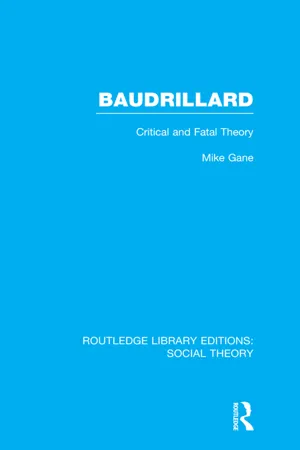
Baudrillard is widely recognised as a powerful new force in cultural and social criticism, and is often referred to as the 'High Priest of Postmodernism'. This study presents a detached assessment of his social thought and his reputation, challenging the way his work has been received in postmodernism and proposing a new reading of his contribution to social theory. Using many sources currently available only in French, Mike Gane provides the keys to understanding Baudrillard's project and reveals the extent and scope of Baudrillard's challenge to modern social theory and cultural criticism. He looks at the sources of Baudrillard's ideas, analysing how Baudrillard has turned these sources against themselves. He describes Baudrillard's dramatic encounter with critical Marxist theory and psychoanalysis, showing how Baudrillard's post-Marxist writings define, through the exploration of fatal theory, a new episode in cultural history: a period of cultural implosion. This balanced account of Baudrillard's social theory emphasises the originality of his work and argues that his significance can only be understood by grasping the paradoxes of his project – Baudrillard's work is poetic, yet, at the same time, critical and fatal.
- 250 pages
- English
- ePUB (mobile friendly)
- Available on iOS & Android
eBook - ePub
About this book
Information
Part I
The tangled web of hatreds, of complicities, of rivalries between different schools of thought and of changes in mood causes each atom in the intellectual world … to prefer itself, while all the atoms detest each other.… The fact that certain disconcerting effects of beauty and truth may spring forth from time to time … remains a miraculous paradox.
(Baudrillard, 1990c: 88)
1 Introduction: reading Baudrillard
To whoever embarks on terrible seas.
Nietzsche (1969:264)
Baudrillard’s writings vary enormously in range, register, style, complexity. His writing seems to differ markedly from his spoken interviews (which seem in comparison, less forceful, less logical – steps of arguments are often passed over, and most noticeably, he often makes concessions which he probably would not make if writing. If an interviewer is corrected yet continues to follow a disputed interpretation, Baudrillard is not likely to put up any determined resistence.) His written work, however, appears to follow lines of argument without concession to their limit. There are, perhaps, two Baudrillards. I became aware of this watching Baudrillard responding to questions from Bernard Pivot on the French television programme Apostrophe, but it is also apparent in Baudrillard’s interviews (for example, in the recent interview (Baudrillard, 1988), where Baudrillard becomes less assured and will often appear to be pushed into a position he really does not accept, even to the point of putting his own position into question. But a more confident Baudrillard appears in the written texts, when the writing is pushed to the limit and there appear to be no limits to expression or position.)
It is instructive to compare the experience of reading Baudrillard with that of reading the texts of Marshall McLuhan. George Steiner once wrote:
This is not an easy thing to do. (They) are so compounded of novelty, force of suggestion, vulgarity of mind and sheer carelessness that one is quickly tempted to put them aside, … the question of how to read McLuhan, of whether reading him is an obsolescent mode of contact, is implicit in McLuhan’s own work.… He sets his readers a perpetual problem: that of reading any further.
(Steiner, 1969:261)
Something of the same feeling occurs to the reader of Baudrillard. It would be possible to argue that Baudrillard is the French McLuhan, or simply is the McLuhan of today (his most recent book is still decisively influenced by him). But who reads McLuhan now? Perhaps Baudrillard will force people to reread a number of writers – McLuhan, Nietzsche – who are often thought to be unreadable. It is certainly striking that a number of recent writers have disguised their dependence on Baudrillard’s work as if he were not quite respectable in academic discourse proper (see, for instance, Rundell, 1987; Richman, 1982; Bauman, 1990a).
But how to read Baudrillard? The problem here is that Baudrillard’s works, as many commentators have noted, have a remarkable unity. There is tension, and out of this there is development. Yet one possible failing in his total project is an abstraction due to the lack of backgrounding, or contextualisation from work to work. As for the English reader, key Baudrillard texts are as yet unavailable in translation and confusion and misinterpretation are high probabilities. In this perspective it is essential that the overall structure of the trajectory of Baudrillard’s work is established, so that the changes in style, which alter as the strategic dynamic changes, are recognised as an essential element of the message of the project. Baudrillard himself has outlined the nature of this project in his ‘Habilitation’ statement which is available in English (1988c). And I shall use this as a first guide to the construction of an account of his work.
I shall also use it as a guide to the essential context of his writing, as a way of locating important influences and debates in which Baudrillard is situated. Some of this context is clearly available, and has been available in English for a long period of time. There are other essential components of the rhetorical context of Baudrillard’s work, which is only at this moment coming into English, and there are other influences which can only be reached through French sources. All of this necessary effort of establishing the intellectual networks which render Baudrillard’s project meaningful is also, in a sense, passive if it remains purely at the level of classification, for Baudrillard’s work is also posed as a challenge, both to the world at large and to the reader as such. Baudrillard himself has often made the distinction between the two types of analysis: structural ranking or ordering, and analysis of a strategic kind which is part of a struggle.1 As I shall show, Baudrillard’s work has contained a very basic internal tension between two very different theoretical positions: his intellectual biography can be understood as a process of the effects of these positions on each other, and as the process of the radical displacement of the dominance of one over the other.
These two positions are fundamentally those of Marx (radicalised, though in different ways, through Nietzsche, Althusser and Adorno), and Durkheim (radicalised through Mauss and Bataille). The latter influence has gone almost completely unnoticed in the accounts of Baudrillard’s works in English. Both of these basic ‘paradigms’ (Baudrillard) will be examined at some length, but here a brief outline conspectus of Baudrillard’s works is essential: a first period was dominated by structural theory (Marx, semiology and sociology). The principal works of this period (1968–72) were studies of the affluent societies (Le Système des Objets and La Societé de Consommation, followed by a collection of essays, For a Critique of the Political Economy of the Sign). These works continued Marxist analyses into commodity consumerism in advanced capitalist societies, as patterns increasingly dominated by semiological relations. Indeed semiological characteristics had become so predominant that consumption could only be explained as a process involving the consumption of signs themselves (use values being a term which came under increasing criticism from Baudrillard). But latent was another, potentially more radical, critique of capitalist consumption as corrosive not of human relations (to Baudrillard a notion tinged with essentialist implications) but of more fundamental symbolic exchange relations articulated around ritual, gift, initiation, reversibility. At the crucial juncture (The Mirror of Production, 1973, trans. 1975a), Baudrillard pilloried Marxist theory (and indeed sociological structuralism) as being caught up in the very code of capitalist reproduction itself. After this critique Baudrillard wanted to retain little of Marxist theory except for the analysis of the process of exchange value and the law of value which was extended dramatically into a wider theory, not of exploitation, but of the dynamic of capitalist culture itself. The critique of this culture was no longer based principally on the formation of class opposition, or on revolutionary proletarian principles. It was based on the principles of those cultures outside and beyond capitalism and rationalism: symbolic cultures. The general theory of these cultures was elaborated in Baudrillard’s major work (L’Echange Symbolique et la Mort, 1976). His subsequent essays have been attempts to move from critical theory, associated with Marxist theory, to what he calls fatal theory (in three major essays (De La Séduction (1979), Les Strategies Fatales (1983b) and La Transparence du Mal (1990b)). I have said that these are close to a Durkheimian paradigm, but this is my (not Baudrillard’s) judgement, and it has to be qualified, for Durkheim could not have foreseen these particular analyses, nor would he have agreed with them in the form in which they have been written. For Durkheim remained essentially a rationalist and a social scientist, and was sceptical of the effectiveness of an aesthetic mode of investigation. The remarkable project Baudrillard has set himself has been to use the Durkheimian paradigm but to place himself in it as a primitive, as a pre- or anti-rationalist, and to evolve a poetic theoretical analysis of the effects of the most advanced technical transformations in our culture. Yet Baudrillard only very rarely refers to Durkheim, preferring to adopt his paradigm as already modified in the work of Bataille and others.
Alongside the works I have noted here as the most significant of Baudrillard’s writings, there are other essays and publications which are important. The first group is a large number of articles contributed to journals, particularly the journal Traverses, on which Baudrillard was a contributing editor (between 1976 and 1989). Many of these essays have been collected in volumes called Simulacra and Simulation (1981a) and La Transparence du Mal (1990). A second group consist of political writing, centred on a critique of Communist and Socialist Party debates in France in the 1970s and 1980s (collected in La Gauche Divine, 1985a). The third group are two volumes of a journal called Cool Memories (1987b, 1990d) which are closer to notebooks than diaries, and a companion volume, America (1988), in which heterogeneous reflections are unified into a voyage. The fourth is single volume of poetry, L’Ange de Stuc published in 1978, but written as early as twenty years before in the 1950s. These latter two groups reveal Baudrillard’s effort to maintain a link with poetic language and with the lived everyday world, especially after the development of the new position from 1973. In the end, he has said, his intention has been to write in two modes, the theoretical and the poetic. This can be seen in his theoretical work where sections of the theoretical writing make their appearance on the page in a form close to the poetic. Thus it is clear that, for Baudrillard, the theoretical is the mode in which the poetic can still have force, and, in its close proximity to the journal can make contact with lived experience.
We again return to the question: how to read Baudrillard? Evidently we are faced with a considerable body of work, of very different kinds of writing, yet produced with a high degree of integrity and unity of purpose. It seems clear that there are dangers in thinking that this body of work is indeed the outcome of a single homogeneous authorial project and time. It is inevitably tempting to apply, say, Baudrillard’s own theoretical elaboration of the anagrammatic nature of poetry to his own poetry, since they were both published at about the same time (1976–8) – indeed it is natural to assume that the poetry is an application of the theory. I have, presumably, like many others, attempted to unravel this, only to be informed by Baudrillard himself that as the poetry was written long before the theory of the anagram, there is no direct relation. This, however, leads to the possibility that much of the basic theoretical and propositional framework of Baudrillard’s mature position was established at a fairly early stage, and was overlaid as it were with a different superstructure of semiological Marxism from 1968 to 1972, only then to emerge in the form of the theory of symbolic exchange. There is then the possibility of internal discrepancies and the emergence of the complex whole as a unity of such diffraction. It must also be remembered that Baudrillard’s educational background is in languages, that he taught German in a French lycée before moving into sociology, and that he was a prolific translator of important theoretical and literary works from German into French (including Marx, Brecht, Weiss, Muhlmann). In this perspective it is likely that the important, even decisive influence, of Hölderlin, Marx, Nietzsche, Heidegger and the Frankfurt school (especially Benjamin, Marcuse, Adorno) was established very early on. One of the key questions in Baudrillard is the assessment of the relative balance of literature (fiction), theory, philosophy and sociology. This is essential to any attempt to define the nature of Baudrillard’s theoretical objectives.
The essential point to make with respect to Baudrillard’s work is that it has remained remarkably well focused on the problem of the object, of the cultural object (generally the fusion of sign and object). Thus, all his various means of approaching these questions are unified by the intransigence of this insistence. It is vital, then, to consider Baudrillard’s construction of his notion of the ‘object’ in relation to his conception of social and cultural evolution: obviously his work is inspired by Marxist analysis of the commodity (but he rarely refers to Lukacs or the problematic of reification, even during his most intense involvement with Marxism), yet the term ‘object’ is much broader, and this is for a good theoretical reason which lies at the base of Baudrillard’s theoretical project.2 The commodity is one form of the object, its exchange-value form. The commodity can be used as a model for the analysis of other forms, but in general it the freeing of the object as such which dominates the configurations of western culture from the Renaissance, and perhaps earlier. Thus Baudrillard’s analyses concern, to speak in Weberian terms, the enchanted world (in which there are no objects, no social relations, no process of production and no consumption – as we understand it), and the descent into ‘disenchantment’.
Baudrillard must be read in this context. His project must be regarded as an assault on the ‘disenchanted’ world from the point of view of a militant of the symbolic (enchanted but cruel) cultures. In this he is prepared to appear in theory as a terrorist, as seducer, as devil’s incubus. His latest essay (La Transparence du Mal (1990b)) has as its epigraph (in English): ‘since the world drives to a delirious state of things, we must drive to a delirious point of view’ (1990b:9). He adds: ‘Il vaut mieux perir par les extrêmes que par les extremités.’ This can be taken as a basic Baudrillardian maxim; better to perish by extremes than by extremities. Baudrillard is a cruel, theoretical extremist, and must be read accordingly. He follows the logic of his own position without allowing convention (or intellectual blackmail) to set up artificial barriers: wherever it leads, without reserve, what counts is total commitment to the divided logic of his investigations. In relation to one of his books he wrote: ‘It must laugh in its sleep. It must turn in its grave!’ (1990c:116). At the back of this, no doubt, there is an elaborate doctrine (probably inspired by Dostoyevsky, Hölderlin and Nietzsche, as well as Kafka, Bataille, Borges and McLuhan), which will have to be reconstructed as far as possible from the fragments Baudrillard gives us. It is important, however, not to reduce Baudrillard to fanaticism or to a notion of individualistic anarchism.3 At this stage it is necessary only to pose the question of reading an ultra, that is, not to close the borders too soon (which would reduce Baudrillard immediately to outlaw status, as has been done in previous periods to Spinoza, Marx, Nietzsche and others). If Baudrillard accuses the west of hypocritical attitudes of tolerance, he will no doubt be expected to be misunderstood. In the reading to be adopted here the challenge is to follow through the logic of Baudrillard’s position wherever it may lead, in the belief that this logic itself contains its own principle. Baudrillard has sought to follow a subversive strategy against the temptations of banal or sentimental opposition to the present system, a revolutionary who has sought to find a line of continuation of revolutionary possibilities after the collapse of the revolutionary movement. In this he provides a measure for the extent to which all others have been reconciled to ‘the object system’. If his work is not dangerous, then, it is nothing. A reading must be prepared for this.
But what I propose here is, partly but not completely for the sake of exposition, to reverse something of the order of Baudrillard’s investigations. I propose to work from Baudrillard’s basic framework as the most direct way of coming to terms with his theoretical ingenuity and repositionings. In this way the reading will work from an initial framework in order to assess the way Baudrillard’s individual essays move towards or away from it.
In fact this procedure has the added advantage of allowing more general theoretical considerations to come to the fore. What it suggests is the possibility in the French sociological tradition for there to be a working compromise between the Marxist and the Durkheimian problematics (just as in Germany there has been the same possibility between Marx and Weber). Let us say then that Baudrillard in effect thinks about world history in terms of three distinct social formations:
1 primitive symbolic cultures (no element of signs);4
2 societies in which symbolic cultures are found, in combination with hierarchies (a limited, circulation of signs);
3 mass societies (dominated by the circulation of signs).
In this framework there is evidently the possibility of analysis of a Marxist kind, since societies of type (1) are non-historical primitive communist societies, and type (2) are class societies. For Durkheim, type -1- are segmental societies, and type -2- are en route to the societies based on organic solidarity.5 Baudrillard attempts to develop a new theory of symbolic cultures, and a new theory of mass societies. But the latter has not appeared without a long gestation period: his first analyses of it are predominantly written in the form of a Marxist semiology, of a society dominated by affluence and new disciplines of consumption, and in which class struggle was still important. After the collapse of the revolt in Paris in 1968 his position changed to take account of his view that revolutionary class struggle was from then on no longer possible. In fact, therefore, his conception of these societies was one based on the dominance of a new phase of capitalism and mass culture, but without a class which could negate the system. As class struggle was effectively eliminated, history, in the Marxist sense, had come to an end: the inner contradictions of capitalist society had in a sense been (negatively) resol...
Table of contents
- Cover
- Half Title
- Title Page
- Copyright Page
- Original Copyright Page
- Dedication
- Table of Contents
- Acknowledgements
- Part I
- Part II
- Part III
- Part IV
- Notes
- Bibliography
- Name index
- Subject index
Trusted by 375,005 students
Access to over 1.5 million titles for a fair monthly price.
Study more efficiently using our study tools.
Frequently asked questions
Yes, you can cancel anytime from the Subscription tab in your account settings on the Perlego website. Your subscription will stay active until the end of your current billing period. Learn how to cancel your subscription
No, books cannot be downloaded as external files, such as PDFs, for use outside of Perlego. However, you can download books within the Perlego app for offline reading on mobile or tablet. Learn how to download books offline
Perlego offers two plans: Essential and Complete
- Essential is ideal for learners and professionals who enjoy exploring a wide range of subjects. Access the Essential Library with 800,000+ trusted titles and best-sellers across business, personal growth, and the humanities. Includes unlimited reading time and Standard Read Aloud voice.
- Complete: Perfect for advanced learners and researchers needing full, unrestricted access. Unlock 1.5M+ books across hundreds of subjects, including academic and specialized titles. The Complete Plan also includes advanced features like Premium Read Aloud and Research Assistant.
We are an online textbook subscription service, where you can get access to an entire online library for less than the price of a single book per month. With over 1.5 million books across 990+ topics, we’ve got you covered! Learn about our mission
Look out for the read-aloud symbol on your next book to see if you can listen to it. The read-aloud tool reads text aloud for you, highlighting the text as it is being read. You can pause it, speed it up and slow it down. Learn more about Read Aloud
Yes! You can use the Perlego app on both iOS and Android devices to read anytime, anywhere — even offline. Perfect for commutes or when you’re on the go.
Please note we cannot support devices running on iOS 13 and Android 7 or earlier. Learn more about using the app
Please note we cannot support devices running on iOS 13 and Android 7 or earlier. Learn more about using the app
Yes, you can access Baudrillard (RLE Social Theory) by Mike Gane in PDF and/or ePUB format, as well as other popular books in Social Sciences & Sociology. We have over 1.5 million books available in our catalogue for you to explore.