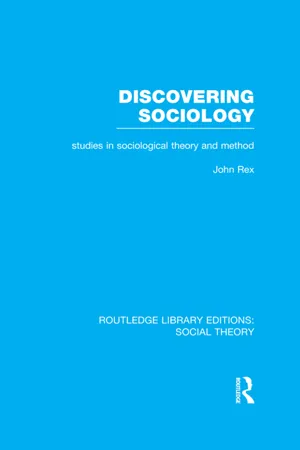
Professor John Rex was one of Britain's most eminent sociologists, and a teacher of a whole generation of sociology students. In this book he presents a stimulating introduction to the major issues of sociological theory and gives an account of the perspective which has informed his thinking and writing. He deals with the objectives of sociological investigation, the methods it uses and how in these respects it resembles or differs from natural science and history. He goes on to discuss the work of Weber, Durkheim, Marx, Engels, Mills and other important theorists, and concludes with a convincing demonstration of the continuing relevance of the Weberian tradition to the study of sociology.
eBook - ePub
Discovering Sociology (RLE Social Theory)
Studies in Sociological Theory and Method
- 294 pages
- English
- ePUB (mobile friendly)
- Available on iOS & Android
eBook - ePub
About this book
Trusted by 375,005 students
Access to over 1.5 million titles for a fair monthly price.
Study more efficiently using our study tools.
Information
I Sociology and the layman
1 Towards a significant sociology
DOI: 10.4324/9781315763668-2
One of the greatest American teachers of sociology recently remarked that nearly all sociological research took place under one of two banners. One of these reads, ‘We don't know whether what we are saying is true, but it is at least significant’; the other, ‘This is demonstrably so, but we cannot indicate its significance’ (Merton, 1957). There is little need in England, with its traditions of historical scholarship and its emphasis upon empirical detail in sociological investigation, to point out the dangers of putting significance before truth. What I wish to do here, therefore, is to put in a plea for a more significant sort of sociological research.
Let me begin by saying that I regard sociology as an attempt to understand and explain the kinds of social relations which exist among people and the changes which occur from time to time in those relations. Another way of saying this is that sociology seeks to understand the nature of our social structure. I believe that a scientific study of this sort can do much to clarify both our political conflicts and more intimate personal conflicts which take place between individuals and small groups. But I believe that sociology in Great Britain is not doing this job and is prevented from doing so by its empiricist traditions.
The earliest empirical research undertaken by people calling themselves sociologists in Great Britain was not concerned with the study of social relations as such, but with the incidence and distribution of primary poverty. Thus, from the beginning, sociology was not merely contributing to the advancement of knowledge for its own sake, but was providing essential information for political reformers. Of course, there were those like Hob-house and Westermarck who continued in the older Spencerian tradition with their comparative studies of social institutions on a world scale, but the major emphasis was upon the study of the socio-economic characteristics of the population, and its significance was to be found within a framework of reformist political beliefs.
This tradition still lives on today. Apart from developing more and more precise measures of poverty, it has collected a wider range of information about the social conditions of the British people. The census has been affected by these researches, and now seeks to discover some of the more subtle characteristics of the population; and, outside government departments, sociologists have directed their attention especially to the occupational distribution and to the distribution of educational facilities. Indeed the most characteristic studies in post-war sociology were concerned with the correlation between the educational opportunities of children and the occupation of their parents. Professor Glass's book Social Mobility in Britain (1954) brought together some of the best of these studies.
Now I do not wish to dispute the value of work such as this in itself. One can only admire the degree of refinement of some of the measures of mobility which have been evolved. Moreover it is clear that, by ruthlessly excluding preconceived ideas and paying attention solely to what numbers come up, our statisticians have presented us with new and surprising data. What I want to ask, however, is, ‘What do these facts mean?’ And here, as a rule, I find it difficult to get a clear or convincing answer.
Despite what I have already said, I would sometimes be happier if those who write and talk about social mobility would confine themselves more rigorously to the facts. If they did, and I asked the question, ‘What does the statement “there is such-and-such a degree of mobility” mean?’ they would be bound to answer that it meant only that there was a certain likelihood that children will, at some point in their lives, be working in a different group of occupations from their parents. If this was the answer, I do not think that I should be considered rude if I replied, ‘So what?’
But the issue is made less clear by the fact that our empiricists often go beyond the facts and suggest that what they are talking about is mobility between classes. I suspect that it would be considered rude to ask what exactly they mean by class, because there is a suppressed premiss that ‘everyone knows what classes are and mobility between classes is a good thing’.
Nonetheless, at the risk of discovering what sociologists are fighting for, I should like to press the point and ask what class membership is supposed to imply in contemporary Britain. Does it mean that upwardly mobile boys and girls will renounce their parents’ values? Does the fact of mobility have political implications? If so, what are they? What truth, if any, is there in Marx's predictions about the behaviour of the various social classes? And, if there is none or little, what are the factors which have led to their invalidation? I am asking, in fact, what we mean by class.
But here again we are on barren ground if we turn to the teachers of sociology. How familiar the arguments are. And how singularly unilluminating. We are told that it is impossible to find an objective criterion of class, and that subjectivism can only lead to work like that of Lloyd Warner in Yankee City, which is said to miss the point with its emphasis upon snobbery and status classes. Finally, avoiding all the difficulties, we are asked to be content with an occupational-status classification, because there is widespread agreement on the subjective status rating of occupations.
What are the questions, then, which these mobility studies leave unanswered? I suggest that they give us no knowledge or understanding at all of those sorts of social relations which we call class relations. They do not tell us, for example, what the implications are for the manual worker of membership of the working class. They do not tell us how he is likely to feel towards his fellow workers, or towards the manager of the firm which employs him, or towards the employing class as a whole. They tell us nothing of how he would behave in the case of an unofficial strike, or how he spends his leisure and why. Nor do they tell us anything about the equivalent problems of middle-class membership.
Similar problems arise in connection with the study of educational opportunity. Is there not a danger of assuming that grammar, technical and modern education are the first, second and third prizes of the scholastic world, and that the only problem is that of how the prizes are shared? Is it not time that someone tried to find out what the various sorts of education mean in terms of later group affiliations and the adoption of attitudes and ideologies? What we need to know is not how the population may be classified, but how it acts in groups, and what the relation is between one group and another.
The sort of research which I have in mind has been undertaken far more by people calling themselves social anthropologists than by sociologists, and I think that the best hope for the future lies in a careful and considered application of the anthropologist's techniques to the analysis of the problems of large-scale societies.
I say ‘careful and considered application’ because I can see relatively little that can be gained from studying one village, district, town or street community after another, as though they were likely to be as excitingly different from one another as the Trobrianders and the Andamanese. I think that the emphasis should be upon communities which prima facie seem to have a special importance for our larger national society, such as the mining communities, which have played so large a part in shaping our political ideologies and organization, or upon special features of community life which illustrate processes widespread in industrial areas, as was the case with the family relationships of Bethnal Green investigated by Michael Young and Peter Willmott (1957) and reported in their book Family and Kinship in East London.
But far more important than purely local studies, it would seem to me, are studies undertaken on a national scale in order to understand the nature of some of the larger social groupings to which we belong. One of the best examples of this kind of study in the immediate post-war years was Ferdinand Zweig's (1950)The British Worker.
It is no criticism of this book that, instead of giving statistical proofs, Zweig tells us what he heard in a pub in Scunthorpe. The fact remains that he is telling us important things about the working class, how they feel about pools and pubs, as well as about socialism, trade unionism and religion. Even if one doubts Zweig's veracity, one will still find in his work a mine of hypotheses well worthy of investigation.
But, to be more explicit, we must ask what the anthropologist's methods are in studies of this kind. The pity is that so few of them are clear as to what the logic of their procedures is, and that those who have attempted to formulate it have been quite gravely misleading.
Thus I cannot accept the formulation which says that the anthropologist's task is to explain social activities in terms of the contribution which they make to the maintenance of the ‘social structure’. I feel that it is this so-called ‘social structure’ which needs explaining, and that the merit of some of the anthropologists is that they have tried to do this. The first great proponent of structural-functionalism, Radcliffe-Brown, failed to get beyond metaphor and analogy when he sought to explain his method (Radcliffe-Brown, 1952), and, later, Talcott Parsons (1952) produced such a complex theory, that unravelling it could leave little time for empirical research. I do not think that the problem is nearly as difficult as either Radcliffe-Brown or Parsons make it out to be, and I think that, in order to understand the nature of what they do we should watch the anthropologists at work, rather than in reflective contemplation years afterwards.
I think that the key to the anthropologist's method is simply close first-hand observation, even to the point of participant observation, coupled with the interpretation of what is observed in terms of the purposes and the meanings of the observed culture. Surely the great achievement of Malinowski was that he came back from the Trobrianders to say to those he liked to call ‘museum-moles’, ‘Go out and live with the native and try to understand how he looks at his world. If you do, you may find that he is not the fool you take him for, either in his agriculture or in his magic.’
If indeed the revolution of method which the anthropologists propose is as simple as this, I would suggest that what they are saying today has its precedents in German historiography and sociology of the late nineteenth and early twentieth centuries, and I should like to conclude this chapter by suggesting that this German tradition has much of importance to contribute to contemporary sociology. If some of its methods were used to supplement the purely empirical studies currently carried on, we might find a way in Britain of blending truth with significance.
Probably the outstanding figure in the German tradition to which I refer was Wilhelm Dilthey (see Hodges, 1944). Just as Malinowski revolted against the misuse of the comparative method by sociologists seeking to establish an evolutionary pseudo-science, so Dilthey revolted against the positive sociology of Comte and Spencer. Malinowski called on the anthropologist to understand the native mind. Dilthey called on the historian for what he called ‘self-surrender’ which, as he said, would make ‘The inner being of the time-born historian into a universe which mirrors the whole historical world’.
Now, of course, no self-respecting sociologist could accept this as a complete account of method, any more than he would feel that the methods of the sociologist of working-class life were adequately explained by the sentence, ‘I went boozing with them.’ Fortunately, however, there is no need to stop there. It is perfectly possible to go beyond this to the precise formulation of hypotheses about the motivation of typical participants, which can be used with something of the same degree of accuracy as any other scientific hypothesis used to interpret observed data. It was the primary contribution of Germany's greatest sociologist, Max Weber, that he made the logic of this procedure explicit. Today many people pay lip service to Weber, I think it is time that we started to apply his methods. How very few pieces of research there are today which explain human behaviour to us in the illuminating way which Weber did in his analysis of the social structure of capitalism, in terms of the life orientation of the typical Calvinist.
It is interesting to notice that nearly all the important sociological works which survive and are actually read today are, in fact, ideal typical accounts of some society or some system of social behaviour. Such a work for example is Veblen's Theory of the Leisure Class (1931).
Veblen's sketch of conspicuous consumption was more than an ironic pillorying of upper-class values. It was also an illuminating interpretative theory which helped a generation of Americans to understand themselves and their society better. More recently the work of C. Wright Mills on The Power Elite and William Foote Whyte on The Organization Man has continued the Veblen tradition, while at the other end of the political spectrum, Lloyd Warner (Warner and Lunt, 1941) has used similar methods in his nostalgic account of the status system of old New England. The most stimulating passage in all the Yankee City reports is to be found in the hundred pages of composite portraits of Yankee City people.
Equally the great value of Marx's work was that it was precisely an ideal typical account of capitalism. There is one beautiful point in Capital where Marx, having outlined the processes at work in the enclosure movement, goes on, ‘Let us now cull a nosegay of examples.’ From the point of view of scientific methodology, how scandalous! But, from the point of view of understanding social reality, how important!
I suggest that British sociology would profit greatly if it would get down to the imaginative task of framing ideal types which might help to explain some of the data which our empirical studies turn up. Let me just mention examples of what I have in mind. I think that one of the key problems of contemporary social structure is that of the attitudes, ideologies, and political behaviour of the new middle classes. It is time that academic sociologists stopped regarding them as nasty little Poujadists and tried to discover the sources of their motivation. Again, we know little or nothing about the motivation of the new youth culture, whose emergence was one of the key phenomena of the fifties. On a wider scale, we know little if anything about the varieties of colonial nationalism, with which it is necessary to live.
Compared with sociological studies of the time, how illuminating Thomas Hodgkin's Nationalism in Colonial Africa was. This was a really path-breaking little book which gave a precise yet sensitive formulation of the political behaviour and motivation of the new Africans with whom the author had talked on his West African journeys. Reading it, one was able to foresee and understand much that was important in the processes and structures involved in decolonization and neo-colonialism.
There are many other topics which cry out for analysis by a Weber or a Veblen. I think that what prevents their being tackled is the fear that such work might be controversial and less than scientifically respectable. And, of course, it never will have the same exactness and precision as analyses of the numbers of boys and girls who failed the eleven plus last year. In urging that it should be undertaken, however, I would suggest that there are ways in which studies of this kind can be tied down to empirical fact and rendered relatively scientific.
To begin with, I would suggest that the first step in the procedure of constructing ideal types should be the study of the attitudes and ideologies of the group for whom an ideal type is to be constructed. My own bias would be in favour of the relatively unstructured interview to find these out, but all types of attitude studies could contribute something. At all events, here is a field of empirical study in which precious little is being done at present.
It is the second stage of type-construction, however, which is the more controversial. Here we must proceed beyond mere reports on motives of particular persons to formulate typical cases. And this does not merely mean the construction of averages or...
Table of contents
- Cover
- Half Title Page
- Title Page
- Copyright Page
- Title Page
- Copyright Page
- Dedication
- Font Chapter
- Table of Contents
- Acknowledgments
- Introduction
- Part I Sociology and the layman
- Part II The grand masters of sociology
- Part III Theoretical themes and contemporary sociology
- Bibliography
- Index
Frequently asked questions
Yes, you can cancel anytime from the Subscription tab in your account settings on the Perlego website. Your subscription will stay active until the end of your current billing period. Learn how to cancel your subscription
No, books cannot be downloaded as external files, such as PDFs, for use outside of Perlego. However, you can download books within the Perlego app for offline reading on mobile or tablet. Learn how to download books offline
Perlego offers two plans: Essential and Complete
- Essential is ideal for learners and professionals who enjoy exploring a wide range of subjects. Access the Essential Library with 800,000+ trusted titles and best-sellers across business, personal growth, and the humanities. Includes unlimited reading time and Standard Read Aloud voice.
- Complete: Perfect for advanced learners and researchers needing full, unrestricted access. Unlock 1.5M+ books across hundreds of subjects, including academic and specialized titles. The Complete Plan also includes advanced features like Premium Read Aloud and Research Assistant.
We are an online textbook subscription service, where you can get access to an entire online library for less than the price of a single book per month. With over 1.5 million books across 990+ topics, we’ve got you covered! Learn about our mission
Look out for the read-aloud symbol on your next book to see if you can listen to it. The read-aloud tool reads text aloud for you, highlighting the text as it is being read. You can pause it, speed it up and slow it down. Learn more about Read Aloud
Yes! You can use the Perlego app on both iOS and Android devices to read anytime, anywhere — even offline. Perfect for commutes or when you’re on the go.
Please note we cannot support devices running on iOS 13 and Android 7 or earlier. Learn more about using the app
Please note we cannot support devices running on iOS 13 and Android 7 or earlier. Learn more about using the app
Yes, you can access Discovering Sociology (RLE Social Theory) by John Rex in PDF and/or ePUB format, as well as other popular books in Social Sciences & Sociology. We have over 1.5 million books available in our catalogue for you to explore.