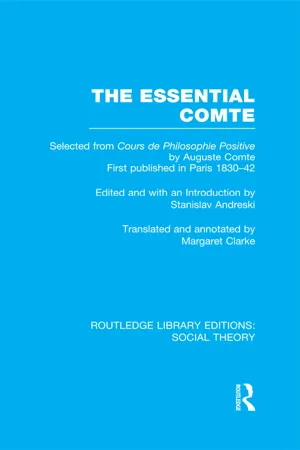
Auguste Comte proclaimed himself the founder of sociology and, on the whole, this claim is accepted. His most important work is the six-volume Cours de Philosophie Positive of which this present book is a selective abridgement. Comte, as this selection shows, was a methodological visionary. He was an eminently successful terminological innovator and to him we owe not only 'sociology' and 'positivism' but also 'biology' and 'altruism'. Professor Andreski, in his lucid introduction, assesses Comte's place under six headings, as scientist, philosopher, sociological theorist, sociological historian, reformer and methodologist. But this selection from Comte's works will be most welcomed because it provides a modern English translation of the main body of his thought.
eBook - ePub
The Essential Comte (RLE Social Theory)
Selected from 'Cours de philosophie positive' by Auguste Comte
- English
- ePUB (mobile friendly)
- Available on iOS & Android
eBook - ePub
The Essential Comte (RLE Social Theory)
Selected from 'Cours de philosophie positive' by Auguste Comte
About this book
Information
COURSE IN POSITIVE PHILOSOPHY
I
Aim of the Course. General Considerations on the Nature and Importance of Positive Philosophy1
Aim of the Course. General Considerations on the Nature and Importance of Positive Philosophy1
The object of this first lecture is to set forth clearly the aim of this course, that is, to determine in exactly what spirit the various branches of natural philosophy will be considered.
No doubt the nature of this course will only be completely understood, and a definite opinion formed about it, when the various parts have been developed in their order. Such is the usual drawback of definitions, when the system of ideas is extensive and the definitions precede the ideas. There are two aspects to generalities: either they are the conspectus of a doctrine still to be established, or the summary of one already established. But even if it is only as a summary that they acquire all their force, as a conspectus they are still extremely important, for they characterise from the start the subject under consideration.
As we understand it, an absolutely indispensable preliminary to a study as vast and hitherto as indeterminate as that which we are about to undertake, is the strict delimitation of the field of research. In obedience to this logical necessity, I must now indicate the considerations that have led me to give this new course, and that will each be developed in the detail demanded by its very great importance.
In order to explain adequately the true nature and proper character of positive philosophy, it is necessary to survey as a whole the progress of the human spirit, for a concept is understood only through its history.
Studying the total development of the human intelligence in its various spheres of activity, from its first trial flights up to our own day, I believe I have discovered a fundamental law to which it is subjected from an invariable necessity, and which seems to me to be solidly established, either by rational proof drawn from one great general entity, a knowledge of our nature, or by the historical test, an attentive examination of the past. This law is that each of our principal conceptions, each branch of our knowledge, passes successively through three different theoretical states: the theological or fictitious, the metaphysical or abstract, and the scientific or positive. In other words, the human mind, by its nature, employs in all its investigations three methods of philosophising, of an essentially different and even opposed nature: first the theological, then the metaphysical, and finally the positive. Hence there are three mutually exclusive kinds of philosophy, or conception systems regarding the totality of phenomena: the first is the necessary starting-point of human intelligence; the third its fixed and final state; the second is only a means of transition.
In the theological state, the human mind, directing its search to the very nature of being, to the first and final causes of all the effects that it beholds, in a word, to absolute knowledge, sees phenomena as products of the direct and continuous action of more or less numerous supernatural agents, whose arbitrary intervention explains all the apparent anomalies of the universe.
In the metaphysical state, which at bottom is a mere modification of the theological, the supernatural agents are replaced by abstract forces, veritable entities (personified abstractions) inherent in the various types of being, and conceived as capable in themselves of engendering all observed phenomena, the explanation of which consists in assigning to each its corresponding entity.
Finally, in the positive state, the human mind, recognising the impossibility of attaining to absolute concepts, gives up the search for the origin and destiny of the universe, and the inner causes of phenomena, and confines itself to the discovery, through reason and observation combined, of the actual laws that govern the succession and similarity of phenomena. The explanation of the facts, now reduced to its real terms, consists in the establishment of a link between various particular phenomena and a few general facts, which diminish in number with the progress of science.
The theological system arrived at the highest perfection of which it is capable when it substituted the providential action of a unique being for the interplay of the numerous independent divinities that had been imagined in the beginning. In the same way the metaphysical system reaches its consummation in the idea not of different particular entities, but of one great general entity, nature, as the unique source of all phenomena. The perfection of the positive system, towards which it toils unwearied, though destined probably never to attain it, would consist in seeing all observable phenomena as the particular cases of one single fact, as for instance the fact of gravitation.
This is not the place to demonstrate the fundamental law of development of the human mind, and to deduce its most important consequences. We will treat that law in proper detail in the part of the course devoted to the study of social phenomena. I am drawing attention to it now however in order to define the precise character of positive philosophy, in contrast with the two other philosophies which successively have dominated our entire intellectual system up to the last few centuries. For the present, in order not to leave unproved a law of this importance, whose application will frequently occur throughout the course, I will rapidly indicate the most telling evidence of its truth.
First of all it seems to me it should be enough to state this law for its truth to be immediately perceptible to all who have a knowledge of the general history of science. Indeed nearly every science today in the positive stage is known to have consisted in the past of metaphysical abstractions, and before that of theological conceptions. Unfortunately we shall more than once have occasion to note in the various parts of this course that in the most advanced sciences there are still considerable traces of the two primitive states.
This general evolution of human intelligence is easily confirmed, in a very notable though indirect manner, by that of individual intelligence. The starting point in the education of the individual is necessarily the same as that of the species, and the principal phases of the individual represent the epochs of the species. Now does not each one of us, when he looks at his own history, recall that he was successively a theologian in childhood, for his most important ideas, a metaphysician in his youth, and a physicist in his maturity? All men who are truly of this century provide us with this easy proof.
But in this brief explanation I must mention, besides the observations, general and particular, which prove the law, the theoretical considerations which demonstrate its necessity.
The most important of these considerations, and one rooted in the very nature of our subject, is the need, in every epoch, of some kind of a theory to link facts, together with the obvious impossibility in the primitive stages of mankind of forming theories from observation.
Since Bacon, intelligent people are agreed that there is no real knowledge save that which rests on observed facts. As applying to the full grown state of our intelligence, this principle is evidently incontestable. But if we look at its formative stage, it is no less certain that the human mind then could not, and should not, think in this way. For if on the one hand every positive theory is necessarily based on observation, on the other it is no less certain that in order to devote itself to observation the mind needs some kind of theory. If in contemplating phenomena we had no principles to which to attach them, not only would we find it impossible to combine isolated observations, and therefore to profit from them, but we would not be able to remember them, and most of the time the facts themselves would pass unperceived before our very eyes.
Thus between the necessity of observation for the formation of genuine theories, and the not less pressing necessity of constructing theories for the pursuit of observation, the human mind must have found itself trapped in a vicious circle, from which it could never have escaped, had not a natural way out been provided by the spontaneous development of theological conceptions, which offered a rallying point for its efforts and material for its activity. Such is the fundamental motive—apart from the weighty social ones which are not to be entered into at this stage—of the theological character of primitive philosophy, and the proof also of its logical necessity.
The necessity becomes still more apparent when we consider the perfect accord between theological philosophy and the nature of the investigations on which the human mind is engaged in its infancy. It is after all extremely remarkable that the questions which are most absolutely inaccessible to human powers: the inner nature of being, the origin and end of all phenomena, are precisely those that our intelligence undertakes in that primitive state, while all the truly soluble problems are looked upon as almost unworthy of serious consideration. The reason is obvious: only experience could teach us the limits of our strength, and if man had not begun by having an exaggerated opinion of it, he would never have attained the utmost of his capabilities. Such is human nature.
Let us try then to imagine, if we can, this universal, ingrained attitude of mind, and ask ourselves what would have been the reception given in such an epoch to positive philosophy, whose proper character is to regard as forbidden to human reason those sublime mysteries which theological philosophy explains with such admirable facility down to the last detail.
The same holds good of the practical inquiries that first occupy the human mind. They offer to man the goal of a limitless empire to be exercised over the external world, which is regarded as destined for his exclusive use, and presenting in its phenomena intimate and continuous relations with his existence. These fantastic hopes, these exaggerated ideas of the importance of man in the universe, which originate in theological philosophy and which wither away at the first breath of positive philosophy, are an initial stimulant without which it would be inconceivable that the human mind could address itself in the primitive state to painful toil.
Today we have put such a distance between us and these primitive attitudes, at least with regard to most phenomena, that we have difficulty in representing to ourselves their force and necessity. Human reason is now sufficiently mature for laborious scientific research to be undertaken without the imagination being activated by any of the ulterior motives that moved the astrologers and the alchemists. Intellectual activity is sufficiently stimulated by the hope of discovering the laws of phenomena, the desire of confirming or refuting a theory. But it could not be so in the infancy of the human mind. Without the attractive chimeras of astrology, without the energising illusions of alchemy, where was the constant ardour to come from that was necessary to collect these interminable series of observations and experiments which later served as a foundation for the first positive theories of one or other of these classes of phenomena?
This primary condition of our intellectual development was long ago perceived by Kepler, in astronomy, and justly appreciated in our own day by Berthollet,2 in chemistry.
Thus we can see that if positive philosophy is the point of arrival of human intelligence, the state to which more or less it has tended, it has none the less had to use at the start, during many centuries, either as provisional method or as provisional doctrine, theological philosophy, a philosophy whose very character is to be spontaneous, and therefore the only possible one in the beginning, the only one that could offer sufficient interest to the awakening intelligence. We can now also see that in order to pass from this provisional philosophy to the ultimate philosophy, metaphysical doctrines and methods had to be adopted as a transitional philosophy. In order to complete the outline of the great law I have indicated, we must consider this last point.
Evidently our understanding, advancing only by scarcely perceptible degrees, could not pass abruptly, without intermediaries, from theological to positive philosophy. Theology and physics are so profoundly incompatible, their conceptions are so radically opposed, that before renouncing the one, in order to employ the other exclusively, human intelligence had to use intermediary conceptions, of a bastard nature, and suited for that very reason to the gradual transition. Such is the natural destiny of metaphysical conceptions: they have no other real use. By substituting in his study of phenomena for the supernatural directive action a corresponding inherent entity, although conceived at first as an emanation of the supernatural directive, man habituated himself little by little to considering only the facts, for the notions of these metaphysical agents were gradually refined to the point of being, for any sound mind, merely the abstract names of phenomena. It is impossible to imagine by what other procedure our understanding could have passed from considerations that were frankly supernatural to the purely natural, from the theological to the positive regime.
Now that we have established, as far as is possible without a detailed discussion—which would at present be out of place—the general law of development of the human mind, we can easily determine the exact nature of positive philosophy. Which is the essential aim of these lectures.
We see that it is the nature of positive philosophy to regard all phenomena as subject to invariable natural laws, the discovery of which, and their reduction to the least possible number, is the aim and end of all our efforts, while causes, either first or final, are considered to be absolutely inaccessible, and the search for them meaningless. There is no need to insist on a principle so familiar to all who have made any serious study of the observational sciences. Everyone knows that in positive explanation, even when it is most perfect, we do not pretend to expound the generative causes of phenomena, as that would be merely to put the difficulty one stage farther back, but rather to analyse the circumstances in which the phenomena are produced, and to link them one to another by the relations of succession and similarity.
To cite a most striking example, we say that the general phenomena of the universe are explained by the Newtonian law of gravitation, because this theory shows, on the one hand, the immense variety of astronomical facts as being one and the same fact seen from different points of view: the mutual attraction of molecules proportional to the product of their masses and inversely proportional to the square of their distances; and on the other, this fact as an extension of a phenomenon which is very familiar, and for that reason regarded as perfectly well known: the weight of bodies on the surface of the earth. As for determining what that attraction and that weight are in themselves, and what their causes, these are questions that we regard as insoluble, as outside the domain of positive philosophy, questions that we rightly resign to the imagination of the theologians and the subtleties of the metaphysicians. The clear proof of the impossibility of obtaining answers to such questions is that every time people have tried to say something rational on the subject, even the greatest minds have only been able to define these two principles by one another, declaring that attraction is nothing but weight, and that weight is simply the attraction of the earth. When one aspires to know the inner essence of things and the mode of their generation, such ‘explanations’ will raise a smile: actually they are the most satisfactory obtainable, for they show two orders of phenomena which had long been regarded as having no connection with one another, as identical. No intelligent person today would seek to go any further.
It would be easy to multiply examples: there will be hosts of them in the course of these lectures, for such is the spirit that today governs the great intellectual enterprises. To cite one only of these contemporary projects, we have M. Fourier’s3 fine series of researches on the theory of heat. It furnishes quite decisive proof of our remarks. In this work, whose philosophic character is eminently positive, the most important and most precise laws of thermological phenomena are revealed without the author having once inquired into the essential nature of heat, or mentioned, otherwise than to indicate its inanity, the agitated controversy between the partisans of calorific matter, and of heat as the vibration of a universal ether. Nevertheless the greatest questions, of which several had never before been raised, are treated in this work, thus providing palpable proof that the human mind may find inexhaustible material for its most profound speculations, without concerning itself with insoluble problems, and keeping strictly to researches of a positive order.
Now that the spirit of positive philosophy has been defined as exactly as is possible in a general summary, we have to examine its present stage of development, and what remains to be done to complete its formation.
The first thing to consider is that the different branches of our knowledge have not gone through the three phases of development indicated above at an equal speed, and consequently have not arrived simultaneously at the positive stage. There is an invariable and necessary order according to which our conceptions progress, each after its kind, and which must be carefully studied as a necessary consequence of the aforesaid law. This order will be the special theme of the next lecture. For the present it is enough to say that it finds itself in conformity with the diverse nature of phenomena, that it is determined by the degree of their generality, simplicity, and mutual independence, three considerations which though distinct contribute to the same end. Thus astronomical phenomena to begin with, as the most general, simplest, and most independent of all the others, after these the phenomena of terrestrial physics, those of chemistry, and finally those of physiology, have proved amenable to positivist theory.
It is impossible to assign a precise origin to the positivist revolution. It can be said with truth that as with all great human events, it was accomplished both unremittingly and gradually, particularly since the work of Aristotle and of the Alexandrian school, and subsequently the introduction of natural science into western Europe by the Arabs. However, since it is advisable to choose a period, if we are to avoid too great a dispersal of ideas, I will choose that great movement of the human mind which took place two centuries ago, through the combined action of the precepts of Bacon, the concepts of Descartes, and the discoveries of Galileo, as the moment in time when the spirit of positive philosophy began to assert itself in the world, as against the theological and the metaphysical spirit. It is then that positive conceptions cast off the superstitious alloy of scholasticism which more or less disguised the real nature of all previous work.
Since that memorable epoch the rise of positive, and the decline of theological and metaphysical philosophy have been very marked. So marked, that today it has become impossible for any observer, conscious of the times, not to recognise that positive studies represent the final destiny of human intelligence, and that human intelligence will separate itself definitely from the vain doctrines and provisional methods which were only suited to its infancy. Thus this fundamental revolution will necessarily be fully accomplished. If therefore there still remains a conquest to be made, a branch of the intellectual domain to be taken over, one can be sure that the transference will take place, as it has taken place in all the others. It is extremely improbable that the human mind, disposed as it is to unity of method, should retain indefinitely its primitive manner of philosophising for any one class of phenomena, once it has come to adopt a new philosophic procedure of an exactly opposite character for all the rest.
Thus everything comes down to a simple question of fact: does positive philosophy, which in the last two centuries has experienced so great an extension, embrace today all orders of phenomena? Obviously it does not, and consequently a great scientific operation still remains to be carried out if it is to acquire the character of universality indispensable to its final form.
For the four principal categories of natural phenomena which we have just enumerated: astronomical, physical, chemical and physiological, leave a gap where the social phenomena ought to be. Though implicitly included with the physiological, they deserve to form a separate category, by reason both of their importance and of the difficulties attending their study. This last order of conceptions, which relates to the most peculiar, complicated and dependent of phenomena, was bound for that reason to progress more slowly than all the preceding ones, quite apart from other obstacles which we shall consider later. At any rate it is evident that it has not yet entered the domain of positive philosophy. The theological and metaphysical methods, which are no longer employed in any other order of phenomena, either as a means of investigation or even of argumentation, are still exclusively used for both these purposes in all that concerns social phenomena, although their inadequacy is already fully recognised by all intelligent persons, for whom the vain and interminable contestation between divine right and the sovereignty of the people has become a source of inexpressible boredom.
Here then is the great, the only lacuna that must be filled if we are to complete the formation of positive philosophy. The human mind has created celestial and terrestrial physics, mechanics and chemistry, vegetable and animal physics, we might say, but we have still to complete the system of the observationa...
Table of contents
- Cover Page
- Half Title Page
- Title Page
- Copyright Page
- Original Title Page
- Original Copyright Page
- Contents
- Translator’s Note
- Introduction
- Course in Positive Philosophy
- I Aim of the Course. General Considerations on the Nature and Importance of Positive Philosophy1
- II Plan of this Course, or General Considerations on the Hierarchy of the Positive Sciences9
- III Philosophical Considerations on all Mathematical Science14
- IV Philosophical Considerations on Astronomical Science16
- V Philosophic Considerations on Physics18
- VI Philosophic Considerations on Chemistry22
- VII Philosophic Considerations on Biological Science30
- VIII Preliminary Considerations on the Necessity of Social Physics as suggested by the Analysis of the Present State of Society43
- IX Fundamental Characteristics of the Positive Method in the Study of Social Phenomena60
- X Restrictions on the Historical Operation94
- XI Summary Appreciation of the Final Effect of Positive Philosophy100
- Contents of the Six Volumes of the Cours
- Plan of the Cours
- Bibliographical Notes
- Notes
- Index
Trusted by 375,005 students
Access to over 1.5 million titles for a fair monthly price.
Study more efficiently using our study tools.
Frequently asked questions
Yes, you can cancel anytime from the Subscription tab in your account settings on the Perlego website. Your subscription will stay active until the end of your current billing period. Learn how to cancel your subscription
No, books cannot be downloaded as external files, such as PDFs, for use outside of Perlego. However, you can download books within the Perlego app for offline reading on mobile or tablet. Learn how to download books offline
Perlego offers two plans: Essential and Complete
- Essential is ideal for learners and professionals who enjoy exploring a wide range of subjects. Access the Essential Library with 800,000+ trusted titles and best-sellers across business, personal growth, and the humanities. Includes unlimited reading time and Standard Read Aloud voice.
- Complete: Perfect for advanced learners and researchers needing full, unrestricted access. Unlock 1.5M+ books across hundreds of subjects, including academic and specialized titles. The Complete Plan also includes advanced features like Premium Read Aloud and Research Assistant.
We are an online textbook subscription service, where you can get access to an entire online library for less than the price of a single book per month. With over 1.5 million books across 990+ topics, we’ve got you covered! Learn about our mission
Look out for the read-aloud symbol on your next book to see if you can listen to it. The read-aloud tool reads text aloud for you, highlighting the text as it is being read. You can pause it, speed it up and slow it down. Learn more about Read Aloud
Yes! You can use the Perlego app on both iOS and Android devices to read anytime, anywhere — even offline. Perfect for commutes or when you’re on the go.
Please note we cannot support devices running on iOS 13 and Android 7 or earlier. Learn more about using the app
Please note we cannot support devices running on iOS 13 and Android 7 or earlier. Learn more about using the app
Yes, you can access The Essential Comte (RLE Social Theory) by Stanislav Andreski, Margaret Clarke in PDF and/or ePUB format, as well as other popular books in Social Sciences & Sociology. We have over 1.5 million books available in our catalogue for you to explore.