This volume examines the location of memories and histories of popular music and its multiple pasts, exploring the different 'places' in which popular music can be situated, including the local physical site, the museum storeroom and exhibition space, and the digitized archive and display space made possible by the internet. Contributors from a broad range of disciplines such as archive studies, popular music studies, media and cultural studies, leisure and tourism, sociology, museum studies, communication studies, cultural geography, and social anthropology visit the specialized locus of popular music histories and heritage, offering diverse set of approaches. Popular music studies has increasingly engaged with popular music histories, exploring memory processes and considering identity, collective and cultural memory, and notions of popular culture's heritage values, yet few accounts have spatially located such trends to focus on the spaces and places where we encounter and engender our relationship with popular music's history and legacies. This book offers a timely re-evaluation of such sites, reinserting them into the narratives of popular music and offering new perspectives on their function and significance within the production of popular music heritage. Bringing together recent research based on extensive fieldwork from scholars of popular music studies, cultural sociology, and museum studies, alongside the new insights of practice-based considerations of current practitioners within the field of popular music heritage, this is the first collection to address the interdisciplinary interest in situating popular music histories, heritages, and pasts. The book will therefore appeal to a wide and growing academic readership focused on issues of heritage, cultural memory, and popular music, and provide a timely intervention in a field of study that is engaging scholars from across a broad spectrum of disciplinary backgrounds and theoretical perspectives.
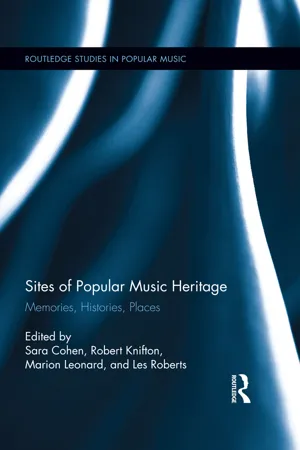
eBook - ePub
Sites of Popular Music Heritage
Memories, Histories, Places
- 268 pages
- English
- ePUB (mobile friendly)
- Available on iOS & Android
eBook - ePub
Sites of Popular Music Heritage
Memories, Histories, Places
About this book
Information
1
Introduction
Locating Popular Music Heritage
Sites of Popular Music Heritage examines the location of memories and histories of popular music and its multiple pasts. The book developed out of a symposium organised by the Institute of Popular Music at the University of Liverpool, the aim of which was to explore the places and spaces where people encounter and engage with popular music histories and legacies. The event attracted academics and practitioners who were interested in the study of popular music heritage and the different and new perspectives and approaches that this might involve. As with the topic of popular music heritage itself, those attending the symposium were representative of a range of disciplines (including musicology, geography, museum studies, cultural sociology) and fields of practice (including museums and archives and music and tourism industries). While ideas of heritage, memory and nostalgia play an increasingly important role in popular music historiography, the spatial and geographic frameworks underpinning the production of popular music histories have until now remained comparatively underexamined.
Focusing on these frameworks helped to ‘locate’ popular music heritage as a site of critical discourse, and prompted reflection on five key and recurrent questions and related themes and issues. These may broadly be summarised as: ‘what is popular music heritage?’; ‘where is it located?’; ‘why does it matter?’; ‘whose popular music heritage?’ and ‘when does popular music become heritage?’ The first obvious and basic question concerns how such a fluid, intangible and ephemeral cultural form has been put to work as heritage (Bennett, 2009), developing notions of music heritage as a focus for the heritage industry, whilst the second, related question brings the spatial and geographic contexts underpinning emerging music heritage practices and discourses to the fore. Participants at the symposium presented research on a broad and diverse range of sites, particularly the physical site and public space, the museum storeroom and exhibition space, and the digitised archive and display space made possible by the internet. Most of this research involved case studies on popular music heritage in Europe, Australia and the US, where an explicit focus on place and location has been evident in narratives that attach popular music to local, regional and national identity. Drawing on the work of various scholars, Brandellero and Janssen (2012: 4) thus emphasize the territoriality of heritage.
Over the past three decades the growth of official and commercial interests in popular music heritage and tourism in the UK and beyond has been evident in the proliferation of monuments and plaque schemes, tours, trails and maps connected to a broad range of styles, from jazz to techno (Gibson and Connell, 2005; Cohen, 2012; Roberts and Cohen, 2014). The sites involved include those dedicated to particular musicians or music ‘scenes’ and sounds (whether the homes of well-known musicians or venues for sound recording or live music performance) as well as those immortalised in songs, videos or on album sleeves. Such initiatives have depended on collaboration between governing bodies and industries concerned with tourism and heritage, music and the media. The music industries, for example, have played a central role in framing, preserving and commercializing the heritage of popular music. This is clear from the industrial clout afforded of tribute acts, classic albums, the commercialisation of rock and pop memorabilia, literary or audio-visual histories of groups, artists or music genres, or of music ‘heritage’ magazines such as Mojo and Classic Rock. As physical record sales have declined and the music industries have sought to expand their revenue streams from other areas such as the live music experience, notions of music heritage have been further exploited from the promotion of ‘heritage acts’ to the trend for bands playing concerts where they perform one of their ‘classic’ albums live. It is not insignificant that in recent years the vast majority of top grossing live acts both in Europe and the US have been those who released their first albums from the 1960s to the 1980s. For example, in 2010 seven out of ten of the top grossing acts in terms of worldwide concert sales were acts of this kind (Reinartz, 2010). This indicates both the increasing commercial significance of the consumption of popular music heritage to the music industries and the central importance of personal and cultural history in the way in which mass audiences engage with popular music.
Over recent years museums have also engaged with popular music heritage, as evidenced by a proliferation of exhibitions on particular popular music performers as well as popular music museums. They have ranged from exhibitions and museums focussed on canonic or commercially successful artists in popular music history (such as the commercial museums dedicated to the Beatles in Liverpool and Hamburg, ABBA in Stockholm and the high-profile exhibitions on Kylie Minogue and David Bowie hosted by the Victoria and Albert Museum (V&A) in London, to more locally based exhibitions which include lesser known (but nevertheless significant) artists. These initiatives have provided sites and spaces of representation inviting critical reflection on the multidimensionality of popular music heritage as an affective, material, symbolic, or performative site of memory. This trend has encompassed a variety of different institutions and approaches, each revealing key issues relating to the way in which popular music heritage is constructed and mediated. For instance, during the early 2000s the failure of high profile national attractions such as the National Centre for Popular Music in Sheffield and the Hot Press Irish Music Hall of Fame in Dublin, illustrate the difficulties in successfully delivering commercial ventures which capture the experiential nature of key popular music practices and convey often complex and diffuse narratives to a broad audience. Perhaps more successful has been the proliferation of local and regional exhibitions that have proliferated over the past decade. The UK, for example, has seen successful temporary exhibitions in major cities such as Birmingham, Cardiff, Coventry, Liverpool and Newcastle, and popular music has also found a presence in the permanent displays within many city museums. These museums and exhibitions illustrate efforts to engage visitors through objects, sounds and images as well as written text, and to explore not only how music is represented but how it is also used to represent social histories and personal, collective and local identities (Leonard, 2007; Leonard and Knifton, 2012). Indeed, it is perhaps instructive that more recent museums with a national remit, such as the British Music Experience in London and the Rockheim Museum in Trondheim, have striven to make social history a key part of their remit.
At the same time heritage practices have proliferated in the digital age, with an array of social networking sites, blogs and web pages devoted to dimensions of popular music heritage, and organised and defined by, amongst other things, genre, artist, period and geography. With regard to the latter, sites dedicated to the popular music of cities such as Birmingham, Manchester, Sheffield, Coventry, Bristol, Woolongong, Brisbane or Detroit speak simultaneously to the hyper-local and global quality of popular music culture. The tensions and ambiguities between the local and the global are also replicated in the sites of popular music heritage that can be found in abundance on video sharing platforms such as YouTube. While many of these attest to the local heritages and histories surrounding specific music cultures, their ‘place’ within the otherwise nonspatial and virtual geographies of Web 2.0 delocalises these histories and reframes them within a qualitatively different spatial context than those operative ‘on the ground’, in localised cultures of popular music heritage. The nature of these and other online practices raise questions about the ontology of the archive as a spatial entity, and of the digital ‘artefact’ and collective memory. In light of the challenges presented to the music industries by digitisation, key questions concern the role of music and related intellectual property in online vernacular or ‘folk’ histories.
Questions surrounding the ‘where’ of popular music heritage have vied with those confronting the ‘what’ and ‘why’ of heritage: the shifting meanings, definitions and understandings of what it is or what it does in any given context. This was evident during the symposium where participants discussed not only how popular music heritage was located or sited but also ways of conceptualising and theorising popular music as heritage. In England popular music has been increasingly categorised as ‘heritage’ by individuals, groups and institutions operating across a broad range of sectors, yet as Lowenthal and others have observed, ‘heritage today all but defies definition’ (Lowenthal, 1996: 94). Roberts (2014b) points to some of the difficulties involved in untangling the different values and meanings attached to ideas of ‘heritage’, such as the close intertwining of heritage with memory, nostalgia and tradition; the tautological notion of ‘cultural heritage’ (Ashworth et al., 2007: 7); and the at times perplexing (and in many respects misleading) distinction between ‘tangible’ and ‘intangible’ heritage.
In 2003 UNESCO accepted the Convention for the Safeguarding of the Intangible Cultural Heritage (ICHC), which formally recognised the ‘intangible’ as a third category of heritage within international policy. Nevertheless Smith argues that the definition of heritage as ‘material (tangible), monumental, grand, “good”, [and] aesthetic’ dominates within what she terms the ‘authorised heritage discourse’ (AHD), a set of Western ideas that is supported by elite social groups and official organisations and policies, and therefore has power and influence. Drawing on examples from the UK, the USA and Australia she shows how this AHD represents a ‘canon’ in that it produces and reproduces ideas about what is worth being classified and promoted as heritage and where its value lies. She illustrates not only some of the practices involved but the ways in which this discourse is responded to and the struggles over who controls it and how. For Smith, therefore, what heritage is and does is defined through discourse, and this challenges the notion of heritage as something that has intrinsic value (2006: 54).
Other scholars have similarly highlighted the contested and dissonant character of cultural heritage, and how it attracts differing and often conflicting perspectives and interpretations (Tunbridge and Ashworth, 1996). Heritage is thus highly politicised, hence the promotion of ‘alternative’ heritages and the notion of ‘heritage activism’. Several participants in the Sites of Popular Music Heritage symposium highlighted the radical potential of reclaiming spaces through mnemonic practices centred on the popular music archive. Feminist identities (Withers, Women’s Liberation Music Archive); nation-state construction (Jones, Welsh-language popular music practices); community initiatives (Henning and Hyder, Bristol Sound), and political groupings (Lawrey, Vague) were just some instances where popular music archives could be mobilised in this way.
These examples help to show how the language and discourse of heritage is used in many different ways and serves various interests, and papers presented at the symposium illustrated the diversity of people, institutions and sites involved with popular music heritage. This helped to highlight a variety of legitimizing discourses of popular music as heritage, ranging from personal and collective attachment and memory to commercial endeavours aimed at rebranding and canonising the musical past. For some papers, particularly those focusing on the personal memories and histories of music audiences, the term ‘heritage’ wasn’t particularly meaningful because their focus was on people (music audiences, for example) for whom the category of ‘cultural memory’ rather than ‘heritage’ was typically deemed to be more relevant (see Forbes, this volume; Roberts and Cohen, 2014). However, there were also papers exploring how official and commercial organisations have used the term ‘heritage’ for marketing purposes, or to construct a sense of shared identity and history (see Bennett, this volume). Moreover, the economic imperatives that have driven, with various shades of success, urban regeneration initiatives in post-industrial towns and cities in the UK have sought to capitalize on an understanding of music as cultural heritage that is predicated (however tenuously) on an intrinsic embeddedness in the place of the local. In this regard, as Roberts (2014a) argues, the appeal of popular music heritage from a tourism and place-marketing perspective can in part be attributed to the ‘contagious magic’ factor: the tapping of symbolic or totemic value associated with well-known musicians, and the interweaving of these narratives into the wider place-myths attached to a particular location as part of boosterist and regeneration strategies.
Linked to the ‘why’ of heritage are questions regarding ‘whose heritage’. During the symposium these were addressed by papers relating popular music heritage to the politics of race, gender or dialect, which in turn prompted discussion about hidden, marginal or minority heritages, and histories from below. The relationship between heritage and cultural diversity has increasingly provided a focus for scholarly research and public debate. For Ashworth, Graham, and Tunbridge (2007: 36), ‘the creation of any heritage actively or potentially disinherits or excludes those who do not subscribe to, or are not embraced within, the terms of meaning attending that heritage’. The same point is made by Stuart Hall in relation to the creation of ‘The National Heritage’ (2005: 24),’ and echoed by Littler and Naidoo (2005: 1) who question key sites and symbols of British heritage, such as the St George Cross, afternoon tea and stately homes, which use ‘white (and often upper- or middle-class) Englishness to define the past’, and obscure ways in which this heritage ‘has been shaped by waves of migration and diaspora, wide-ranging imperial histories and contemporary flows of globalisation’. Recognition of ‘intangible heritage’ has grown in countries and regions with significant indigenous and migrant populations, and in response to constructions of ‘official’ heritage that focus on material sites. It is a heritage not yet recognised by British government, but in his seminal keynote address for the 1999 Arts Council conference ‘Whose Heritage?’, Hall noted the emergence of ‘new diasporic forms’ evident within African and Asian communities in England (2005: 34), including emerging music genres such as ragga, jungle, rap and electro-funk, describing them as examples of cutting-edge cultural phenomena that allowed Afro-Caribbean and Asian musicians to assert a transgressive, modern identity. Music reissues such as Honest Jon’s London Is the Place for Me series illustrate Hall’s thesis, whilst offering alternate historic discourses on popular music heritage: in this instance, the significance of the Empire Windrush presaging Caribbean immigration to the United Kingdom, and the importance to the evolution of British popular music of the sounds and styles Calypsonians such as Lord Kitchener and Lord Beginner brought with them. The performance of the Trinidad All Steel Percussion Orchestra at the 1951 Festival of Britain crystallises this interplay of tangible and intangible heritages, by placing this popular music in the symbolic site for the reinvention of British cultural heritage.
The potential of popular music to articulate or erase ‘unofficial’ or vernacular histories and identities has been explored through recent projects that inspired the Sites of Popular Music Heritage symposium. They include a European research project entitled ‘Popular music heritage, cultural memory, and cultural identity: Localised popular music histories and their significance for music audiences and music industries in Europe’, hereafter referred to with the acronym POPID. This three-year collaborative and interdisciplinary project, which started in 2010, was financed under the Humanities for the European Research Area (HERA) and examined the increasing importance of popular music in contemporary renderings of cultural identity and local and national cultural heritage. It did so through a comparative perspective and research conducted in the Netherlands, the UK, Austria and Slovenia.1 For generations of Europeans born after 1945 popular music forms such as rock and punk have become a potent symbol of national or local identity and heritage. By exploring the dynamics of meaning and identity formation around popular music, POPID considered how local popular music histories and their remembrance challenge any consensus that has been created around a ‘narrative of nation’ (Burgoyne, 2003: 209). As noted in the introduction to a special journal issue based on the first phase of the project, ‘individual and community understandings of popular music heritage are created via their interaction not only with institutional discourses but also local articulations of cultural memories. Popular music heritage is thus...
Table of contents
- Cover
- Title
- Copyright
- Contents
- 1 Introduction: Locating Popular Music Heritage
- PART 1 Problematizing Popular Music Heritage
- PART 2 Mapping, Music and Memory
- PART 3 Archives and Virtual Sites of Memory
- PART 4 Nostalgia and Heritage Practices
- PART 5 Pilgrimage and Sacred Sites
- Contributors
- Index
Trusted by 375,005 students
Access to over 1.5 million titles for a fair monthly price.
Study more efficiently using our study tools.
Frequently asked questions
Yes, you can cancel anytime from the Subscription tab in your account settings on the Perlego website. Your subscription will stay active until the end of your current billing period. Learn how to cancel your subscription
No, books cannot be downloaded as external files, such as PDFs, for use outside of Perlego. However, you can download books within the Perlego app for offline reading on mobile or tablet. Learn how to download books offline
Perlego offers two plans: Essential and Complete
- Essential is ideal for learners and professionals who enjoy exploring a wide range of subjects. Access the Essential Library with 800,000+ trusted titles and best-sellers across business, personal growth, and the humanities. Includes unlimited reading time and Standard Read Aloud voice.
- Complete: Perfect for advanced learners and researchers needing full, unrestricted access. Unlock 1.5M+ books across hundreds of subjects, including academic and specialized titles. The Complete Plan also includes advanced features like Premium Read Aloud and Research Assistant.
We are an online textbook subscription service, where you can get access to an entire online library for less than the price of a single book per month. With over 1.5 million books across 990+ topics, we’ve got you covered! Learn about our mission
Look out for the read-aloud symbol on your next book to see if you can listen to it. The read-aloud tool reads text aloud for you, highlighting the text as it is being read. You can pause it, speed it up and slow it down. Learn more about Read Aloud
Yes! You can use the Perlego app on both iOS and Android devices to read anytime, anywhere — even offline. Perfect for commutes or when you’re on the go.
Please note we cannot support devices running on iOS 13 and Android 7 or earlier. Learn more about using the app
Please note we cannot support devices running on iOS 13 and Android 7 or earlier. Learn more about using the app
Yes, you can access Sites of Popular Music Heritage by Sara Cohen,Robert Knifton,Marion Leonard,Les Roberts in PDF and/or ePUB format, as well as other popular books in Media & Performing Arts & Museum Studies. We have over 1.5 million books available in our catalogue for you to explore.