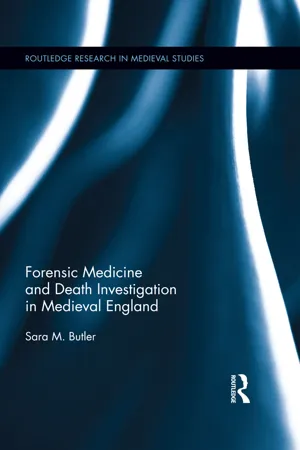
England has traditionally been understood as a latecomer to the use of forensic medicine in death investigation, lagging nearly two-hundred years behind other European authorities. Using the coroner's inquest as a lens, this book hopes to offer a fresh perspective on the process of death investigation in medieval England. The central premise of this book is that medical practitioners did participate in death investigation – although not in every inquest, or even most, and not necessarily in those investigations where we today would deem their advice most pertinent. The medieval relationship with death and disease, in particular, shaped coroners' and their jurors' understanding of the inquest's medical needs and led them to conclusions that can only be understood in context of the medieval world's holistic approach to health and medicine. Moreover, while the English resisted Southern Europe's penchant for autopsies, at times their findings reveal a solid understanding of internal medicine. By studying cause of death in the coroners' reports, this study sheds new light on subjects such as abortion by assault, bubonic plague, cruentation, epilepsy, insanity, senescence, and unnatural death.
- 312 pages
- English
- ePUB (mobile friendly)
- Available on iOS & Android
eBook - ePub
Forensic Medicine and Death Investigation in Medieval England
1
The Coroners
Any study of medieval death investigation inescapably begins with the coroner. The coroner existed at the center of the process. When death was sudden or unnatural, the law barred family and neighbors from removing or burying the body of the dead until the coroner arrived to view it, and the few surviving amercements of communities who failed to adhere to this regulation confirm that the crown vehemently defended the needs of the coroner. This proscription held firm even when the district’s county coroner had to journey across vast distances to reach the scene of the crime, and also in the heat of the summer when having a decomposing corpse around for any great length of time was unenviable.1 Given the intermediacy of the coroner, it is noteworthy that historians have had little constructive to say about this royal official. Many view him merely as a “tax gatherer,” failing to acknowledge that the job involved more than just delivering the king’s profits.2 Carelessness and indolence are the traits that dominate scholarly depictions of the medieval coroner. Much of the fault for this negative perception must be laid at the feet of R.F. Hunnisett himself. Not only did he see coroners as crooked and extortionate, he also distrusted their documentation, cautioning historians to be wary of submitting their findings to statistical analysis. His suspicion of coroners’ rolls rested on the following premises:
- 1) Precedent books so dictated the nature of the enrollments that coroners had no leeway to incorporate extraneous details.
- 2) Coroners regularly altered the dates of inquests to make themselves appear more conscientious in the execution of their office.
- 3) Coroners commonly mislaid their files before they properly enrolled the relevant information, and thus much of the detail is missing from the records.3
Carrie Smith has since established that Hunnisett’s concerns regarding the coroners’ rolls are misplaced. Medieval formularies had little to say about the structure and composition of the coroners’ rolls. If coroners falsified the documentation to make themselves appear more diligent, then they did not do a particularly good job at it. Finally, the sparse detail evident in various coroners’ rolls is not a result of missing files, but rather of coroners’ intent to meet only the minimum standards of statutory requirements.4 While Smith’s revision has renewed confidence in medieval coroners’ rolls as a meaningful historical source, admittedly, her view of the coroner is no more optimistic than is Hunnisett’s. The coroner was not only corrupt, he was also lazy: even when a community bothered to notify the coroner, “he might be both less willing to turn out and more prepared to turn a blind eye if the weather was particularly bad.”5 Hunnisett and Smith are not alone (by far) in their pessimism. J.B. Post writes “the further from a main road that a death occurred, the less likely it was to reach the ears of the coroner and the less likely he was to travel for the purpose of an inquest.”6 Like Smith, he also supposes that the winter’s lower rate of homicide has less to do with patterns of criminality than that “the coroner was less diligent, as the weather got worse.”7 J.D.J. Havard sees the problem less in terms of lethargy than in moral rectitude: he expresses his fears most eloquently by saying that “the coroners had contracted from the sheriffs the disease which it had been intended they should cure—corruption.”8
These conclusions are galvanized by the grumblings of Parliamentary discourse. Sessions of Parliament entertained a profusion of complaints about royal officials. Contrary to perceptions fostered by England’s corpus of outlaw literature, the English crown was highly responsive to fears about the quality of its officeholders, even if it was not always capable of enforcing compliance. In fact, the introduction of the coronership owed much to contemporary apprehensions about the early sheriffs’ autonomy. The crown intended coroners to act as “watchdogs on the sheriff,” hoping to check any oppressive behavior by imposing accountability through the coroner and his documentation.9 Even so, medieval Parliament oversaw a whole host of complaints about coroners relating to unlawful distraint,10 false records,11 absenteeism,12 selling or suppressing indictments,13 creating false indictments,14 losing coroners’ rolls,15 maintenance,16 and extortion.17 To achieve the appropriate perspective, we must acknowledge that the legal lens inexorably provides a view of the coroner at his worst. Assuredly, some coroners were corrupt. Some coroners took bribes, and some coroners did so regularly. Some coroners were apathetic. Yet, we do not know that all coroners took bribes, or even that most coroners did; nor do we know that most coroners stayed home, lazing by the hearth and sipping a hot beverage rather than do their jobs in the bitter cold of England’s winters. The law exists to punish offenders, not to reward honesty and hard work. Thus, complaints and legislation, on their own, are an insufficient basis on which to assess the coroners as a whole.
Why is any of this relevant? Indeed, the quality of the coroners does matter. If we assume that most coroners were unscrupulous, looking out only for their own best interests, then by extension we must also infer that death investigation was conducted, at best, in a mediocre fashion—a supposition that, as this chapter will demonstrate, is not corroborated by the documentation. Moreover, as this chapter contends, coroners belonged to a cast of individuals with substantial experience in law enforcement. Coroners belonged to families who, over multiple generations, dedicated their careers to upholding the peace. Surely, some of these individuals were attracted to the position out of a desire to serve the kingdom, rather than glimpsing an opportunity for graft. The goal of this chapter is not to redeem the medieval English legal system, but to argue that the history of the coroner needs a fresh start. We need to approach the subject with an open mind and realize that medieval coroners were entirely human. Some of them were corrupt; but others were conscientious and hard working. By looking to the parameters of the office as the legal documentation articulates it, we can gain a much better sense of how the ideal coroner functioned in the process of death investigation, what guidelines the crown had to offer, and the nature of the obstacles he might encounter while executing his duties.
The Sources
Because English common law is unwritten, the corpus of legal writing weighs much more heavily on our understanding of the practice of the law. This chapter draws mainly, but not exclusively, from three forms of legal writing: statutory law, legal treatises, and the Year Books. First, statutory law exists outside common law. Statutes are legislation promulgated by Parliament primarily in response to a perceived problem not already addressed by common law procedures. While statute law predates Edward I, historians credit his reign with “one of the greatest outbursts of reforming legislation in English history until the nineteenth century.”18 Edward I promoted a positive reception to new law, a foreign concept to a law thought to be grounded in ancient tradition. England’s royal justices were typically well versed in statute law out of necessity. Because collections of statutes for reference purposes did not circulate until the mid-fourteenth century, royal justices memorized the body of statute law by rote.19 As the coronership was created by statute, not by the Anglo-Saxons, members of Parliament employed statutory law for the continuing regulation of the position. Consequently, statute law has much to offer concerning expectations for the office. In particular, its instructions relating to the process of investigation are astonishingly thorough. From the historian’s perspective, what is most striking is that the legislation does not privilege the financial aspects of the office at the expense of a thorough investigation. Indeed, the coroner is both financial officer and death investigator. The two go hand in hand.
Second, the legal treatises, founded in part on the performance of English law, supply us with some of the best insight into the workings of the English judicial system. Four English treatises address the subject of the coroner-ship specifically. On the Laws and Customs of England, traditionally associated with and maybe even penned by, Henri de Bracton (c. 1210–1268), a renowned royal justice and cleric, is the first to discuss the office.20 The treatise is sometimes considered problematic in that its author drew a sizeable portion of its content from Roman law rather than English custom.21 However, as the coronership was an English innovation, these passages are free of Continental borrowings. The other three treatises in order of appearance are The Mirror of Justices, Fleta, and Britton. There has been much contention about the dating and origin of each treatise. The most persuasive scholarship locates all three as “late thirteenth-century updates and abridgements” of Bracton, all of unknown authorship, and most likely written “within the space of ten or fifteen years.”22 The Mirror of Justices, in particular, has been the target of much ridicule and abuse by historians, largely because of its openly Christian viewpoint. Once dismissed by Maitland and Pollock as “speculation or satire,”23 under David Seipp’s guidance the treatise has returned to its proper place in history as a “reformist textbook on law.”24 Britton presents its own challenges in that it professes to have been composed at the command of King Edward I and is even written in the first person plural as if it were the king’s authorized code of law. Yet it, too, is clearly an abbreviated version of Bracton. Together, all four treatises, which vary in interesting ways, enhance our vision of the medieval coroners, whom Britton describes as “the principal guardians of our peace” in every county.25
Finally, with the rise of sergeants and pleaders in the thirteenth century, a new genre of literature surfaced in order to prepare them for their careers in common law: the Year Books. Drawn from actual cases and courtroom dialogues from England’s myriad courts of law, royal justices intended these annual publications to clarify the law’s known ambiguities and to model good judicial decision making. Medieval English common law did not function according to precedent. Nonetheless, close study of the compilation of cases included in these texts achieved much the same effect. Pleaders acquired a sense of how best to defend their clients by looking to the successes and failures of past cases. The vast majority of Year Book cases involve civil suits. The meager assemblage of crown pleas included in the publications, however, offer fruitful insight into the coroner and his office.
Collectively, all three facets of the legal literature have much to tell us about the coroner and his role in death investigation.
Who were the Coroners (In Theory)?
The crown imagined coroners as knights. The 1194 article that concocted the position expressed this stipulat...
Table of contents
- Cover
- Title
- Copyright
- Contents
- List of Figures
- List of Tables
- Table of Royal Statutes
- List of Abbreviations
- Acknowledgments
- Introduction
- 1 The Coroners
- 2 The Jurors
- 3 The Process of Investigation
- 4 The Medical Dimension of a Coroner’s Inquest
- 5 Health and Healthcare in the Coroners’ Rolls
- Conclusion
- Glossary
- Bibliography
- Index
Trusted by 375,005 students
Access to over 1.5 million titles for a fair monthly price.
Study more efficiently using our study tools.
Frequently asked questions
Yes, you can cancel anytime from the Subscription tab in your account settings on the Perlego website. Your subscription will stay active until the end of your current billing period. Learn how to cancel your subscription
No, books cannot be downloaded as external files, such as PDFs, for use outside of Perlego. However, you can download books within the Perlego app for offline reading on mobile or tablet. Learn how to download books offline
Perlego offers two plans: Essential and Complete
- Essential is ideal for learners and professionals who enjoy exploring a wide range of subjects. Access the Essential Library with 800,000+ trusted titles and best-sellers across business, personal growth, and the humanities. Includes unlimited reading time and Standard Read Aloud voice.
- Complete: Perfect for advanced learners and researchers needing full, unrestricted access. Unlock 1.5M+ books across hundreds of subjects, including academic and specialized titles. The Complete Plan also includes advanced features like Premium Read Aloud and Research Assistant.
We are an online textbook subscription service, where you can get access to an entire online library for less than the price of a single book per month. With over 1.5 million books across 990+ topics, we’ve got you covered! Learn about our mission
Look out for the read-aloud symbol on your next book to see if you can listen to it. The read-aloud tool reads text aloud for you, highlighting the text as it is being read. You can pause it, speed it up and slow it down. Learn more about Read Aloud
Yes! You can use the Perlego app on both iOS and Android devices to read anytime, anywhere — even offline. Perfect for commutes or when you’re on the go.
Please note we cannot support devices running on iOS 13 and Android 7 or earlier. Learn more about using the app
Please note we cannot support devices running on iOS 13 and Android 7 or earlier. Learn more about using the app
Yes, you can access Forensic Medicine and Death Investigation in Medieval England by Sara M. Butler in PDF and/or ePUB format, as well as other popular books in History & British History. We have over 1.5 million books available in our catalogue for you to explore.