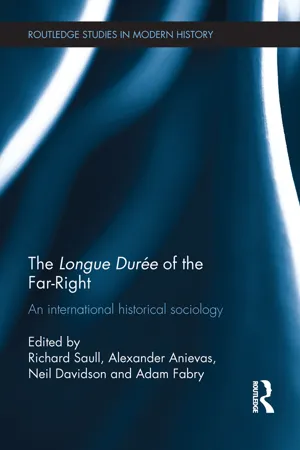
This volume brings together a number of international scholars to offer an original analysis of far-right movements and politics, challenging the existing literature through a very different methodological and theoretical perspective. The approach offered here is that of 'longue durée' analysis, whereby the far-right is understood as an evolving subject of capitalist modernity. The authors argue that an assessment of the contemporary characteristics of the far-right needs to consider the ways in which it is a product of deeper and longer-term structures of socio-economic and political development, than, for example, the inter-war crises of capitalism. The book aims to provide a critical and theoretically-informed assessment of the history of the far-right that centres on the international as key to any understanding its evolution, and which distinguishes between the fascist and non-fascist variants as an essential precondition for comprehending the far-right presence in contemporary politics
eBook - ePub
The Longue Durée of the Far-Right
An International Historical Sociology
- 226 pages
- English
- ePUB (mobile friendly)
- Available on iOS & Android
eBook - ePub
The Longue Durée of the Far-Right
An International Historical Sociology
About this book
Information
1 The origins and persistence of the far-right
Capital, class and the pathologies of liberal politics
Introduction
The persistence of the (European) far-right highlighted by its post-Cold War re-emergence and its more recent – if uneven – spike of popularity with the escalation of the Eurozone crisis after 2009 is an important feature of contemporary European politics. The continuing presence of the far-right, particularly with the absence of its historical revolutionary socialist foe suggests that the political currents associated with it are deeply embedded within the social and political fabric of liberal Europe in spite of the awful consequences of fascism and the attempts to construct a post-fascist social and political settlement after 1945.
Interestingly, much of the scholarly writing on the far-right – contemporary or otherwise – has tended to downplay this embeddedness through emphasizing the singularity of the inter-war fascist episode and comparing the contemporary far-right to fascism, as if this is the ultimate reference point for the ‘far’, ‘extreme’, ‘populist’, or ‘radical’ right (Griffin 2006; Hainsworth 2008; Ignazi 1997; Prowe 1994). The problem with such perspectives is that they imply that the far-right is a kind of aberration within liberal polities replicating the historical singularity of fascism; an exceptional occurrence within the European body politic associated with the momentary appearance of unpleasant outlooks but which, ultimately, cannot or should not be considered as, in some sense, constituting the body politic of liberal-democratic states.
The persistence of the far-right – both before and after fascism – suggests otherwise (Saull 2013a). Consequently, if the social and political essence or embodiment of the far-right is not reducible to fascism, then the analytical reference point for a discussion of this particular political-ideological perspective needs to consider not only the pre-fascist far-right, but also the distinct constellation of forces, processes and structures that gave birth to the modern far-right. Further, if it is accepted that the far-right should be seen as a major constituent of modernity, then it suggests that it is likely to be with us for as long as the socio-economic and political arrangements that define that (capitalist) modernity persist.1 Therefore, to understand the far-right not only requires an examination of the parties and movements that have been labelled as ‘far-right’ but also and, ultimately, more importantly, a consideration of the particular arrangements of State–society relations, politics and economics – international and domestic – that have given rise to such political modalities, and which have continued to promote their reproduction over the longue durée.
It is the purpose of this chapter to focus on the question of the origins of the far-right as a specific current of modern politics. I will argue that the far-right emerged in Europe as a product of a particular socio-economic and political order that came into existence through the second half of the nineteenth century; an order that was fundamentally shaped by international structures and processes associated with the specifities of uneven and combined capitalist development. This (international) order was defined by historically unique ideological fault-lines, social imaginaries and political possibilities very different from those which had preceded it, and which served to engineer a socio-economic and political environment out of which a far-right politics was to emerge. Whilst both the international and domestic characteristics of this capitalist social order have, obviously, undergone significant changes since the nineteenth century, as I will seek to demonstrate in the following section, both the uneven and combined development and socio-economic insecurities and crises endemic to capitalism continue to fundamentally shape the social and political terrain from which far-right positions are still reproduced (Saull 2013b).
The far-right emerged within a political-ideological landscape that was already defined by the influence of what we might regard as a ‘reactionary’ or traditional-conservative right that was associated with the defence of the ancien régime, which had emerged in response to the 1789 French Revolution (Hobsbawm 1975; Weiss 1977). These social and political forces – particularly through their control of the administrative and coercive machineries of states – continued to play a significant role in determining the direction of the domestic and international politics of European states throughout the nineteenth century; indeed, up until 1914 (Halperin 2004; Mayer 1981). However, the dominance of this right – anchored in the traditional and neo-feudal relationship between lords and peasants and a politics sourced in the countryside and agrarian social relations and political economy – was to be challenged and eclipsed as the nineteenth century wore on and the socio-economic and political transformations derived from capitalist development took hold.
Now, in locating the emergence and development of the far-right as a consequence of capitalist development I am referring, in other words, to the rise of the ‘social question’. The social question can be seen as an enduring by-product of capitalism that tends to contrast with the more fixed, hierarchical and geopolitically-insulated determinations of social order that had characterized pre-nineteenth century European state/society complexes (see Teschke 2003). Specifically, it concerns the – ongoing – ‘revolutionary’ social transformations that occurred across Europe over the nineteenth century as capitalism gained a more widespread and deeper footing within existing state/society structures and as state elites and ruling classes sought to manage – from the top-down – such transformations, whilst preserving domestic political order (Moore 1973); hence, rendering uneven and combined social development.
The first sign of the rise and fundamental influence of the social question associated with the difficulties in managing the ‘transition to capitalism’ came with the 1848–9 European revolutions (Hobsbawm 1975, 1995; Mann 1993; Sperber 2005). The revolutions revealed not only the deep social and political contradictions afflicting many European state/society arrangements at the time, but also the inabilities of the traditional ancien régime right to articulate and institutionalize a politics that could accommodate and manage such changes. Consequently, even though the revolutions cannot be simply described as ‘bourgeois revolutions’, indicating that moment whereby one mode of production is superseded by another – and along with it the dominance of a new ruling class (Davidson 2012: 133–51) – they can be seen, at least within the western half of Europe, as reflecting a particularly intense moment in the process of transformation towards societies increasingly dominated by the logic of capitalist social relations of production. In a word, the revolutions marked a moment whereby European state-societies became increasingly subject to, and moved towards opening themselves up to, the tentacles of an international capitalist system centred on Britain.
What was also significant about the revolutions with regard to the origins of the far-right was that they also reflected the emergence of a ‘mass’ or modern democratic politics most evident in the entrance onto the European political stage of a working class as an independent revolutionary political subject. Thus, although the revolutions did not result in the victory of democratic forces – indeed, in the short term in all of the different national locales of revolution, the ‘forces of democracy’ were defeated – the social fabric of the political sphere was transformed. Whereas the politics of the ancien régime had been premised on the idea of ‘godly’ principles of rule centred on monarchy, nobility and church, and where the ‘people’ were regarded as either passive bystanders or pawns of their ‘social superiors’, after 1848 political elites and ruling classes increasingly had to take notice of – and engage with – a public through institutions that were seen as representing the voices of ‘the people’ in the business of government and the prosecution of rule. The role, design and significance of these proto-democratic institutions varied across different national locales reflecting the different dynamics of political transformation associated with the varying constellations of social forces (witness the differences in the relative power and influence of traditional landowning classes in the political workings of Britain, France and Germany after 1848) across Europe. Therefore, such developments were intimately connected to the pace, scope and depth of capitalist industrialization and, with it, the centring of politics as an urban phenomenon increasingly involving the three classes that came to dominate modern politics – bourgeoisie, proletariat and petit bourgeoisie.
As I will seek to show in the discussion that follows, ‘1848’ can be seen as a watershed moment in the social and political transformation of the interiors of European states, serving to make them a fertile social topography for a far-right politics committed to engaging and mobilizing the masses in a political struggle to determine the political response to the social, economic and cultural transformations unleashed by the internationally-mediated spread of capitalist modernity. Consequently, without such socio-economic changes connected to a wider international social and geopolitical dispensation, a far-right would not have emerged. The rest of this chapter will substantiate these claims through focusing on the significance, causal dynamics and consequences of the 1848–9 revolutions and then a discussion of the way in which the post-1848 development of the social order of capitalist modernity combined with liberal politics to provide the environment that produced, and has continued to reproduce, the far-right.
The chapter is organized in the following way. First, I examine the social and political conjuncture of the 1848–9 revolutions. The aim here is to convey the character of the socio-economic and political terrain out of which the revolutions occurred and the principal consequences of the revolutions for the framing of European politics thereafter. The next section of the chapter then offers an explanation for the emergence of a modern far-right in the latter part of the nineteenth century as the changes unleashed by 1848 came to fruition. The chapter concludes with some comments as to the continuing connections between our liberal-capitalist modernity and the far-right. However, before I move to look at the conjuncture of 1848, I will spend a moment with some comments on the temporality of the far-right as a coherent political-ideological orientation compatible with the different and evolving pathologies of capitalist development over the longue durée.
The ideas and politics of the far-right over the longue durée
The discussion of the ideational and political attributes of a ‘far’, ‘extreme’ or ‘reactionary’ right continue to pre-occupy scholars both with respect to how such terms relate to the meaning of fascism and the connections between the contemporary manifestations of the far-right and its historical bedfellows in the nineteenth century (Eatwell 1996; Hainsworth 2008; Mann 2004; Mudde 2007; Saull 2013a, 2013b; Woodley 2010). Yet, whilst recognizing the differences between the fascist and contemporary far-right from their respective nineteenth-century antecedents, my claim is that the type of politics – meaning the identification of the key issues for political resolution through a reconstitution of the political realm (i.e. state transformation at the domestic and international levels) – that we associate with the far-right, the social layers that it seeks to mobilize and the ideological methods that it deploys have, largely, persisted over the longue durée. The details and specifics may have changed (e.g. the targeting of a ‘Muslim other’ as a source of threat that has become a sine qua non of a contemporary far-right political sensibility was not a feature of either the fascist or nineteenth-century far-right ideological armoury) but the general perspective of the far-right, which began to cohere as a distinct political orientation in the latter part of the nineteenth century, continues to characterize the contemporary far-right at least as reflected in such movements and parties as the British National Party, the French Front National, the Italian Lega Nord and the German National Democratic Party, amongst others.
The ideas and institutions that came to be associated with a modern far-right over the nineteenth century emerged out of the processes of socio-economic and political change that spread, unevenly, across Europe after 1848. What, then, has provided the internal political and ideological coherence of the far-right over the longue durée? This is crucial, as over this temporality the specifities of the historical manifestations of the European far-right have consisted of movements and parties encompassing a range of historically contingent, but ontologically similar, positions: hostility to free trade, the defence of empire and the idealization of an agrarian idyll in the nineteenth century, militarism, militant anti-communism and an ‘exterminist’ anti-Semitism in the inter-war era, and, now, Islamophobia, ‘welfare nativism’ and a hostility towards globalization and European integration.
There are two elements of modernity that have provided the sources of political-ideological coherence for the far-right. First, is the conduct of politics via ‘mass’ or democratic politics and the representative institutions and processes that have become associated with the modern liberal democratic state. Although the formal institutionalization of a democratic politics was to take some time to materialize in ...
Table of contents
- Cover
- Half Title
- Title Page
- Copyright Page
- Dedication
- Table of Contents
- List of contributors
- Acknowledgements
- The longue durée of the far-right: an introduction
- 1 The origins and persistence of the far-right: capital, class and the pathologies of liberal politics
- 2 Mass hysteria or a class act? Premonitions of fascism between Marxism and liberalism
- 3 Hegemonic transition, war and opportunities for fascist militarism
- 4 Reaction and adaptation in the longue durée: the far-right, international politics and the state in historical perspective
- 5 Passato e presente? Gramsci’s analysis of fascism and the far-right
- 6 The far-right and ‘the needs of capital’
- 7 The far-right and neoliberalism: willing partner or hegemonic opponent?
- 8 Poland’s recombinant far-right populism and the reconfiguration of post-communist neoliberalisation
- 9 Hegemony and the far-right: policing dissent in imperial America
- Index
Trusted by 375,005 students
Access to over 1.5 million titles for a fair monthly price.
Study more efficiently using our study tools.
Frequently asked questions
Yes, you can cancel anytime from the Subscription tab in your account settings on the Perlego website. Your subscription will stay active until the end of your current billing period. Learn how to cancel your subscription
No, books cannot be downloaded as external files, such as PDFs, for use outside of Perlego. However, you can download books within the Perlego app for offline reading on mobile or tablet. Learn how to download books offline
Perlego offers two plans: Essential and Complete
- Essential is ideal for learners and professionals who enjoy exploring a wide range of subjects. Access the Essential Library with 800,000+ trusted titles and best-sellers across business, personal growth, and the humanities. Includes unlimited reading time and Standard Read Aloud voice.
- Complete: Perfect for advanced learners and researchers needing full, unrestricted access. Unlock 1.5M+ books across hundreds of subjects, including academic and specialized titles. The Complete Plan also includes advanced features like Premium Read Aloud and Research Assistant.
We are an online textbook subscription service, where you can get access to an entire online library for less than the price of a single book per month. With over 1.5 million books across 990+ topics, we’ve got you covered! Learn about our mission
Look out for the read-aloud symbol on your next book to see if you can listen to it. The read-aloud tool reads text aloud for you, highlighting the text as it is being read. You can pause it, speed it up and slow it down. Learn more about Read Aloud
Yes! You can use the Perlego app on both iOS and Android devices to read anytime, anywhere — even offline. Perfect for commutes or when you’re on the go.
Please note we cannot support devices running on iOS 13 and Android 7 or earlier. Learn more about using the app
Please note we cannot support devices running on iOS 13 and Android 7 or earlier. Learn more about using the app
Yes, you can access The Longue Durée of the Far-Right by Richard Saull,Alexander Anievas,Neil Davidson,Adam Fabry in PDF and/or ePUB format, as well as other popular books in Politics & International Relations & Politics. We have over 1.5 million books available in our catalogue for you to explore.