![]()
The Ghṛṣṇeśvaraliṅga in Varanasi and the bāṇaliṅgas from the Narmada River
Mikael Aktor
Śivaliṅgas, the all-dominant objects of worship of the Hindu god Śiva and among the most common Hindu objects of worship, are seen in a variety of forms, sizes, and materials across India and globally, wherever Hindus have settled. Walking along the ghāṭs and small lanes of the holy city of Śiva in Varanasi, one will see perishable liṅgas made of sand or clay or merely drawn on the ground with chalk or charcoal as well as elaborately decorated liṅgas made of durable materials such as stone, copper, or glass. One will also see natural stones, often egg-shaped and with a smooth surface but without any ornamentation, placed on altars in either wall recesses or private homes; these are considered to be naturally “self-produced” (svayambhū) liṅgas. Śivaliṅgas, in other words, are presented not only as man-made objects produced in accordance with a traditional iconography but also as unmanufactured natural stones, often originating from specific rivers. For the former, we may adopt from archaeology the notion of a religious artifact: that is, a man-made object of ritual significance. For the latter, we may adopt the notion of a religious manuport: that is, a natural object that has been moved by humans from its natural place of occurrence but has been left unmodified so that its cultural context and use cannot be deduced from the object itself.
In spite of this division between artifact and manuport, śivaliṅgas are commonly and generally described as aniconic representations of Śiva (e.g., Hohenberger 2013: 72). Historians of religious art have used the concept of aniconism to describe objects that lack visible likeness to the gods or holy persons they represent. But the notion is ambiguous as it includes not only unmanufactured natural objects but also (and even more typically) man-made images of objects that have only a symbolic or metonymic relation to these gods or persons. As such, the fish as a symbol of Jesus Christ and the wheel as a reference to the Buddha have both been described as aniconic representations. However, from the point of view of semiotic sign classification, according to which the image is an iconic sign of something by virtue of the visual qualities it has in common with its object (what it actually depicts; Maniura 2011: 52), the aniconic in opposition to the iconic must be understood only as referring to objects that are seen as not depicting anything. Christian and Buddhist images of the fish and the wheel are not aniconic in this sense since they do in fact look like fishes and wheels. In order to avoid this ambiguity, I will therefore use the term aniconicity in this chapter rather than the more common ‘aniconism’ of the art historians.1
In line with this reasoning I will argue in what follows, on the one hand, that the man-made śivaliṅgas – the artifacts – are not fully aniconic, but contain more or less iconic elements of traditional iconography, and, on the other, that the naturally occuring śivaliṅgas – the manuports – although aniconic in terms of their natural state are selected by what I call a ‘narrative gaze’, one which sees a likeness between certain visible (or tangible) properties of the natural object and certain fragments of the mythology of Śiva. Thus, iconicity – in this chapter understood as a recognized visual likeness – is not absolute. Rather, it is relative with regards to both types: it is neither fully present in the first category (it is more accurate to say that it is subdued) nor completely absent in the latter category.2
Traditional classifications
According to the medieval Śaiva Purāṇas and Āgamas, liṅgas can be divided into several categories. First there is the division between fixed (sthānu, sthāvara, or acala) and movable (cala or cara) liṅgas. The former are typically the ritually installed liṅgas in the inner sanctum of Śiva temples. The latter may be transportable liṅgas in the home, liṅgas worn on the body, or liṅgas made and worshipped for single occasions (kṣaṇika). These latter may be made of sand, clay, cooked rice, sandalwood paste, butter, cow dung, or other available materials. Furthermore, there is a division according to how the liṅgas were established or worshipped originally, whether by humans (mānuṣa), by ṛṣis (ārṣa), by gods (daiva), or self-produced (svayambhū). These origins are expressions of value or efficacy, the mānuṣaliṅgas ranking lowest and the svayambhūliṅgas ranking highest. Bāṇaliṅgas, which are natural stones collected from certain places in the Narmada River, constitute their own category, but may also be classified among svayambhūliṅgas (Rao 1914: 75–80; Hikita 2005: 245–246).
The man-made liṅgas, the mānuṣaliṅgas, are those most elaborated upon in the manuals, which are found in various literary genres: mythological (Purāṇas, Āgamas) as well as technical (Darmaśāstra Nibandhas and Śilpaśāstra, that is, respectively, the scholarly literature on duty and that on architecture and sculpture). Whereas svayambhūliṅgas are often selected as such due to some extraordinary natural properties, the sacredness of mānuṣaliṅgas depends on the employment of complicated and strict iconographic rules by the artisans that produce them, as well as on elaborate rituals. It is generally the case that sacredness resides in the natural but extraordinary or in the cultural but strictly rule-governed. Thus, mānuṣaliṅgas have to be established by rituals (pratiṣṭhā), and the presence of Śiva in the liṅga (or rather as the liṅga) must be invoked by the employment of a series of mantras and visualizations (āvāhana).3 In contrast, svayambhū- and bāṇaliṅgas can be worshipped with minimal or no consecration and invocation rituals (Rao 1914: 81–82; Hikita 2005: 246, n.15); in these liṅgas, divine presence is inherent and is not in need of being established or invoked (Bühnemann 1988: 136).
While they may occur as extraordinary natural phenomena – such as, for instance, the ice stalagmite in the Amarnāth cave of Kashmir – a svayambhūliṅga may also be a natural stone that has been worshipped for many generations and then raised to the status of a svayambhūliṅga by local priests. According to Gopinatha Rao: “If such indeed be the superiority of the Svāyambuva Liṅgas over others, it is no wonder that every village claims the Svāyambhuva nature for the Liṅga set up in its temple” (Rao 1914: 82). In the Śivapurāṇa (1.18.32–33), svayambhūliṅgas are seen as Śiva taking the form of a sprout underneath the earth. This idea is probably related to the fact that svayambhūliṅgas are often specific to cave temples (Kramrisch 1946: 172; Kumar 1986: 21; Hikita 2005: 247). The Varanasi stone replica of the Amarnāth Liṅga on Tulsī Ghāṭ is located in a small underground room. According to the Kāmikāgama, svayambūliṅgas are also said to be immune to damage, except for complete destruction, which, however, has severe consequences for the king (Rao 1914: 82).
The liṅga as an artifact: what does it look like?
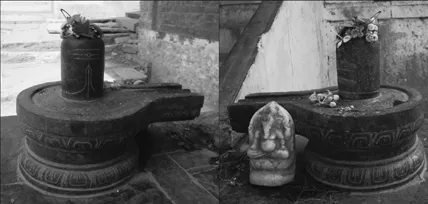
The question to be discussed in this section is not so much about the visual appearance of śivaliṅgas, but is more in accordance with the overall theme of iconicity/aniconicity: what do they resemble? I will use as an example one particular śivaliṅga from Varanasi (Figure 1.1). This example has been chosen because it displays some of the changes that are typical of the iconographic history of śivaliṅgas. It is located near Śivālā Ghāṭ outside the small Ghṛṣṇeśvara (or Ghuśmeśvara) Mahādeva temple. The liṅga, with the same name as the temple, was set up in 2010 by Bangali Baba, the founder of the temple.
Figure 1.1 The Ghṛṣṇeśvara Mahādeva Liṅga at the upper platform, Śivālā Ghāṭ, Varanasi, 7 April 2011. Left: view from the east side; right: view from the West side (photo: Mikael Aktor).
The basic and classical structure of the liṅga is clear from this example. The sculpture is composed of two parts forming an intersection of vertical and horizontal lines. Vertically we see an upper cylindrical shaft (the liṅga proper) and horizontally we see a rounded pedestal (the pīṭha), which is elongated in one direction, in the classical structure usually (but not always) pointing north in the direction of Śiva in his Transhimalayan abode. The shaft, however, is not placed on top of the pedestal, as it appears to the viewer to be. In fact, the shaft penetrates the pedestal and extends down into the ground beneath its base, and thus the iconographic scheme divides the full shaft in to three sections: an underground square part called the brahmabhāga, which rests on a subterranean base (adhiṣṭhāna); an octagonal part called the viṣṇubhāga, which is hidden in the center of the pedestal; and the uppermost, visible and (mostly) cylindrical part called the rudrabhāga or pūjābhāga, which is worshipped as Śiva (Rudra) with water, leaves etc. Manuals on architecture and sculpture (śilpaśāstra), such as the Mānasāra, set out the very detailed rules regarding the dimensions of each part according to specific types and according to the dimensions of the inner sanctum (garbhagṛha) in which the liṅga is to be placed. By following these rules, nothing is left to chance or coincidence (Mānasāra 52.1–170 in Acharya 1934: 523–31; Rao 1914:...