'In this remarkable collection of essays, Holton and Turner demonstrate that Parsonian sociology addresses the most central problems of our time – issues of sickness and health, power and inequality, the nature of capitalism and its possible alternatives. They develop a mature and original perspective on Parsons as the only classical theorist who avoided crippling nostalgia. Holton and Turner not only talk about Parsonian sociology in a profound and insightful way, they do it, and do it well. As sociology moves away from the rigid dichotomies of earlier debate, this book will help point the way.' – Jeffrey Alexander, Professor and Director of Graduate Studies in Sociology, UCLA
eBook - ePub
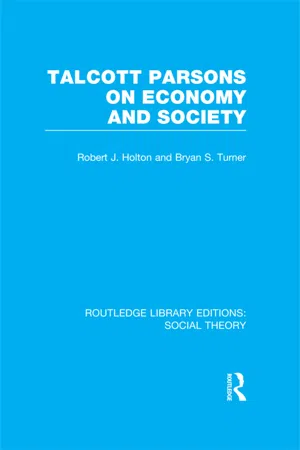
Talcott Parsons on Economy and Society (RLE Social Theory)
- 282 pages
- English
- ePUB (mobile friendly)
- Available on iOS & Android
eBook - ePub
Talcott Parsons on Economy and Society (RLE Social Theory)
About this book
Information
1 Talcott Parsons and the theory of economy and society
DOI: 10.4324/9781315763767-2
‘It is vain to speak of the higher authority of a unified social science. No doubt if that existed Economics would gladly find shelter under its wing. But it does not exist; it shows no signs of coming into existence. There is no use in writing idly for it; we must do what we can with our present resources.’(Alfred Marshall, 1885)
‘Economic theory need not remain an “island” of theoretical specificity totally alone in an uncharted “sea” of theoretical indeterminacy…. Even though the general theory of action … is unevenly developed, we have been able to place economic theory within the general theory of social systems with considerable accuracy.’(Talcott Parsons and Neil Smelser, 1956a)
Introduction
One of the characteristic features of modern western social thought is the representation of economic life as a discrete self-subsistent element in the social order. It is largely upon this basis that ‘economics’ has arisen as a distinct member of the family of social sciences, with its own internal body of economic theory as well as a separate academic identity. The question nonetheless arises as to the relationships that are taken to exist between the economy and society, and as a corollary between the inquiries of economics and the other social sciences. How in the first place, is the economy to be defined, such that its characteristic processes can be distinguished from other parts of society? What are the other parts of society, and how is the economy articulated with them? In the light of such questions how adequate is the view that the economy is (at least for certain purposes) self-subsistent, and able as such to exert a determinate, or even dominant influence on social life in general? How, finally, is the current prestige of economics as a theoretically coherent and yet self-subsistent social science to be understood?
Such questions have engaged a wide range of social scientists, most of whom have been critical of the perspectives on economy and society generated within the mainstream of conventional economic thought. Amongst the most influential of these are the work of Marx and Marxian political economy, Veblen and the ‘institutionalists’, and Polanyi and the school of economic anthropology. Less widely known but of equal interest is the theory of economy and society developed between the 1930s and 1950s by Talcott Parsons.
Parsons’ work draws explicitly on the classical European sociological tradition of Weber and Durkheim, and on what might be called the sociologically informed economics of Marshall and Pareto. The Parsonian synthesis may be distinguished from the other three currents in two very interesting ways. First, an attempt is made to combine a generic theory of the economy with a concern for the importance of values and normative order in relationships linking the economy and society. While Parsons shares the former of these aims with Marxist political economy, and the latter with both institutionalism and economic anthropology, his combination of the two objectives is both highly distinctive and theoretically provocative. Second, Parsons seeks not to undermine or reject conventional economic theory as indefensibly abstract or as an apologetic version of ‘bourgeois ideology’, but rather to subsume it as an insightful but incomplete theoretical project within a general theory of society.
While this paper offers an exegesis of an under-appreciated side of Parsons’ work, it has three further aims. The first is to challenge the predominance of ‘political economic’ approaches to economy and society within contemporary sociological thought. Perspectives of this kind may be seen as inadequate, as Parsons points out, both in terms of their handling of the problem of order and in relation to their analyses of the structure of modern Western society. Secondly, it is claimed that Parsons’ contribution is not to have produced another evangelical manifesto in support of the diffuse importance of the social context of economic activity, but to have identified a systematic theoretical apparatus offering sophisticated analyses of the relations between economy and society. The third aim is to demonstrate that Parsons’ economic sociology can be operationalised in empirical research and that the yield from what might be called the Parsonian research programme seems very promising. In all these respects there is good reason to argue not for the ‘de-Parsonising’ of sociology, but for a process of ‘re-Parsonisation’.
An initial technical note
The concept of ‘conventional’ or ‘mainstream’ economic thought deployed throughout this paper is associated with the major tradition of Anglo-Saxon economic thought concerned primarily with the functioning of market systems in terms of rational action. This tradition links Adam Smith and Ricardo with the neo-classical economists of the late nineteenth century and twentieth-century traditions such as Keynesianism and monetarism. Use of this broad concept is not meant to imply that economics is an homogeneous harmonious discipline. The concept may rather be seen as a Weberian ideal-type expressly designed to focus in a ‘one-sided’ manner on certain recurring features in the logic of economic explanation. As such the term ‘conventional economic thought’ is a deliberate abstraction rather than an empirical generalisation. Its function is essentially heuristic. The term represents a first approximation as to the nature of economic thought, bringing some initial order to a field, an order which may later be relaxed in cases of empirical deviation from the initial concept. As such this concept initially bears no more or less relationship to empirical reality than do economists’ postulates of perfect competition or rational economic man.
The challenge of The Structure of Social Action
The problem of how to conceptualise and theorise the interrelationships between economy and society occupies a strategic position in the development of Parsons’ thought. This is evident in his critique of utilitarian economics which formed much of the basis of his ‘voluntaristic theory of action’, his discussion of ‘power’ as a circulating medium analogous to ‘money’, and above all in the development of the four-function (AGIL) paradigm, for the analysis of social systems.
Parsons’ engagement with problems of economy and society may be separated into two phases. The first, in the late 1920s and 1930s, setting out from his doctoral dissertation on theories of capitalism, sought a basis upon which action theory could be reconciled with difficulties prompted by the Hobbesian problem of ‘order’ (see especially Parsons, 1934c, 1935a, 1937a).
In the light of this problem, conventional economic theory was seen as still entrapped within the inadequate theories of action of nineteenth-century positivism and utilitarianism. While containing certain insights on the nature of means-end rationality, economic thought must now turn to the reformulated version of action theory developed by the classical sociologists of the late nineteenth century.
The second phase of Parsons’ work in economic sociology during the 1950s was predicated on his development of a general theory of action which looked beyond the ‘voluntarism’ of classical sociology. The elaboration of his general theory within the theory of social systems saw the resumption of a concern with the relations between economy and society. This culminated in the publication of Economy and Society, jointly with Neil Smelser in 1956.
The publication of The Structure of Social Action in 1936 represents the culmination of the first phase of Parsons’ works in social theory. The point of departure in this study concerns certain internal problems within the leading nineteenth-century variant of action theory – namely that associated with utilitarianism. While the terms ‘utilitarianism’ and ‘utilitarian’ have sometimes been used to refer to a system of social reform, Parsons’ usage is directed towards those nineteenth-century action theories characterised by an ‘atomistic’, ‘rationalistic’ and positivistic approach to action.
The unit act in this atomistic schema is seen in terms of individual strategies to realise ‘ends’ irrespective of the ‘ends’ desired by other actors. ‘Ends’ moreover may be said to have both substantive and formal components. Substantively ‘ends’ are constituted out of values and are thus empirical phenomena. Analytically speaking, however, the formal concept of end in this action schema refers not so much to some valued ‘anticipated future state of affairs’, but more specifically to ‘the difference between the anticipated future state of affairs and that which it could have been predicted would ensue from the initial situation without the agency of the actor having intervened’ (Parsons’ emphasis).
By ‘rationality’, Parsons refers in this context to the normative patterns that link the ‘means’ chosen to the desired ‘ends’. In analytical terms ‘means’ do not refer to ‘things’ employed in realising ends in some general sense, but only to those aspects of means susceptible to ‘control’ by the actor. Rationality in this schema applies not to the status of ends which may be taken as a ‘given’, but to the appropriateness of the normative processes wherein particular means are chosen and deployed in a given situation to realise ‘ends’. The ‘rational’ or ‘irrational’ nature of choice in this utilitarian context is seen moreover as capable of determination by scientific means – actors’ strategies for verifying the appropriateness of chosen means being analogous to those employed by scientists. Parsons describes this assumption as ‘positivist’ in the sense that ‘scientifically verified knowledge of the situation is regarded as “Man”s sole possible significant, cognitive relation to external (non ego) reality, man as actor that is’ (1937a, p. 61). It follows that departures from rationality within the utilitarian system can only be regarded as cognitively disprivileged, the results either of ‘error’ in choice, or ‘ignorance’ of available means.
A final, more explicit, feature of the system derivable from its other three characteristics is, according to Parsons, a view of the ‘concrete’ ends chosen by actors as ‘random’ elements. This arises as a result of combining the atomistic assumption that an individual takes no account of the ends of others, when setting his ‘own’, and the positivistic assumption that means-end calculation is not simply a conceptual device, but is also empirically descriptive of social action.
Having outlined these characteristics, Parsons locates a disabling theoretical instability in the system, designated as the ‘utilitarian dilemma’. This may be seen as an immanent property of utilitarian action theory as it developed within nineteenth-century social thought in general, and nineteenth-century understandings of the relationship between economy and society in particular. The dilemma arises from the attempt to combine a sense of the autonomy of individual human agency and choice with the assumption of the randomness of individual ends. It may be stated as follows. In the first instance the atomistic assumption that individuals take no account of other ends may appear to safeguard the autonomy of agency. However, if individual ends are regarded as a random, then the difficulty arises as to how selection of ends arises. The indeterminacy which surrounds the notion of choice between random ends seems to reflect a patternless normative chaos in relations between actors. In attempting to overcome this unacceptable prospect, Parsons perceives that utilitarian action theory ran the danger of turning to an equally unacceptable alternative. This emerges when the problem of normative randomness or chaos is resolved by appeal to the causal significance of given conditions of action, external to the actor. Environmental pressure would be one example of such conditions. The problem with this option is that it is thoroughly inconsistent with action theory, since the autonomy of the actor is effectively undermined. The horns of the utilitarian dilemma are therefore, on the one side normative chaos, and on the other determinism. Parsons’ general conclusion is that there remains no basis for resolving such difficulties while a positivistic theory of knowledge is maintained.
Nineteenth- and twentieth-century economic thought represents for Parsons the principal and most influential expression of utilitarian action theory and was thus especially vulnerable to the utilitarian dilemma. The essence of this argument, as it applies to economic theory, has recently been confirmed – apparently quite independently of Parsons’ critique – in the work of Spiro Latsis (1972). Like Parsons, he demonstrates that economic theory contains not one but two logical structures of explanation. These are termed ‘situational determinism’ and ‘economic behaviouralism’. Latsis demonstrates this dualism in economic theories of rational choice with particular reference to the theory of the firm. Reversing the order in which Parsons presents the horns of the utilitarian dilemma he starts, not with the problem of normative disorder, but with situational determinism. An important example of this is the neo-classical theory of the firm as visualised within theories of perfect competition or monopoly. On the assumption of independence of individual decision-makers, and rational choice in pursuit of self-interest, Latsis shows how economic theory, faced with either perfect competition or monopoly, sees only a single choice or exit involved in any decision. In this sense the outcome to action is determined exclusively by the conditions of the situation, since there is effectively no choice about what to do.
This ‘situational determinism’ is however seen as increasingly inadequate when applied to conditions of imperfect competition, such as oligopoly. Here it is empirically difficult to retain the assumption that ‘ends’ could ever be set independently of each other since so few actors are involved. At the same time there remains, according to Latsis, more freedom of manoeuvre for such actors allowing a multiple-exit situation. In the ‘emergent research programme’ of economic behaviouralism as applied to oligopoly, attention shifts from explanation of action ‘as best decisions in constraining situations’ to ‘more or less good solutions in fluid and partially known or even completely misunderstood situations’ (1972, 229). In the latter case, the only ‘secure’ variable becomes the propensities of the individual decision-maker. Latsis’ conclusion is that this produces two incommensurable ‘paradigms’. ‘The neo-classical view stresses the situation and turns the decision making agent into a “cypher”. The behavioural view on the other hand, focusses on the nature and characteristics of the decision making agent’ (p. 234) but at the cost of relational instabilities.
Both Parsons and Latsis are clearly concerned with the familiar problem of structure and agency as it affects the theorisation of economic life. Parsons’ position diverges from that of Latsis, however, in linking this issue to the further problem of order. This arises in any attempt to maintain an individualistic version of action theory where the connection between individual ends is regarded as indeterminate, chaotic or random. How, in other words, is it possible for society to hold together when faced with an atomistic plurality of actors each possessing different psychological propensities and pursuing separate ends? Is a normative theory of order at the level of such ‘ends’ unnecessary, or are there alternative ways of producing a theory of order consistent with the main principles of the utilitarian action theory?
Such questions are of course highly pertinent both to general theories of society and to any account of the relationship between economy and society. If the economy is defined in a conventional manner as that sphere where ‘means’ are deployed to satisfy material ends, it makes a very great difference to any theory of society, as to whether the ‘economy’ is taken:
- to function without any need of normative order at the level of ends,
- to generate its own normative order at this level,
- to be dependent on external sources of normative order, or
- to be dependent on some type of order, other than normative order, e.g. coercion.
What room is there then within utilitarian action theory, and utilitarian theories of economy and society, for an adequate response to the problem of order? Parsons identifies the relaxation of assumptions about the randomness of ends as one device by which this problem could be addressed with least disturbance to the overall theory. This was achieved primarily through the substitution of the notion of ‘identity of interests’ for any strict assumption of randomness of ends. A solution to the Hobbesian question of how to guarantee social order in the face of an atomistic pursuit of individual advantage was found not in some kind of social contract between ruler and ruled, but in the assumption that rational action incorporated some respect for the rights of others. Individual actors could still be regarded as possessing disparate ultimate ends. But they also shared a common disposition to recognise that the pursuit of individual advantage is only possible if there existed a reciprocal obligation to recognise individual rights even where this conflicted with immediate interests. Following Locke, this disposition was located in the rationality of social actors, through which a minimum of normative order was brought to the conduct of social exchange. In this way, a means of accounting for order was offered consistent with the atomistic, rationalistic and positivistic features of the utilitarian action system.
Whether this amounts to a solution of the problem of order is however very debatable. Parsons points to the importance of a line of argument begun by Hobbes and developed by Ricardo and Marx, which provides an influential theoretical critique of the assumption of natural identity of interests. In this tradition, the parties to social exchange cannot be regarded as sharing reciprocal obligations to respect each other’s pursuit of self-interest. The terms of exchange are rather dictated by conflicts of interest and resolved through the exercise of power – whether in the form of bargaining power or outright coercion.
This approach to the problem of ‘order’ has become immensely influential in contemporary sociology in large measure through the impact of Marxist political economy. Under capitalism, ‘order’ is conceived as the product of class ‘power’ exercised directly through the labour...
Table of contents
- Cover Page
- Half Title Page
- Title Page
- Copyright Page
- Original Title Page
- Original Copyright Page
- Table of Contents
- Acknowledgments
- Reading Talcott Parsons: introductory remarks
- 1 Talcott Parsons and the theory of economy and society
- 2 Sickness and social structure: Parsons' contribution to medical sociology
- 3 Parsons, Schutz and the problem of Verstehen
- 4 Parsons and his critics: on the ubiquity of functionalism
- 5 Against nostalgia: Talcott Parsons and a sociology for the modern world
- Bibliography of Talcott Parsons
- General Bibliography
- Index
Trusted by 375,005 students
Access to over 1.5 million titles for a fair monthly price.
Study more efficiently using our study tools.
Frequently asked questions
Yes, you can cancel anytime from the Subscription tab in your account settings on the Perlego website. Your subscription will stay active until the end of your current billing period. Learn how to cancel your subscription
No, books cannot be downloaded as external files, such as PDFs, for use outside of Perlego. However, you can download books within the Perlego app for offline reading on mobile or tablet. Learn how to download books offline
Perlego offers two plans: Essential and Complete
- Essential is ideal for learners and professionals who enjoy exploring a wide range of subjects. Access the Essential Library with 800,000+ trusted titles and best-sellers across business, personal growth, and the humanities. Includes unlimited reading time and Standard Read Aloud voice.
- Complete: Perfect for advanced learners and researchers needing full, unrestricted access. Unlock 1.5M+ books across hundreds of subjects, including academic and specialized titles. The Complete Plan also includes advanced features like Premium Read Aloud and Research Assistant.
We are an online textbook subscription service, where you can get access to an entire online library for less than the price of a single book per month. With over 1.5 million books across 990+ topics, we’ve got you covered! Learn about our mission
Look out for the read-aloud symbol on your next book to see if you can listen to it. The read-aloud tool reads text aloud for you, highlighting the text as it is being read. You can pause it, speed it up and slow it down. Learn more about Read Aloud
Yes! You can use the Perlego app on both iOS and Android devices to read anytime, anywhere — even offline. Perfect for commutes or when you’re on the go.
Please note we cannot support devices running on iOS 13 and Android 7 or earlier. Learn more about using the app
Please note we cannot support devices running on iOS 13 and Android 7 or earlier. Learn more about using the app
Yes, you can access Talcott Parsons on Economy and Society (RLE Social Theory) by Bryan S. Turner,Robert J. Holton in PDF and/or ePUB format, as well as other popular books in Social Sciences & Sociology. We have over 1.5 million books available in our catalogue for you to explore.