eBook - ePub
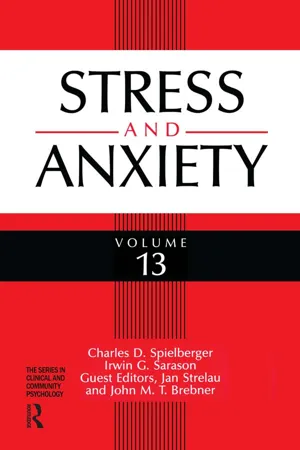
Stress And Anxiety
- 336 pages
- English
- ePUB (mobile friendly)
- Available on iOS & Android
eBook - ePub
About this book
This Volume Is Concerned With Emotional Reactions To Stress And Is organized in five parts dealing with stress and emotion theory; stress Conflict And Personality; Emotional Reactions To Stress; Physiological reactions to stress; and the relationship of type-A behaviour to heart disease.
Information
III
EMOTIONAL REACTIONS TO STRESS
8
Emotional Reactions of Pregnant Women to Ultrasound Scanning and Postpartum
Yona Teichman
Dorit Rabinovitz and Yaron Rabinovitz
Pregnancy and childbirth are considered stressful life events (Dohrenwend & Dohrenwend, 1974; Holmes & Rahe, 1967) or at least as experiences with crisis potential (Teichman, 1988). The stress is caused by physiological, psychological, and interpersonal experiences as well as by the close association with the medical profession and medical settings. As in many other stresses, investigators have attempted to determine factors that influence the way pregnant women deal with the stress. The most investigated factors have been social support and information. The study of individual differences has received less attention. Research on social support has focused mainly on support from the husband during pregnancy, childbirth, and early parenthood. As can be expected, women whose husbands are supportive manifest less anxiety, tension, and pain and report less complaints and more enjoyment (Huttel, Mitchell, Fischer, & Meyer, 1972; Norr, Block, & Charles, 1977). The topic of social support is not addressed in this chapter. As far as information was investigated, it applied to information obtained in childbirth preparation courses. Generally, findings indicate that such information is associated with less anxiety, less medication, and greater satisfaction (Davenport-Slack & Boylan, 1974; Klusman, 1975; Zax, Sameroff, & Farnum, 1975). We suggest that the ultrasound scanning during the first trimester of pregnancy can be considered as an additional source of information to the pregnant woman. This procedure provides information about the course of pregnancy and fetal sex. The purpose of the present study was to evaluate the influence of a general state of information versus no information. The impact of particular information, especially regarding the sex of the fetus, was presented elsewhere (Teichman, Rabinowitz, & Rabinowitz, 1988).
Since Janis’s (1958) study, investigators have attempted to determine the role of information in coping with medical stress (surgery). Janis proposed that preoperative information would at first elevate patients’ anxiety and initiate “work of worrying,” which later in the postoperative stage would help in reducing anxiety. Janis’s proposition was extensively investigated and failed to gain empirical support. Most of the findings indicated that in the preoperative stage, information about medical procedures and expected sensations does not elevate anxiety (Vernon & Bigelow, 1974) and occasionally even reduces it (Wallace, 1984). In the postoperative stage, most findings support the idea that informed patients experience less distress (Hayward, 1975; Johnson & Leventhal, 1974; Johnson, Rice, Fuller, & Endress, 1978; Wallace, 1984). Findings about the effect of information given to pregnant women following ultrasound scanning indicate that such information, if properly delivered, is accepted enthusiastically, reduces postpartum anxiety, and enhances bonding between mother and child (Hyde, 1986; Kohn, Nelson, & Weiner, 1980; Milne & Rich, 1981; Reading & Cox, 1982).
On the basis of the conceptualization that pregnancy and childbirth resemble medical stress and previous findings with surgical patients and pregnant women, we suggest that Janis’s (1958) theory can be investigated in this context as well. From this theoretical point of view we expected that information following an ultrasonic examination would first elevate emotional arousal but after the main stressful event, in the postpartum period, would reduce emotional arousal. Emotional arousal was evaluated by the level of reported state anxiety and depressed mood.
We also investigated the influence of individual differences (trait anxiety) on short- and long-term emotional reactions of pregnant women to the ultrasound procedure. The interaction between trait anxiety and information was examined as well. Trait anxiety is a very relevant variable to consider in this context. In Spielberger’s (1966, 1972) trait–state theory of anxiety, the critical personality variable involved in determining an individual’s experience of anxiety is anxiety proneness, that is individual predisposition to experience anxiety. Spielberger (1966, 1972) differentiated between two anxiety constructs: transitory or state anxiety (A—state) and anxiety proneness as a personality trait (A—trait). Trait–state anxiety theory predicts that persons high in trait anxiety are more prone to experience elevations in state anxiety in stressful situations. In order to measure these two aspects of anxiety, Spielberger, Gorsuch, and Lushene (1970) developed the State–Trait Anxiety Inventory (STAI). The STAI was translated and adapted to Hebrew by Teichman and Melnick (1985) and was used in the present study to evaluate both the independent variable (A—trait) and the dependent variable (A— state).
The influence of A—trait on reactions of surgical patients has been evaluated quite extensively. Most studies indicate that high A—trait patients manifest higher pre- and postoperative state anxiety (e.g., Auerbach, 1973; Chapman & Cox, 1977; Hodges, 1968; Hodges & Spielberger, 1966; Lamb, 1973; Spielberger, Auerbach, Wadsworth, Dunn, & Taulbee, 1973). In an attempt to explain these findings, Johnston (1988) and Eysenck (1988) suggested that high A—trait individuals engage a coping style that directs high attention to the dangers in the situation; that is, they are sensitizers. As a result, high A—trait individuals experience a higher A—state. This in turn makes them more vulnerable to physical and psychological problems, and a vicious circle that perpetuates anxiety starts to operate. If indeed this kind of sequence is set in motion, it has important implications for the psychological and physical well-being of the expectant mother, the new mother, and the baby.
Spielberger (1966, 1972) concentrated only on the relationship between the two types of anxiety; however, if Izard’s (1972) theory that people typically experience more than one emotion and that emotions are related and organized in clusters is considered, it may be suggested that A—trait influences not only the level of experienced anxiety, but also the level of other emotions that are related to anxiety. One such emotion according to Izard (1972) is depression or, as he referred to it, distress. On the basis of this idea we have defined emotional arousal as elevation in anxiety and depressed mood and suggest that A—trait influences both emotions in a similar way.
Integrating the theoretical propositions and empirical findings regarding the effect of information and A—trait on emotional reactions of patients before and after a stressful event in a medical context, we tested the following hypotheses: (a) High A—trait women would report higher levels of A—state and depressed mood than low A—trait women, in the beginning of pregnancy, after the ultrasound scanning, and postpartum. (b) Uninformed women would report higher A—state and depressed mood than informed women after the examination and postpartum, and their level of anxiety was exp...
Table of contents
- Cover
- Half Title
- Title Page
- Copyright Page
- Table of Contents
- Contributors
- Preface
- Attention
- I Stress and Emotion Theory
- II Stress, Conflict, and Personality
- III Emotional Reactions to Stress
- IV Physiological Reactions to Stress
- V Stress, Type a Behavior, and Heart Disease
- Author Index
- Subject Index
Trusted by 375,005 students
Access to over 1.5 million titles for a fair monthly price.
Study more efficiently using our study tools.
Frequently asked questions
Yes, you can cancel anytime from the Subscription tab in your account settings on the Perlego website. Your subscription will stay active until the end of your current billing period. Learn how to cancel your subscription
No, books cannot be downloaded as external files, such as PDFs, for use outside of Perlego. However, you can download books within the Perlego app for offline reading on mobile or tablet. Learn how to download books offline
Perlego offers two plans: Essential and Complete
- Essential is ideal for learners and professionals who enjoy exploring a wide range of subjects. Access the Essential Library with 800,000+ trusted titles and best-sellers across business, personal growth, and the humanities. Includes unlimited reading time and Standard Read Aloud voice.
- Complete: Perfect for advanced learners and researchers needing full, unrestricted access. Unlock 1.5M+ books across hundreds of subjects, including academic and specialized titles. The Complete Plan also includes advanced features like Premium Read Aloud and Research Assistant.
We are an online textbook subscription service, where you can get access to an entire online library for less than the price of a single book per month. With over 1.5 million books across 990+ topics, we’ve got you covered! Learn about our mission
Look out for the read-aloud symbol on your next book to see if you can listen to it. The read-aloud tool reads text aloud for you, highlighting the text as it is being read. You can pause it, speed it up and slow it down. Learn more about Read Aloud
Yes! You can use the Perlego app on both iOS and Android devices to read anytime, anywhere — even offline. Perfect for commutes or when you’re on the go.
Please note we cannot support devices running on iOS 13 and Android 7 or earlier. Learn more about using the app
Please note we cannot support devices running on iOS 13 and Android 7 or earlier. Learn more about using the app
Yes, you can access Stress And Anxiety by Charles D. Spielberger, Irwin G. Sarason, Jan Strelau, John M. Brebner, Charles D. Spielberger,Irwin G. Sarason,Jan Strelau,John M. Brebner in PDF and/or ePUB format, as well as other popular books in Psychology & History & Theory in Psychology. We have over 1.5 million books available in our catalogue for you to explore.