Taking trophies in war is a practice as old as warfare itself. Celtic warriors would seek to collect the severed heads of their foes; Roman generals paraded in triumph behind the captured nobility and temple goods of their defeated enemies. In more recent times, much blood has been spilt in attempts to seize or defend regimental standards. Monuments and medals have been cast from the metal of captured guns. Here, I will discuss the continuation of such practices during the First World War, in particular by the forces of Britain and its Dominions. Furthermore, the wealth of memoirs and other personal records of the Great War will permit an investigation of the collecting of trophies by individuals.
First, it is necessary to define ‘trophy’, as opposed to ‘souvenir’. Essentially a trophy can be defined as something seized by force from the enemy. It may be a purely symbolic item; it may have a practical (or military) value, or even a monetary value. Virtually always it will be in some way redolent of the enemy from whom it was taken. However, for the purposes of this analysis, it will not include items scavenged from the battlefield. There was in fact an ‘immense vogue’ among British troops for collecting artillery shell nose-caps’ (Anon 1919: 46; see also Richards 1964: 92; Coppard 1969: 62). However, these were picked up from the battlefield, not captured from the enemy.
As contemporary diarists, letter writers and chroniclers were not interested in categorizing such activities, their work shows no analytical precision in separating the trophy from the souvenir. Both terms appear to be used almost indiscriminately. A member of 37th Division, writing in the division’s ‘chronicle’ under the pseudonym ‘Gwinell’, stated
For the purposes of this chapter, trophies will be divided into two main categories: ‘public’ – trophies which passed through official channels and were intended for public display; ‘personal’ – trophies acquired by individuals.
Public trophies
The practice of publicly displaying captured enemy war material was well established by 1914. To do so satisfied a number of desires: victory was plainly announced – you cannot capture enemy guns while retreating (see Vance 1995: 48); civilian morale was likely to be bolstered; and (by no means a lesser consideration) the esprit de corps of the unit responsible for the capture of such trophies was enhanced. The letters, diaries and memoirs of British soldiers contain frequent references to the capture of such trophies. Graham Greenwell, an officer with 1/4 Oxfordshire & Buckinghamshire Light Infantry, wrote to his mother (on 17 March 1917) ‘We captured two little German machines for bomb-throwing, which are being despatched to Oxford’ (Greenwell 1972: 163). The following year, Colonel A.C. Borton was delighted to include the following news in his diary, regarding guns captured in Palestine by 2/22nd London Regiment, commanded by his son: ‘He says his captured Turkish guns are to come home as a present to BERMONDSEY!’ (Slater 1973: 154).
Interestingly, both of these references date from a period when the regional associations of British Army regiments were becoming increasingly diluted by a policy of sending new drafts of men from areas outside their traditional recruiting area. Officers, however, where they served with their own regiment, generally attempted to sustain the original regimental identity. They did so not only out of sentiment, but also as a way of enhancing the morale of their soldiers. A fine example of regimental tradition expressed in the form of a trophy is recorded by Rowland Fielding, in a letter to his wife in July 1916:
I saw a big ‘minenwerfer’ [German trench mortar] very cunningly concealed in a deep excavation. A piece of paper was attached to it, with the following words: ‘Captured by the Minden boys’; i.e. the Suffolk Regiment, a battalion of which attacked at that point.
(Fielding 1929: 88)
Not only was the Suffolk Regiment claiming merit for the capture of the mortar in question, but its officers did so by a reference to the Regiment’s most famous action – at the Battle of Minden, in 1759.
Such marking of trophies extended even down to individual companies. After a successful action in April 1917, Graham Greenwell wrote that ‘Our captured [machine] guns are fine trophies, and I have already had them stamped “Captured by ‘B’ Company 1/4 Oxford and Bucks Lt. Infty.” They will go to Oxford at the end of the war.’ (Greenwell 1972: 175). Infantry formations were not the only type of unit to wish to obtain trophies expressive of their achievements. As late as the spring of 1919, the Wing Commander of 65th Wing RAF wrote to the Officer Commanding 204 Squadron: ‘I have applied for one German ARCHIE [i.e. anti-aircraft] GUN, from the 6th French Army, as a remembrance of the work done by your Squadron when working with them’ (NA AIR 1/1084/204/5/1714 Letter 31/3/19 from DAE to GOC RAF France.)
On occasion, major items of captured equipment could bear the marks of more than one unit. The series of inscriptions and motifs added to the German A7V tank captured at Villers Brettoneux by 26th Battalion, Australian Imperial Force, is a case in point. They ranged from the badge and name of the battalion and the name of the salvage unit that recovered it, to individual names of men who handled the tank in the rear areas (Whitmore 1989: 52–3). One such trophy, a huge German railway gun captured at the Battle of Amiens (8 August 1918), became a source of some controversy. The Australian 31st Battalion effected its capture, but, in the wake of the continued Allied advance, the gun received a large painted inscription stating that the gun had been captured by the British 4th Army (of which the ANZAC Corps was a component). A thorough investigation was made of the circumstances of the gun’s capture – an insightful example of the contested nature of war material involving notions of identity and ownership – before it was finally transported to Australia for public display (AWM Archive).
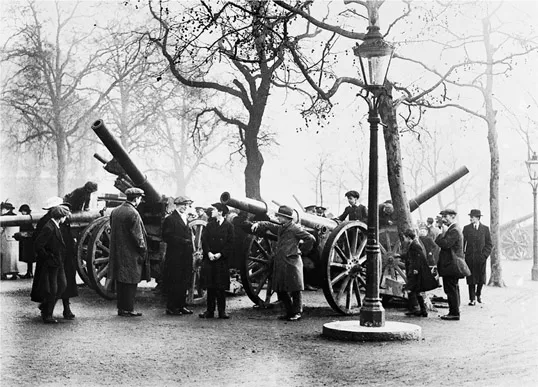
Captured weapons were employed by all the combatant powers to symbolize the success of their troops in the field, generally being displayed in their capital cities. In London, a large number of German guns were placed in The Mall (IWM Photos Q31243–Q31251) (Figure 1:1). Such trophies also acted as an aid to raising money from the public. The Imperial War Museum sent out items from its collections to various British cities during ‘War Weapons Week’ in the summer of 1918. Its secretary Charles Ffoulkes, quoted in The Times, stated that the collections could still be drawn upon for local exhibitions having as a ‘sole object the raising of funds for war charities, or other purposes directly conducive to the successful prosecution of the war. The public response to the direct appeal of actual and tangible souvenirs of the war has been very marked’ (The Times, 6 June 1918). The same article referred to the success of a British tank used for money raising, but went on to suggest that
A captured gun, grimed with the mud of France or Flanders, a heavy minenwerfer that perhaps a month ago was shelling a British first line trench, a machine-gun that may have ‘held-up’ half a battalion till its team were bayoneted by the vanguard of our advancing infantry, make an even more effectual appeal.
(ibid.)
Smaller trophies were also used to raise money. The Imperial War Museum’s collections feature a captured Austrian bayonet, bearing a Serbian inscription, which was sold in aid of the work of the Red Cross in alleviating the suffering of the latter country (IWM WEA 159). The Red Cross also benefited from the sale of pieces of German airships that had been shot down. Again, the Imperial War Museum has several examples (IWM EPH 4653).
Figure 1:1 A public display of captured German guns in The Mall, London. (© and courtesy of the Trustees of the Imperial War Museum, IWM Q 31244)
After the war, many trophies were issued to individuals and communities who had shown particular endeavour in fundraising or war-work. The Imperial War Museum possesses five German rifles that bear plaques on their butts noting that they were presented to private individuals in recognition of their work raising money for war charities (IWM FIR 7104–5, FIR 7344, FIR 7348, FIR 7868). In Canada, German heavy guns were offered as prizes during a Victory Loan drive in 1919 (Vance 1995: 49).
Recruitment was another area in which trophies were held to be efficacious. In the late summer of 1918, with British manpower resources coming under intense strain, the Irish Recruiting Council requested trophies suitable for displaying in ‘about ten shops in different parts of Ireland’. They asked for ‘a truckload of selected trophies, not too bulky in size, such as rifles, bomb throwers, flame throwers, helmets, damaged machine guns etc.’ (NA NATS 1/258. Letter 26/8/18 P Lloyd-Greame). Interestingly, a subsequent attempt to get this consignment increased failed, due to the fact that ‘no more could be spared & so much of what they had being claimed by units & consequently could not be sent out of the country’ (NA NATS 1/258 Memo 5/9/18 Maj. Garnett).
Even before the end of the war, the Army Council had set up a board to oversee the distribution of officially sanctioned trophies. A letter to the Treasury in January 1919 gave an assurance that there was an already functioning
Departmental Committee to deal with all the questions relating thereto, and to watch the interests of the Imperial War Museum in consultation with the museum committee. The normal procedure is for guns and other trophies sent to this country from France and other theatres of war, to be claimed as having been captured by certain units. If the claims of these units are substantiated the commanding officers are given the opportunity of determining whether the trophies should be presented to the Regimental Depot, the Imperial War Museum, or some City, Borough, etc.
(NA T1/12438)
The trophies were free gifts, but towns and cities had to defray the cost of transport. The Treasury did, however, agree to fund the transportation of trophy guns to Colonial countries (NA T1/12438).
Therefore, in addition to adorning Regimental Headquarters and augmenting the collections of the Imperial War Museum (see Cornish 2004), trophies were publicly displayed by municipal authorities, at town halls, in parks and as adjuncts to war memorials. Such foci of civic pride appear to have been particularly popular in the Dominions. In Australia, ‘State Trophy Committees’ were set up to supervise the distribution of captured weapons, a number of which have survived to this day (CDVA 2000). Others were pressed into service under the threat of Japanese invasion in 1942. Indeed, there were enough German machine-guns to make it worthwhile to have them rechambered for .303 inch ammunition (Skennerton 1989: 54–7), an ironic transformation of weapons reconfigured as trophies of the First World War back into working weapons during the Second. In Canada, according to Jonathan Vance:
Hundreds of Canadian communities clamoured for a trophy to place in their park or schoolyard, but not out of a recognition that technology had played the most important part in the war. German field guns and mortars were craved for precisely the opposite reason, because they proved that Canada’s citizen-soldiers had overcome the...