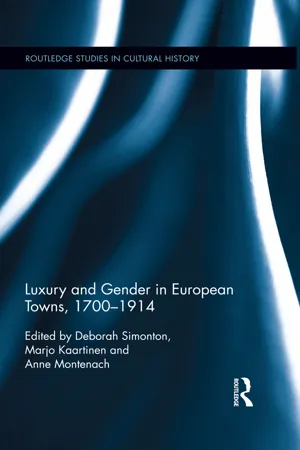
This book conceives the role of the modern town as a crucial place for material and cultural circulations of luxury. It concentrates on a critical period of historical change, the long eighteenth and nineteenth centuries, that was marked by the passage from a society of scarcity to one of expenditure and accumulation, from ranks and orders to greater social mobility, from traditional aristocratic luxury to a new bourgeois and even democratic form of luxury. This volume recognizes the notion that luxury operated as a mechanism of social separation, but also that all classes aspired to engage in consumption at some level, thus extending the idea of what constituted luxury and blurring the boundaries of class and status, often in unsettling ways. It moves beyond the moral aspects of luxury and the luxury debates to analyze how the production, distribution, purchase or display of luxury goods could participate in the creation of autonomous selves and thus challenge gender roles.
eBook - ePub
Luxury and Gender in European Towns, 1700-1914
- 276 pages
- English
- ePUB (mobile friendly)
- Available on iOS & Android
eBook - ePub
Luxury and Gender in European Towns, 1700-1914
About this book
Information
1 Luxury, Gender and the Urban Experience
DOI: 10.4324/9781315750170-1
Luxury and Gender in European Towns, 1700–1914, conceives the role of the modern town as a crucial place for material and cultural circulations of luxury. The chapters in this volume concentrate on a critical period of historical change, the long eighteenth and nineteenth centuries. This period was marked by the passage from a society of scarcity to one of expenditure and accumulation, from ranks and orders to greater social mobility, from traditional aristocratic luxury to a new bourgeois and even democratic form of luxury. This volume recognises not only the notion that luxury operated as a mechanism of social separation but also that all classes aspired to engage in consumption at some level, thus extending the idea of what constituted luxury and blurring the boundaries of class and status, often in unsettling ways. This book asks what was acceptable and desirable luxury, according to gender, status, social class, life-course, time and space. It analyses in what ways the production, distribution, purchase or display of luxury goods could participate in the creation of autonomous selves and thus challenge gender roles.
This book is about urban practices of luxury. Therefore it moves beyond the moral aspects of luxury and the luxury debates, which have dominated much of early modern thinking and which have fascinated historians. By exploring the processes of production, distribution and consumption of luxury goods from a gendered perspective, and articulating a wide geographical spectrum, the chapters fill gaps in the rich historiography of material culture and luxury consumption. In order to interrogate the concept of luxury itself and its shifting meanings, this volume looks at specific political, social and cultural contexts on a European scale and investigates different local cultures of luxury. Towns were at the heart of these shifting paradigms. As a physical environment, and a social and spatial construct, the town comprises discourses about the meanings and perceptions of towns by its inhabitants and observers as well as the material fabric and objects which give the town a physical and symbolic shape. Modern European towns fostered commercial developments that meant that more goods and services were available to support the urban community. The growth of proto-industries, although often rural, had their birthplace in urban capitalism, which managed the circulation of raw materials and finished products. These were central to the growth of a wider commercial marketplace on a regional, national and even global scale, a marketplace that gave birth to luxury production and consumption. Therefore, the town constitutes a key site to observe and analyse the relationship between luxury and gender.
An important contribution of this book is its chronological and geographic coverage, which juxtaposes discussions of luxury and towns in much-researched Britain and France with developments in Scandinavia, the Mediterranean and Eastern Europe. Drawing on a range of sources, including official records such as censuses, tax records, post-mortem inventories, court records and guild records; receipts, bills and private account books; memoirs and letters; and a variety of materials from the burgeoning print culture like maps, novels, treatises, newspapers and magazines, and often reading across the grain, the authors illustrate the variety of materials that can be used to evaluate the production, marketing and consumption of luxury.
Luxury Discourses
This book offers an opportunity to view luxury not only as an object of consumption but also from the viewpoint of production and regulation of luxury. We do not propose to review the luxury debates and historiography in depth here. Nevertheless, a few comments that situate this volume are in order. As a malleable and dynamic concept, luxury ‘can be understood as one of the basic categorising components of a society’s grammar’, as Christopher J. Berry has pointed out.1 Luxury is an extremely complex social, historical and cultural construct which has to do with desirability, expensiveness, rarity, sensory enjoyment, refinement and pleasure(s), superfluity, magnificence and ostentation, but also with high quality, design and fashion, creativity and innovation or authenticity. Definitions and perceptions of luxury changed over time as well. During the period under scrutiny, luxury was not only a social and economic concern, but also a political issue.
The eighteenth century is now well known as a time of strong economic expansion in Europe, where towns of all sizes, and especially commercial centres, experienced significant growth in population and wealth. At the same time, people’s lifestyles changed gradually, but dramatically. Given growth in what John Brewer and Roy Porter identify as a new ‘world of goods’, which they interpreted as the source of an alarming confusion of social conditions, many contemporaries denounced ‘the scourge of luxury’.2 By upsetting social markers and blurring the divisions between upper and lower classes, increased trade and consumerism certainly challenged the traditional values inspired by social hierarchies and sumptuary legislation. Many eighteenth-century authors viewed this phenomenon as a disease that had infected the entire society.
One relevant issue that emerged from these debates was the interest in finding a definition for ‘luxury’, a concept that was open to myriad interpretations but that mostly appears to be ‘the code word for threatening social changes’.3 Adam Ferguson, Professor of Moral Philosophy at the University of Edinburgh, reflected in 1767:
We are far from being agreed on the application of the term luxury, or on that degree of its meaning which is consistent with national prosperity, or with the moral rectitude of our nature. It is sometimes employed to signify a manner of life which we think necessary to civilization, and even to happiness. It is, in our panegyric of polished ages, the parent of arts, the support of commerce, and the minister of national greatness, and of opulence. It is, in our censure of degenerate manners, the source of corruption, and the presage of national descension and ruin. It is admired, and it is blamed; it is treated as ornamental and useful; and it proscribed as a vice.4
Ferguson thus synthesized the opposing and shifting view of luxury as a vice (i.e., as corruption and excessive displays by the elite) to that of a ‘refinement for the gratification of the senses’, as previously expressed by Mandeville in his famous Fable of the Bees (1714), and also of a market.5 In this process of ‘de-moralization’ of luxury, to quote Christopher Berry, luxury was increasingly seen as merchandise that was not only socially useful, but also good for business and human well-being.
As a result of the transport ‘revolution’ and increasing domestic and international trade, rising competition and the ‘industrious’ revolution with its growing production rates, some products that people still considered luxuries at the turn of the seventeenth century, such as sugar or drink ware and its paraphernalia for hot drinks, entered working-class homes in the eighteenth century. In the nineteenth and early twentieth centuries, further commercialization, better transport and the emergence of urban department stores as well as an increasingly vociferous bourgeois class intent on stamping their image on the century led to a further diversification of luxury items. Thus by the First World War, social constructions of luxury and their cultural meanings permeated all levels of society. However, these meanings operated differently and were inevitably variable in terms of class, nationality and status. As Woodruff Smith argued, ‘as a word, as a concept, and a set of cultural practices, [luxury] has always had multiple meanings, few of which have been stable over time or unambiguous.’6
Gender, Luxury and Consumption
This volume does not assume luxury as a feminine construct but looks at the ways in which luxury was gendered. As Samuel Fawconer suggests in his 1765 An Essay on Modern Luxury, the eighteenth-century understanding of luxury was not necessarily perceived as feminine:
where the exteriours form our judgment of the man, and appearance in the vulgar eye passes for the only criterion of true worth: every one is ready to assume the marks of a superiour condition, in order to be esteemed more than what he really is.7
For those who wanted to moralize luxury, both sexes were guilty of the want of too much. Early modern Swedish and Danish sumptuary laws rarely distinguished between men and women while stipulating limits on luxury purchases, and, notably, Danish law was more concerned with feasts and food than with fashion.8 However, many eighteenth-century authors highlighted two aspects that demonstrated the close links between luxury and femininity. First, luxury, now defined as any unnecessary object that created desire through the specific process of seduction and temptation, was thought to be more attractive to women because of their excessive desire for fashion, novelties and frivolities.9 Second, luxury led to the development of mollesse, a physical phenomenon that led to effeminacy and hence to the emasculation of men and national decline.
Contemporaries quickly singled women out as purchasers of luxury items. Josiah Wedgwood, the Staffordshire potter whose wares became all the rage, including commissions from Catherine II, catered for all levels in society, both home and abroad. As a consummate promoter of his goods, he acknowledged: ‘Few ladies, you know, dare venture at anything out of the common stile,’till authoris’d by their betters—by the Ladies of superior spirit who set the ton.’10 In English tracts from the period, contemporaries quickly began to blame women for the excesses of luxury. Bernard Mandeville wrote: ‘I have shewn already that the worst of Women and the most profligate of the Sex did contribute to the Consumption of Superfluities, as well as the Necessaries of Life’.11 Mandeville did not exclusively attack women for their profligate spending, but his discussions of men tended to situate them as victims of employers and others, including women, who conspired to relieve them of their money. Millinery and fashion came to be epitomised as a female world where women’s purchases made victims of their husbands and their pocketbooks, as Louis-Sébastien Mercier wrote:
What is spent on fashion today exceeds the expenses of the table and that for horses and carriages. The unfortunate husband can never calculate to what price these changing fantasies will climb; & he will need swift resources to fight off these unexpected whims.12
Thus women quickly came to be seen as idle, frivolous and irresponsible purchasers. This is an image that continued throughout the nineteenth century, and Emile Zola neatly juxtaposed the frivolous female consumer with the hardworking shop assistant in Au Bonheur des Dames (1883).13 He also captured the impact of the department stores and their selling and promotion of luxury experiences, while pointedly criticising the practice of under-cutting producers by insisting on buying from them at prices that made their work uneconomic. In this passage he characterises several female customers:
Madame Marty, carried away by her rage for spending, took everything at The Ladies’ Paradise, without choosing, just as the articles appeared; Madame Guibal walked about the shop for hours without ever buying anything, happy and satisfied to simply feast her eyes; Madame de Boves, short of money, always tortured by some immoderate wish, nourished a feeling of rancour against the goods she could not carry away … The idea of getting goods below cost price awoke in them all the greed felt by women, whose enjoyment as buyers is doubled when they think they are robbing the tradesman.14
However, men were also important shoppers and this created anxiety for moralists, who threatened luxury-consuming men with succumbing to effeminacy. Luxury and effeminacy denoted individual and national degeneracy, and submission to female charms and conspicuous consumption was perceived as undermining manly virtue. Michele Cohen has argued that effeminacy was a dominant metaphor for ‘problematic gender boundaries for men’ and conflated with ‘luxury’, it was used to criticize many social evils.15 The British, especially, linked the critique of luxury to the French, and believed French style and the desire for imported luxury goods was damaging both economic and military strength. National patriotic political discourse drew on women in luxury trades, condemning ‘Frenchness’ in millinery, mirroring discourses in electoral politics. The critique was both economic and political in the final analysis, with ‘luxury’ identified as French, and adherence to sober ‘English’ goods a central part of national identity. The Society for the Encouragement of the Arts, Manufactures and Commerce, founded in 1754, promoted British culture over French, and awarded prizes to women for their ‘nationalist’ endeavours. Mrs Williams, awarded a prize in 1784 for breeding silkworms, hoped ‘[t]hat my poor endeavours may one day prove beneficial to my country.’16 Cultural disintegration and commercial imperatives went hand in hand.
National good and the importance of competitiveness in commerce gradually undermined sumptuary legislation in the eighteenth century, and the critique of luxury shifted to accommodate commercial imperatives. So, contemporary critiques of luxury had altered by the end of the eighteenth century, encapsulated by Adam Smith’s argument that individual greed and acquisitiveness were necessary prerequisites for the stimulation of the economy, and one of the last Scottish laws regulating dress, in fact, controlled imports from the continent which it was believed were hurting Scottish commerce.17 In this respect, the wider ability of people to consume items deemed luxurious was seen as a positive factor, so that by the nineteenth century laissez faire economics valorised the consuming habits of the populace as stimulus to production and commerce.18 At the same time, luxury, when conceived as the incarnation of good taste, was seen by romantic artists and dandy writers such as Baudelaire as the driving force behind moral and aesthetic sensibility.19
Metropole and Province
The history of consumption and material culture has closely associated luxury with city life, as a place of fancy, novelty and display. This certainly is what contemporaries thought of luxury because it was believed that metropolises especially fed a need for self-presentation through ostentation; anonymity and the desire to distinguish oneself ‘opened the possibilities of fantasy and self-fashioning’.20 This was, of course, done by dressing up and deploying various luxury items on one’s person, parading on new urban prome...
Table of contents
- Cover
- Half Title Page
- Series Page
- Title Page
- Copyright Page
- Dedication
- Table of Contents
- List of Figures
- List of Tables
- Preface
- Acknowledgments
- 1 Luxury, Gender and the Urban Experience
- PART I Markets and Opportunities
- 2 Milliners and Marchandes de Modes: Gender, Creativity and Skill in the Workplace
- 3 Gender and Luxury in Eighteenth-Century Grenoble: From Legal Exchanges to Shadow Economy
- 4 Women in the Late Eighteenth-Century-Copenhagen Luxury Trades
- 5 Feminisation and the Luxury of Visual Art in London’s West End, 1860–1890
- PART II Metropole and Province
- 6 Men, Women and the Supply of Luxury Goods in Eighteenth-Century England: The Purchasing Patterns of Edward and Mary Leigh
- 7 The Luxury Shopping Experience of the Swedish Aristocracy in Eighteenth-Century Paris
- 8 Gender and Luxury in Eighteenth-Century Catalonia: Town and Countryside
- 9 Gender, Craftwork and the Exotic in International Exhibitions c. 1880–1910
- PART III Class and Status
- 10 A Feminine Luxury in Paris: Marie-Fortunée d’Este, Princesse de Conti (1731–1803)
- 11 Favourites of Fortune: The Luxury Consumption of the Hackmans of Vyborg, 1790–1825
- 12 The ‘Díszmagyar’ as Representation in the Andrássy Family in Late Nineteenth-Century Budapest
- 13 The Luxury They Could Not Afford? Households of Workers in the Industrial Town of Drammen, Norway c. 1900
- Afterword: Gender, Luxury and Towns Revisited
- Contributors
- Guide to Further Reading
- Index
Trusted by 375,005 students
Access to over 1.5 million titles for a fair monthly price.
Study more efficiently using our study tools.
Frequently asked questions
Yes, you can cancel anytime from the Subscription tab in your account settings on the Perlego website. Your subscription will stay active until the end of your current billing period. Learn how to cancel your subscription
No, books cannot be downloaded as external files, such as PDFs, for use outside of Perlego. However, you can download books within the Perlego app for offline reading on mobile or tablet. Learn how to download books offline
Perlego offers two plans: Essential and Complete
- Essential is ideal for learners and professionals who enjoy exploring a wide range of subjects. Access the Essential Library with 800,000+ trusted titles and best-sellers across business, personal growth, and the humanities. Includes unlimited reading time and Standard Read Aloud voice.
- Complete: Perfect for advanced learners and researchers needing full, unrestricted access. Unlock 1.5M+ books across hundreds of subjects, including academic and specialized titles. The Complete Plan also includes advanced features like Premium Read Aloud and Research Assistant.
We are an online textbook subscription service, where you can get access to an entire online library for less than the price of a single book per month. With over 1.5 million books across 990+ topics, we’ve got you covered! Learn about our mission
Look out for the read-aloud symbol on your next book to see if you can listen to it. The read-aloud tool reads text aloud for you, highlighting the text as it is being read. You can pause it, speed it up and slow it down. Learn more about Read Aloud
Yes! You can use the Perlego app on both iOS and Android devices to read anytime, anywhere — even offline. Perfect for commutes or when you’re on the go.
Please note we cannot support devices running on iOS 13 and Android 7 or earlier. Learn more about using the app
Please note we cannot support devices running on iOS 13 and Android 7 or earlier. Learn more about using the app
Yes, you can access Luxury and Gender in European Towns, 1700-1914 by Deborah Simonton,Marjo Kaartinen,Anne Montenach in PDF and/or ePUB format, as well as other popular books in Historia & Historia europea. We have over 1.5 million books available in our catalogue for you to explore.