“Reducing disaster risk is everybody’s business, and needs everyone’s participation and investment – civil society, professional networks as well as municipal and national governments.”
– Ban Ki-Moon, United Nations Secretary-General, on the occasion
of the International Day for Disaster Reduction
(“Curbing disaster risk,” 2010)
Context of study
In 2015, two international frameworks draw to a close: the Millennium Development Goals (MDGs) and the Hyogo Framework for Action (HFA): ‘Building the capacity and resilience of the community against disasters 2005–15’ – a program focusing on disaster risk management (DRM) (UNISDR 2005). International debate is taking place on current progress with both frameworks to define future ways to effectively manage disaster risks and to reduce poverty and how to link these agendas in the coming decades (UNISDR 2013c). This study seeks to inform this dialogue.
Key trends and challenges within the Asia-Pacific region introduce the study, with a consideration of the challenges posed by vulnerability and social and economic realities. This is followed by discussion concerning two major concerns of governments: (1) compound disasters and (2) financing and insurance. The final section reviews various levels of governance of DRM, starting at the local and community levels, rising to the national level and followed by the regional level. This section concludes by considering the ways that DRM can be advanced through international frameworks. A series of conclusions and recommendations for decision makers closes the study.
Perhaps the greatest challenge faced by our team of authors as we have worked on this study has been how to capture the flood of information that this subject now generates, how to use it to develop and expand our collective knowledge and then, the most difficult part, how to distil this emerging knowledge into practical wisdom. This is needed so that those with the responsibility to make wise decisions in the complex fields of disaster risk and climate change can protect people, their habitat and the environment.
The regional disaster threat
The Asia-Pacific region, with 60 per cent of the world population, is highly vulnerable to the impact of hazards and has experienced major and minor disasters throughout the past decade. Between 2002 and 2011, 40 per cent of all reported disasters (1,524) occurred in Asia, causing 63 per cent of all global disaster deaths (669,263), affecting 90 per cent of all those affected globally (2.2 billion) and causing 48 per cent of global damage (US$691 billion).
Populations ‘at-risk’ in Asia-Pacific countries
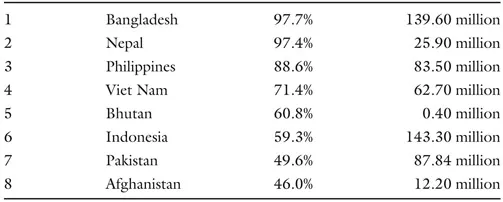
In the Global Risk Hotspots Analysis, the first eight globally ranked countries with “relatively high mortality risk from multiple hazards” were all within the Asia-Pacific region. Noted below are the percentages of the population of the country that lived in areas of high risk.
This number is followed by the number of people who were at risk within these countries in 2005 (Dilley et al. 2005).
Table 1.1 Populations ‘at risk’ in Asia-Pacific countries
What is particularly striking about these statistics is that the vast majority of the population of Bangladesh, Nepal and the Philippines (with a combined total population of 249 million people) was faced in 2005 with the threat of virtually blanket exposure and vulnerability to hazards. While it is not known how these statistics have changed during the intervening eight years, the likelihood is that these patterns of virtual risk saturation remain.
The year 2011 was an ‘extreme year’ for global disaster exposure and vulnerability. It was the costliest on record for disasters, with economic losses exceeding the previous record of US$262 billion – a record set in 2005. Some 80 per cent of these losses were attributed to the Asia-Pacific region (Guha-Sapir et al. 2012; Oxley 2013). During this year the Great East Japan Earthquake and Tsunami occurred, with 19,846 reported dead or missing, the destruction of almost 300,000 buildings and an estimated total economic loss of US$201 billion, but this figure is projected to rise to approximately $375 billion (ESCAP and UNISDR 2012, p. 7). The disaster had severe economic consequences, including a decline of 47 per cent in Japanese automobile production during 2011.
Later in 2011, the Southeast Asia floods caused massive devastation, and the international economic consequences were particularly felt in Thailand, where 813 persons died and the reported economic losses were US$45–45.7 billion. Swiss Re reported that insured losses were estimated at US$12 billion (the highest number on record for a single flood event) (Jha & Stanton-Geddes 2013, p. 66).
One consequence of the flood impact was the increase in the global cost of computer hard drives, which tripled on account of factory damage and the consequent disruption of international supply chains (ESCAP and UNISDR 2012, p. xxv). (See Thailand flooding case study in Chapter 3, p. 78.)
But in September 2011 there was some encouraging news. A serious earth quake, measuring 6.7 on the Richter scale, occurred in Banda Aceh, Indonesia. This coastal town had suffered extensive damage and loss of life in the South Asian earthquake and tsunami of 2004. However, due to improved disaster preparedness as well as the quality and safety of the reconstruction, only two persons were killed in this event (Jakarta Post 2011).
The trends described and analyzed in Chapters 2–4 indicate that disaster risk management activities within the region have a fourfold concern, with closely interwoven priorities:
- Protecting lives
- Protecting property (in the form of all forms of investment in buildings, infrastructure, etc.)
- Protecting livelihoods at the micro-scale and economies at the macro-scale (a concern requiring authorities to look beyond regional boundaries to global supply chains)
- Protecting and sustaining the natural environment.
(See Appendix 1, Table 1.1, The impact on lives and property of major Asian Disasters 2004–2013.)
Organization of study
The study, conceived by the Asian Development Bank Institute (ADBI) with support from the Asian Development Bank (ADB), was reviewed by regional experts and government officials in ADBI in Tokyo in October 2012 and February and June 2013.
Highlights of this study were presented at the ADB Annual Meeting in Delhi in May 2013, with additional valued feedback (ADBI 2013). These review processes have strengthened the study with a useful critique from officials, experts and practitioners, and the dialogue has raised awareness of the need for national commitment to effective disaster risk reduction (DRR) measures and to building common ownership.