The Sierra Leone Language Review is the African Language Journal of Fourah Bay College, the University College of Sierra Leone. The Journal is devoted to the detailed study of languages in Sierra Leone and neighbouring areas of West Africa, and also to the more general study and discussion of African languages and language-problems.
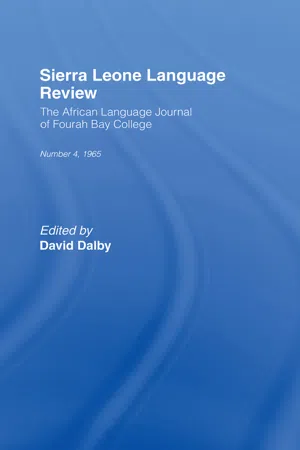
- 135 pages
- English
- ePUB (mobile friendly)
- Available on iOS & Android
eBook - ePub
African Language Review
About this book
Information
Vestiges of Portuguese in the Languages of Sierra Leone
INTEREST in the classification of the languages of Africa has tended to concentrate the attention of scholars on the fundamental vocabulary and grammar, which provide the evidence for deciding genetic relationships. The available descriptive material, however, increasing rapidly in volume and accuracy, also offers plenty of scope for the investigation of the historical and cultural traces embedded in language. We may quote the example of English used by Greenberg in his Studies in African Linguistic Classification and apply it differently:
Even in English where we are told that foreign vocabulary amounts to sixty to seventy per cent of the lexicon, non-Anglo-Saxon words have barely touched the fundamental vocabulary.1
If the philologist is mainly concerned with the Anglo-Saxon words and grammatical systems, which enable him to demonstrate the Germanic origin and affinities of English, the historian using philological evidence can find in the large ‘foreign’ vocabulary information no less valuable. Even in the complete absence of other historical records it would be possible, from a rigorous examination of the word-stock, not only to infer the fact of the Norman Conquest but also to assess in some measure the effect it had on English life. In most parts of Africa historical records comparable to those which we have of the Norman period are largely absent and the clues carried down from the past by language assume correspondingly greater importance.
Unfortunately, though the word-stock of a language may contain precious traces of the past, these will inevitably be found in a state of complete confusion. The collection will resemble one of those sad museums stuffed with a gallimaufry of objects assembled by old-fashioned archaeologists who kept no record of the provenance or circumstances of their finds. Without literary evidence or detailed descriptions relating to different periods it is an extremely difficult task to work out the stratigraphy of a mass of lexical material. But the effort is very well worth making and no doubt, as the materials increase, improved techniques will be developed to assist the study and analysis of them.
This paper reports a very modest venture in the process of sorting the vocabularies of some of the languages of Sierra Leone. The Portuguese contribution to these languages is admittedly minute but the attempt to filter it out seems justified by two special considerations: first is the fact that Portuguese has long been a dead language in the area of investigation and therefore the loan-words are genuine survivors, endenizened in the languages which have borrowed them; secondly, in this case at least we have a considerable amount of documentary evidence concerning the circumstances in which the borrowing took place.
The stupendous nautical achievements of the Portuguese have unduly overshadowed their important successes in establishing human contacts and developing trade. Wherever they sailed they endeavoured to discover not only the currents and winds of the ocean and the outline of the coast but also what manner of men inhabited the lands they visited, how they lived, what objects they had to offer for trade, and what they desired in return. There is much to be said for the view that regards a successful trade negotiation as a more progressive and genuinely human achievement than a victory in battle or an expansion of territory won by conquest; conquerors and destroyers the Portuguese did not aim to be in West Africa and in this they were superior to the Spaniards who ravaged the civilizations of Mexico and Peru and to the more bellicose among the settlers of North America. Butchery and pillage can be accomplished without recourse to speech but trade, unless it is on the level of silent barter, requires question and answer, discussion and argument.
The problem of surmounting language barriers can be solved in two ways: either the traveller learns the language of the people he visits or they must be persuaded to learn the language of the stranger. The former method was employed, for example, in Brazil by Álvares Cabrai in 1500. Certain persons would be detailed to remain among the local inhabitants and learn their tongue and customs in the interval before the next ship called. These interpreters and missionaries—for they were naturally expected to communicate the Christian faith—had, for obvious and melancholy reasons, to be expendable; they were in fact exiles or criminals whose punishment it was to be anthropologists and evangelists against their will. Such people could hardly be expected to show much enthusiasm for their work, even if they succeeded in persuading their hosts that they were more valuable as pets than as protein. In West Africa, however, this method does not seem to have been much favoured; while it is true that, as trade developed along the coast, many of...
Table of contents
- Cover Page
- Title Page
- Copyright Page
- Contents
- Editorial
- Vestiges of Portuguese in the Languages of Sierra Leone
- Susu studies and literature: 1799-1900
- The Function of the Song in Mende Folktales
- Julius Caesar in Krio
- Sierra Leone Items in the Gullah Dialect of American English
- Phonemic Interpretation Problems in Some West African Languages.1
- The Dia-Phonemic Principle in Field Work1
- Emotional Bias in the Translation and Presentation of African Oral Art
- Studies Devoted to S. W. Koelle's Polyglotta Africana Yoroba Dialects in the Polyglotta Africana
- Fula Dialects in the Polyglotta Africana
- Nigerian Cross River Languages in the Polyglotta Africana: Part II
- Mel Languages in the Polyglotta Africana Part I: Baga, Landuma and Temne
Trusted by 375,005 students
Access to over 1.5 million titles for a fair monthly price.
Study more efficiently using our study tools.
Frequently asked questions
Yes, you can cancel anytime from the Subscription tab in your account settings on the Perlego website. Your subscription will stay active until the end of your current billing period. Learn how to cancel your subscription
No, books cannot be downloaded as external files, such as PDFs, for use outside of Perlego. However, you can download books within the Perlego app for offline reading on mobile or tablet. Learn how to download books offline
Perlego offers two plans: Essential and Complete
- Essential is ideal for learners and professionals who enjoy exploring a wide range of subjects. Access the Essential Library with 800,000+ trusted titles and best-sellers across business, personal growth, and the humanities. Includes unlimited reading time and Standard Read Aloud voice.
- Complete: Perfect for advanced learners and researchers needing full, unrestricted access. Unlock 1.5M+ books across hundreds of subjects, including academic and specialized titles. The Complete Plan also includes advanced features like Premium Read Aloud and Research Assistant.
We are an online textbook subscription service, where you can get access to an entire online library for less than the price of a single book per month. With over 1.5 million books across 990+ topics, we’ve got you covered! Learn about our mission
Look out for the read-aloud symbol on your next book to see if you can listen to it. The read-aloud tool reads text aloud for you, highlighting the text as it is being read. You can pause it, speed it up and slow it down. Learn more about Read Aloud
Yes! You can use the Perlego app on both iOS and Android devices to read anytime, anywhere — even offline. Perfect for commutes or when you’re on the go.
Please note we cannot support devices running on iOS 13 and Android 7 or earlier. Learn more about using the app
Please note we cannot support devices running on iOS 13 and Android 7 or earlier. Learn more about using the app
Yes, you can access African Language Review by D. Dalby in PDF and/or ePUB format, as well as other popular books in Scienze sociali & Studi regionali. We have over 1.5 million books available in our catalogue for you to explore.