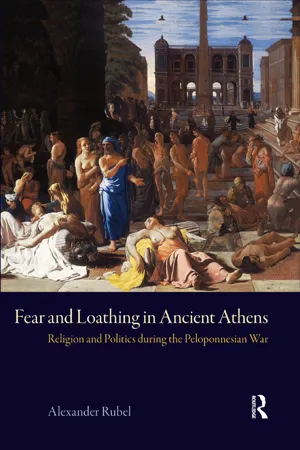
Athens at the time of the Peloponnesian war was the arena for a dramatic battle between politics and religion in the hearts and minds of the people. Fear and Loathing in Ancient Athens, originally published in German but now available for the first time in an expanded and revised English edition, sheds new light on this dramatic period of history and offers a new approach to the study of Greek religion. The book explores an extraordinary range of events and topics, and will be an indispensable study for students and scholars studying Athenian religion and politics.
eBook - ePub
Fear and Loathing in Ancient Athens
Religion and Politics During the Peloponnesian War
- 316 pages
- English
- ePUB (mobile friendly)
- Available on iOS & Android
eBook - ePub
Fear and Loathing in Ancient Athens
Religion and Politics During the Peloponnesian War
About this book
Information
1
Introduction
Nun sag, wie hast du’s mit der Religion?
Du bist ein herzlich guter Mann,
Allein, ich glaub, du hälst nicht viel davon.1
1.1 Religion and the Peloponnesian War
When Socrates met Euthyphro in front of the Stoa Basileios, near the entrance to the law courts, the famous philosopher told him of the accusations that had been brought against him. When explaining the charges – that Socrates was the “inventor” of new deities (ποιητὴν εἶναι θεῶν), and that he did not believe in the ancestral gods (δ’ἀρχαίους [θεούς] οὐ νομίζοντα) – Euthyphro was hardly surprised. On the contrary, he observed that such an accusation was likely to be successful, because such calumnies would easily find their way to the ears of the mob, a fact of which the accuser Meletus was well aware (εἰδὼς ὅτι εὐδιάβολα τὰ τοιαῦτα πρòς τοὺς πολλούς).2
Euthyphro, presented as a seer and an expert soothsayer, is usually taken as a conservative representative of traditional religiosity and, as such, as an expert in religious matters: the sort of specialist that Socrates confuted with dialogues in his characteristic style.3 Euthyphro’s observation, presented shortly before Socrates’ trial for impiety (399 BCE), that the Demos would easily adopt the charge of religion profanation, or at least its significant points, is thus expressed by an authoritative voice.
At first sight, however, the statement of this specialist in religious matters is astonishing. Such imputations of religious intolerance seem unacceptable for democratic Athens during the classical period, labelled by K. Popper, for example, an “Open Society” in a well-known paper.4 Was Pericles not correct when, in his famous speech for the war dead, he praised the tolerance of democracy in the context of which everybody is granted personal freedom to the highest degree? Aristotle expresses the same opinion about an Athenian democracy that allowed everyone to live as they pleased:5 ζῆν ὡς βούλεταί τις. Furthermore, many recent publications on Greek religion mention that institutions within the polis did not care for the “orthodoxy” of their citizens, a concept that was in fact alien to polytheism. Instead, they focused on the correct practice of religion (orthopraxy) and, as such, they were concerned as to whether citizens were fulfilling their legal religious obligations.6
The basic freedom from dogma in Greek religion, a religion that lacked the organization of a centralized “church”, or any hierarchical structure, or any priestly class with exclusive special knowledge, is always underlined by modern scholars in order to differentiate it from modern religious conceptions dominated by Christianity.7 When analysing the passage from Plato, we might also have to take into account the possibility that the author might have exaggerated slightly in denouncing what in his view was the outrageous injustice brought against his famous teacher on account of the Athenians, as a violent deed of the Demos and as a judicial assault.8 Could it be that Plato’s viewpoint – present throughout Euthyphro – came about only on account of the denunciation of Socrates, without corresponding in any way to Athenian public opinion in c. 400?
When considering more closely, however, the period for which according to Plato Euthyphro offers his view concerning the general atmosphere of the time, and looking back as far as the 430s, religious issues move to centre stage. This interval of around thirty years, when the Athenians lost not just a war, but also a maritime empire, when they experienced two oligarchic coups, and when the population fell to less than half on account of plague and war, was dominated by religious themes.9 That they are not expressed in an obvious manner is due to the reticence of Thucydides, the main source for this period. The great historian refers to religion-related issues but rarely and insufficiently; to a certain extent, he excludes religion on principle.10 Nonetheless, this phase of Athenian history witnessed important events that are studied more for political analysis than for their indisputable religious significance. The same period of Athenian democracy is marked by numerous charges of impiety brought against philosophers11 who had criticized religion, but mostly against the persons who had mutilated the Herms and profaned the Eleusinian Mysteries in 415 BCE. Such religious trials were unique to this period.12 It is thus legitimate to talk about a “heated” atmosphere at Athens at the end of the fifth century, expressed through the trials judged by the Assembly and by the courts, where the accused were charged with religious offences.
Otherwise, scholarly attention is attracted by a series of new gods and cults, “borrowed” during this interval; there is still no firm explanation for this development. Bendis, Sabazius, Cybele, Asclepius and Adonis make their solemn entrance to the city, thus enlarging the spectrum of the traditionally worshipped divinities. At the same time, in 411/10 there was a revision and codification of Solon’s calendar for cults and festivals. This measure is rightly regarded as the strongest traditional element of conservative religious politics.13
There was also an important religious component, often played down, in the 406 prosecution of the generals who had won the battle of Arginusae.14 These genuine religious disputes had from the start a direct influence upon the history of the city. Because Alcibiades, probably the most skilled general of his day, was convicted of impiety, he was pushed into the arms of his enemies. Similarly, the naval victory of 406 became a defeat post factum, through the collective conviction of the generals. In the same context belong the major architectural monuments built during the war; through their function and configuration, they underline traditional religious virtues, frequently interpreted as the influence of a conservative current.15
What is often referred to as the Plague of Athens was of crucial importance during the Peloponnesian War. Moreover, it constitutes the starting-point of this paper. It is essential to realize that this (still not entirely understood) malady, which killed about a third of the population between 430 and 427/26, was the crucial event in the life of the Athenians at the beginning of the war. The consequences of this plague marked the public conscience for a long time. The religious dimension of the epidemic, interpreted from a pre-modern perspective as a punishment from the gods, has often been overlooked, largely because of Thucydides’ rationalist approach.16 Some scholars have of course commented correctly and provided a real insight into the religious aspects of these events and of their consequences.17 Nevertheless, there is still no work on these consequences as a homogeneous system of a crisis, defined in its essence through the experience of the plague and of the difficulties caused by the war.18
One wonders whether, generally speaking, these events and their consequences, with their predominantly religious connotations, should be seen in the context of a coherent overall picture of religious anxiety. I refer here to the charges of impiety brought against philosophers, to the persecution of the profaners of the Mysteries and mutilators of the Herms, to the admission of new deities in the city, to the conviction of the victorious generals after the battle of Arginusae and, eventually, to Socrates’ fate. Against this background, we must examine to what extent the period of the Peloponnesian War can be seen as a crisis period when, given the religious hysteria of the mob, the Assembly voted many inducements to radical action and important decisions, relevant in the context of the war. Among them should be mentioned the deposition of Pericles in 430, the recall of Alcibiades, and the conviction of the generals after Arginusae. As W. Furley has succinctly put the matter: “religion was anything but a dead issue”.19
This then is the central theme of my research. The decision-maker, and thus the sovereign of the democratic state, was the popular Assembly, where all Athenian citizens, regardless of origin and social status, voted on the political interests of the state.20 Obviously people from lower socio-economic groups delivered most votes during the session of the Assembly.21
This is why, in the context of this book, the opinions of the Demos – which the politicians took into account or should have influenced – will take centre stage. Such research is, however, handicapped because the Athenian Demos is less represented in the sources. The historians and philosophers of that time naturally belonged to social elites and usually shared the political outlook of their aristocratic or oligarchic upbringing; they do not have many good things to say about the fickle Demos, and even then, only if its concerns were brought forcefully to their attention.22 Their interpretation of the behaviour of the masses during important political votes is subordinated to their elitist view of the world; this is why they seldom saw democracy as a congenial political system.23
Plato and the “Old Oligarch” saw the Assembly less as an institution that supported the state than as a meeting of the mob, where illiterates and the poor could speak against the norms of reason.24 Nevertheless, even these tendentious views provide enough material for the present research, because the contemporary interpretations and estimations are also based on events that are open to fresh interpretation.
Methodologically, the research has to be conducted from the other direction, since the literary sources – written by members of the elite – only allow indirect insights into the attitude of the Demos on religious issues. Thucydides, for example, does not seem to be at all interested in religion, since he eliminated it for the most part from his concept of history. He does, however, provide some ideas about the religious life of his contemporaries, if only between the lines. For example, when he wants to denounce the superstitions of the Demos as old-fashioned and irrational, he inevitably ends up speaking of widely held superstitions and religious fears.25 Thus, when talking about the plague, he mentions a very puzzling oracle; in this context, people associated the sombre prophecy with the plague, thus propagating the idea, which led to a general state of anxiety.26 Through this episode, Thucydides provides an important fact that he would have otherwise certainly omitted, had he not wanted to draw attention to the narrow-mindedness of the mob.
The orators – with some exceptions – and Aristophanes were more explicit. Given their professional background, they had to frequent the Agora; they were thus well aware of generally accepted opinion relating to religious issues, and they made their own statements about widespread beliefs. For the most part, the orators display a rather more positive attitude to democracy and, unlike historians and philosophers, they serve mainly a “common ideology”.27
Texts survive of popular decrees regulating the conduct of cults, or referring to the development and endowment of sanctuaries, and they provide additional information regarding state organization of religious life. Other epigraphic sources (votive epigrams, for example) constitute particularly eloquent testimony in the field of private religiosity.28 In addition, the ever-growing archaeological material, mostly discovered during the past few decades, provides more knowledge about the day-to-day religiosity of the Athenians. Thus, after 430, the year of the plague, there are indications that the Agora witnessed the invigoration of old heroic cults.29 Even the fact that during the war, despite the difficult financial situation, Athenians retained an interest in erecting expensive temples and developing cult-related monuments (often with distinct archaic characteristics) provides indirect information regarding the status of religion during this period.30 By including the results of recent archaeological research, the present study is more evidence-based than older accounts such as the fundamental work of E. R. Dodds.
The documentary material is heterogeneous and the presentation of the literary sources, mainly referring to issues related to politics and the state, is tendentious (and thus unsatisfactory). This is why it seems more appropriate to measure the Athenians’ attitude to religion less through the words transmitted by written tradition than through the attested actions and reactions of the Demos. It will thus first be necessary to analyse the religious implications of various democratic decisions, with their consequences for the fate of Athens. In this context, it is worth considering whether the votes of the Assembly were based in the main on political, rational, concepts or, in view of the period of crisis, whether religious fears and considerations were given more importance than usual.
1.2 Religion and politics
1.2.1 The concept of “religion” in the study of religion31
In his handbook on Greek religion, W. Burkert begins with a brief presentation of the history of research before developing the subject both chronologically and thematically. He naturally starts with the idea that a phenomenon such as “Greek religion”, or “religion” in general, exists per se, and the reader is expected already to possess a fairly clear idea of the underlying concepts. The author can thus reasonably count on the pre-scientific understanding of the reader, with sufficient understanding of the relevant concepts, to make detailed explanation superfluous.
To proceed in the same manner would, however, run the risk of taking as read concepts that are open to question. It is not that one hesitates to enter in medias res or because one wishes to see problems where they do not exist. One is simply trying to draw a distinction betw...
Table of contents
- Cover
- Half Title
- Title Page
- Copyright Page
- Table of Contents
- Preface to the English edition
- 1. Introduction
- 2. Impiety trials against philosophers and Sophists
- 3. The Plague, Pericles and the Peloponnesian War
- 4. Other prosecutions for impiety
- 5. The mutilation of the Herms and the profanation of the Mysteries: religious and political implications
- 6. Tradition and innovation: the new gods
- 7. Building for the gods: sacred architecture during the Peloponnesian War
- 8. The Arginusae trial
- 9. The trial of Socrates: an overview
- Appendix I: Athenian democracy: modern views and ancient realities
- Appendix II: Tragedy and history, Euripides and religion
- Appendix III: Diocleides’ false testimony (415)
- Appendix IV: On Hyperbolus’ ostracism and the quorum for ostracism
- Abbreviations
- Notes
- References
- Index
Trusted by 375,005 students
Access to over 1.5 million titles for a fair monthly price.
Study more efficiently using our study tools.
Frequently asked questions
Yes, you can cancel anytime from the Subscription tab in your account settings on the Perlego website. Your subscription will stay active until the end of your current billing period. Learn how to cancel your subscription
No, books cannot be downloaded as external files, such as PDFs, for use outside of Perlego. However, you can download books within the Perlego app for offline reading on mobile or tablet. Learn how to download books offline
Perlego offers two plans: Essential and Complete
- Essential is ideal for learners and professionals who enjoy exploring a wide range of subjects. Access the Essential Library with 800,000+ trusted titles and best-sellers across business, personal growth, and the humanities. Includes unlimited reading time and Standard Read Aloud voice.
- Complete: Perfect for advanced learners and researchers needing full, unrestricted access. Unlock 1.5M+ books across hundreds of subjects, including academic and specialized titles. The Complete Plan also includes advanced features like Premium Read Aloud and Research Assistant.
We are an online textbook subscription service, where you can get access to an entire online library for less than the price of a single book per month. With over 1.5 million books across 990+ topics, we’ve got you covered! Learn about our mission
Look out for the read-aloud symbol on your next book to see if you can listen to it. The read-aloud tool reads text aloud for you, highlighting the text as it is being read. You can pause it, speed it up and slow it down. Learn more about Read Aloud
Yes! You can use the Perlego app on both iOS and Android devices to read anytime, anywhere — even offline. Perfect for commutes or when you’re on the go.
Please note we cannot support devices running on iOS 13 and Android 7 or earlier. Learn more about using the app
Please note we cannot support devices running on iOS 13 and Android 7 or earlier. Learn more about using the app
Yes, you can access Fear and Loathing in Ancient Athens by Alexander Rubel,Michael Vickers in PDF and/or ePUB format, as well as other popular books in Geschichte & Altertum. We have over 1.5 million books available in our catalogue for you to explore.