This volume is a text-book for students of marketing, providing a basic understanding of the concept and techniques of marketing. It shows how basic background information relating to the UK market may be integrated into business planning and how information from other sources should be incorporated and used.
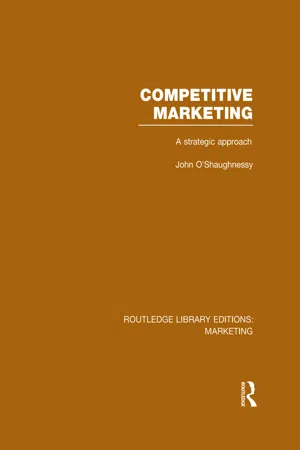
- 762 pages
- English
- ePUB (mobile friendly)
- Available on iOS & Android
eBook - ePub
Part I
Marketing and marketing planning
Chapter 1
The nature of Marketing
Definition of marketing
Marketing’s focus and mode of thinking
Marketing’s focus
Marketing’s mode of thinking
The marketing concept and its limitations
Modes of influence
Limitations of the marketing concept as the philosophy of business
Marketing’s mission
Marketing and ethical responsibility
The deontological approach
The consequentialist tradition
The contract view of ethics
Communitarianism and virtue ethics
Marketing technology
Domains of marketing other than consumer goods
Business to business marketing
Services
Nonbusiness marketing
Conclusion
Success in business is success in a market. Firms go out of business not by closing factories but by unprofitable marketing. Entrepreneurs usually enter a business by developing products (that is, goods and services) but stay in business only by creating and retaining customers at a profit. It is the task of marketing to guide the firm into generating only those products for which customers can be attracted; to position the product in a market and support it with the right promotion, servicing, pricing, and distribution, that is, right from the customer’s point of view. This book deals with that task.
DEFINITION OF MARKETING
There are a number of ways to define a subject. An analytic definition seeks to capture its essence by showing in exactly what way marketing differs from other activities of the firm. For example:
Marketing covers those activities that relate the organization to those parts of the outside world that use, buy, sell or influence the outputs it produces and the benefits and services it offers.
Analytic definitions of marketing tend to be somewhat abstract and meaningful only to those already familiar with the subject. In any case, they are usually controversial. This is because, when we accept a particular definition of a subject, we endorse a particular perspective or way of looking at the topic. In fact, analytic definitions often preface an argument just to induce a certain perspective to facilitate persuasion. Thus the debates over whether law is to be defined in terms of principles certified by reason, or the decree of those with the power to enforce their will, or in the nature of reciprocal agreements among the citizen population, are not just academic debates. When one definition is accepted rather than another, then one set of attributes of the subject is accepted as being more fundamental than another. This is a key issue since the consequences deduced from a definition relate to what attributes are stressed. Thus the above analytic definition of marketing views marketing as an activity that spans the boundary between the company and the business world, from which it might be deduced that marketing undertakes activities that facilitate the development of favorable relationships with those whose decisions affect the commercial success of the company. This deviates somewhat from a view of marketing as the art of creating and maintaining customers; a definition that sees marketing as the skill of finding and securing customers. Another analytic definition defines marketing as the “performance of business activities directed toward, and incident to, the flow of goods and services from producer to consumer to user.” This definition views marketing as a business activity (not for nonbusinesses) and directs attention more toward promotion and distribution than anything else. In practice, none of these definitions receives universal endorsement. This is because there are widely differing views over what constitutes the “essence” of marketing.
Less in dispute are the activities embraced by the term “marketing”: activities that are often implicit in any analytic definition of marketing. This is fortunate since it allows us to define marketing in more concrete terms using the operational definition. Thisdefinition relates the subject to be defined to our experience. It takes the form, “as you do this or observe that, you will understand the meaning of the concept.” When we define an “excellent” salesperson as one who achieves 30 percent more sales than the standard set, we are defining operationally. Andrew Jackson, a past president of the United States, was operationally defining democracy when he said, “if a citizen has the right to cuss the Government and all the Government can do is cuss back or go fishing, that’s a democracy.” Similarly, whenever those in an organization are debating what to offer; to whom; when; where; how and for how much; or are undertaking activities associated with these questions, they are engaging in marketing, since the fundamental activities of marketing are:
• defining markets that fall within the firm’s business;
• finding out what those in the market want (or potentially might want);
• if those in the market want different things, to group them into categories according to what they seek;
• selecting those customer categories whose wants and needs can be better met by the firm than by rival organizations;
• determining the offering (product, price, promotion and distribution) that meets the want;
• making the offering available;
• informing prospective or actual customers about the offering and where it might be obtained;
• deciding on a continuous basis what offerings to add, subtract, modify and upgrade to meet changing wants and circumstances; and
• cooperating with other functions of the business and external organizations to secure the resources and help needed to implement marketing plans.
The above are the activities involved in marketing and which are typically carried out by a marketing department. However, some marketing departments do not have responsibility for all these activities or have even wider responsibilities including dealing with an organization’s suppliers. In any case, marketing as a subject area is involved with the total configuration of features/benefits (that is, the offering) sought by customers and provided by the producer. An offering consists not just of the product itself (including its packaging and other tangible and nontangible benefits that add value for the customer) but its price, promotion, and distribution. The focus here is on “benefits.” Marketers speak of the marketing of benefits not just of the marketing of products. There are several reasons for this:
• customers are interested in what a product can do for them and/or the organizations for whom they are buying; appeals on the basis of benefits are the persuaders since they tell customers what beneficial effects buying, possessing, using, or consuming the product will bring;
• the product can be given different meanings in terms of benefits for different audiences since not everyone buys the same product for the same reasons;
• talking about benefits focuses the attention of marketers to what it is about the product that customers really want since the product may contain elements that are positively not wanted (e.g. fattening calories).
The general public associates marketing exclusively with business. But the marketing activities listed above are not restricted to commercial organizations. Whether an organization has patrons and clients or creditors and customers is irrelevant to the need to carry out, implicitly or explicitly, activities that are essentially of a marketing nature.
Kotier1 speaks of three stages of marketing consciousness:
1 consciousness one: where marketing is restricted to business and the market transaction;
2 consciousness two: where marketing is expanded to embrace all organizations that undertake customer or client transactions; and
3 consciousness three: which extends the scope of marketing still further. Thus museums, universities, libraries, and charities need to market their cause, as well as their product, to gain political and social support as well as financial.
In extending the scope of marketing, marketers are claiming that there are marketing problems in nonbusiness organizations and (if we accept Kotier’s consciousness three stage) that there are marketing problems in dealing with all of an organization’s “stakeholders,” such as the government, environmentalists, unions, etc., and not just customers and competitors. But a practical problem is only a marketing problem to the extent that marketing approaches and techniques are better able to solve the problem than rival approaches. In the final analysis it is a matter of empirical inquiry to demonstrate marketing’s distinct contribution in all these areas of suggested application. Marketers are doing this. In the case of some of the applications quoted, however, it may be that solutions, whose theoretical basis and basic approach reside purely in psychology, are being claimed for marketing. Other applications appear merely to redescribe existing approaches (for example to fund-raising) in marketing terms without demonstrating the advantages gained by mere redescription.
MARKETING’S FOCUS AND MODE OF THINKING
Marketing’s focus
Just as the physicist studies the atom as the basic unit of analysis, so marketing, as a discipline, seeks some basic focus. Academics have suggested the focus should be the concept of exchange2,3 or the transaction.4 There are problems with making either exchange or the transaction the focus for marketing. There is already a well-established branch of sociology, known as “exchange theory,” while transactions are simply individual exchanges where something concrete passes. The question therefore arises of the distinctiveness of marketing exchange problems as contrasted with those dealt with in sociological exchange theory and economics. It is significant that exchange as marketing’s basic unit of analysis has been more talked about than applied though there have been exceptions.5 The concept of exchange to some marketers seems sterile, that is, does not have the seed for development. This is because exchange theory views customers as simply seeking to maximize rewards and minimize costs which seems an inadequate basis for explaining all we would wish to explain about buying behavior. Others claim that making either exchange or the transaction the focus of marketing completely misses the importance of the social processes that bind buyers to sellers in ongoing relationships that lead to exchanges.6 Such social processes are an important research area given a marketing mission of creating trust and loyalty.
Marketing’s mode of thinking
Although some attention has been paid to the focus of marketing as a discipline, there has been less discussion of the key mode of thinking in marketing management. If the key mode of thinking in surv...
Table of contents
- Cover
- Half Title
- Title Page
- Copyright Page
- Original Title Page
- Original Copyright Page
- Table of Contents
- List of figures
- List of tables
- Preface to the third edition
- Part I Marketing and marketing planning
- Part II Buyers, markets, and competition
- Part III Marketing intelligence
- Part IV Marketing mix elements
- Part V Implementation and organization
- Postscript
- Author index
- Subject index
Trusted by 375,005 students
Access to over 1.5 million titles for a fair monthly price.
Study more efficiently using our study tools.
Frequently asked questions
Yes, you can cancel anytime from the Subscription tab in your account settings on the Perlego website. Your subscription will stay active until the end of your current billing period. Learn how to cancel your subscription
No, books cannot be downloaded as external files, such as PDFs, for use outside of Perlego. However, you can download books within the Perlego app for offline reading on mobile or tablet. Learn how to download books offline
Perlego offers two plans: Essential and Complete
- Essential is ideal for learners and professionals who enjoy exploring a wide range of subjects. Access the Essential Library with 800,000+ trusted titles and best-sellers across business, personal growth, and the humanities. Includes unlimited reading time and Standard Read Aloud voice.
- Complete: Perfect for advanced learners and researchers needing full, unrestricted access. Unlock 1.5M+ books across hundreds of subjects, including academic and specialized titles. The Complete Plan also includes advanced features like Premium Read Aloud and Research Assistant.
We are an online textbook subscription service, where you can get access to an entire online library for less than the price of a single book per month. With over 1.5 million books across 990+ topics, we’ve got you covered! Learn about our mission
Look out for the read-aloud symbol on your next book to see if you can listen to it. The read-aloud tool reads text aloud for you, highlighting the text as it is being read. You can pause it, speed it up and slow it down. Learn more about Read Aloud
Yes! You can use the Perlego app on both iOS and Android devices to read anytime, anywhere — even offline. Perfect for commutes or when you’re on the go.
Please note we cannot support devices running on iOS 13 and Android 7 or earlier. Learn more about using the app
Please note we cannot support devices running on iOS 13 and Android 7 or earlier. Learn more about using the app
Yes, you can access Competitive Marketing (RLE Marketing) by John O'Shaughnessy in PDF and/or ePUB format, as well as other popular books in Business & Business General. We have over 1.5 million books available in our catalogue for you to explore.