As a radical critique of theoretical sociological orthodoxy, The Dominant Ideology Thesis has generated controversy since first publication. It has also been widely accepted, however, as a major critical appraisal of one central theoretical concern within modern Marxism and an important contribution to the current debate about the functions of ideology in social life.
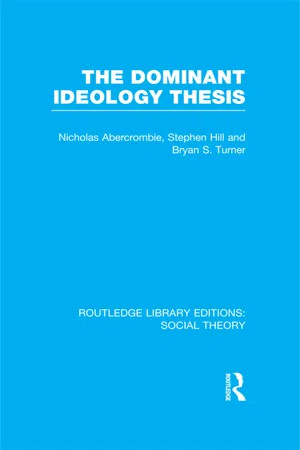
- 218 pages
- English
- ePUB (mobile friendly)
- Available on iOS & Android
eBook - ePub
The Dominant Ideology Thesis
About this book
Trusted by 375,005 students
Access to over 1.5 million titles for a fair monthly price.
Study more efficiently using our study tools.
Information
Chapter 1 Theories of the Dominant Ideology
DOI: 10.4324/9781315763804-2
Within Marxism, the kind of view which, in the Introduction, we have characterised as the dominant ideology thesis has its origins in the German Ideology. We quote at length (Marx and Engels, 1965, p. 61):
The ideas of the ruling class are in every epoch the ruling ideas: i.e., the class which is the ruling material force of society, is at the same time its ruling intellectual force. The class which has the means of material production at its disposal, has control at the same time over the means of mental production, so that thereby, generally speaking, the ideas of those who lack the means of mental production are subject to it. The ruling ideas are nothing more than the ideal expression of the dominant material relationships, the dominant material relationships grasped as ideas; hence of the relationships which make the one class the ruling one, therefore, the ideas of its dominance. The individuals composing the ruling class possess among other things consciousness, and therefore think. Insofar, therefore, as they rule as a class and determine the extent and compass of an epoch, it is self-evident that they do this in its whole range, hence among other things rule also as thinkers, as producers of ideas, and regulate the production and distribution of the idea of their age: thus their ideas are the ruling ideas of the epoch.
There are three preliminary points to be made about this very familiar passage. First, Marx and Engels, in speaking of the means of mental production, place what we shall call the apparatus of the transmission of ideology at the centre of their analysis. The ruling class has a grip over the mental life of a society, because it controls this apparatus. Secondly, Marx and Engels speak of a ruling class producing ruling ideas. The imagery is very much of one class doing something to another; members of the ruling class rule also as thinkers. We may call this view a class-theoretical account of the way in which the dominant ideology works. Thirdly, it is possible to formulate two interpretations of the passage, one stronger than the other. In the weak version, Marx and Engels can be interpreted as saying that the intellectual life of a society is dominated by the ruling class, so that an observer will necessarily perceive only the ruling ideas and will not be able to apprehend the culture of subordinate classes simply because that culture does not have institutions to give it public expression. More strongly, it can be argued that the command exercised by the ruling class over the apparatus of intellectual production means that there cannot be any subordinate culture, for all classes are incorporated within the same intellectual universe, that of the ruling class. So, in the first interpretation there are a variety of cultures present in a society, but only one is ever publicly noticeable, while in the second there is only one dominant culture, in which all classes share.
In the German Ideology it is not clear which interpretation Marx and Engels favoured. In fact, both make an appearance in the text. However, from their other work it is clear that they did not adopt a fully fledged theory of incorporation, and the notion of class struggle, at the ideological as well as at the economic and political levels, plays a central role. For example, Engels said in his The Condition of the Working Class in England in 1844: ‘The bourgeoisie has more in common with every other nation of the earth than with the workers in whose midst it lives. The workers speak other dialects, have other thoughts and ideals, other customs and moral principles, a different religion and other politics than those of the bourgeoisie’ (Engels, 1968, p. 124). In Volume 1 of Capital, Marx was at pains to show that the working class was engaged in a struggle with the bourgeoisie over the length of the working day. This struggle was partly won by the working class in that legislation was passed restricting the length of the working day (Marx, 1970, ch. 10). Marx made it clear that the struggle started as a purely economic phenomenon, but was generalised into a political movement (Marx’s letter to F. Bolte in Marx and Engels, 1968). However, there was also an ideological conflict involved in the economic and political struggle which concerned the rights and wrongs of child labour, methods of work and the length of the working day, amongst other things.
We contend, therefore, that Marx and Engels did not adopt an incorporation theory. However, this is not true of their recent followers, many of whom have stressed the stronger interpretation of the German Ideology as a basis for their own theories of the ideological incorporation of the working class in capitalist societies. In the last fifty years or so many Marxists have been impressed by the apparent stability of capitalist societies and the lack of a radical working-class consciousness. They have looked for an explanation of these phenomena in the ideological control of the working class by the capitalist ruling class, such that the working class has come to identify its interests with those of capitalism rather than with a revolutionary movement. Further, in very recent works of Marxist theory there has been a tendency, not only to stress the importance of compliance through ideological control in capitalist societies, but also to elevate the theoretical importance of the concept of ideology by comparison with that of the economy (Althusser, 1969, 1977; Hindess and Hirst, 1975; Cutler et al., 1977). It is the central argument of this book that such a tendency exaggerates the importance of ideology.
In the early phase of the development of Marxist thought, from Marx’s death up to the beginning of the First World War, there was an emphasis on the elaboration of Marx’s economics. The belief was that an account of the laws of motion of the capitalist mode of production would show clearly how the system would break down. The social could simply be read off from the economic. Connected with this emphasis was the use of a particular scientific method, namely, a crude positivism. That is, Marxist analyses were to take the form of law-like propositions expressing causal connections between the economy and other social phenomena. The combination of the emphasis on the economy and the adoption of a positivist method produced a firm belief in the inevitable collapse of capitalism through its own contradictions (Bottomore, 1975, ch. 1).
Bernstein was an early dissentient from this economic reductionism and since the early 1920s the bulk of Marxist thought has reacted against the earlier texts. This reaction has taken three main forms. First, as has often been pointed out (P. Anderson, 1976), these later theorists were essentially academics, not activists. Not only were their working lives remote from working-class struggles, their writing was often of a technical nature, not likely to appeal to a wide audience. Secondly, there was an increasing emphasis on the method of Marxism and on Marxist philosophy. This often took the form of an objection to positivism and an emphasis on the importance of human agency and ‘subjective’ elements. Thirdly, the Marxist response to ‘Second International Marxism’ took the form of a relatively greater interest in superstructural questions of politics and ideology, and relatively less interest in analyses of the economy. The supposition was that the hidden secrets of capitalist society could not be discovered merely in the economy. Rather, the opportunities for progress, both political and theoretical, lay in the detailed analysis of the superstructure, on the assumption that it was relatively independent of the economy.
The renewed interest in the superstructure is, from the perspective of this book, the major point of interest in the revival of Marxist theory after the First World War. It has three separable elements. First, there is a concern with superstructure in general. In this respect emphases differ as between different writers. The Frankfurt school, for example, emphasised the independent role of culture, while Gramsci was primarily a theorist of politics. Althusser, however, sums up the spirit of reaction when he says:
But History ‘asserts itself’ through the multiform world of the superstructures, from local traditions to international circumstance … In History, these instances, the superstructures, etc. – are never seen to step respectfully aside when their work is done or, when the time comes, as his pure phenomena, to scatter before His Majesty the Economy as he strides along the royal road of the Dialectic.
These are confident words even though ‘the theory of the specific effectivity of the superstructures and other “circumstances” largely remains to be elaborated’ (Althusser, 1969, pp. 112–13).
Secondly, there has been a continuing specific interest in the sphere of ideology and culture. Adler sums up this theme well when he says ‘it cannot be said that ideology, in the Marxist sense, is something inessential and ineffective in historical development, [it] is a substantial and essential element in the lawfulness of the social process’ (Adler, 1978, pp. 256, 261). However, more specifically, it is not only ideology per se which commands interest, but its particular effects. Thus, it is often argued that one of the main reasons for the relative quiescence of the working class, and the consequent stability of capitalism, is the independent power of ideological incorporation, an outcome intended and produced by the intellectual activities of the ruling class. As Marcuse says, Onedimensional thought is systematically promoted by the makers of politics and their purveyors of mass information. Their universe of discourse is populated by self-validating hypotheses which, incessantly and monopolistically repeated, become hypnotic definitions or dictations’ (1964, p. 14).
Of course, the various themes in the renewed interest in the superstructure are closely related. A remoteness from working-class struggle produced both an academic interest in philosophy and art and a pessimism, a belief in the essential stability of capitalism. Given the conviction that capitalism will no longer collapse of its own internal contradictions, the only way forward for socialism is the assertion of the human will to overcome a massive social reality. Hence the interest in recent Marxist theory in voluntarism and humanism (Bottomore, 1975; P. Anderson, 1976).
We do not intend to review the history of Marxist thought in any detail. However, in order to illustrate these tendencies within recent Marxism, we will discuss the views of three Marxist writers of very different theoretical persuasions: Gramsci, Habermas and Althusser.
Gramsci
Gramsci’s work is very much directed by his opposition to any form of economism, which involves The iron conviction that there exist objective laws of historical development similar in kind to natural laws, together with a belief in a predetermined teleology like that of a religion’ (Gramsci, 1971, p. 168). Similarly, ‘The claim, presented as an essential postulate of historical materialism, that every fluctuation of politics and ideology can be presented and expounded as an immediate expression of the structure, must be contested in theory as primitive infantilism and combated in practice with the authentic testimony of Marx …’ (Gramsci, 1971, p. 407). Bukharin, on whom a good deal of the Prison Notebooks is lavished, is a favourite target. Ironically, Gramsci cites Croce’s critique of Bukharin’s economism in which technique is made the supreme cause of economic and social development. Croce holds that Marx did not reduce everything to the ‘mere technical instrument’ and his work was, in any case, not a pursuit of ‘ultimate causes’.
For Gramsci, the rejection of economic reductionism is an acceptance of the relative importance of superstructures, a point of view which he believes is faithful to Marx. He is pre-eminently a theorist of politics, particularly of the state and of political parties. However, he is also concerned with the ideological sphere and would not in any case have regarded the separation of politics and ideology as at all valuable. He takes the cultural differences between societies, or parts of societies, seriously in that they have important social, political and economic effects; they cannot be treated as mere epiphenomena (Gramsci, 1971, pp. 93 ff.). His concern with ideology and politics is also connected with an emphasis on the creative possibilities of the individual as against a determining social structure. For Gramsci, since ‘the will and initiative of men themselves cannot be left out of account’, not only can Marxism not be a science which formulates general laws, but politics and ideology themselves must be autonomous practices, the outcome of the triumph of the human will.
In sum, Gramsci expresses a general antipathy to economism and a wish to establish theoretically the autonomy of political and ideological practice. This orientation produces the concept of hegemony, a concept crucial in the history of Marxism since the First World War and aptly illustrative of our argument of the central tendency of Marxist theory.
The concept of hegemony expresses the notion of leadership which is as much ideological as political or repressive, although, in fact, Gramsci’s use of the term varies considerably (P. Anderson, 1976/7). Further, a number of commentators on Gramsci have rendered the concept entirely in terms of ideological control. Despite these divergencies, it seems to us not only a fair interpretation of Gramsci but also a theoretically sensible usage to treat hegemony as fusing all the elements of leadership together, particularly control by repression with control by ideological persuasion. For example, Gramsci says (1971, pp. 57–8):
The methodological contention on which our own study must be based is the following: that the supremacy of a social group manifests itself in two ways, as ‘domination’ and as ‘intellectual and moral leadership’. A social group dominates antagonistic groups, which it tends to ‘liquidate’, or to subjugate perhaps even by armed force; it leads kindred and allied groups. A social group can, and indeed must, already exercise ‘leadership’ before winning governmental power … it subsequently becomes dominant when it exercises power, but even if it holds it firmly in its grasp, it must continue to ‘lead’ as well.
Hegemony, then, cannot be seen as a purely ideological notion. However, it is also true that Gramsci’s distinctive contribution is his insistence on the importance of ‘intellectual and moral leadership’ and that is certainly how he is often interpreted (see, for example, Bates, 1975; Femia, 1975).
Hegemony, then, critically involves ideological domination. However, the balance between coercion and consent in the exercise of hegemony varies historically. Generally, the weaker the engineering of consent, the stronger the repression exercised by the state has to be. For example, Gramsci contrasts Russia, in which repression is the main weapon, with the West, in which there is a combination of repression and consent, and incidentally implies that the West is the stronger for combining the two.
Gramsci is careful to point out that one cannot take consent for granted; obedience is not automatic but has to be produced. There has, therefore, to be some analysis of the machinery by which ideological domination is effected. Some indication of Gramsci’s solution to this question is provided by his distinction between civil society and political society or state. Again, Gramsci’s usage is variable. As Anderson argues, there are at least three senses of the terms themselves and of the relationships between them (1976/7). One of the senses, however, dominates Gramsci’s writing and is the one for which he is best known. In this interpretation of the terms, Gramsci argues that civil society and the state are separate structures or sets of institutions within society. Civil society is made up of ‘private’ institutions like the church, trade unions and schools, while the state is made up of public institutions like the government, courts, police and the army. The distinction between civil society and the state runs together with that between force and consent discussed earlier. Civil society is the site of the engineering of consent while the state represents the apparatus of repression. Confusingly, Gramsci also equates the concept of hegemony both with civil society and with the generation of consent, and the concept of ‘domination’ with political society and the use of force. However, as we have already indicated, it is better to reserve the term hegemony for the leadership of one group based on a fusion of repression and consent, even if the balance between these two varies. At other points in his work Gramsci takes a rather different view of the relationship of state and civil society. Here he argues that the state in modern capitalist societies is not purely an instrument of repression but has important ideological functions, particularly in respect of the institution of parliamentary democracy. Although a minority view in Gramsci’s work as a whole, this is a significant point and we will return to it later in the discussion of Althusser’s views.
Within civil society, the site of the ideological unity of a society, intellectuals have an important role. For Gramsci, ‘every relationship of “hegemony” is necessarily an educational relationship’ and it is the intellectual stratum that directly educates. In his view everyone is an intellectual in some sense in that everyone works out some conception of the world. Besides that, any task, however menial, requires intellectual activity of some kind. However, ‘All men are intellectuals, one could therefore say: but not all men have in society the function of intellectuals’ (Gramsci, 1971, p. 9). There are therefore specialised groups of intellectuals, specialised by the function that they perform, and intellectual only in...
Table of contents
- Cover Page
- Half-Title Page
- Title Page
- Copyright Page
- Original Title Page
- Original Copyright Page
- Table of Contents
- Acknowledgements
- Foreword
- Introduction
- 1 Theories of the Dominant Ideology
- 2 Theories of the Common Culture
- 3 Feudalism
- 4 Early Capitalism
- 5 Late Capitalism
- 6 The End of Ideology?
- Appendix: The Concept of Ideology
- Bibliography
- Index
Frequently asked questions
Yes, you can cancel anytime from the Subscription tab in your account settings on the Perlego website. Your subscription will stay active until the end of your current billing period. Learn how to cancel your subscription
No, books cannot be downloaded as external files, such as PDFs, for use outside of Perlego. However, you can download books within the Perlego app for offline reading on mobile or tablet. Learn how to download books offline
Perlego offers two plans: Essential and Complete
- Essential is ideal for learners and professionals who enjoy exploring a wide range of subjects. Access the Essential Library with 800,000+ trusted titles and best-sellers across business, personal growth, and the humanities. Includes unlimited reading time and Standard Read Aloud voice.
- Complete: Perfect for advanced learners and researchers needing full, unrestricted access. Unlock 1.5M+ books across hundreds of subjects, including academic and specialized titles. The Complete Plan also includes advanced features like Premium Read Aloud and Research Assistant.
We are an online textbook subscription service, where you can get access to an entire online library for less than the price of a single book per month. With over 1.5 million books across 990+ topics, we’ve got you covered! Learn about our mission
Look out for the read-aloud symbol on your next book to see if you can listen to it. The read-aloud tool reads text aloud for you, highlighting the text as it is being read. You can pause it, speed it up and slow it down. Learn more about Read Aloud
Yes! You can use the Perlego app on both iOS and Android devices to read anytime, anywhere — even offline. Perfect for commutes or when you’re on the go.
Please note we cannot support devices running on iOS 13 and Android 7 or earlier. Learn more about using the app
Please note we cannot support devices running on iOS 13 and Android 7 or earlier. Learn more about using the app
Yes, you can access The Dominant Ideology Thesis by Bryan S. Turner,Nicholas Abercrombie,Stephen Hill in PDF and/or ePUB format, as well as other popular books in Social Sciences & Sociology. We have over 1.5 million books available in our catalogue for you to explore.