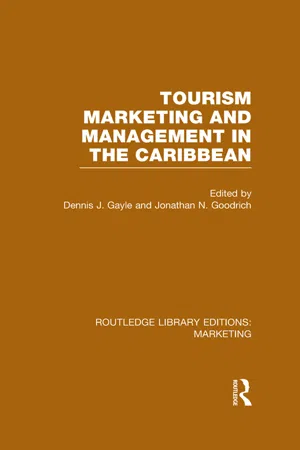
The Caribbean now has one of the largest regional tourism industries in the world amongst developing countries. When originally published this volume was the first to provide a comprehensive discussion of tourism in this part of the world. It begins with an overview of the industry and then examines aspect of tourism marketing and management on a region-by-region basis, covering the Bahamas, Jamaica, Barbados, St Lucia, Trinidad and Tobago, Guyana and Cuba. Detailed analysis follows of sectors within the industry, such as heritage and health care, with central issues such as the intense competition between the cruise ship and hotel industries being highlighted. Discussion of the impact of US and EU policies on Caribbean tourism provides an important international perspective. Throughout, the focus is on the contribution of the regional tourism industry to Caribbean economic growth and development.
eBook - ePub
Tourism Marketing and Management in the Caribbean (RLE Marketing)
- 298 pages
- English
- ePUB (mobile friendly)
- Available on iOS & Android
eBook - ePub
Tourism Marketing and Management in the Caribbean (RLE Marketing)
1 Caribbean tourism marketing, management and development strategies
THE INTERNATIONAL TOURIST INDUSTRY
Tourism first emerged during the Middle Kingdom in ancient Egypt, from 2040–1786 BC, when the erection of imposing temples, tombs and other monuments impelled regular travel by the nobility for curiosity and pleasure.1 However, until the 1850s, when British tour operator Thomas Cook pioneered tours of Europe, the concept of travel for pleasure was commonly seen as a contradiction in terms. Indeed, the English word ‘travel’ was derived from the French word ‘travail’, work or torment, which in turn, originates from the Latin noun ‘tripalium’, a three-pronged instrument of torture. Tourism may be described as the temporary movement of people to destinations away from their usual places of residence and work, for more than a day, primarily for the purpose of recreation.2 The modern travel and tourism sector may be defined as the sum of passenger-transport industries; hotels and lodging; restaurants; and recreational as well as cultural services. Thus defined, travel and tourism constituted the world’s largest industry by 1987, when it recorded $2 trillion in sales, and employed 6.3 per cent of the global workforce.3
Between 1966 and 1986, when international tourist receipts amounted to about $115 billion per annum, the number of international tourist arrivals almost tripled, to 340 million people each year.4 In 1989, travel and tourism generated almost $2.5 trillion in revenues,* or 6.5 per cent of the world’s aggregate gross national product.5 In 1990, the international tourist industry accounted for about 25 per cent of all international trade in services. In 1991, the travel and tourism sectors employed more than 112 million people worldwide, or 6.5 per cent of the total workforce. These sectors also accounted for more than $350 billion annually in new facilities and capital equipment, or 7.3 per cent of worldwide capital investment.6
The World Tourism Organization projects that international tourist arrivals will grow by approximately 4.2 per cent during the 1990s.7 Across the developed industrial countries of the OECD, changing demographic and occupational profiles suggest more frequent and shorter special-interest oriented holidays, and the growth of related world air traffic at an average annual rate of up to 7 per cent, doubling during the 1990s to the year 2000.8 At the same time, up to 80 per cent of all international travel is undertaken by the citizens of just twenty countries. More than 50 per cent of all international travel expenditure is made by US, British, French, German and Japanese tourists.9 The sections that follow discuss the implications of alternative tourism strategies within small islands, before providing a summary profile of the Caribbean, and reviewing regional tourism development between 1973 and 1991. The final section explores some of the principal tourism marketing and management challenges in the Caribbean.
ALTERNATIVE TOURISM DEVELOPMENT STRATEGIES
It has often been argued that most small tropical island states have little alternative but to accept traditional tourism development, with its mass tourism, multinational corporate control and large-scale facilities.10 Yet there is normally an inverse relationship between population size and the positive impacts of tourism. The United Nations Environment Programme has pioneered the concept of tourist carrying capacity – the number of tourists that can be accommodated at any one time, with minimum environmental damage. But carrying capacity can be increased by techniques such as improved hotel room design, with ventilation, screening and ceiling fans, so as to reduce electricity consumption.11
The travel and tourism sector is characterized by multiple paradoxes. For instance, it is a mature industry which markets recreation and rather juvenile escapist dreams, often to ageing repeat customers, who may be accommodated in enclaves which inhibit exposure to local culture.12 This industry evokes images of laughter and romance, yet continues to be criticized as a low value-added sector, employing relatively unskilled workers and generating balance-of-trade deficits as well as inflation, while damaging its ecological and sociocultural environment.13 The quality of interaction between residents and visitors is affected by several factors: scale and type of tourism; modal social norms; access to employment in the tourism sector; and the development of visitor services.
In chapter 13, Rex Nettleford offers the observation that tourism and culture can only be mutually reinforcing when a nation celebrates its cultural heritage for its own sake, and subsequently invites guests to share it. At the same time, the main determinants of tourism’s impact on the physical environment include the intensity of tourist site use, resiliency of the ecosystem and the time scale adopted by developers.14 In Barbados, tourism development led to the substantial destruction of coral reefs, extensive beach sand loss and coastal water contamination as a result of insufficient regulatory foresight.15
Particularly for developing countries, the prime challenge of tourism expansion is to generate long-term growth and development. Consequently, the creation of a dynamic partnership between the public and private sectors is perhaps more important in tourism than in any other sector. This imperative is illustrated by the Dominican Republic’s 1991–5 tourism development plan, which was sponsored by an IDB grant, which aims to assist investors in site development while having regard to environmental factors.
In thinking about tourism policy, it is essential to distinguish between economic growth and development.16 Economic growth implies the constant creation of enhanced capacity to produce wealth.17 It is easily measured in terms of gross domestic product levels and rates of increase. Such growth is generated by product and service innovation, employment as well as export expansion and increased investment. Development, on the other hand, emphasizes productivity and distribution, or the creation of optimal capacity to challenge human abilities, as well as to satisfy human needs and desires, over time.18 In the case of the Seychelles Islands (during the 1970s), for example, where growth without development took place, tourism expansion drew workers away from agriculture to construct an airport and hotels, depressing agriculture; yet when the building boom ended, few jobs were available. Imports, inflation, prostitution and crime rates soared.
However, broad-based effective demand and performance incentives can be mutually reinforcing. Again, this requires careful planning and systematic government–industry cooperation. In the case of Bermuda, for instance, tourism was dramatically expanded between 1945 and 1985. This sector provided 55 per cent of GNP, 60 per cent of foreign exchange earnings and 70 per cent of local employment. In 1989, this sub-tropical island, where rental cars and roadside advertisements are banned so as to preserve the local environment, the number of hotel beds is restricted to 10,000, and no more than two cruise ships are allowed in port at once, recorded a GNP per capita of $18,000, one of the world’s highest, and few socioeconomic ills that could be attributed to tourism.19
Similarly, following Exxon’s decision to close its refinery in Aruba, in 1984, an almost total collapse of the island’s economy appeared likely. However, at the urging of the Dutch government and the IMF, Aruba’s tourist sector was substantially expanded. Since 1985, the industry has been growing at a rate of 15 per cent per annum. Half a million tourists visited Aruba in 1991, when 7,200 hotel rooms were available, compared with 2,500 six years earlier. As a result of this expansion, some 6,000 houses were built for imported workers, several new schools were constructed, and local water and electricity plants were upgraded.
The extended debate as to whether tourism should be accepted as a viable development strategy, partially integrated into short-term development planning, or essentially rejected as a contributor to socioeconomic growth, has continued since the 1960s.20 For example, during a June 1990 conference in Trinidad and Tobago, dealing with tourism and sociocultural change in the Caribbean, former Tourism Minister Suruj Rambachan declared that the twin-island republic’s drive for economic growth must not be allowed to destroy either the natural environment or the culture and values of the host people. He also contended that hotel operators should maximize their use of local products and that visitors should be encouraged to demonstrate respect for local entertainers.
Barbadian Police Commissioner Orville Durant pointed out that hotel construction plans that did not include consultation with security experts might end up encouraging crime against tourists. Peggy Antrobus, Director of the University of the West Indies’ Women and Development Unit, argued that there was an increasing incidence of sex tourism in the Caribbean, as the deepening economic crisis across the region impelled many desperate young women to prostitute themselves with foreign visitors. In partial response, the Reverend Allan Kirton, General Secretary of the Caribbean Council of Churches, proposed an eleven-point code of ethics for tourists, which emphasized the need for such visitors to listen and observe, seek to understand local cust...
Table of contents
- Cover
- Half Title
- Title Page
- Copyright Page
- Original Title Page
- Original Copyright Page
- Dedication
- Table of Contents
- List of figures
- List of tables
- Notes on editors and contributors
- Preface
- Foreword
- Acknowledgements
- Abbreviations
- Map
- 1 Caribbean tourism marketing, management and development strategies
- 2 The Caribbean Tourism Organization in historical perspective
- Part I Tourism marketing and management
- Part II Sectoral issues
- Part III The impact of US and EC policies
- Part IV Caribbean tourism in the year 2000
- Bibliography
- Author index
- Corporate index
- Subject index
Trusted by 375,005 students
Access to over 1.5 million titles for a fair monthly price.
Study more efficiently using our study tools.
Frequently asked questions
Yes, you can cancel anytime from the Subscription tab in your account settings on the Perlego website. Your subscription will stay active until the end of your current billing period. Learn how to cancel your subscription
No, books cannot be downloaded as external files, such as PDFs, for use outside of Perlego. However, you can download books within the Perlego app for offline reading on mobile or tablet. Learn how to download books offline
Perlego offers two plans: Essential and Complete
- Essential is ideal for learners and professionals who enjoy exploring a wide range of subjects. Access the Essential Library with 800,000+ trusted titles and best-sellers across business, personal growth, and the humanities. Includes unlimited reading time and Standard Read Aloud voice.
- Complete: Perfect for advanced learners and researchers needing full, unrestricted access. Unlock 1.5M+ books across hundreds of subjects, including academic and specialized titles. The Complete Plan also includes advanced features like Premium Read Aloud and Research Assistant.
We are an online textbook subscription service, where you can get access to an entire online library for less than the price of a single book per month. With over 1.5 million books across 990+ topics, we’ve got you covered! Learn about our mission
Look out for the read-aloud symbol on your next book to see if you can listen to it. The read-aloud tool reads text aloud for you, highlighting the text as it is being read. You can pause it, speed it up and slow it down. Learn more about Read Aloud
Yes! You can use the Perlego app on both iOS and Android devices to read anytime, anywhere — even offline. Perfect for commutes or when you’re on the go.
Please note we cannot support devices running on iOS 13 and Android 7 or earlier. Learn more about using the app
Please note we cannot support devices running on iOS 13 and Android 7 or earlier. Learn more about using the app
Yes, you can access Tourism Marketing and Management in the Caribbean (RLE Marketing) by Dennis J. Gayle,Jonathan N. Goodrich in PDF and/or ePUB format, as well as other popular books in Business & Business General. We have over 1.5 million books available in our catalogue for you to explore.