The account handler is a key person within an advertising agency, liaising between the client on the outside and the planning, creative and media function within. This book presents essential checklists for each aspect of the planner's role: presentations made to clients, briefing creative and media teams, and helping to get the best out of both client and agency.
- 194 pages
- English
- ePUB (mobile friendly)
- Available on iOS & Android
eBook - ePub
Advertising for Account Holders (RLE Marketing)
Chapter 1 Introduction
DOI: 10.4324/9781315766867-1
Is This Book for You?
This book is written for today’s and tomorrow’s account handlers, and all the people they deal with. It provides a close-up view of the whole advertising process.
Most people in advertising are alternately helped and frustrated by account handlers — from clients to copywriters, and from art directors to media buyers and salesmen. For them, this book will help explain a handler’s point of view and motives, and so suggest effective ways to work with him.
For account handlers themselves there is the opportunity to stop and think, and to develop a point of view. Almost all account handlers can improve themselves, the author included. Good account handlers aren’t born, they’re made as experience takes them up the learning curve. This book might help shorten that curve, and show a few short cuts.
I must apologise to all the many talented female account handlers, clients, copywriters, planners etc. I know. The English language does not, alas, contain a pronoun that means ‘he or she’. So I’ve settled on ‘he’ throughout, but only for ease of reading.
This is a practical book which you could keep at work within handy reach. It’s as short as the subject permits and could probably be read from cover to cover in about four hours or so. In fact, it’s probably best read selectively and mulled over.
How to Find Your Way Around This Book
Section I is about account handling. It starts by surveying the big picture — the world of advertising — and gradually becomes more focused as it looks at advertising agencies and how they work. It then considers what account handlers do and don’t do and introduces a special member of the team_ the account planner. Chapter 3 concentrates on good account handling, and in the following chapter the detail of handling advertising accounts is studied. Mostly, account handling is detail.
Section II concerns the creation of advertising campaigns. It starts off by interrogating the product and then considers the role of advertising. Media and creative briefings follow. Working with the creative team, reviewing their work and selling it to the clients are the subjects of the next three chapters. And buying advertising media, going into production and assessing the campaign are the final three chapters of the section.
Section III deals with all the bits and pieces, but especially with management. Supporting the campaign below the line provides a brief overview of other communications disciplines, like public relations and direct mail. Managing clients, colleagues and money are the subject of the next two chapters and some agency politics are thrown in — a brief survival course.
Meetings have a chapter all of their own. It’s really about how to get more done in shorter meetings. Chapter 19 on new business includes some hints; in essence, it’s about going for it.
Advertisers warrant a special, made-to-measure chapter. After all, being a good client is difficult; they are to be treasured. And Chapter 21 is about the advertising industry’s value.
Chapter 22 is concerned with the best way to develop your advertising career. Learn to sell, and then some more. After all, you can’t get much richer simply by working more hours. You need to find ways to work better.
The final chapter is a glossary of 101 terms. It helps to know exactly what they mean.
Part I Account handling
Chapter 2 It’s an ad world
DOI: 10.4324/9781315766867-2
Advertising is an extraordinary business – in the people it attracts, their working circumstances and the way they go about their work.
Where do advertising agencies come from? They were originally owned by the media owners to whom their first loyalty lay. They were not independent organizations. They made their money not by taking a commission in space but by trading it, or more specifically by buying space in bulk at a discount, and selling it on. Next, they started a copywriting service to encourage clients to buy their space, and soon afterwards they added design and art services.
From a legal point of view, however, an ‘agency’ now contracts in its own right with both clients and media owners. It is nobody’s agent, in the sense of being owned by another organization. Today, agencies are independent of media and clients. Legally, they act as principals rather than agents and have separate contracts with both parties.
Inside advertising
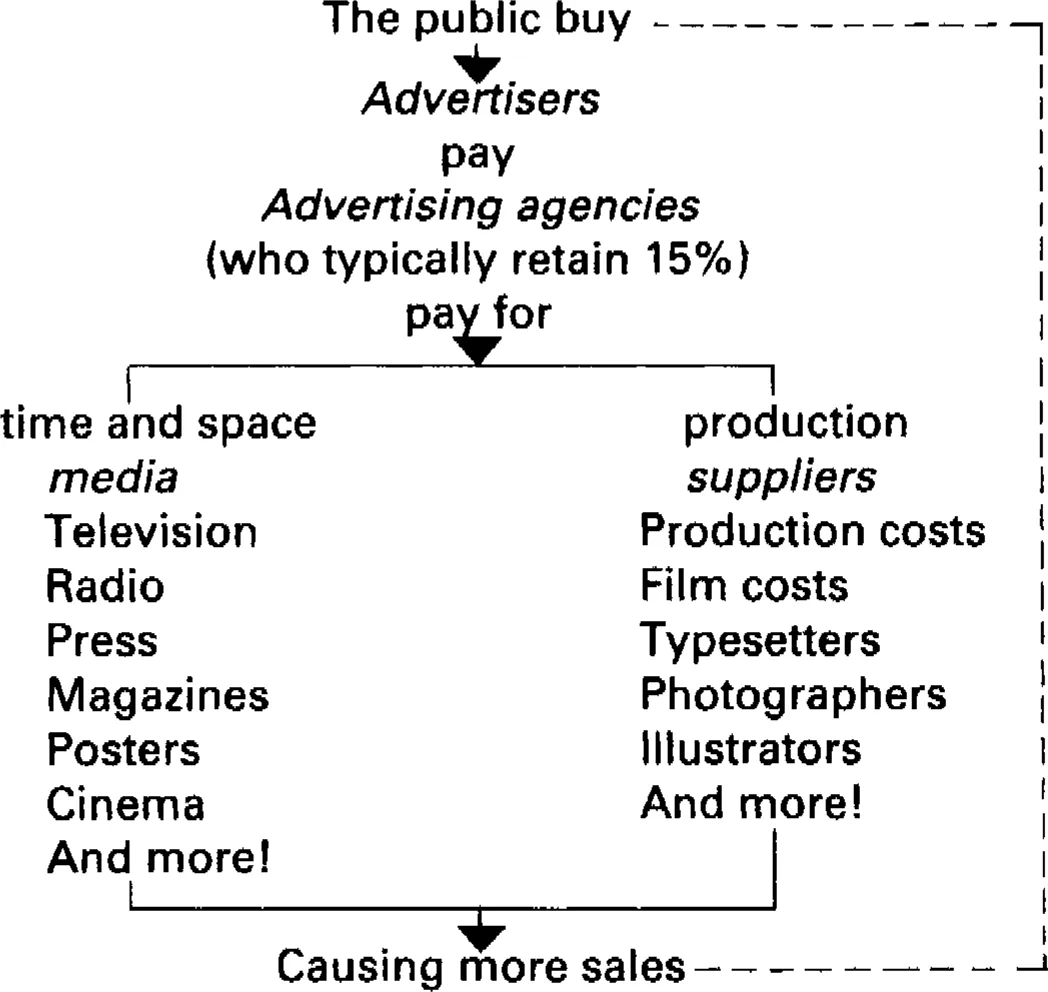
Advertising has been defined as any piece of paid-for communication which is designed to persuade its audience. It usually involves just four groups of people: the advertiser who has a product which he wants to sell; the advertising agency which creates advertising proposals; the media which carry the advertising; and the suppliers who help the agency turn ideas into reality.
The advertiser owns the product which is to be promoted. He pays for the advertisements to be thought-up, produced and put into the media. Each advertiser, or client, hires and fires his agency as he wants to.
Advertisers are, of course, companies in their own right and their effectiveness sometimes appears to the agency to be constrained by internal political hurdles. The agency may typically be dealing with a brand manager (usually responsible for one or more products with a particular brand name), marketing managers (responsible for marketing a range of products) or, in some cases, a sales manager. The titles are endless.
These managers will usually report to directors who may, in turn, report to others. The agency’s contact is only one individual in one department within the company, and the company’s definition of its priorities may not coincide with that of the department. The advertising agency sometimes provides a shoulder for its frustrated clients to cry on.
Advertisers should know more about their products and markets than the agency, but they may well know less about advertising. Some agencies affect to adore their clients, some simply have serious business relationships with them and others don’t respect them at all. In the end, however, it’s the clients who call the shots.
The media take most of any advertiser’s money — 85 per cent as a rule. The agency holds on to 15 per cent of the media expenditure as a commission, although some now agree to charge fees instead. Media have their own sales departments which compete for slices of advertising budgets. They lobby the advertisers and the agencies.
The advertising agencies
Advertising agencies are in business to create advertisements. If the agency is any good, it creates memorable advertisements which are liked by the public, add to the product’s intrinsic value, and help the client’s sales figures climb satisfactorily upwards. If the agency is not very good, it creates dull advertisements which go unnoticed by the public, make no difference to sales figures, and, at best, do no harm to the product. You pays your money and you takes your choice.
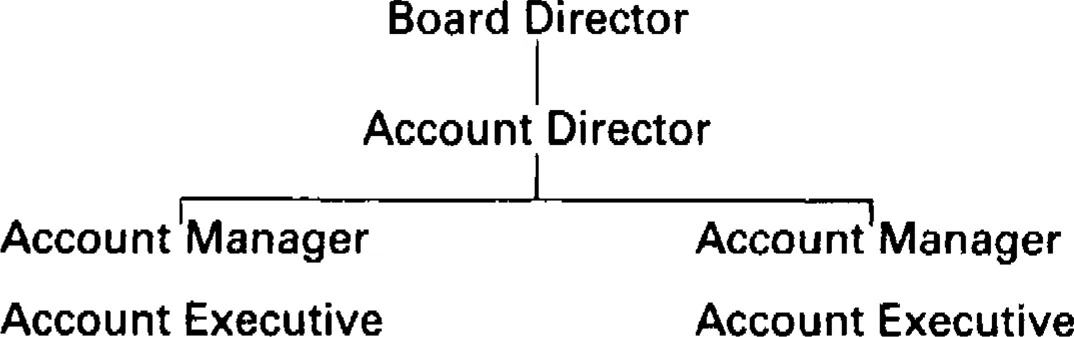
Within the agency, the ‘account handler’ is variously titled ‘account executive’, ‘account manager’ or ‘account director’, depending on his seniority, and how liberal his agency is at dishing out titles. One leading agency calls him the sales representative, or sales rep for short. The ‘account’ bit of the handler’s title is simply derived from the fact that he looks after some of the agency’s clients, each of whom has an ‘account’ at the agency.
Each advertising agency has several departments. A media department deals with the whole business of where the advertising will appear. The media people plan which medium to use and when and how, and also negotiate prices with the media. These two functions are sometimes split between ‘media planners’ and ‘media buyers’. Alternatively, clients can use a separate company for this, known as a media independent, while their agency produces the advertisements.
Most large agencies have in-house planners or researchers. Planners are concerned with getting the agency’s thinking straight before creative work is requested, as well as ensuring that the final work reflects that thinking.
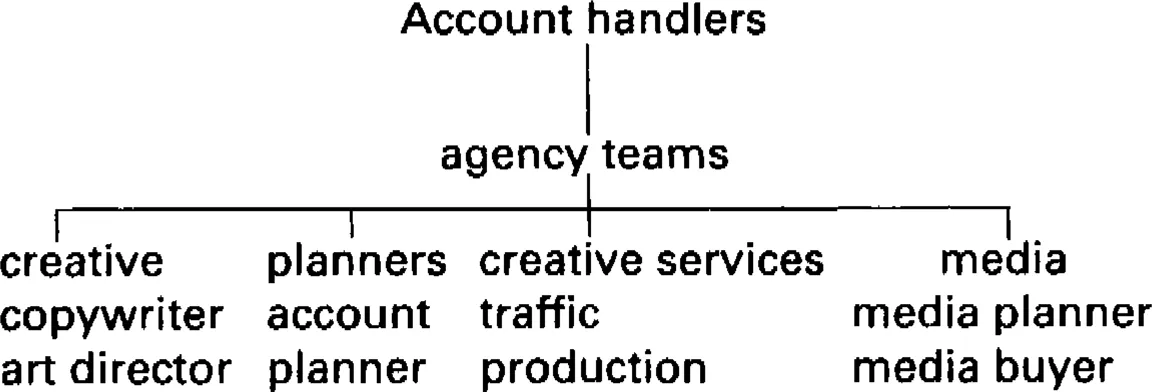
Advertising agencies employ creative teams, usually a duo of an art director and a copywriter, to produce the advertising idea, normally called a concept, and subsequently any pictures and words that will eventually go into the advertising. The agency can also buy these skills freelance, especially if it is particularly busy. These people are often called creatives.
In fact, all sorts of specialists contribute facts, thoughts, opinions and ideas before a definitive brief is written for the copywriter and art director (the creative team) whose job it is to think up the ideas that will eventually be seen by the public as finished advertisements: the single pieces of persuasion that both client and agency believe will say the right things, to the right people, at the right time, to get consumers trying or buying the product.
Many larger agencies have people responsible for ensuring that internal work is done on time and that quality control systems are applied. Usually they are called traffic people. Control systems often mean that work must be approved by senior staff before it can be presented to the client, and that all work must be checked. The traffic department is the nerve centre of the agency. It ensures that each brief and advertisement is correctly routed through the agency, and that everything happens according to plan. Traffic people must produce a detailed timing plan which covers all stages of production and tallies with the media plan, and they must see that it is followed.
Most agencies also employ production experts, who are concerned with the quality of the finished advertisements, which are normally completed outside the agency by suppliers, including studios and typesetting houses and, whenever necessary, directors and production companies, photographers and illustrators. The biggest agencies often have specialist TV departments to oversee the finished quality of all their TV, radio and cinema work. Agencies usually mark up outside production costs which are incurred on their clients’ behalf. They mark up the net amounts by 17.65 per cent which equates to 15 per cent of the gross, or by whatever they think they can get away with.
Most agencies also have a vouchers department. It is its responsibility to obtain a copy of every advertisement that appears in print. It supplies the accounts department with the relevant newspaper or magazine, which is affixed to the agency’s invoice for the space. Some advertisers refuse to pay unless they receive a voucher copy. They want to see for themselves that the advertisement has appeared and to check the quality of the printing. If the client’s product looks cheap and nasty because of poor printing, he is entitled to an apology, a reduction in the bill, or a free repeat appearance if the reproduction was really poor.
Larger agencies often put traffic people and production people into one department. Its function is to help provide the right environment and working habits for good advertising to be created. It is usually called a Creative Services department.
Agencies do not keep photographers, illustrators, musicians, film directors a...
Table of contents
- Cover Page
- Half Title Page
- Title Page
- Copyright Page
- Title Page 01
- Copyright Page 01
- Table of Contents
- Foreword
- Acknowledgements
- 1 Introduction
- Part I Account handling
- Part II Creating campaigns
- 7 Putting the brief in
- 8 How to help your creative team
- 9 What’s the big idea?
- 10 Sell, sell, sell
- 11 Buy, buy, buy
- 12 Into production
- 13 Will it do the Job?
- Part III The rest
- 101 Handy definitions
- Index
Trusted by 375,005 students
Access to over 1.5 million titles for a fair monthly price.
Study more efficiently using our study tools.
Frequently asked questions
Yes, you can cancel anytime from the Subscription tab in your account settings on the Perlego website. Your subscription will stay active until the end of your current billing period. Learn how to cancel your subscription
No, books cannot be downloaded as external files, such as PDFs, for use outside of Perlego. However, you can download books within the Perlego app for offline reading on mobile or tablet. Learn how to download books offline
Perlego offers two plans: Essential and Complete
- Essential is ideal for learners and professionals who enjoy exploring a wide range of subjects. Access the Essential Library with 800,000+ trusted titles and best-sellers across business, personal growth, and the humanities. Includes unlimited reading time and Standard Read Aloud voice.
- Complete: Perfect for advanced learners and researchers needing full, unrestricted access. Unlock 1.5M+ books across hundreds of subjects, including academic and specialized titles. The Complete Plan also includes advanced features like Premium Read Aloud and Research Assistant.
We are an online textbook subscription service, where you can get access to an entire online library for less than the price of a single book per month. With over 1.5 million books across 990+ topics, we’ve got you covered! Learn about our mission
Look out for the read-aloud symbol on your next book to see if you can listen to it. The read-aloud tool reads text aloud for you, highlighting the text as it is being read. You can pause it, speed it up and slow it down. Learn more about Read Aloud
Yes! You can use the Perlego app on both iOS and Android devices to read anytime, anywhere — even offline. Perfect for commutes or when you’re on the go.
Please note we cannot support devices running on iOS 13 and Android 7 or earlier. Learn more about using the app
Please note we cannot support devices running on iOS 13 and Android 7 or earlier. Learn more about using the app
Yes, you can access Advertising for Account Holders (RLE Marketing) by Nigel Linacre in PDF and/or ePUB format, as well as other popular books in Business & Business General. We have over 1.5 million books available in our catalogue for you to explore.