![]()
Part I
Activity Theory
![]()
Joanne Hardman and Alan Amory
Introduction
South Africa faces an educational crisis that has seen its schooling population placed last on international benchmarking tests in crucial areas such as mathematics and science (Howie, 2001; Evans, 2013). The effect of poor educational attainment at a school level is felt in higher education settings, where lecturers are faced with students who have not been sufficiently prepared to engage with academia (Hardman & Ng’ambi, 2003). In a bid to effect pedagogical change to meet the needs of diverse students, some lecturers have turned to the use of emerging technologies as developmental tools to assist students in accessing academia successfully. The project that informs this book seeks to investigate what emerging technologies are utilized in higher education in South Africa and Australia as well as developing an understanding of how these technologies potentially can affect pedagogical change. While some cases referred to in the book are drawn from Australia, the primary context for this book is South Africa, a country characterized by a turbulent history that continues to influence students’ developmental trajectories today. This is a multicultural country with 11 national languages, steeped in a history of unequal access to educational opportunities; clearly, to understand the subtleties of any transformative process in this country requires a theoretical framework capable of speaking to cultural and historical influences. To this end, the book adopts a Cultural-Historical Activity Theory framework (CHAT) as a foundation for understanding change as culturally and historically informed. Part I of this book introduces CHAT against the background of three case studies that utilize this framework in order to understand the potentially transformative nature of emerging technologies in higher education. All the cases reported in Part I of this book aim to understand teaching/learning with technology as culturally situated, historically informed, complex activity systems, imbued with power and control, which directs how emerging technologies are taken up as developmental tools. This introductory chapter outlines a brief history of the ideas that inform CHAT. As the focus of Part I of this book is on understanding pedagogy with emerging technology, the introductory chapter focuses its argument on understanding pedagogy as an activity system.
Vygotsky and mediation: towards a theory of pedagogy as an activity system
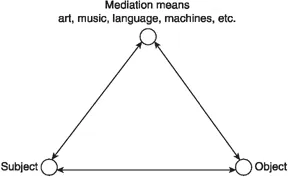
Operating from a Marxist conceptualization of psychology as emerging socially, Vygotsky (1978) proposed that human learning, the development of uniquely human higher cognitive functions, requires the appropriation of cultural tools through a process of mediation. This process is illustrated in Figure 1.1.
The simple brilliance of Figure 1.1 illustrates Vygotsky’s assertion that higher cognitive functions are necessarily mediated, while lower, elementary functions, illustrated at the base of the triangle, are innate and shared with animals. This represented a clear departure from the Piagetian epistemic subject popular at the time of Vygotsky’s writing. In Figure 1.1, elementary mental functions (those shared with animals) take place at the base of the triangle. That is, the subject acts directly on the object; however, higher cognitive functions, those functions unique to humans, must necessarily be mediated, as indicated in the triangle’s apex. Wertsch (1985) points out that Vygotsky conceived of this as the difference between the ‘natural’ line of development and the ‘social’ or ‘cultural’ line of development that converts elementary forms into higher cognitive functions. Wertsch (1985, p. 25) outlines the four major criteria that distinguish elementary from higher cognitive functions:
1 The emergence of voluntary regulation, indicated in a shift from environmental to individual control.
2 The emergence of conscious realization of mental processes.
3 The social origin and nature of higher cognitive functions captured in Vygotsky’s general genetic law, which states that all higher cognitive functions begin in external, social interaction, before turning inward.
The very mechanism underlying higher mental functions is a copy from social interaction; all higher mental functions are internalized social relationships …Their composition, genetic structure, and means of action [forms of mediation] – in a word, their whole nature – is social. Even when we turn to mental [internal] processes, their nature remains quasi-social. In their own private sphere, human beings retain the functions of social interaction.
(p. 25)
Figure 1.1 Vygotsky’s human learning through mediation
4 The use of signs to mediate higher cognitive functions. Vygotsky distinguishes between object-oriented external technical tools and subject-oriented internal, psychological tools (or signs).
[A technical tool] … serves as a conductor of humans’ influence on the object of their activity. It is directed toward the external world; it must stimulate some changes in the object; it is a means of humans’ external activity, directed toward the subjugation of nature.
(Vygotsky, quoted in Wertsch, 1981)
A psychological tool, or sign, however:
changes nothing in the object of a psychological operation. A sign is a means for psychologically influencing behaviour – either the behavior of another or one’s own behaviour; it is a means of internal activity, directed toward the mastery of humans themselves. A sign is inwardly directed.
(Vygotsky, quoted in Wertsch, 1981)
Languages, maps, mnemonic techniques are some examples Vygotsky gives of psychological tools. Kozulin (2003, p. 16) defines psychological tools as:
those symbolic artifacts – signs, symbols, texts, formulae, graphic organizers – that when internalized help individuals master their own natural psychological functions of perception, memory, attention, and so on (see Kozulin, 1998). Each culture has its own set of psychological tools and situations in which these tools are appropriated.
What is of interest in the Kozulin quote is the focus on how culture plays a central role in the acquisition of psychological tools. This is of interest, especially, in South Africa that is a multicultural society. We may well expect to see performance differences on tasks, depending on the nature of the psychological tools actors bring to bear on the task. It is important therefore to keep in mind that psychological tools are social in origin and are not innate. For Miller (2011):
the mediating role of signs is directed at mental activity, or what he [Vygotsky] called higher mental functions, the point being that these mental functions are “higher” precisely because of the mediation of signs. The notion of an agent lugging a cultural toolkit around … manages to miss entirely Vygotsky’s core idea that the mediational means or psychological tools are part of the constitution of the agent, of the development of the agent’s higher mental functions, and not a constituent part of the agent’s actions “-with-” which, or by means of which, an action is accomplished … In Vygotsky’s conception … mediational means are not things an agent acts with or uses to accomplish an action like a carpenter acting with a hammer, or a vaulter with a pole, or a researcher with graph paper. Mediation in Vygotsky’s terms is what determines the form of the action and not what constitutes the action. In this sense, it refers to higher mental processes that precede and shape the action, processes that enable the carpenter to reach out for the hammer to achieve a certain goal rather than the act of hammering-with-the-hammer.
(pp. 314–315)
Implicit and explicit mediation
Explicit mediation is the intentional use of objects, people or signs by an individual that “overtly and intentionally introduces a ‘stimulus means’ into an ongoing stream of activity” (Wertsch, 2007, p. 180) that is obvious and non-transitory. Implicit mediation, on the other hand, is less obvious but involves signs, especially language and communication. Whether mediation operates through direct intervention or through language and signs, individual transformation, by necessity, includes both explicit (tools and signs operating on other minds) and implicit (internal tools and signs actions) operating modes of mediation. But Vygotsky also used the term mediation in another way related to reflective and non-reflective mediation. Reflective mediation is about thinking about the tool/sign while undertaking an activity, and during non-reflective activity the subject/actor is concentrated on the particulars of a task without thought of the tool/sign.
Mediation can be viewed from different perspectives, but always includes either a material tool or a cognitive sign; may also be explicit or implicit; and may include reflection or not. In addition, mediation is hierarchical, and “not only refers to the nature of what goes on between people … but also to the process of co-creation between the social world and the internal world of ideas, feelings, and personal development” (Edwards, 2008, p. 174). Finally, for Vygotsky (1978), the primary form of mediation is semiotic; it is primarily through language that the social becomes personal. Hasan (2002) posits that there are a number of implications that arise as a result of linking higher mental functions to semiotic mediation. First, the origins of consciousness lie in the social interpersonal interactions, and second, the enabling nature of higher mental functions contributes to the evolution of humanity and allows us to sidestep the dualism contained in the nature/nurture debates by emphasizing that mind is in fact social.
Mediation with educational technology
The intentional use of explicit and implicit mediation in learning design could offer us a mechanism to ensure that we more carefully marry social-cultural theory to practice. Wertsch (2007) spoke of the intentional insertion of a tool, or sign, into an ongoing stream of activity (explicit) and also the intentional inclusion of opportunities for dialogue (dialogical activity). In the following authentic task, the different forms of mediation (explicit versus implicit, and tool versus sign)1 are highlighted:
Your Head of Department (HOD) has just had one of those cathartic moments: game-based learning is the way to go! While this may be an interesting development...