- 360 pages
- English
- ePUB (mobile friendly)
- Available on iOS & Android
eBook - ePub
About this book
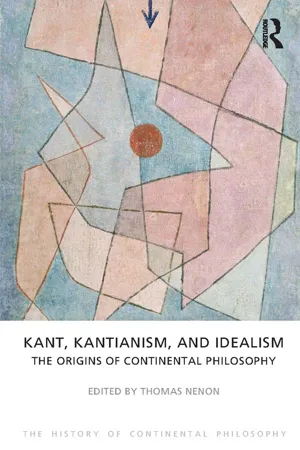
"Kant, Kantianism and Idealism" presents an overview of German Idealism, the major movement in philosophy from the late 18th to the middle of the 19th Century. The period was dominated by Kant, Fichte, Schelling and Hegel, whose work influenced not just philosophy, but also art, theology and politics. The volume covers not only these major figures but also their main followers and interpreters. These include Kant's younger contemporary Herder, his early critics such as Jacobi, Reinhold, and Maimon, and his readers Schiller and Schlegel - who shaped much of the subsequent reception of Kant in art, literature and aesthetics - as well as Schopenhauer, whose unique appropriation and criticism of theories of cognition later had a decisive influence on Nietzsche. The "Young Hegelians" - such as Bruno Bauer, Ludwig Feuerbach, and David Friedrich Strauss, whose writings would influence Engels and Marx - are also discussed. The influence of Kant and German Idealism also extended into France, shaping the thought of such figures as Saint-Simon, Fourier, and Proudhon, whose work would prove decisive for subsequent philosophical, political, and economic thinking in Europe in the second half of the 19th century.
Information
1
IMMANUEL KANT’S TURN TO TRANSCENDENTAL PHILOSOPHY
Thomas Nenon
The year 1781 marks the beginning not only of a remarkably productive two decades in Kant’s own work, but in many ways also a decisive turning point in the history of philosophy. Up until that point, Kant1 was known as a gifted, but not very significant figure in the German philosophical scene. But 1781 marked the appearance of the first edition of the Critique of Pure Reason, in which Kant introduced a “critical” philosophy with a radical new approach to traditional questions in epistemology and metaphysics that completely reshaped the philosophical landscape. In the years that followed, he would produce equally significant and original contributions to philosophical ethics in his Groundwork of the Metaphysics of Morals (1785), Critique of Practical Reason (1788), and in the second part of his Metaphysics of Morals (1797); an influential new approach to theories of art and the production of artworks in his Critique of Judgment (1790), novel ways of considering the philosophy of history in the Critique of Judgment and in his later political essays such as “Concerning Perpetual Peace” (1795); important reinterpretations of theological themes in all of these works and in his Religion Within the Boundaries of Mere Reason (1793); and theories of the state and society in the first part of the Metaphysics of Morals and in his later essays. The impact that this work had on the history of philosophy in general and on what later, in the second half of the twentieth century, would come to be known as “continental philosophy” can hardly be overstated.
I. EARLY WORKS
The publications prior to 1781 are commonly referred to as Kant’s “precritical writings.” They give little hint of the scope, originality, and significance of the work that was to follow. Of relatively modest origins (his father was an independent harness-maker), Kant was raised and schooled in an atmosphere that was strongly influenced by Pietism.2 As he began his university studies at the age of sixteen, however, he was also strongly influenced by the theology professor Franz Albert Schultz (1692–1763) and the philosophy professor Martin Knutzen (1713– 51), both of whom took seriously the work of the Leibnizian Christian Wolff (1679–1754), who had been banished from Prussia at the urging of some orthodox Pietists, who saw his relatively enlightened adoption of Leibnizian philosophical positions such as pre-established harmony as a threat to traditional religious belief. Other prominent influences there were professors oriented on Aristotelian philosophy and on Christian Thomasius’s (1655–1728) eclecticism.
Kant’s earliest publications deal with questions at the intersection of natural science and philosophy and on methodological issues in philosophy and theology. His first book, Thoughts on the True Estimation of Living Force, written in 1746 and published in 1749 when Kant was still a young student, and his 1755 dissertation Succinct Exposition of Some Meditations on Fire and his General History of Nature and Theory of the Heavens from the same year are examples of the former; prime examples of the latter are his 1755 essay A New Exposition of the First Principles of Metaphysical Knowledge, which he defended as part of the requirements for his appointment as private docent, his essay on The Only Possible Basis of a Demonstration of the Existence of God (1763), his Investigations of the Clarity of the Principles of Natural Theology and Morals (1764), and the inaugural dissertation On the Form and Principles of the Sensible and the Intelligible World, which he defended in conjunction with his appointment to the rank of professor in 1770. The underlying issues throughout all of these works is the attempt to reconcile the empirical and rational grounds of knowledge and the question of the possibility and limits of metaphysical reasoning in resolving disputes regarding natural phenomena such as comets, tides, and fire as well as debates in theology, morals, and rational psychology. They also show how he began to move beyond the framework of rationalist metaphysics in the Leibniz-Wolffian mode and to incorporate the critical stance of thinkers such as Rousseau and Hume into his own work.
During his years as private docent, Kant’s sole source of income was the fees paid by the students who attended his lectures. Nonetheless, it is also during this period that Kant gained a reputation for sociability and a kind of urbane cosmopolitanism in spite of the fact that he had not ventured (and never would travel) more than about a hundred miles from Königsberg.3 His appointment to a professorship in 1770 alleviated his financial concerns considerably, but during the following ten years prior to 1781, Kant’s publication output was so scant4 that this period of his career has become known as “the silent decade.”5
One way to introduce the problems that occupied Kant’s thinking during that decade is in terms of the positions he defended in his inaugural dissertation about how knowledge6 in general is possible, and more specifically rational metaphysical knowledge of what he calls the “sensible and intelligible worlds.” He notes there, for instance, that there are certain “forms” that seem to be invariant features of every object even within the sensible world, namely space and time, but that these forms are not “rational forms or nexus of objective ideas” but rather “phenomena” that “attest to some principle of universal conjunction but do not exhibit it.”7 Moreover, with regard to the “matter” or “contents” as opposed to the form of objects within the sensible world, metaphysical knowledge cannot say anything, since from the standpoint of metaphysics these appear as “accidents” or “contingencies” that cannot be derived from the concepts of those things. Knowledge of these properties or determinations of objects in the “sensible world” is given to us through sensibility, not through the intellect (commonly translated into English as “understanding” as a result of Kant’s own translation of the Latin term “intellectus” into the German “Verstand”). This “sense knowledge” provides us, he says there, “merely representations of things as they appear; intellectual knowledge by contrast are representations of things as they are” (ID, II, 392). He traces back the form of these objects to a kind of image that results from laws innate to the subject and its mind. Since these images, space and time, are the forms of all appearances, Kant says, they are nonetheless “true” because they are necessary components of the appearance of any sense object.
Insight into the “intellectual world” that provides access to the “things themselves” is for Kant still seen as possible through the employment of concepts that are accessible to the intellect (at this stage Kant does not distinguish between what will later be seen as the two different faculties of the understanding and of reason). Hence, methodological reflection must restrict the use of the principles of the sensible world to appearances; however, Kant still maintains that proper employment of intellectual concepts such as “cause” “substance,” and “necessity” can be employed to attain knowledge of the things in themselves in a manner similar to the analyses conducted in Leibnizian-Wolffian metaphysics. The guarantee for the possibility of such knowledge is the fact that, “The human mind is only affected by external things and the world is only infinitely accessible to human intuition to the extent that it, together with everything else, is sustained by one and the same infinite power of a single entity” (ID, II, 409), a view that, he admits, puts him in close company with Malebranche, “namely that we intuit everything through God” (ibid.). In spite of the similarities of several of these doctrines with the positions later expounded in the Critique of Pure Reason, for instance the conception of space and time as forms of the sensible world that have their origin in the subject and hold only for appearances, the dominant idea here is still that traditional metaphysical knowledge of things in themselves is possible through the proper employment of intellectual concepts.
II. THE CRITIQUE OF PURE REASON
The basic question that Kant wrestles with during the following ten years can be summarized most succinctly through a famous quote from a letter to his friend and student Marcus Herz dated February 21, 1772. In his reflections on a “general phenomenology” that would introduce a theoretical metaphysics that could provide the basis for practical philosophy, he notes that:
As I thought through the theoretical part, considering its whole scope and the reciprocal relations of all of its parts, I noticed that I still lacked something essential that I had failed to pay attention to and that, in fact, constitutes the key to the whole secret of hitherto still obscure metaphysics. I asked myself: What is the ground of the relations of that in us which we call “representation” to the object?(AA X, 129– 35)
If the sensibility simply gives us representations of the objects and not the objects, then one finds oneself trapped in the problem that has vexed modern philosophers from Descartes to Hume, namely, how do we know that these representations are “true,” that is, correspond to the objects they purport to give us? If the reply falls out along the lines of the inaugural dissertation, and we count truth as agreement with the representations, then it seems we abandon any claims to genuine objectivity except by recourse to the creator God who governs the order of nature and the order of the human mind accordingly. Moreover, the entire edifice rests on the ability of the intellect’s concepts to grasp the true nature of the things themselves, that is, the universe, the mind, and God without any reliance on the senses – and if the guarantee for the ability of the mind’s ability to do so is supposed to be a benevolent and all-powerful creator God who is the source of the universe and the mind’s order, then this seems to fall prey to the same sort of circularity that befell Descartes. When Kant later famously attributes Hume with having awakened him from his “dogmatic slumbers” (Prol, IV, 260), it is precisely these kinds of questions that he recognizes his previous position could not answer.
Kant famously describes the radicality and originality of his solution to the problem in the Critique of Pure Reason through a comparison with Copernicus’s “revolution in the way we think” (B XXII n.). Instead of assuming that the objects have a pregiven structure in themselves and then asking how human cognition can come to know it, Kant says that we should pursue the hypothesis that there are structures of knowledge that are necessary for the very experience of any object so that any object we can ever possibly experience must conform to and hence exhibit those structures. Although he makes clear that he begins with this assumption as a hypothesis, he believes that the results of the analyses he presents in the Critique confirm that he has taken the right approach. Just as Copernicus begins with a counterintuitive assumption that ends up providing a better and more elegant solution that still explains the facts we observe about planetary movement in our daily lives, Kant believes that by adopting several counterintuitive philosophical assumptions, he can explain and vindicate our everyday beliefs about things that are otherwise difficult to explain.
The general structure of the Critique still exhibits traces of the overall organization of Wolff’s metaphysical system that began with a “metaphysica generalis vel ontologia”, followed by a “metaphysica specialis” that is subdivided into a rational psychology, a rational cosmology, and a rational theology. The former corresponds roughly to Kant’s “Transcendental Aesthetic” and “Transcendental Analytic,” which represents the first section of the “Transcendental Logic”; the latter to the “Transcendental Dialectic,” which makes up the second section of the “Transcendental Logic.” Together, the “Transcendental Aesthetic” and the “Transcendental Logic” are grouped together under the heading of a “Transcendental Doctrine of the Elements,” which constitutes about 80 per cent of the book. They are preceded by a brief “Preface” and a longer “Introduction,” which outline his general approach, and the book closes with a “Transcendental Doctrine of Method,” which provides some general reflections on the method of Kant’s transcendental philosophy, and an architectonic that outlines the systematic place of various philosophical topics that may be treated with the framework of transcendental philosophy.
The “Transcendental Analytic” shares with traditional ontology the claim that it can show the formal principles of any object whatsoever, with the important caveat, however, that these principles apply only to the extent that these objects can be objects of experience for us. This means that it must remain mute about the possibility that there can be objects that may exist but lie beyond the range of possible experience for us. The “Transcendental Dialectic” then turns explicitly to such objects, namely the soul, the world as a whole, and God, showing why human reason inevitably gives rise to such ideas, but demonstrating that and why experience can neither confirm nor refute the existence of those objects.
Much of the Critique hinges on Kant’s analysis of the very notion of “experience” (Erfahrung) itself. In fact, in several places Kant explicitly describes the project as a “Zergliederung” – literally a “dissection” or, to use a Greek term that provides the basis for the common English translation of the term, the “analysis” (“breaking up“ or “taking apart”) – of knowledge and the appearances that are given to us in experience. Kant tries to show that experience involves more than just having sense impressions – or even having them against the backdrop of a formal backdrop of space and time as he had described in the inaugural dissertation. Rather, it must be organized in terms of concepts that bring these impressions into some sort of unity. And, of course, from the very outset, Kant had believed that, at least for objects in the sensible world, concepts alone are not sufficient without some input from the senses. Hence Kant’s famous dictum: “Thoughts without concepts are empty, intuitions without concepts are blind” (A 51/B 75). The general view is that positive knowledge is possible only on the basis of experience, which necessarily involves both sense experience (intuitions) and the operations of the intellect (concepts). In the Critique, Kant further distinguishes between those functions of the mind that are involved in the organization and unification of intuitions into knowledge from the functions that involve the higher-order unifying operations of seeking overarching unities or ultimate grounds for knowledge in objects that lie outside the realm of sense experience. The former he calls “Verstand” or “understanding”; for the latter, he reserves the term “Vernunft” or “reason” in the strict sense. He concedes, though, that the term “reason” is often used ambi...
Table of contents
- Cover
- Half Title
- Title Page
- Copyright Page
- Table of Contents
- Series Preface
- Contributors
- Introduction
- 1. Immanuel Kant's turn to transcendental philosophy
- 2. Kant's early critics: Jacobi, Reinhold, Maimon
- 3. Johann Gottfried Herder
- 4. Play and irony: Schiller and Schlegel on the liberating prospects of aesthetics
- 5. Fichte and Husserl: life-world, the Other, and philosophical reflection
- 6. Schelling: philosopher of tragic dissonance
- 7. Schopenhauer on empirical and aesthetic perception and cognition
- 8. G. W. F. Hegel
- 9. From Hegelian reason to Marxian revolution, 1831–48
- 10. Saint-Simon, Fourier, and Proudhon: “Utopian” French socialism
- Chronology
- Bibliography
- Index
Trusted by 375,005 students
Access to over 1.5 million titles for a fair monthly price.
Study more efficiently using our study tools.
Frequently asked questions
Yes, you can cancel anytime from the Subscription tab in your account settings on the Perlego website. Your subscription will stay active until the end of your current billing period. Learn how to cancel your subscription
No, books cannot be downloaded as external files, such as PDFs, for use outside of Perlego. However, you can download books within the Perlego app for offline reading on mobile or tablet. Learn how to download books offline
Perlego offers two plans: Essential and Complete
- Essential is ideal for learners and professionals who enjoy exploring a wide range of subjects. Access the Essential Library with 800,000+ trusted titles and best-sellers across business, personal growth, and the humanities. Includes unlimited reading time and Standard Read Aloud voice.
- Complete: Perfect for advanced learners and researchers needing full, unrestricted access. Unlock 1.5M+ books across hundreds of subjects, including academic and specialized titles. The Complete Plan also includes advanced features like Premium Read Aloud and Research Assistant.
We are an online textbook subscription service, where you can get access to an entire online library for less than the price of a single book per month. With over 1.5 million books across 990+ topics, we’ve got you covered! Learn about our mission
Look out for the read-aloud symbol on your next book to see if you can listen to it. The read-aloud tool reads text aloud for you, highlighting the text as it is being read. You can pause it, speed it up and slow it down. Learn more about Read Aloud
Yes! You can use the Perlego app on both iOS and Android devices to read anytime, anywhere — even offline. Perfect for commutes or when you’re on the go.
Please note we cannot support devices running on iOS 13 and Android 7 or earlier. Learn more about using the app
Please note we cannot support devices running on iOS 13 and Android 7 or earlier. Learn more about using the app
Yes, you can access Kant, Kantianism, and Idealism by Thomas Nenon in PDF and/or ePUB format, as well as other popular books in Philosophy & Philosophy History & Theory. We have over 1.5 million books available in our catalogue for you to explore.