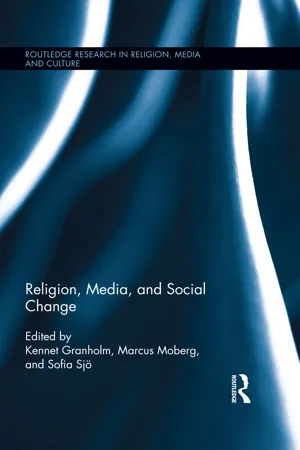
In an era of heightened globalization, macro-level transformations in the general socioeconomic and cultural makeup of modern societies have been studied in great depth. Yet little attention has been paid to the growing influence of media and mass-mediated popular culture on contemporary religious sensibilities, life, and practice. Religion, Media, and Social Change explores the correlation between the study of religion, media, and popular culture and broader sociological theorizing on religious change. Contributions devote serious attention to broadly-defined media including technologies, institutions, and social and cultural environments, as well as mass-mediated popular culture such as film, music, television, and computer games. This interdisciplinary collection addresses important theoretical and methodological questions by connecting the study of media and popular culture to current perspectives, approaches, and discussions in the broader sociological study of religion.
eBook - ePub
Religion, Media, and Social Change
- 214 pages
- English
- ePUB (mobile friendly)
- Available on iOS & Android
eBook - ePub
Religion, Media, and Social Change
About this book
Information
1
Introduction
Contemporary intersections of religion, media and mass-mediated popular culture are having an increasingly noticeable impact on the very character and nature of religion and religious life and practice across the globe. A number of recent studies have highlighted the ways in which media shape views on religion, how religion and religious practice are being affected by media and mass-mediated popular culture and how the increasingly pervasive media environment of today has grown into an ever more important resource and site for the exploration of religious ideas and the construction of religious identities and worldviews.1 In order to reach a more comprehensive understanding of contemporary processes of religious change, further scholarly attention must be paid to the multitude of intersections of religion, media and mass-mediated popular culture.
This volume aims to contribute with some perspectives and insights that can help guide future research in this area through focusing on the interplay between religion, media and mass-mediated popular culture in relation to broader processes of social and religious change since the mid-twentieth century, particularly as theorised in the sociological study of religion.
This introduction outlines how the terms ‘social change’ and ‘religious change’ are understood and employed in the context of the present volume and critically discusses the relation of the study of religion, media and mass-mediated popular culture with the broader sociological study of religion. It also provides a brief description and discussion of the individual contributions to the volume and the ways in which they advance our understanding of the aforementioned issues.
1. A Changing Social World
The story of social change in the West can be told in several ways. In the context of the present volume, the broad and frequently ambiguous term ‘social change’ is understood as a general umbrella term for a range of closely interrelated macro-level processes that are typically taken to have impacted greatly on the socioeconomic and cultural makeup of Western societies in particular. These include a range of interrelated (yet partly contrasting) processes that, following Haraway, can be approached as multiple ‘horns’ of a ‘wormhole’2—a metaphor intended to illustrate how different aspects or elements of what is most commonly included under the heading of social change ‘appear and disappear in the fabric of one another’.3
First and foremost among these is the highly multifaceted process of globalisation, which is often presented as something of a ‘prime mover’ that most other processes of social change need to be related to.4 Encapsulating the constantly intensifying global movement and criss-crossing of populations, information, economics and ideas and so on, globalisation has had far-reaching implications for social and cultural life, including religion and religious life, across the globe. Among many other things, globalisation has cultivated religious diversification and pluralisation in many parts of the world through migration, the emergence of transnational religious diasporas and the global flow of religious ideas.
Globalisation also goes hand in hand with rapid technological development in modern times. Technology has increasingly become implicated in a range of other central processes of social change relating to, among other things, the emergence of a global economic system, industrialisation and rationalised techniques of production and manufacture, transnational travel and profound advances in health care, reproduction and our understanding of the human body.5 The development of modern communications technologies and digital technologies in particular has fundamentally altered not only our means of communication and interaction but also our sense of time and space. As argued by some influential theorists, in an age of instantaneous global communication, social relations have become ever more characterised by ‘relations between “absent” others, locationally distant from any given situation of face to face interaction’.6 The seemingly accelerating development of ‘technologies, institutional arrangements, circulatory systems, and shifting modalities of reception’7 that are collectively referred to as ‘media’ have no doubt also increasingly come to both provide the environments and set the parameters for how religious communities of virtually all strands organise, function, interact, construct, express and communicate their messages and activities (both outward and inward) in ways unknown to previous generations.8
Furthermore, globalisation and technological development are intimately connected to a range of significant changes and restructurings of the global political economy following the spread and implementation of neoliberal ideology since the 1980s, the emergence of transnational corporations and the establishment of consumerism as the dominant cultural ethos of late modernity.9 The rise of neoliberalism and consumerism has coincided with major shifts in the global religious field, thus further highlighting the need for processes of religious change to be approached and understood against the background of the more general ‘recent shaping of culture by economics’.10 For example, the increasing marketisation of ever more spheres of contemporary institutional life has greatly affected the very self-understanding and organisational culture of many long-established religious institutions that, faced with additional challenges brought by shrinking church membership and changing church–state relations, now find themselves in a situation in which austerity has emerged as a key agent of change, compelling them to downsize, economise and continuously rethink their organisational structures and communicative strategies.11
These processes of social change are frequently taken to have entailed a general shift from a traditional to a posttraditional society, chiefly expressed in changes in authority structures that promote increased individualisation. As explored in detail in the work of many influential social theorists,12 ‘stripped of tradition, time/space, class, categories and so on, the basic unit of social reproduction is now claimed to be the individual’.13 This development has had further consequences for religion, leading to an accelerated individualisation and privatisation of religion and the gradual erosion of received understandings of religious tradition.
As noted in much literature on the topic, the processes of social change briefly sketched here have also brought about both a certain homogenisation of lifeworlds and an intensified polarisation between different populations and regions of the world (e.g. between rich and poor).14 One of the consequences of the dissolution of traditional authority, changing time–space relations, modes of work and production and individualisation is that traditionally established understandings of gender and gender roles are no longer taken for granted but are rather routinely questioned as open-ended categories. The same is true for notions of power, hierarchy and authority.
It is worth noting here that when striving to describe the various relationships among these different yet closely intertwined processes of social change, it becomes difficult to draw clear distinctions between these processes and their actual and presumed outcomes. Rather than trying to distinguish between processes and outcomes, the two are more usefully viewed as standing in a dialectical relationship to one another, with processes of social change (e.g. globalisation and technological development) producing certain outcomes which in turn continuously feed back into and transform these processes themselves, thus further producing yet different outcomes and so on.
Although many additional significant processes of change could be identified and be subsumed under the heading of ‘social change’, the processes outlined are commonly taken to have impacted decisively on contemporary religion and religious life and practice. What, then, are the specific consequences of these often quite ineffable and elusive macro-level social changes for the character of contemporary religion, and how it is understood, practiced and lived?
2. Social Change—Religious Change
The sociological study of religion has been grappling with the types of issues outlined in the previous section ever since the late nineteenth and early twentieth centuries. Fast-forwarding to the present, the sociological study of religion currently finds itself in a transitory phase marked by the rethinking and abandonment of earlier monolithic secularisation theories coupled with a growing need for novel perspectives and further theoretical innovation in order to make sense of the changing nature of religious life in the Western world, as well as beyond it.
The impact of the aforementioned processes of general social change on contemporary religion and religious life has long been studied under the (often equally ambiguous) concept of ‘religious change’. In the context of the present volume, ‘religious change’ is understood broadly and used to denote the actual as well as presumed effects and consequences of the aforementioned processes of social change on contemporary religion and religious life and practice across Western societies in particular.
Macro-level processes of social change translate into processes of religious change in complex ways and become most clearly identifiable and observable in relation to a range of accompanying meso-level social changes, such as changes in state and government policies and regulatory systems, changes in the power relations between different social and cultural institutions and organisations vis-à-vis various religious institutions, organisations and communities and the interplay between the local and the global in particular national and regional contexts. Among the types of actual, empirically observable changes most commonly subsumed under the heading of ‘religious change’, one could pick out the following closely interrelated, much-studied developments in particular: long-term general institutional religious decline; changing religious community and organisational structures resulting in the emergence of so-called ‘postinstitutional’, ‘posttraditional’ or ‘detraditionalised’ forms of religiosity; progressively weakening mechanisms of traditional and institutional religious socialisation; a significant growth in the number of people who identify as ‘non-religious’,15 the proliferation of ‘alternative spiritualities’, an increasing privatisation of religious life and practice; and changes in the environments, spaces and ‘locations’ of religion following the development of so-called new media.
These developments all constitute central areas of study within the sociology of religion today. Understood in this general way, ‘religious change’ has been approached and conceptualised through a wide range of interrelated and sometimes contrasting theoretical concepts and frameworks such as secularisation, desecularisation, resacralisation, reenchantment, subjectivisation, postsecularity, de-Christianisation and unchurching, to name just a few. However, apart from a few notable exceptions,16 such theorising has so far rarely devoted any serious attention to the growing influence and impact of media (understood broadly in terms technologies, institutions, infrastructures, social and cultural environments etc.) and mass-mediated popular culture (in the form of film, popular music, television, computer games etc.) on contemporary religious sensibilities, life and practice.
3. Religion, Media and Mass-Mediated Popular Culture and the Sociological Study of Religion
As Stewart M. Hoover and Knut Lundby argued already in 1997: ‘Sociologists of religion […] have tended to avoid the problematization of media as rendering any unique contribution to modernity or postmodernity. They have not arrived at any general theory of how media fundamentally changes cultures—and religion—in spite of the fact that much such work […] is highly suggestive’.17 They went on to argue how rethinking the relationship between religion and media has ‘to begin with more general reflections on media, religion, and culture as they are embedded in changes in society’.18 A very similar point was raised by Jeremy Stolow nearly a decade later: ‘if an emerging consensus suggests that religion is everywhere now, thanks in no small measure to the media technologies that carry it into our homes and streets and places of power, it is hardly evident that there exists a readily available conceptual language for making this ubiquity intelligible’.19 These thoughts are further echoed by Hoover, who argues that ‘the “common culture” represented by the media has today become determinative of the contexts, extents, limits, languages, and symbols available to religious and spiritual discourse’.20
These observations highlight the extent to which various forms of media have become integrated into the very fabric of both public and private social and cultural everyday life. During past decades (varyingly empirically sub...
Table of contents
- Cover Page
- Half Title page
- Series page
- Title Page
- Copyright Page
- Contents
- Acknowledgements
- 1 Introduction
- Part I Theorising Media and Religion in the Public Sphere
- Part II Media, Popular Culture and Contemporary Religious Sensibilities and Communities
- Part III Impacts and Outcomes of Contemporary Encounters between Religion, Media and Popular Culture
- Contributors
- References
- Index
Trusted by 375,005 students
Access to over 1.5 million titles for a fair monthly price.
Study more efficiently using our study tools.
Frequently asked questions
Yes, you can cancel anytime from the Subscription tab in your account settings on the Perlego website. Your subscription will stay active until the end of your current billing period. Learn how to cancel your subscription
No, books cannot be downloaded as external files, such as PDFs, for use outside of Perlego. However, you can download books within the Perlego app for offline reading on mobile or tablet. Learn how to download books offline
Perlego offers two plans: Essential and Complete
- Essential is ideal for learners and professionals who enjoy exploring a wide range of subjects. Access the Essential Library with 800,000+ trusted titles and best-sellers across business, personal growth, and the humanities. Includes unlimited reading time and Standard Read Aloud voice.
- Complete: Perfect for advanced learners and researchers needing full, unrestricted access. Unlock 1.5M+ books across hundreds of subjects, including academic and specialized titles. The Complete Plan also includes advanced features like Premium Read Aloud and Research Assistant.
We are an online textbook subscription service, where you can get access to an entire online library for less than the price of a single book per month. With over 1.5 million books across 990+ topics, we’ve got you covered! Learn about our mission
Look out for the read-aloud symbol on your next book to see if you can listen to it. The read-aloud tool reads text aloud for you, highlighting the text as it is being read. You can pause it, speed it up and slow it down. Learn more about Read Aloud
Yes! You can use the Perlego app on both iOS and Android devices to read anytime, anywhere — even offline. Perfect for commutes or when you’re on the go.
Please note we cannot support devices running on iOS 13 and Android 7 or earlier. Learn more about using the app
Please note we cannot support devices running on iOS 13 and Android 7 or earlier. Learn more about using the app
Yes, you can access Religion, Media, and Social Change by Kennet Granholm, Marcus Moberg, Sofia Sjö, Kennet Granholm,Marcus Moberg,Sofia Sjö in PDF and/or ePUB format, as well as other popular books in Social Sciences & Religion. We have over 1.5 million books available in our catalogue for you to explore.