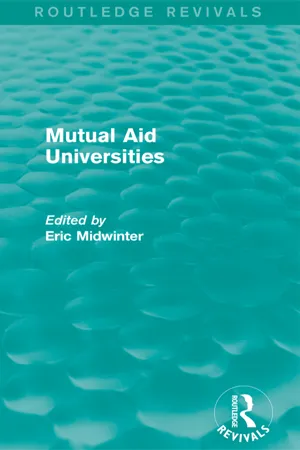
First published in 1984, this collection of essays was the first account of the development of the University of the Third Age in Britain (U3A). Changing employment patterns and increasing pressure on traditional areas of secondary and higher education has led to the idea that learning can be a life-long process. The theories of U3As in Britain, their development under the influence of European models, and the major influences on them are analysed. The authors argue that the consequences of social change and the economic, social, political, sexual and racial inequalities that exist are often reinforced by the inequalities in our educational system. A comprehensive title, this book will be useful to any students with an interest in adult and continuing education.
- 160 pages
- English
- ePUB (mobile friendly)
- Available on iOS & Android
eBook - ePub
Mutual Aid Universities (Routledge Revivals)
About this book
Trusted by 375,005 students
Access to over 1.5 million titles for a fair monthly price.
Study more efficiently using our study tools.
Information
Topic
EducationSubtopic
Adult EducationChapter 1
UNIVERSITIES OF THE THIRD AGE: THE ENGLISH VERSION
The out-and-out Chauvinist might rejoice in the United Kingdom’s version of the University of the Third Age, for it seems to incorporate a medley of characteristics usually deemed peculiarly English. There is a mildly mocking air about its use of that somewhat portentous title. There is a stubborn refusal to be overly theoretical about its structure. There is a valid and stern determination to wax independent. There is a rugged air of suspicion about the infallability of authority. It certainly adds up to what, on a twilit evening and with the light behind it, might be called flexibility, but is perhaps nearer what Anglo-Saxons are wont disarmingly to refer to as ‘muddle’. It might, at the onset, be helpful to tease out the meanings of these four aspects.
(A) A Portentous Title
First, as to the title. It is, of course, an unashamed burglary of the continental usage and reflects a genuine effort to align the British endeavour with the international activity. From its French beginnings some dozen years ago, the idea has spread to several countries, although, numerically, the emphasis remains in France, which has roughly two thirds the world’s U3A’s. The classic model is the identification of an organised body of older students with its local university, with, in each case, a contract negotiated with that institution for the provision of tutorial succour. The lesson of bargaining for what is required, as opposed to accepting meekly what is proferred, has not been lost on this side of the Channel, but. in effect, precious few British U3A’s rely, wholly or partly, on institutional assistance of that kind.
The reasons for this are mixed, even contrary. The situation reflects the variegated pattern of adult and continuing education already in existence in Britain, with its mesh of local authority, university extra-mural, Workers’ Educational Association, Open University and other elements. But it also reflects the supposition that such agencies have either ignored, or are incapable of responding to, the needs of older people.
Thus, the title ‘University of the Third Age’ is deliberately used in two senses. On the one hand, it tries to boost the image of what should and can be provided for our older citizens. Whatever else, it is less demeaning than the labels of other services organised for that age group by the state: ‘meals on wheels’, ‘home helps’, ‘day centres’: these hardly have the exciting ring of colourful and mettlesome bustle. ‘Third Age’ is certainly a major improvement, for it avoids the wasting strictness of a chronological division. It refers to a phase of life rather than the accident of a birthday. It accepts that, after an opening ‘age’ of dependent childhood and education and a second ‘age’ of active economic and, for many, domestic and social involvement, a period follows, presaging the fourth stage of dependence and death, in which one is in fine fettle but with the major socio-economic commitments completed. It covers, then, not just the officially ‘old’ – the over-sixties or sixty-fives – but, for instance, the man unluckily made redundant in his fifties and with no prospect of other full-time employ; the non-working woman who has perhaps given prime years to the care of a sick relative; parents whose children have grown up and left home, and so forth. Of course, the distinction is less startlingly clearcut than with the appalling rigidity of, say, compulsory retirement on a given day, but it is, nonetheless, a genuine arc of most people’s life-span.
On the other hand, there is a slight tongue-in-cheek feature about the deployment of the word ‘university’. The studied inference is that the U3A is not one of your new-fangled, modern universities of the last hundred or so years, obsessed with weird epistemological divisions, with arbitrary notions of what constitutes scholarship, with a bizarre urge to grade and re-grade its clients in an atmosphere of false competitiveness, and with a fierce compulsion to maintain these mystiques for the supposed benefits of a tiny, privileged minority. The U3A, the inference continues, is of a purer, more ancient stamp. It returns to the older connotation of the early medieval university, with, in its ideal form, the concept of fellow-students joined together in the selfless pursuit of knowledge and truth for its own sake. In other words, the U3A cocks a perky snook at the conventional university, and, by implication, criticises it.
The U3A tag, has, however, caused difficulties in the public mind, and not merely among the choleric defenders of existing universities, outraged at such a cavalier use of the sacred name. The difficulties have been, as difficulties often are, the other face of the advantages. The insouciant ‘university’ claim has, therefore, both attracted those in search of some kind of degree or qualification, anathema to the trueblooded U3A-er, and discouraged those who expected that U3A might prove just as precious and offputting as its statutary namesake. The former have had quietly to be directed elsewhere, and the latter persuaded that the outlook was not so grim as they had mournfully visualised.
Nonetheless, several local groups, because of such factors, have decided on their own nomenclature, while preserving the general principles of U3A-ship. The acronym itself has become, like UCD or LSE before it, acceptable and accepted. At least one local branch has decided to adhere to the abbreviation without making explicit for what it stands, just as, occasionally, one cannot always recall the full version of ICI, BOC, or UNICEF. The national umbrella body for the U3A’s is, for example, registered for charitable purposes as the Third Age Trust. So the title of the movement has been the subject, like many titles, of grave debate. At the same time, that means, on the positive side, that it is an ebullient talking point, and it has to be said that no preferable generic name (as opposed to some splendid parochial instances) has been suggested.
(B) A Theoretical Frailty
That lengthy log of the passions evoked by the title is a correct reflection of what has never failed to cause argument. ‘Third Age’ is sometimes mistaken for ‘Third World’, as an additional complication, and, as several have severely remarked, it is an ill-advised label which requires such an elaborate explanation. It does offer, however, a tidy introduction to the second of those English ‘peculiarities’; a wholesome suspicion of too pedantic a theoretical diktat. It has been said that, if the limerick had been created on the continent, then logical, latin academics would have insisted that the Edward Lear formula would have become the unbreakable mould, with, for instance, the fifth being a reprise of the first line, and the middle third and fourth phrases as strictly governed. In less rational hands, the form has, in fact, known wild excess; thus:
There once was a bard of Japan
Whose verses no one could scan
When asked why ‘twas so
He said, ‘yes, I know;
The main reason is because I try to get as many words into the last line as ever I possibly can’.
There would be no point denying that the U3A movement in Britain defiantly lacks a rigid form and that, indeed, it tries to get as many types into the running as ever it possibly can. The proliferation of sizes, shapes and styles is sufficient to cause some furiously to ponder whether there is any commonalty at all. There are sizeable, quite highpowered versions; there are tiny, aimiable instances. One may cater for a township; another for a region. Some may have the backing of professional and institutional big guns, where, elsewhere, two or three individuals might be struggling to launch a U3A from someone’s home.
The rightly celebrated Cambridge U3A was the first major enterprise, although one or two of the smaller brethren did actually organise meetings before the Cambridge launch at the Easter of 1982. An embryonic national committee was born at much the same time, when there were no more than half a dozen initiatives being contemplated, and, by the summer of 1983, when the third of a number of national seminars was organised, there were some thirty or forty groups, active or at an advanced stage of planning, in the field. At that juncture, the small committee was extended by election to seven, charitable status, with attendant financial benefits, was offered affiliate members, a news bulletin was planned and an annual meeting mounted.
Part 2 of this book describes, in general and by specific case-study, the history of the movement thus far, but that relation between centre and locality touches closely on the issue of theoretical structure, and warrants some examination. The two elements grew organically, and liaison between them was largely unforced. As local bodies formed, there was a natural desire to exchange ideas, and some kind of national clearing-house was welcome. Speakers, advisers, newsletters and even some small amounts of seed-money were made available centrally, with the help of the by no means excessive charitable funds at the national committee’s disposal. Press and media coverage and appearances stimulated some public response, in terms of potential organisers as well as putative members, and this helped enormously. Nationally, a kit – ‘U3A DIY’ – was constructed from the early experience of pioneer groups, and this proved quite popular.
In this creakingly cyclic way, local groups grew in number and the central body grew in strength, to the point where a second part-time organiser, to act as a promulgator on a countrywide basis as a complement to the present centrally based secretary and convenor, was being contemplated. A simple constitution emerged. Groups which wish to affiliate to the national league have the right to choose a representative to that central convention which, in turn, elects the national committee. In the solemn terms of the political scientist, the U3A movement is a confederation.
All of which says precisely nothing about the objectives of or criteria for membership. There is a tacit assumption, optimistic rather than naive, that groups which have contacted the central office and talked with one another know themselves whether they are U3A in character. It is hazardous. Already there has been a slightly embarrassing case of a dog-in-the-manger-ish outfit which, having collapsed itself, somehow managed to thwart temporarily a replacement venture in the same area. But it is consciously nebulous. Frankly, until groups have tried this or that technique and have learned by trial and error, it would be folly to whistle up a detailed theory of U3Agery and firmly insist that it be obeyed to the letter. Moreover, it is unlikely that so solid a structure will ever emerge, for it is already apparent, and as the case-studies in Part Two confirm, that there are many roads to Rome.
Self-evidently, a University of the Third Age is for older rather than younger persons, although, as the redundant forty year olds of the Devon branches pleasingly demonstrate, the term is comparative and not definitive. Beyond that, the primitive theory is best pronounced negatively. The U3A eschews standards of eligibility and avoids the establishment of qualifications. It maintains expenditure (not least, as its organisers would ruefully admit, through lack of choice) as low as possible, and only rarely pays tutorial salaries. It is not just about what is normally thought of as academic. Physical and recreational activities, as well as a broad gamut of intellectual pursuits, might be on offer, while, in some groups, research and the consideration of the issue of ageing in the United Kingdom are matters which are uppermost.
Perhaps the nearest approach to a theoretical pattern is to be found in the principles or guidelines included in the national committee’s prospectus and which, originally, were devised by Peter Laslett, a chief founder of the movement in Britain and Chairman of the U3A in Cambridge. They run as follows:
i. The University of the Third Age shall consist of a body of persons who undertake to learn and to help others to learn. Those who teach will be encouraged also to learn and those who learn shall also teach, or in other ways assist in the functioning of the institution – by, for instance, counselling other members, offering tuition and help to the housebound, bedridden and hospitalised, by assisting in research projects, by helping to provide intellectual stimulus for the mass of the elderly in Britain, by taking part in offers of manpower to educational and cultural institutions which may require this, such as art galleries, museums, libraries and so on. Secretarial and administrative or fund raising assistance would be an important function for those wanting to help the institution.
ii. Joining the University shall be a question of personal choice. No qualifications shall be required and no judgements made by the University of the Third Age as between applicants. The standards of the University should be those set by its individual classes and other activities, and the form taken by each individual pursuit shall be decided by members collaborating for this purpose.
iii. The curriculum of the University of the Third Age shall be as wide as its human and financial resources permit, but the preference of members will be the only criterion of what is done. Strong emphasis will be laid on research projects, on practical skills, on physical and allied leisure activities as well as on intellectual and academic pursuits. Insistence on learning as an end in itself will guide the decisions as to what activities to undertake.
These are the leading guidelines for the University of the Third Age, and the Committee has, in fact, agreed a more detailed format of twenty principles. Where a local group feel they can subscribe in general to those tenets, and where the national committee recognise, with equal tolerance, the group’s good faith, there, then, is a U3A brought into being; for it is recognised in the scriptures that in my father’s house there are many mansions.
(C) A Sturdy Independence
That broad church-ness is, in turn, a valid manifestation of the third feature under review, namely, the sturdy independence of each U3A in Britain. But that independence reflects much more than the benign refusal of the central body to impose an onerous dogma or, should it err in that officious direction, the local branches’ potential to resist. The basic issue is that of self-regulation, and this independence is asserted not just of other branches or a national committee, but of other public providers. In practice, this varies substantially. Some U3A’s have developed under the wing of a friendly institution, often at the bidding of an active and sympathetic tutor. Others have puritanically put temptation behind them, even to the point of refusing to seek any form of public funding. Nonetheless, the former would claim that their powers of self-determination have not been usurped, that the discreet use of accommodation and clerical support has been indispensable to the foundation of a U3A, and that a close relationship between a statutory and a voluntary agency is mutually advantageous.
It has to be confessed that there is some contentiousness on the fringes of this issue. Put extremely, there are those who believe that any connection with the existing system is damaging, at least psychologically, while their opponents insist that the current service should be revised to cope more effectively with an older clientele. All agree that the system has failed elderly people disastrously. There is no sadder wryness in British education than the onset of mass leisure at retirement leading to an abrupt collapse in the take-up of educational chances. Only a handful, certainly less than 200,000 of Britain’s ten million over-sixties, are, at any given time, involved in any kind of official education activity.
The reasons for this are as well-rehearsed as they are regrettable. Highly practical points, like the costly fees, the inadequacies of public transport, the security fears about the streets after dark, rub shoulders with deeply entrenched cultural prejudices, like the fatal association in the popular mind of education with youth and its sister myth, the automatic decline of mental faculties with age. Several of these important aspects will be elaborated in proper detail in later chapters, but the institutional dimension touches closely on the initial structure of U3As. The question amounts to the degree of culpability within existing institutions for a lamentable state of affairs whereby, plainly, those enthused by the notion of providing educational nurture for older people operate more or less from a standing start; that is, they must assume that, for all practical purposes, there is scarcely any provision at all.
The optimists urge that the universities and polytechnics and the local authority adult and continuing education agencies must be forced or persuaded to mend their ways and provide more realistically for a massive age-group, massively disadvantaged. They claim that it would be foolish to turn one’s back on the resources available in the huge complex of British education, resources, indeed, purchased, especially in the post-war boom years, out of the taxes and rates of the very retired people who now receive hardly a jot or tittle of that bounty.
The pessimists are much less sanguine. They argue that it is the very institutionalism of the existing agencies, and not just their lack of will or imagination, which makes them faulty in this regard. They are remote and divorced from ordinary humanity, and this particularly affects the older generation, most of them who left school at thirteen or fourteen, four-fifths with no qualifications whatever, and only one in twenty of whom, compared with almost four in twenty of the younger age-groups, has had higher educational experience. Disheartened by their past schooling and discouraged by their present perception of it, the argument runs, elderly people exhibit a marked distrust of the overweening formalism and narrowness of the public sector.
The U3A national committee has adopted a pluralistic stance. It is prepared to campaign for much greater access for older citizens to the prevailing institutions. It accepts that, with more sensitive or more colourful approaches, in-takes of elders might and should be extended in traditional fields. At the same time, it places greater prominence on its own essential role as the promoter of a new style of agency. It sees no incompatibility in this. Some defenders of the established system, itself under financial and other attack, have accused U3As of further undermining the stability of the existing framework by concentrating on a novel and largely non-statutory approach. The U3A pioneers reject this charge on the grounds that there is room and need for both approaches: indeed, before the educational slack in the potential elderly market is taken up, there will need to be many more developments, some adaptive reforms of what is, some entirely fresh devices.
For it is a significant part of the U3A pitch that the scale of the question of educational provision for older people requires the invention of new institutions, of which the University of the Third Age c...
Table of contents
- Cover Page
- Half-Title Page
- Title Page
- Copyright Page
- Original Title Page
- Original Copyright Page
- Contents
- Part One. The General: Background and Development
- Part Two. The Particular: Case-Studies of British U3As
- Index
Frequently asked questions
Yes, you can cancel anytime from the Subscription tab in your account settings on the Perlego website. Your subscription will stay active until the end of your current billing period. Learn how to cancel your subscription
No, books cannot be downloaded as external files, such as PDFs, for use outside of Perlego. However, you can download books within the Perlego app for offline reading on mobile or tablet. Learn how to download books offline
We are an online textbook subscription service, where you can get access to an entire online library for less than the price of a single book per month. With over 1.5 million books across 990+ topics, we’ve got you covered! Learn about our mission
Look out for the read-aloud symbol on your next book to see if you can listen to it. The read-aloud tool reads text aloud for you, highlighting the text as it is being read. You can pause it, speed it up and slow it down. Learn more about Read Aloud
Yes! You can use the Perlego app on both iOS and Android devices to read anytime, anywhere — even offline. Perfect for commutes or when you’re on the go.
Please note we cannot support devices running on iOS 13 and Android 7 or earlier. Learn more about using the app
Please note we cannot support devices running on iOS 13 and Android 7 or earlier. Learn more about using the app
Yes, you can access Mutual Aid Universities (Routledge Revivals) by Eric Midwinter in PDF and/or ePUB format, as well as other popular books in Education & Adult Education. We have over 1.5 million books available in our catalogue for you to explore.