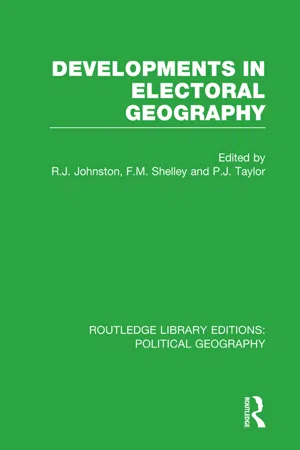
The essays in this collection show how electoral geography has shifted from empiricist activity towards a closer involvement with the wider issues addressed by social scientists. They illustrate the potential contributions that electoral geographers can make towards the understanding of global, national and local societies.
- 288 pages
- English
- ePUB (mobile friendly)
- Available on iOS & Android
eBook - ePub
Developments in Electoral Geography
Chapter one
Developments in electoral geography
Electoral geography, or the systematic spatial analysis of elections, has a long intellectual history. The mapping of voting statistics has provided important insights into the operation of modern polities. But such contributions have been rare. Electoral geography has been a victim of that most debilitating of all intellectual diseases – rampant empiricism. Many electoral geography studies have consisted of mere descriptions of the spatial pattern of the vote in a particular election with little or no concern for wider issues. Hence the social theory underlying the analysis is left implicit as a status quo model of society. This has generated a very uncritical body of knowledge under the label electoral geography.
It was a generally felt dissatisfaction with this intellectual legacy that provided the stimulus for organizing a conference on electoral geography and social theory in Los Angeles in April 1988. The purpose was to slay the empiricist dragon once and for all and the results of this exercise are before you. What is very clear is that electoral geography is in a state of flux. In this it reflects the current pluralism of human geography as a whole. There is a sense of transition from empiricism but it is by no means obvious where we are going. A diversified product is to be welcomed as long as we avoid an eclectic blurring of theory. At Los Angeles the focus on social theory was manifest in two ways. First some papers provided critical evaluations of traditional theories in recent electoral contexts. Second, some papers attempted to look outwards to alternative social theories in which to situate electoral geography. Between them these approaches combine continuity and innovation to provide electoral geography with a fresh platform for researches in the 1990s.
Electoral geography’s unsatisfactory legacy is largely due to a recent history of intellectual neglect. In the early twentieth century, electoral geography played a major role in the development of social science theory. For example, the American historian Frederick Jackson Turner relied heavily on mapped election results in developing his theses about the roles of sectionalism and the frontier in American history (Turner, 1908).
The intellectual prominence of electoral geography was reduced, however, following the Second World War. The mid-twentieth century was characterized by a number of related developments associated with the achievement of American hegemony over the world economy, including the development of a liberal, pluralist conception of the democratic political order, plus methodological and technical advances in social science which encouraged researchers to rely on individual-level survey data in empirical research. Behaviouralism, which bases empirical research on analysis of the reported attitudes and characteristics of individual voters, came to dominate political science in the 1950s. Behavioural analysis relied on data derived from individual survey research, which was facilitated by sophisticated polling methods that provided inferences about an entire population from small samples of voters. Thus researchers examined relationships between reported voting behaviour and voter characteristics such as economic status, income, education, ethnicity, religion and occupation.
The behavioural approach is closely linked to a liberal, pluralist conception of democratic governance. Pluralism in democracy implies that governments are elected following open competition among organized political parties which offer alternative platforms to rational, self-interested voters. Implicit in the assumption of voter rationality is the voter’s belief that exercise of the franchise can lead to increases in individual utility (Downs, 1957). Thus voters select the party whose proposals are most consistent with their own views. Individual voter utilities and hence actual votes can be predicted on the basis of income, ethnic status and other economic and social characteristics. This pluralist conception of democracy was assumed to characterize Europe, North America and other industrialized democracies. Moreover, in conjunction with contemporary development theory pluralism implied that an important component of the ‘modernization’ process was the eventual adoption of Western democratic values in developing nations.
Critiques of electoral geography
The dominance of the behaviouralist paradigm in political science relegated electoral geography to a secondary intellectual position during the 1950s and 1960s. Only as the ideology of liberal pluralism came to be questioned did electoral geography begin to return to its former intellectual stature. These historical considerations provide a backdrop for the first section of the book. The chapters by John Agnew and David Reynolds trace the intellectual development of electoral geography since the 1960s. Recognizing that the selection of governments hinges upon decisions made by individual voters and the procedures by which the voters’ preferences are aggregated, both Agnew and Reynolds identify several distinct lines of enquiry focused on the geography of electoral behaviour and of electoral systems.
Agnew briefly reviews research that has been undertaken from what he terms ‘modernization–nationalization’ and ‘social welfare’ approaches. Both of these approaches represent the philosophical underpinnings of the paradigm of liberal pluralism. Indeed, the modernization–nationalization perspective is a statement of the relationships between liberal pluralism and contemporary regional development theory, as summarized in Table 2.3. More directly relevant from the perspective of social theory are two alternative approaches examined by Agnew: the perspective of uneven development inspired by the world-systems analyses of Wallerstein and that of place context, which examines electoral geography in terms of daily experience within social contexts associated with particular places. For Agnew, the latter two approaches are not only more consistent with the mainstream of current social theory, but they are also indeed more geographical and hence more consistent with the application of social theory in human geography.
Reynolds, like Agnew, identifies the uneven development and place-context approaches as major areas for intellectual development in electoral geography. He also points out the intellectual linkages and analogies between the world systems framework and the politics of place. While the former concentrates on global issues, the latter emphasizes local concerns. However, at both scales political competition is bound up in struggles between factions of capital as well as between capital and labour. The world-systems perspective identifies a single global economy composed of discrete nation-states which compete for influence within the world economy. The position of each nation-state within the world economy affects its internal politics and indeed politicians often debate policies intended to ‘improve’ their country’s position. American politicians, for example, campaign to improve the prospects for competing with Japan, Russia, Western European, and other nations. At the local scale, analogous patterns of competition between factions of capital can often be identified and may be manifested in land use or other locational conflicts. Thus, as Reynolds indicates, place-related contextual information can help to account for the frequent observation that sectional and regional conflicts continue to be important to the outcomes of national elections in many countries.
The substantive contributions in Parts II and III of this book illustrate many of Agnew’s and Reynolds’s arguments. Part II comprises a selection of case studies of elections in countries where the analyses follow the modernization–nationalization tradition of the Lipset and Rokkan social cleavage model. Part III deals with elections in the United States and is mainly concerned with place-based politics and local issues. Finally, Part 4 contains three chapters that focus on new directions for study in electoral geography.
The cleavage model and its implicit social theory
The role of organized political parties and cleavages along party lines among national or subnational electorates is the underlying theme of the second part of the book, which includes chapters on electoral geography in other developed countries of the world. The theme of party and electoral cleavage is discussed in the chapter by Ron Johnston, who addresses the issue of the continuing role of electoral cleavages in post-industrial society. Traditional electoral theory as articulated by Lipset and Rokkan (1967) posits the existence of long-standing cleavages between groups of voters, with political parties mobilized on either side of the cleavage. According to this model, parties in Western democracies tend to be organized along one or more of four types of cleavage: between centre and periphery; between urban and rural interests; between church and state, or between different religious interests; and between labour and capital. Generally the development of centre-periphery and religious-based cleavages antedated the Industrial Revolution while the latter developed after transformation to an industrial economy. Johnston addresses the validity of this model by pointing out the increasing phenomenon of dealignment, in which traditional loyalties between party and voter are weakened. Dealignment appears to cast doubt on the longevity of the traditional cleavages posited by Lipset and Rokkan (Johnston, 1987). In examining recent electoral shifts in Great Britain, Johnston points out that while in general cleavages act to structure political conflict, cleavages that are too rigid frustrate the possibility of minority victory, creating long-run instability in the country’s political system. Thus long-run stability requires short-run flexibility. As political parties can and do attempt to manipulate cleavages for electoral benefit, further changes in alignment patterns are likely, not only in the United Kingdom but elsewhere as well.
The 1987 general election in New Zealand illustrates the impact of realignment based on the restructuring of traditional political cleavages. This election is discussed in the chapter by Rex Honey and Ross Barnett. Over the past several decades, the urban-based Labour Party has competed with the more conservative and more rural-oriented National Party for influence in New Zealand. The concentration of Labour supporters in the nation’s larger cities has aided National owing to an electoral bias resulting from the concentration of Labour supporters in urban districts (Johnston, 1976). In most elections, Labour must win a substantial majority of votes cast nation-wide in order to ensure a parliamentary majority. This situation changed, however, in 1987. By adopting conservative fiscal policies emphasizing the free market, the incumbent Labour government was able to reach out and increase its support by cutting across traditional cleavage lines. While the Labour government’s new economic policies alienated some of the party’s traditional supporters, such alienation was insufficient to overthrow the government. Encouraging such realignment in the electorate, Labour may have initiated a restructuring of New Zealand politics. Thus Honey and Barnett illustrate the importance of the role of the political party in realignment. In New Zealand, Labour’s change in economic policy not only restructured the electorate, but also signalled a willingness to abandon the traditional class-based cleavage typical of developed British Commonwealth countries.
The importance of the traditional class cleavage in British politics is addressed by Munroe Eagles, who reviews the relative merits of individual-level as opposed to aggregate electoral research, pointing out that the two approaches tend to yield divergent conclusions. In Britain, for example, Eagles argues, survey research indicates a recent decline in class-based voting while aggregate data analysis documents continued class cleavages. Integrating these perspectives by reporting the results of an intensive study of working-class voters in Sheffield, he indicates support for the place-based approach to politics advocated by Agnew (1987) and Johnston (1985). Although persons in working-class neighbourhoods tended to vote in similar ways, it cannot necessarily be concluded that these similarities are the result of neighbourhood-level diffusion processes. Thus Eagles, like Johnston, concludes with advocacy of a view of local homogeneity that is ‘set more firmly into the context of place-based socialization’.
Nico Passchier and Hermann van der Wusten illustrate the ‘electoral dynamics and historical change’ theme which Reynolds sees as becoming increasingly popular in electoral geography. Using standard factor analytic methodology, they define electoral eras and regions for the Netherlands over the period 1888–1986, and identify continuity in the traditional three ‘pillars’ of Dutch politics even after the secularization of social life, with the decline of the Christian Democrat pillar and the compensating renewal of the Liberal pillar.
Assessing the validity of the Lipset–Rokkan model for Ireland, John O’Loughlin and Tony Parker discuss the unique position of Ireland among its European neighbours. Within the European Community, Ireland is a peripheral nation-state, with traditional dependence on and animosity towards Great Britain in particular. Ireland was long a colony of Britain, and the aftermath of its struggle for political independence, including the island’s division between the Irish Republic and Northern Ireland, which remained in the United Kingdom, has left a lasting impact on Irish politics. In particular, the cleavage between capital and labour characteristic of the politics of many European countries was sublimated to the national independence movement in the early twentieth century. Unlike Great Britain and New Zealand, members of the Irish Parliament are elected through an electoral system which results in substantially more representation of minority views and interests. These factors have influenced the outcomes as well as the distributions of votes in national referenda on a variety of economic and non-economic issues.
In commenting on the other chapters in this section, Arend Lijphart focuses on the Lipset–Rokkan cleavage model as articulated by Johnston and elaborated upon by the other authors. Lijphart notes that the four basic partisan cleavages postulated in the Lipset–Rokkan model are insufficient to deal with the complexities of contemporary Western democratic politics (as also do Harrop and Miller, 1987). Thus he proposes the addition of several additional dimensions – foreign policy cleavages, regime support (including the role of parties on the extreme right or left of a national political spectrum), growth of the governmental sector, and post-industrialism. The last three, which together take into account the issues of participatory democracy and environmentalism, do not fit neatly with the current left-right spectrum of internal politics in most Western nations. The Green Party of West Germany and similar parties elsewhere, as well as anti-governmental, libertarian-oriented political movements, can be accounted for in an expanded typology of this sort. This expansion can also help in responding to Johnston’s call for increased flexibility and dynamism in political party organization. Indeed, such increased flexibility and dynamism may be crucial in the development of an increasingly international outlook associated with the increased economic and political co-ordination of contemporary western Europe.
The American experience and the ideology of democracy
The Lipset and Rokkan model has not been widely used in the analysis of United States elections; Taylor and Johnston’s (1979) attempt to do this is untypical. Instead, the often-noted exceptionalism of US politics is reflected in geographical studies of elections there. The chapters in this part of the book reflect that, at both national and local scales. The United States is the oldest functioning liberal democracy in the world. In many respects American democracy is unique among Western liberal democracies. Compared to most European countries, American government is decentralized and territorially oriented, with strong linkages between representatives to national, state and local legislative bodies and their constituents. American electoral procedures emphasize place-related considerations, and sectional and territorial conflicts in American politics often eclipse those based on class cleavages, which tend to dominate the politics of European nations (Agnew, 1987; Shelley, 1988). Thus place context as identified by Agnew is particularly important in understanding the geography of American politics.
These unique characteristics of American democracy underlie the third part of the book. In particular, the chapters there emphasize conflict between places and economic sectors, illustrating the importance of the place-context perspective described by Agnew and Reynolds. Rebecca Roberts, Frances Ufkes and Fred Shelley focus on a recent referendum on the legality of corporate farm ownership in the agricultural state of Nebraska. Application of social theory to the topic of agriculture in developed societies illustrates the contradictory class position of the Mid Western farmer at a time when the size and economic power of the agricultural sector in the developed world are declining rapidly. American farmers are on a ‘technological treadmill’. Advances in production technology resulted in lower commodity prices, forcing farmers to expand production through either additional land acquisition or increased technical innovation, and these pressures have the long-run effect of increasing the efficiency of food production, driving prices down and placing renewed emphasis on increased efficiency. Responding to the ‘technological treadmill’ process, American farmers have long turned to electoral politics in attempts to reduce the impacts of large corporations on farming. However, empirical analysis of the referendum on corporate farming in Nebraska, undertaken from a social-theoretic perspective demonstrates that while place context and the effects of capitalistic differentiation could effectively predict the outcome of the election, its passage did little to influence the underlying structural relationships in the region’s agriculturally based economy.
The chapters by David Hodge and Lynn Staeheli and by Diane Whalley focus on urban conflicts. Following the lead of Katznelson (1981), Hodge and Staeheli focus on the divergence between the politics of production and the politics of consumption. They argue that changing relationships between the workplace and the home associated with contemporary transition to a post-industrial economy have resulted in an increasing separation of contemporary consumption issues from partisan politics. In examining a series of ballot issues in the city of Seattle, Washington, Hodge and Staeheli identify two distinct dimensions – one which reflects partisan divisions in the electorate and emphasizes work-related issues and a second which is oriented to consumption-based politics and is relatively independent of partisan elections.
Diane Whalley’s chapter...
Table of contents
- Cover
- Half Title
- Title Page
- Copyright Page
- Original Copyright Page
- Table of Contents
- List of tables
- List of figures
- Contributors
- 1 Developments in Electoral Geography
- Part I: The state of electoral geography
- Part II: The cleavage model and electoral geography
- Part III: American exceptionalism
- Part IV: Future directions
- Index
Trusted by 375,005 students
Access to over 1.5 million titles for a fair monthly price.
Study more efficiently using our study tools.
Frequently asked questions
Yes, you can cancel anytime from the Subscription tab in your account settings on the Perlego website. Your subscription will stay active until the end of your current billing period. Learn how to cancel your subscription
No, books cannot be downloaded as external files, such as PDFs, for use outside of Perlego. However, you can download books within the Perlego app for offline reading on mobile or tablet. Learn how to download books offline
Perlego offers two plans: Essential and Complete
- Essential is ideal for learners and professionals who enjoy exploring a wide range of subjects. Access the Essential Library with 800,000+ trusted titles and best-sellers across business, personal growth, and the humanities. Includes unlimited reading time and Standard Read Aloud voice.
- Complete: Perfect for advanced learners and researchers needing full, unrestricted access. Unlock 1.5M+ books across hundreds of subjects, including academic and specialized titles. The Complete Plan also includes advanced features like Premium Read Aloud and Research Assistant.
We are an online textbook subscription service, where you can get access to an entire online library for less than the price of a single book per month. With over 1.5 million books across 990+ topics, we’ve got you covered! Learn about our mission
Look out for the read-aloud symbol on your next book to see if you can listen to it. The read-aloud tool reads text aloud for you, highlighting the text as it is being read. You can pause it, speed it up and slow it down. Learn more about Read Aloud
Yes! You can use the Perlego app on both iOS and Android devices to read anytime, anywhere — even offline. Perfect for commutes or when you’re on the go.
Please note we cannot support devices running on iOS 13 and Android 7 or earlier. Learn more about using the app
Please note we cannot support devices running on iOS 13 and Android 7 or earlier. Learn more about using the app
Yes, you can access Developments in Electoral Geography by Ron Johnston,Fred M. Shelley,Peter J. Taylor in PDF and/or ePUB format, as well as other popular books in Physical Sciences & Geography. We have over 1.5 million books available in our catalogue for you to explore.