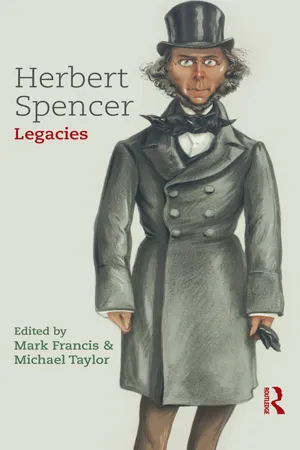
The Spencerian legacy consists of the predisposition to assess both the evolutionary past and future of humanity as progressive. Where this predisposition takes on a scientific guise, it has competed with Darwinian and Lamarckian theories by offering a naturalistic explanation of the development of psychological, biological and sociological mechanisms without reference to natural selection or to an organism's intention to change. When the Spencerian legacy is non-scientific, it holds a position between the utopian and conservative views of the world. Instead of directing humanity towards an ideal future, Spencerianism emphasized that growth was slow, and constrained by past social and political developments. While this sounds like conservatism, it is not: the Spencerian notion of tradition contains no wisdom and offers no guidance; it is simply a set of naturally formed practices and rules. In both its scientific and non-scientific forms, the Spencerian legacy offers hope for the future while denying that there is any way of forcing the direction or rate of change. This Spencerian legacy differs from Spencer's own writings in being more optimistic, and less cluttered with echoes from competing doctrines. That is, Spencer himself was as concerned with dissolution and death as he was with evolution and life, and he was occasionally capable, depending on circumstances, of offering Darwinian or Lamarckian arguments as additions, or substitutes, to his own thought. In general, the Spencerian legacy was a purer doctrine than one to which Spencer himself would have adhered.
There are two key questions to ask when reflecting on Spencer's legacy. First, did Spencer propagate one organic law of evolution that governed not only his biological theories but also his views on social evolution and the development of the mind? Or would it be preferable to regard Spencer's evolution as a cluster of complementary and competing theories? Second, if Spencer's evolutionary theory was primarily an organic one, should it be grouped with either Darwinian or Lamarckian evolution, or does it occupy its own independent space? The various contributions to the volume answer these questions, but not in the same way. This is not just a matter of polite scholarly disagreement; essays on Spencer and his successors sometimes relate to issues that are still current in debates about evolution and comparative social and natural development. It is still possible to defend more than one view on such subjects. The editors do not hope to resolve these matters, but only to stimulate a better informed debate on how we came to theorize in the way we do.
In addition to warning the reader that there are some unavoidable disagreements in answering questions about Spencerian evolution, there is an important observation to make about Spencer's legacies. Spencer was not only a philosopher of science, a psychologist and a sociologist, but also the author of popular works. By this I do not refer to the fact that his Study of Sociology was a popular variant of The Principles of Sociology, but wish to emphasize that a number of Spencer's influential works were not part of his scholarly and scientific endeavours; they were pieces of advocacy by a liberal reformer. These writings mattered in the past and a Spencerian might have been someone who was not necessarily a fan of Spencer's philosophy or his views of evolution, but of his Social Statics, Education or The Man “Versus” the State. Spencer's popular works focused on radical politics, individual development or individualism, and, while they were liberal and progressive, they were not scientific or philosophical. A reader of these works might have been a Spencerian who had little interest in evolution.
Who should count as a Spencerian? This question is hard to answer for two reasons. First, since Spencer had a huge readership during the late nineteenth and early twentieth centuries, there is an initial temptation to include as Spencerian everyone who admired Spencer, and, subsequently, a desire to add everyone who speculated on evolution or individual development or who had disagreed with Spencer. Then one could extend this generalized Spencerianism to later generations who had read authors who may have been Spencerian in tone. Obviously, this kind of taxonomy is too inclusive because it applies to writers in the past and present who may have cited Spencer, but who had, or have, independent interests in evolutionary biology, social evolution or developmental psychology. Second, Spencerians are difficult to identify because Spencer himself has became a figure in the dramatic genre of popular history. He is often listed as a stock figure in a moral narrative that brought forth the birth of a discipline in the sciences or social sciences. Like the polar opposites of an old mystery play on Cain and Abel or Abraham and Isaac, or the antinomian pair of Punch and Judy, Spencer is a protagonist in the birth of an academic discourse. He is yoked to another as one of a pair: Darwin and Spencer, Comte and Spencer, Mill and Spencer, Marx and Spencer, or Weber and Spencer. The descendants of these thinkers are imagined to be equally dichotomous and so, for example, to be either Darwinian or Spencerian. One of the dual figures is imagined to be decent and hard-working in pursuit of genuine knowledge, while the other – usually Spencer – is mischievous. The latter acquires only superficial knowledge by the use of a synthetic machine: a system of knowledge that produces results without labour, that is, without experimental effort, real scientific work or archival investigation. Since morality tales deal with caricatures and ignore biographies, there is little difficulty in avoiding any material that does not fit the story. In such fictions, it is a simple matter to assign the Spencerian part to someone who loosely speculates about evolution and who is unscientific.
When identifying Spencerians one should avoid both perils: that of over-inclusiveness and that of searching for Spencerians who fulfil an ideal role in a morality tale. The historic reality was that Spencerians often employed ideas from both Spencer and his putative antagonists, such as John Stuart Mill and Charles Darwin. Often the best one can do in recognizing a Spencerian is to rely on their self-identification. With this in method it is relatively easy to distinguish a Spencerian from a non-Spencerian. For example, one should reject a suggestion that G. Stanley Hall, the founder of American developmental psychology and the author of the bizarre and racialized Adolescence: Its Psychology and Its Relation to Physiology, Anthropology, Sociology, Sex, Crime and Religion (1905), was a Spencerian. While Hall viewed Spencer as a worthy Victorian, he thought his value was only as the author of classical evolutionary works that should be taught to undergraduates. The only idea that Hall adopts from Spencer is the famous, but peculiar, notion that cerebral women were less fertile. This was silly when first enunciated by Spencer, and it was not improved by Hall's attempted verification that showed low birth rates for women college graduates (Hall 1905: vol. 2, 602). As an experimental psychologist, Hall was a disciple of Wilhelm Wundt, who disapproved of Spencer and of evolutionary theory in general. On the other hand, it is clear that ethnographers such as John Wesley Powell (Hinsley Jr 1981: 125–43) and sociologists such as Lester F. Ward (Ward 1919: vol. 1, 139, 180, 244; [1883, 1892] 1923: vol. 1, 150–51, 154–5, 166–8) were Spencerian. Unlike Hall, they overtly described themselves as Spencerian, although they adopted this label chiefly because they shared Spencer's belief in the importance of empirical – rather than abstract – data when interpreting cultural evolution.
While the accurate identification of Spencerians was relatively simple before the First World War, afterwards it became more difficult. Increasingly, Spencerian evolutionary theories had become part of a general language of social change. The author of the language did not matter. When a significant evolutionary theorist such as Leslie A. White insisted on honouring “classical” evolutionary writers such as Spencer, Lewis Henry Morgan and E. B. Tylor, the point was not to protect the legacy of Spencer or another nineteenth-century evolutionist, but to criticize contemporary “neo-evolutionists” for using a neologism to describe themselves. White's argument was that all social evolutionists from Spencer to himself were following the same theory, but the fact that he had to make this criticism suggests that “neo-evolutionists” were ignorant of their traditions and of their debt to Spencer. It would seem that Spencer's legacy had vanished before the mid-twentieth century, as Jonathan H. Turner suggests in this volume. What still survives from Spencer's sociology is as non-specific as his legacies in psychology, metaphysics, biology and ethics. This qualification aside, it would seem that Spencer's various evolutionary and developmental theories still provide an impulse to speculation about social progress and about the place of the human mind in the universe and its progressive future.
This impulse is not accompanied by any of the philosophical sophistication that can be found in Spencer's System of Synthetic Philosophy. An enthusiasm for evolution is still present, but there is little sign of the scholarship and sophistication that accompanied the origins of evolutionary theory. On the contrary, evolutionary theorizing is often cruder than in the past. Present-day speculation on the noble standing of human beings and their destiny would not be out of place in the works of a nineteenth-century author, but there is less finesse. There is a déjà vu sound to recent work when it proclaims that “by any conceivable standard, humanity is far and away life's greatest achievement. We are the mind of the biosphere, the solar system, and – who can say? – perhaps the galaxy?” (Wilson 2012: 288). If our far-reaching minds did not promise excitement enough, then others offer hope that our dark side, our propensity to violence, is disappearing (e.g. Pinker 2011). The future will be even more peaceful as we emerge from our murderous past, where our development was controlled by natural selection and exaptation, into an era where we shall control our future evolution (see Tattersall 2012). Although he would have been mystified by the concepts of biosphere and exaptation, Spencer would have felt comforted by these aspirations because they were the same as his. Of course, E. O. Wilson, Steven Pinker and Ian Tattersall may not be conscious of the Spencerian foundations of their ideas; possibly they have adopted a Spencerian stance simply because they were considering the same problems as Spencer.
Both the ebullience and the naivety of recent evolutionary speculation are daunting: that is, the presence of so much faith in the human condition and its future is humbling. To raise sceptical objections to it would be equivalent to preaching atheism to a religious audience who might be happier facing the world with their beliefs intact. It is also a little depressing to critique recent evolutionary speculation because, if its authors could understand such comment, they would have equipped themselves better philosophically to begin with. However, on the basis that everyone is teachable, it seems worthwhile to alert evolutionary writers to Spencer's works in an effort to sustain their thinking when they venture on to metaphysics and ontology. Evolutionary writers should be Spencerian because they think like him, but with less philosophical acumen. If they insist on writing about non-scientific matters in social organization and ethics, then they might gain a competitive advantage by adapting Spencerianism evolutionary philosophy. Spencerianism is likely to do them more good than reading the works of scientists such as Darwin and Alfred Russel Wallace, because what is needed is not an account of how a nineteenth-century scientist made a discovery, but a sophisticated way of discussing theories of the development of human society and of the mind.
What happened to Spencer's ideas – once they passed from his hands into those of his followers, enemies and disinterested bystanders – is a complex set of stories, each of which requires a discrete narrative. It was usually not his system of philosophy that was adhered to, rejected or casually plundered. Rather, it was Spencer's individual works such as his Social Statics, Education, The Principles of Psychology, First Principles, The Study of Sociology and The Man “Versus” The State. These texts were appropriated for use in a variety of sometimes contradictory discourses. This is not to say that contradictions found in Spencer's philosophical system were played out in the writings of his imitators or critics – although this could happen – but to remark that it was often the case that sympathy for, or reaction against, Spencer's ideas depended on the use of a single text, not of his whole system. For example, Spencer's Education, which was the most widely reprinted and translated of his works, could be read as a progressive tract that attacked rote learning and the use of classics in education. As a critic of repetition and the replication of dated information about history and science, Spencer pleaded for kindness and the avoidance of cruelty in the classroom. Ethics was important to Spencer; without it there would be neither individuation of immature minds nor any personal development. Education was not about evolutionary science or progressive citizenship. Another “Spencerian” work, Social Statics, with its radical egalitarianism and its land nationalization, was read as a socialist tract, while his The Man “Versus” The State gave comfort to libertarians. Politics was not the only source of dissonance for Spencerians: even from within Spencer's “System”, his legacy differed depending on which work was the subject of analysis. The Principles of Biology and The Principles of Sociology, which were massive compilations of empirical data, lent themselves to a secular view of the world. The Principles of Psychology and First Principles, which were conventionally philosophical in method, gave comfort to the spiritually inclined. While it would have been possible for readers to discover a common philosophical or progressive thread that tied Spencer's various works together, in practice this search was not carried out. It was more convenient, when appropriating a text, to ignore any of Spencer's works that conflicted with the one that had been chosen. For example, Ward, a founding father of American sociology, ignored the individualism in The Man “Versus” The State and, instead, advocated a Spencerian-inspired socialism because he felt that the evolutionary thrust of the institutional sections of The Principles of Sociology allowed for further growth in state institutions.
To reiterate, in the late nineteenth and early twentieth centuries, Spencer's legacies were often dependent on single texts that his imitator or critic took as standing for any developmental or evolutionary trend in philosophy or politics that was wished for by its reader. Since Spencer was known as a systemizer, it seemed a plausible assumption to his interpreters that each fragment of his thought could stand for the whole because it was somehow consistent with it. Even well-informed Spencer interpreters, such as William James, who were aware that some of Spencer's ideas were the result of induction and relied on different sets of data, still treated Spencerian evolution as a source of deductive principles that were analogous to scientific laws that could be tested. The focus in single texts led to variations in Spencerianism_ scholarly practice emphasized the gaps and problems that already existed in Spencer's system. This point is worth making because it is necessary to correct the assumption that Spencer's philosophical difficulties were caused by his argumentation being “home-spun”. That is, modifications to Spencer's philosophy were not carried because it was somehow out of step with contemporary philosophy: as John Skorupski shows in this volume, much of Spencer's logic and style of argumentation was quite conventional for its period and, on fundamental questions, his general position was similar to that of his critics such as Henry Sidgwick.
The mention of James and Sidgwick focuses attention on the Anglo Saxon world, but similar difficulties arise in the interpretation of Spencer's legacy outside this linguistic sphere. Beyond the English-speaking world there was an appropriation of Spencer's ideas that varied both in terms of intensity and longevity. In France and Italy, his impact was greater than it was in Britain and almost as pervasive as it was in the United States, although French and Italian readings of Spencer dwelt on the secular qualities of his scientific philosophy with as much excitement as his American readers felt when sensing hidden connotations in Spencer's metaphysics and philosophy of mind (see Govini forthcoming; Richard forthcoming).
Distant legacies and positivism
Beyond Europe and the United States, Spencer's influence was significant but tended to be of shorter duration, as it was in Japan. From further away, Spencerianism was also regarded as a current in the general tide of scientific culture. From a distant perspective he seemed little different from Auguste Comte, Darwin and Mill. That is, in the Arab world (see Elshakry forthcoming) as in South America and in parts of Asia, Spencerianism was just a brand of liberal and secular positivism that was replacing knowledge based on religious or traditional authority. The specific ways in which Spencer's ideas differed from those of Comte, Darwin and Mill seemed to be small matters in comparison to the great need to establish knowledge on a modern foundation.
Despite a global tendency to abolish distinctions between nineteenth-century, modernizing, scientific publicists such as Spencer, Comte, Darwin and Mill, it is unsatisfactory to call them all positivists because that would be to overemphasize the importance of Comte's philosophy of science in the late-nineteenth-century world. This is not just a matter of scholarly apportionment as it would be if one were, for example, attempting to give due credit to Spencer versus Darwin. Comte was running in a different race; he was not like an evolutionary thinker in his treatment of science. Comte left no direct legacy in evolutionary psychology or in evolution in general; he was not located in the evolutionary discourses that unseated reason and emphasized biological processes. His philosophy of science is best described as a delayed moment in the eighteenth-century Enlightenment. That is, Comte should be regarded as an anticlerical rationalist whose system of “positive science” left no place for the development of the species, brains or cultures. The ways in which Spencer and Darwin naturalized the human mind and humanity in general, as products of historical change, was anathema to Comteans. This was a contentious matter in the mid-nineteenth century; so much so that when G. H. Lewes, Comte's spokesman in England, attempted to incorporate evolutionary psychology into “positive science” he was expelled from the positivist movement by Comte himself (Francis 2014). Mill, himself a renegade Comtean, was responsible for tutoring Lewes and Alexander Bain so that they would construct a scientific psychology, free from Comte's rationalist imperative. Indirectly, through Le...