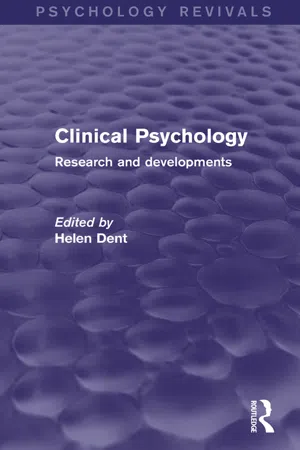
Originally published in 1987, this book presents papers from the First Conference of European Clinical Psychologists, held at the University of Kent Canterbury in July of that year. It shows some of the most exciting and recent developments in research and innovations in professional practice from many European countries with an overall theme of the WHO strategy of 'Health for all by the year 2000.' The whole range of clinical psychology is covered, including: cognitive therapy, clinical psychology and WHO strategy, the mental health of ethnic minority groups, health psychology, care in the community, and many other topics. The book is likely to be of interest for anyone concerned with the recent history and policies in clinical psychology.
- 342 pages
- English
- ePUB (mobile friendly)
- Available on iOS & Android
eBook - ePub
About this book
Trusted by 375,005 students
Access to over 1.5 million titles for a fair monthly price.
Study more efficiently using our study tools.
Information
Subtopic
Clinical PsychologyIndex
PsychologyChapter One
INTRODUCTION
The papers in this book have arisen from the First Conference of European Clinical Psychologists held at the University of Kent at Canterbury, U.K. in July, 1986. The need for such a conference was prompted by developments within Europe on three professional and political fronts. In 1981, the European Federation of Professional Psychological Associations (EFPPA) was formed. The UK representative (and from 1982, EFPPA’s president) Dr. Frank McPherson, was involved on the conference committee from the beginning. Secondly, the emergence of the Directive on the Free Movement of Professionals within the EEC which is likely to be implemented in 1987. Thirdly, the publication of the World Health Organisation’s strategy of Health for All by the year 2000 (WHO/HFA 2000) which emphasises the need for collaboration between professional groups in the European Region. As clinical psychologists, we are – or have been – probably more aware of the work of our colleagues in the USA, Canada and Australia than of our geographically closer colleagues in Europe. The First Conference of European Clinical Psychologists sought to redress this balance and to lay the groundwork for harmonisation of methods and standards of training and practice within the EEC.
The conference was a great success and the purpose of the book is to bring to a wider audience the exciting research reported there. Not all papers presented at the conference are included here; some were not submitted for publication and a few could not be accommodated within the structure of the book, which has been designed to stand alone and is not simply a report of proceedings. One important theme running through the conference, WHO/HFA 2000, has been used to create a structure within which individual papers are placed. Accordingly, the book falls into three major parts.
Part One is directly concerned with WHO/HFA 2000 and the role that psychologists can play in this strategy. Dr. John Henderson, now Medical Director of St. Andrew’s Hospital, UK, but formerly the Regional Officer for Mental Health at the WHO Regional Office in Europe, gives a clear account of that organisation and its objectives in chapter two. In chapter three Dr. Rene Diekstra details the skills and knowledge that psychologists have to offer HFA/2000, and the appendix to his chapter lists the specific targets of relevance to psychologists. Chapter four concludes this section with a detailed examination of the contribution that psychologists have made to one relevant area of health promotion – smoking prevention. This chapter highlights our shortcomings so far, and clearly points the way forward.
Part Two is based upon the theme of WHO/HFA 2000 Target 4 which states that:
“By the year 2000, the average number of years that people live free from major disease and disability should be increased by at least 10%.”
Psychologists have many and varying skills to offer to this target and so this part of the book is divided into four sections each of which focuses on a particular approach presented in the conference.
General health psychology, which has been interpreted as the contribution of psychologists to illness that has a major physical component, comprises the first section. The chapters present work carried out in the UK, USA, Germany, France and Australia and deal with problems ranging from coping with severe physical disorders such as cancer or burns, to psychological sequelae of artificially induced pregnancy. The methodologies similarly range from international epidemiology through developmental and exploratory studies, to controlled experimental designs.
The second section in Part Two is concerned with health problems arising out of, or in the context of, cultural marginality. The papers were presented in a symposium convened by Professor Raymond Cochrane, to whom I am grateful for his assistance in editing this section and for writing, in chapter thirteen, a most helpful and informative introduction to this area.
Section three contains chapters which examine the role of therapists, including medical practitioners, nurses and clinical psychologists, the interactions between therapist and clients and includes a rare glimpse in chapter nineteen of research carried out behind the iron curtain.
Section four in Part Two is concerned with the therapeutic intervention itself. The burgeoning interest in cognitive approaches to therapy made this an obvious choice for a symposium and workshops at the conference, and hence the focus in this section. Chapter twenty-four provides an introduction by the symposium’s convenor, Paul Salkovskis, and the whole section constitutes a brief but wide ranging introduction to much of the important thinking in this area.
Part Three is based upon the theme of WHO/HFA 2000 Target 3 which states that:
“By the year 2000, disabled persons should have the physical, social and economic opportunities that allow at least for a socially and economically and mentally creative life.”
Current concern with the drawbacks of institutional life and the move towards caring for disabled people within the community reflect the spirit of this target. Psychologists have much to offer to the care in the community movement and, indeed, many clinical psychologists are involved at all levels from planning through to ‘hands on’ care. The chapters in Part Three present this approach with various client groups throughout Europe. The first section in Part Three provides a thoughtful introduction to the most important issues in community care. It represents a symposium convened by Dr. John Hall, to whom I am grateful for editing the chapters in this section. The following sections focus on care in the community with different client groups.
Section two is concerned with chronic psychiatric patients and contains contributions from Italy, Belgium, Norway, Israel, Germany and the UK. Included are some practical accounts of providing a service and some more detailed theoretical contributions which, I am sure, will provoke stimulating debate.
Section three focuses on providing a service for the elderly within the community. It neverthetheless contains a chapter on residential care in which Dr. Robert Woods and Professor Per Haugen argue that many elderly people cannot be adequately cared for in the community, therefore there is a need for psychologists to work towards improving the quality of life within institutions. Such work is quite consistent with the spirit of target 3.
The final section in Part Three follows the theme of preparing clients to return to or cope with the community. The chapters present the work of clinical psychologists with mentally handicapped and neurologically impaired clients and with those who have been detained following breaches of the law. The approaches described range from the clearly detailed therapeutic interventions of Dr. Barbara Wilson, to a comparison of services for the mentally handicapped in the Netherlands and England.
In addition to clinical and other professional psychologists, the contributors to the book include physicians, psychiatrists, paediatricians, social workers and a graphic designer. The wide spread of subject matter ranging from variables involved in the reporting of breast cancer to setting up a rehabilitation day centre in Northern Italy will give the book an appeal to a similarly broad range of professionals within the health service. Inevitably a book of this nature must lack depth in its consideration of the issues and hence its greatest value will be as an introduction to applied research and an update on clinical practice in psychology throughout the European Community.
In conclusion, I would like to thank the authors who submitted their papers for publication and the conference committee who placed their trust in my editorship. It has been a most enjoyable and rewarding task. My greatest debt of gratitude, however, goes to Mrs. Sheila Turner for her skilful typing, insightful comments and organisational ability. Without her hard work and dedication, this book would not have seen the light of day.
May I wish you good reading …..
| PART ONE: | WORLD HEALTH ORGANISATION (WHO) STRATEGY: HEALTH FOR ALL BY THE YEAR 2000 (HFA 2000). |
Chapter Two
HEALTH FOR ALL IN EUROPE: THE WORLD HEALTH ORGANISATION STRATEGY AND TARGETS
INTRODUCTION
The World Health Organisation (WHO) is a specialised agency of the United Nations, with primary responsibility for international health matters and public health.
Throughout the Organisation, which was created in 1946, the health professions of some 160 countries exchange their knowledge and experience of health information of many kinds. WHO’s main function is to act as a directing and co-ordinating authority on international health work to ensure valid and productive technical co-operation and to promote international research.
The member states of WHO have set for themselves a common goal “Health for all by the Year 2000” whereby at the end of this century all citizens of the world shall have a level of health that will permit them to lead a socially and economically productive life.
The global strategy for health for all adopted in 1981 – represents a solemn agreement between the governments and WHO with the aim of making possible the attainment that people everywhere should have access to health services and that essential health care is planned with full community involvement. It means that health begins at home, in schools and in factories, and that people will use better approaches than they do now for preventing disease and alleviating unavoidable disease and disability.
It means that people will realise that they have the power to shape their own lives and the lives of their families, free from the avoidable burden of disease, and aware that ill health is not inevitable.
The WHO Regional Office for Europe is one of six Regional Offices throughout the world, each with its own programme geared to the particular health problems of the countries served. The European Region has 3 2 active member states and it is unique in that a large proportion of them are industrialised countries with highly advanced medical services. The European programme, therefore, differs from those of other regions in concentrating on the problems associated with industrial society.
In its strategy for attaining the goal of health for all by the year 2000 the Regional Office is arranging its activities in three main areas of work: promotion of lifestyles conducive to health; reduction of preventable conditions; and provision of care that is adequate, accessible and acceptable to all.
In 1978 the International Conference on Primary Health Care, held in Alma-Ata, U.S.S.R., declared that primary health care is the key to attaining the goal of health for all by the year 2000. Primary health care is based on practical, scientifically sound and socially acceptable methods and technology. It should be made universally accessible to individuals and families in their community through their full participation and at an affordable cost on a continuing basis. Primary health care takes place at the first contact between individuals and the national health system, as close as possible to where people live and work. It is the first element in a continuing health care process, and forms an integral part of a country’s health system.
The European Strategy
The European countries, with their long experience and vast resources, have a special responsibility to the rest of the world as front-runners in exploring new avenues to solve health problems and reduce inequalities. Following the adoption in 1977 of “Health for All” as the main social target of governments and the WHO, the European Region WHO has taken important steps towards that goal with the formulation of a common health policy in 1980 and the adoption in 1984 of regional targets in support of the European regional strategy for health for all. The regional targets have been developed for the European member states through the active participation...
Table of contents
- Cover
- Half Title
- Title Page
- Copyright Page
- Original Title Page
- Original Copyright Page
- Table of Contents
- Preface
- Chapter 1 Introduction
- Part One: World Health Organisation (WHO) Strategy: Health for All by the year 2000 (HFA 2000).
- Part Two: Health Psychology
- Part Three: Care in the Community
- Details of Contributors
- Index
Frequently asked questions
Yes, you can cancel anytime from the Subscription tab in your account settings on the Perlego website. Your subscription will stay active until the end of your current billing period. Learn how to cancel your subscription
No, books cannot be downloaded as external files, such as PDFs, for use outside of Perlego. However, you can download books within the Perlego app for offline reading on mobile or tablet. Learn how to download books offline
Perlego offers two plans: Essential and Complete
- Essential is ideal for learners and professionals who enjoy exploring a wide range of subjects. Access the Essential Library with 800,000+ trusted titles and best-sellers across business, personal growth, and the humanities. Includes unlimited reading time and Standard Read Aloud voice.
- Complete: Perfect for advanced learners and researchers needing full, unrestricted access. Unlock 1.5M+ books across hundreds of subjects, including academic and specialized titles. The Complete Plan also includes advanced features like Premium Read Aloud and Research Assistant.
We are an online textbook subscription service, where you can get access to an entire online library for less than the price of a single book per month. With over 1.5 million books across 990+ topics, we’ve got you covered! Learn about our mission
Look out for the read-aloud symbol on your next book to see if you can listen to it. The read-aloud tool reads text aloud for you, highlighting the text as it is being read. You can pause it, speed it up and slow it down. Learn more about Read Aloud
Yes! You can use the Perlego app on both iOS and Android devices to read anytime, anywhere — even offline. Perfect for commutes or when you’re on the go.
Please note we cannot support devices running on iOS 13 and Android 7 or earlier. Learn more about using the app
Please note we cannot support devices running on iOS 13 and Android 7 or earlier. Learn more about using the app
Yes, you can access Clinical Psychology (Psychology Revivals) by Helen Dent in PDF and/or ePUB format, as well as other popular books in Psychology & Clinical Psychology. We have over 1.5 million books available in our catalogue for you to explore.