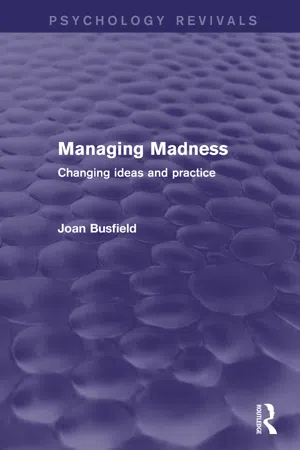
Psychiatry regularly comes under attack as a way of caring for and controlling the mentally ill. Originally published in 1986, this title explores the history and theory of psychiatry to illuminate current practice at the time, and shows why mental health services had developed in particular ways. The book was invaluable for all those who needed to understand the problems and processes behind current psychiatric practice at the time – sociologists and psychologists, psychiatrists and doctors, social workers, and health service planners and administrators – and will still be of historical interest today.
- 404 pages
- English
- ePUB (mobile friendly)
- Available on iOS & Android
eBook - ePub
About this book
Trusted by 375,005 students
Access to over 1.5 million titles for a fair monthly price.
Study more efficiently using our study tools.
Information
part one
Theoretical Issues
1 Psychiatry and medicine: thought and practice
Controversy over the aims, methods and nature of psychiatry, and the organization and content of the mental health services, reflects a diversity of ideas and assumptions about the nature and causes of mental illness, about the efficacy and value of therapeutic techniques, about the power of professionals, and about the structure and organization of society and the distribution of power within it. The object of the first part of this book is to delineate and analyse some of the divergent strands of the debates and discussions concerning psychiatry and the mental health services, in order both to clarify the controversies that surround psychiatry and to serve as a first step towards providing an account of the factors that have shaped its development.
Psychiatrists as medical specialists carry out their work within a context of ideas about medical practice that permeate the whole of medicine. There are, of course, important differences between psychiatry and other areas of medicine, particularly in their historical trajectories, some of which are outlined briefly at the end of this chapter. There is, too, considerable diversity in the ideas and practices of different medical practitioners whatever their specialism. None the less, it is possible to identify a shared framework of beliefs and assumptions about the nature of medical and psychiatric work that dominates both psychiatry and medicine.1* Much of the conflict about the causes of mental illness, for instance, and about preferable treatments occurs within this framework and does not question its basic parameters. The framework constitutes, therefore, an ideology – that is, a set of ideas and assumptions and the related practices in which they are embedded – which is rarely called into question.2 I have called this ideological framework as it operates within the psychiatric sphere the liberal-scientific conception of psychiatry rather than the ‘medical’ or ‘psychiatric’ conception, since such phrases, like the more fashionable term ‘medical model’, suggest a single, distinctively medical way of thinking about psychiatry, that is a necessary and unchanging foundation of medical and psychiatric work. The term medical model in particular has become a shorthand for a set of ideas about mental illness and psychiatry whose content is rarely specified. As a result its meaning has become extremely vague and imprecise. Goffman used the term to refer to the medical version of what he called the ‘tinkering services’ model. His concern was to specify the general characteristics of the service relationship between client and expert and to identify some of the problems of applying this model to medicine.3 More commonly, however, the term is used, along with that of the ‘disease model’, simply to refer to a view of mental illness that locates its significant causes and treatment exclusively within the realm of the body, and to imply that this view is common to all medical practitioners.4 Since there is considerable diversity of opinion among psychiatrists about the causes and treatment of mental illness, however, and no necessary symmetry between aetiological accounts and therapeutic practices; and since the conception that I shall delineate embraces both ideas about the tasks and methods of psychiatry and about the nature of mental illness, and is a particular historical product, I have preferred the characterization ‘liberal–scientific’, recognizing, thereby, that the ideological foundation of psychiatry, as of medicine, changes over time.
The liberal-scientific conception of psychiatry
The liberal-scientific conception of psychiatry has its immediate origins in Enlightenment thought of the eighteenth century and the value it placed on reason and scientific rationality.5 The lineaments of that thought incorporated beliefs and values that structured and still continue to structure the form and content of medicine and the specialism of psychiatry as well as many practitioners’ ways of thinking about their work. The conception of psychiatry, like others, incorporates basic assumptions about the nature and causes of mental illness, the role of psychiatry, the source and extent of its powers and the assessment of its value and efficacy, as well as about the distribution of power within society. Psychiatry, according to this point of view, is a specialty that has developed within medicine to provide help and treatment for one group of the sick: the mentally ill. More specifically it is a branch of clinical medicine – that is, of medicine whose object is the cure and treatment of sickness (the word clinical meaning ‘of or pertaining to the sick bed’).6 As such the overriding obligation of the psychiatrist, as of other clinicians, is to provide help for the patient’s sickness: as one author puts it ‘the role of the physician centres on his responsibility for the welfare of the patient in the sense of facilitating his recovery from illness to the best of the physician’s ability’.7 This objective, associated as it is with the highest ideals of medicine, provides the raison d’être of psychiatry as of medicine.
However, within the liberal-scientific framework a commitment to helping the sick is not in itself sufficient to specify the exact nature of medical or of psychiatric activity. What helps to distinguish the clinician from others who seek to help and care for the sick is a further obligation that points to the methods that should be used in helping the patient. This is the obligation: ‘to acquire and use high technical competence in “medical science” and the techniques based upon it’.8 Although the aim is action, action should be based on science and scientific knowledge should be the foundation of clinical care. It is assumed, therefore, that psychiatric knowledge should, as far as possible, have its basis in science -a science that constitutes the pinnacle of human reason. Consequently the concepts, explanations and treatments offered by psychiatry can be contrasted with the non-scientific, less rational orientation towards the insane and mentally disturbed of other times and places. What others have called madness, lunacy and insanity are deemed to be illnesses; to be the consequence of natural processes (that is to say those that can be studied scientifically); to be best treated and eradicated by natural means; and their care and treatment to be placed in the hands of medical practitioners. The liberal-scientific conception rejects, for example, any idea that mental illnesses are the result of forces of evil or of some supernatural power, or that they should be dealt with either by exorcism or punishment. Moreover, it sees psychiatry, by virtue both of its objective and its methods, as more liberal and more humane in its approach to mental disorder than any alternative. Zilboorg, whose classic History of Medical Psychology provides an interesting exemplar of this perspective, conveys the ideas and imagery of the new humanism: ‘Mental disease, which medicine finally wrested from the clutches of superstitious sadism, began to be looked upon as the misfortune of man as a person; the lunatic became as much an object of human concern as any sick man.’9
Science is, then, viewed as the lynchpin of psychiatric practice; it is science that permits the boundary to be drawn between the normal and the pathological; it is science that creates the possibility of accurate identification of the mentally ill; it is science that provides sound knowledge of the causes of mental illness; and it is science that provides effective methods of cure. Consequently, it is science that determines the essential content and form of psychiatric practice; what help is offered, where it is offered, and who receives it, within, of course, the constraints of the existing political order and its willingness to provide and finance the psychiatric services that science dictates.
If, moreover, science is the essential arbiter of the form and content of psychiatry, the psychiatrist serves as the repository and purveyor of this knowledge, the expert whose authority, power, status and prestige derive from his (or occasionally her) expertise, whose task it is to apply and use scientific knowlege in the interests of individual patients to cure their sickness. The psychiatrist is considered a professional; someone whose lengthy training is necessary to transmit the full range of relevant scientific knowledge, and whose socialization and professional status are the guarantee of integrity and altruistic concern.10 And as a pr...
Table of contents
- Cover
- Half Title
- Title Page
- Copyright Page
- Original Title Page
- Original Copyright Page
- Table of Contents
- Preface
- Part One Theoretical Issues
- Part Two Historical Developments
- Bibliography
- Name index
- Subject index
Frequently asked questions
Yes, you can cancel anytime from the Subscription tab in your account settings on the Perlego website. Your subscription will stay active until the end of your current billing period. Learn how to cancel your subscription
No, books cannot be downloaded as external files, such as PDFs, for use outside of Perlego. However, you can download books within the Perlego app for offline reading on mobile or tablet. Learn how to download books offline
Perlego offers two plans: Essential and Complete
- Essential is ideal for learners and professionals who enjoy exploring a wide range of subjects. Access the Essential Library with 800,000+ trusted titles and best-sellers across business, personal growth, and the humanities. Includes unlimited reading time and Standard Read Aloud voice.
- Complete: Perfect for advanced learners and researchers needing full, unrestricted access. Unlock 1.5M+ books across hundreds of subjects, including academic and specialized titles. The Complete Plan also includes advanced features like Premium Read Aloud and Research Assistant.
We are an online textbook subscription service, where you can get access to an entire online library for less than the price of a single book per month. With over 1.5 million books across 990+ topics, we’ve got you covered! Learn about our mission
Look out for the read-aloud symbol on your next book to see if you can listen to it. The read-aloud tool reads text aloud for you, highlighting the text as it is being read. You can pause it, speed it up and slow it down. Learn more about Read Aloud
Yes! You can use the Perlego app on both iOS and Android devices to read anytime, anywhere — even offline. Perfect for commutes or when you’re on the go.
Please note we cannot support devices running on iOS 13 and Android 7 or earlier. Learn more about using the app
Please note we cannot support devices running on iOS 13 and Android 7 or earlier. Learn more about using the app
Yes, you can access Managing Madness by Joan Busfield in PDF and/or ePUB format, as well as other popular books in Psychology & Clinical Psychology. We have over 1.5 million books available in our catalogue for you to explore.