This book explores how clothing consumption has changed in Russia in the past 20 years as capitalism has grown in a postsocialist state, bringing with it a "consumer revolution." It shows how there has been and continues to be a massive change in the fashion retail market and how ideal lifestyles portrayed in glossy magazines and other media have contributed to the consumer revolution, as have shifts in the social structure and everyday life. Overall, the book, which includes the findings of extensive original research, including in-depth interviews with consumers, relates changes in fashion and retail to changing outlooks, identities, and ideologies in Russia more generally. The mentioned changes are also linked to the theoretical concept of fashion formed in postsocialist society.
- 182 pages
- English
- ePUB (mobile friendly)
- Available on iOS & Android
eBook - ePub
Fashion and the Consumer Revolution in Contemporary Russia
About this book
Information
1 Media and the ideology of consumption and fashion The case of Krest'ianka
DOI: 10.4324/9780203766477-1
In this chapter I explore how the discourse on fashion and clothing consumption has changed in Russia since the beginning of the 1990s in the context of postsocialist transformations. Beginning in the mid-1990s, a number of magazines concerned with issues of fashion and clothing consumption entered the media market in Russia. One of the pioneers was Burda Moden, a German magazine devoted to sewing, which had been published in Russia since 1987. Later, Russian versions of the many international glossy journals, such as Cosmopolitan (1994), Harper’s Bazaar (1996), Elle (1996), and Marie Clair (1997) were published. 1 At the same time, domestic magazine publications, such as Медведь (Bear 1995) for men and ОНА (SHE 1996) for women appeared on the media market.
Former socialist women’s magazines, such as Rabotnitsa (Working Woman) and Krest’ianka (Peasant Woman), were forced to reorient in the new circumstances and find new audiences. While the new glossy journals mostly represented western patterns of fashion and consumption and hence had to negotiate the new representations, meanings, and practices vis-à-vis the postsocialist consumer market, the former socialist magazines have struggled to appropriate new media technologies and consumption patterns brought by new reality. In this chapter I will examine the shifts in the discourse on fashion and clothing consumption, using Krest’ianka as a case for study (Figure 1.1, 1.2). I deliberately chose this magazine, which first emerged during Soviet times and has undergone postsocialist transformations, as a means of exploring how socialist patterns of consumption have informed the current discourse on fashion and clothing consumption in the new Russian circumstances.
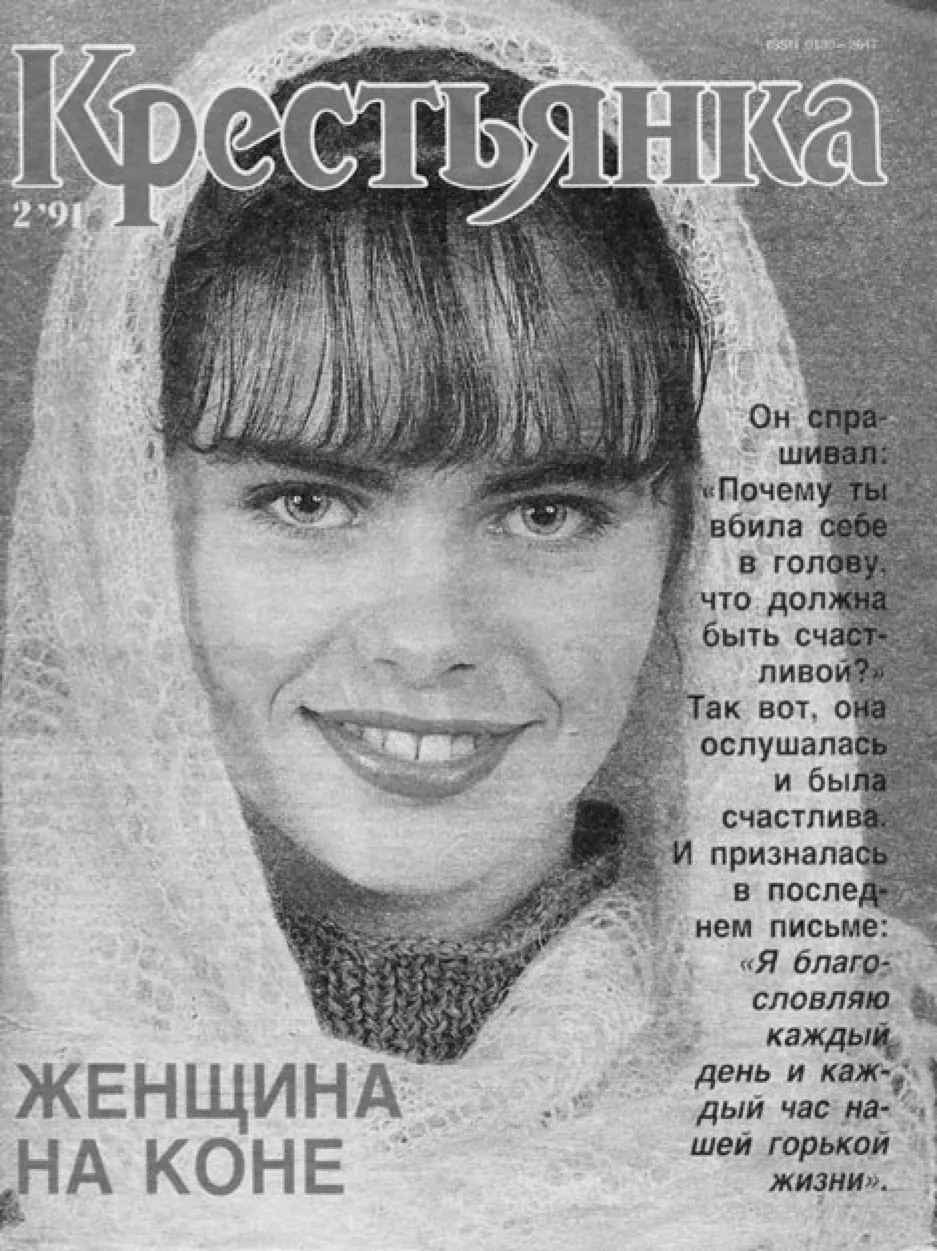
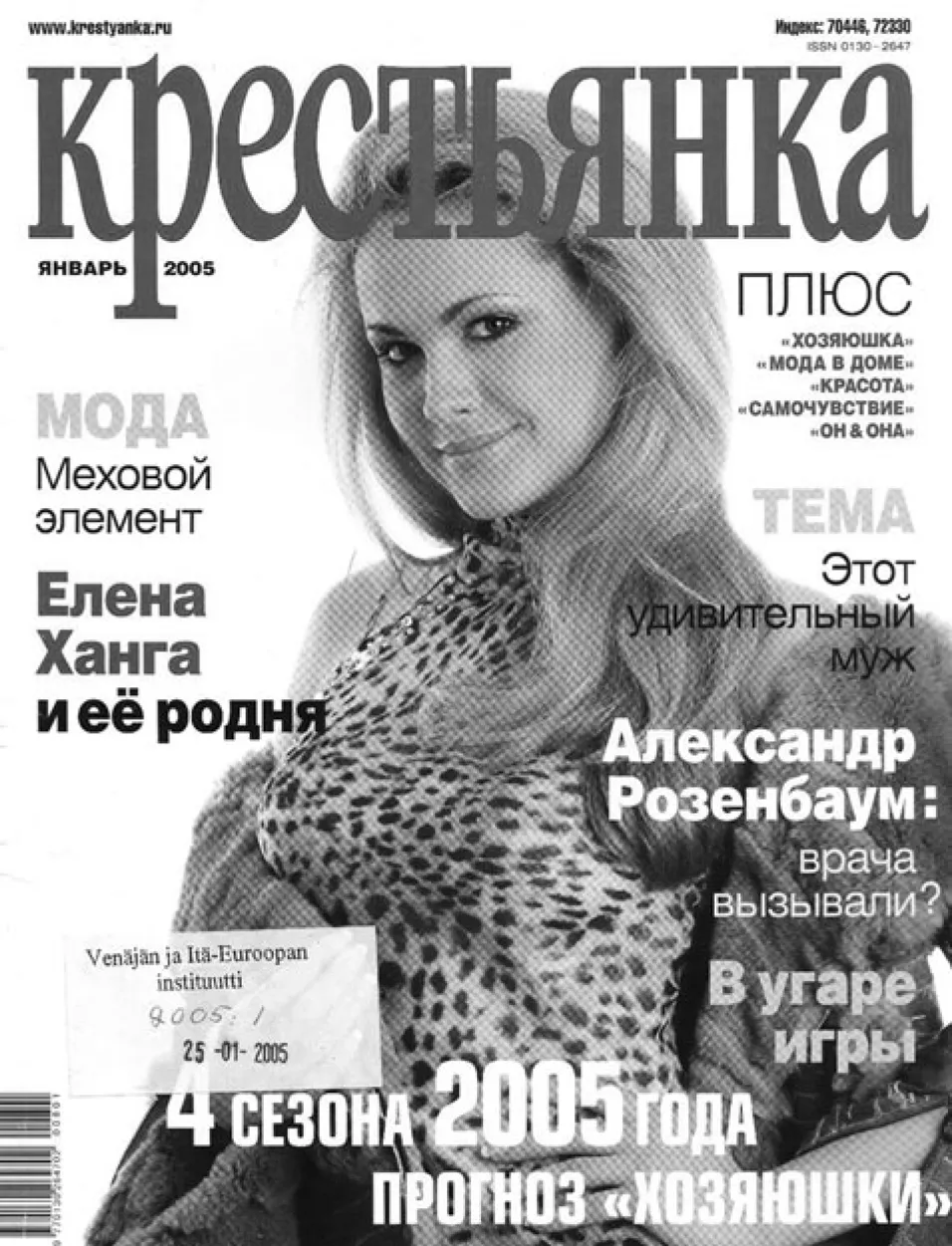
Krest’ianka was launched in 1922 as a magazine targeting a female “mass” audience (Attwood 1999: 26). During the Soviet period, it was one of the major magazines for women together with Rabotnitsa, which first appeared in 1914. For a long time Krest’ianka addressed a broad range of issues related to social and political life. Its writers urged Soviet women to enter public life, to become valuable citizens of Soviet society, and to be consumers (Attwood 1999: 12–13). With several million readers, Krest’ianka was one of the most popular women’s magazines under socialism. Currently, its circulation number is 180,000. 2 During the last 20 years the magazine has changed editors, and consequently, its concept has altered several times, although it keeps its original name. Krest’ianka is translated into English as Peasant Woman. As indicated, the magazine was initially aimed at a particular group of socialist society. The current editor presents the magazine as a lifestyle magazine, a publication for those who live an urban life outside the city.
The magazine has lost its mass popularity over the past two decades. The portrait of today’s reader is the following: women (83 percent), older than 35 (89 percent), with secondary education (71 percent), whose occupation is specialist, worker, or retiree. 3 Such a reader hardly belongs to the urban middle class, and one can hardly say that Krest’ianka has been able to become a significant part of the lifestyle of today’s middle class. Nevertheless, I see Krest’ianka as a valuable source for analyzing the middle-class culture of consumption. Popular in the 1990s, the magazine made attempts to follow its readers and to live up to their lifestyle. This difficult path will allow us to see all the continuity and ruptures, the tradition and novelties that happened to the former socialist magazine and to the middle-class consumption during this path.
I thus chose Krest’ianka for my analysis for the following reasons: first, it is one of the oldest and longest-lived women’s magazines in Russia; second, it survived the reforms of the 1990s and other social, cultural, and economic upheavals; and third, it provides an opportunity to examine how the Soviet legacy informs postsocialist ideas and practices related to fashion and clothing consumption, as well as how major changes in the media and in society in general have affected the discourse of this former socialist journal and the consumer practices represented therein. Besides, the issues of the magazine almost always contain headings and enclosures devoted to fashion, thereby enabling us to trace how the ideology of fashion and consumption has changed during the last 20 years.
Drawing on an analysis of the empirical data collected from Krest’ianka during postsocialist times (from the beginning of the 1990s until the end of 2011), I will be discussing the ideologies of fashion and consumption. The notion of ideology has been used fruitfully in analyses of women’s magazines (Gill 2007: 181). I rely on Louis Althusser’s notion of ideology as a set of representations of social and cultural reality, a set of concepts, ideas, myths, and images of reality, which form people’s understanding, evaluation, and experience of the real conditions of their existence (Althusser 2000). Having used this notion elsewhere (Gurova 2006), I treat ideology as a set of dominant discourses that contain ideas about the body, the self, and consumption as represented in various forms of cultural production or cultural artifacts (magazines, newspapers, TV, cinema, material objects).
I also use the category interpretative repertoire and its charachistics—a tone, a lexicon, a register of terms used to charachize and evaluate actions and events (Potter and Wetherell, cited in Edley 2001: 198; Vihalemm and Keller 2011). An interpretative repertoire is a relatively coherent way of talking about a particular topic. The analysis is based on a search for interpretive schemes that change each other and are revised. In doing such an analysis, one begins to feel as though things have been read before. Patterns, categories, and figures of speech are recognized across time (Edley 2001: 198–199). Repetitiveness or rather a change of discourse indicates an interpretative repertoire. By looking at the ways the writers for Krest’ianka deal with fashion and clothing consumption, we can begin to understand how discourse has changed from the point of view of both style and content.
I will begin with a brief review of previous research on women’s magazines and consumption in Russia in the 1990s and the first decade of the 2000s. Thereafter, I will discuss the shifts in Krest’ianka’s writings about fashion and clothing consumption over the past 20 years. Then I will proceed to analyze significant topics related to fashion and clothing in the magazine’s discourse. Three major topics were covered extensively in Krest’ianka: daily consumer practices, identity construction, and fashion as a social institution. These topics will be discussed along with the ideology of fashion. In a closing section I will suggest an explanation for the shifts in discourse on fashion and clothing consumption that have occurred in Russia since the dissolution of the Soviet Union. Although the basic ingredients of women’s magazines were established long ago, social, cultural, political, and economic transformations have wrought major changes and shifts in the content of women’s magazines (cf. Gill 2007).
Women's magazines in Russia write about fashion: previous scholarship
Women’s magazines in postsocialist Russia have become a popular topic of research (Goscilo 2000; Roginskaia 2004; Kopnina 2007; Ratilainen 2008, 2013; Gudova and Rakipova 2010; Rosenholm et al. 2010). Scholars argue that the majority of Russian lifestyle media projects, both television and print media, are derivatives of international counterparts, although they point to a number of distinct features that demonstrate how these magazines have endeavored to come closer to the Russian viewer and reader (Zvereva 2010; Bartlett 2006). Once the culture of European and American women’s magazines, often called glossy magazines, began to proliferate in Russia, it pushed aside domestic pioneers in women’s print media, such as Rabotnitsa and Krest’ianka. By comparison with Finland, for instance, where local women’s magazines successfully reevaluated the “beauty myth” imposed as the dominant ideology by global consumer culture and turned instead to “real women,” in Russia the culture of glossy magazines was enthusiastically embraced by readers (Kriazheva 2008; Roginskaia 2004).
Women’s magazines serve as a powerful tool for the construction of gender identities and relations, expressions of sexuality, representations of body, and changes in the cultural meanings ascribed to them. As for gender representation in women’s magazines, scholars have shown that after the dissolution of the Soviet Union, Russia’s media discourse promoted the “beauty myth” and sexuality, reclaiming traditional femininity after the years of prescribed gender equality among men and women (Ratilainen 2008). Along with the double burden of being a worker and a mother, the postsocialist woman carried a third burden, namely, the demand to beautify herself, to care about her body and appearance. For men, especially those involved in business, appearance, and image—that is, “seeming” to be something—was also of major importance, and consumption became a significant manifestation of a dominant masculinity (Yurchak 2001).
A significant shift related to the representation of gender in glossy magazines should be noticed. In the 1990s and the beginning of the 2000s, the magazines served as promoters of oppressive ideology, creating an image of a passive, sexualized woman whom Oksana Kis designates as Barbie, a narcissistic individual who creates her beauty for a man of her own (Kis 2005: 115–122; cf. Gill 2007). In recent years, an active woman, a self-managing individual, an “entrepreneur of herself” pampering herself with consumption, replaced the woman as a passive object. This shift, which is a global phenomenon, reflects the transition to a woman as a postfeminist neoliberal subject (Lazar 2009: 371; Foucault 2008). In recent years, there has been a growing body of scholarly literature on neoliberalism and postfeminism as the dominant ideologies in women’s magazines (Gill and Scharff 2011; Lazar 2009). Nevertheless, Krest’ianka stands far from this glossy journal ideology, promoting clearly distinct gender roles and rather essentialist view as the main gender ideology, yet this needs to be researched further.
Scholars admit that the arrival of glossy magazines in Russia signalled a change in the imagery, the politics of style, the consumption practices, and the gender representations (Bartlett 2006). Women’s magazines are widely regarded from the viewpoint of the world of images they create. The magazines inspire consumers’ dreams, offering a feast for the eyes, tantalizing women’s imaginations, and stimulating their desires (cf. Stevens and Maclaran 2005). The bridge between fantasy and reality is especially noticeable in societies in transition, such as Russia. In the 1990s, when international glossy magazines b...
Table of contents
- Cover
- Halftitle Page
- Routledge
- Title Page
- Copyright Page
- Contents
- List of figures
- List of interviewees
- Acknowledgments
- Introduction: “We started to dress more better”
- 1 Media and the ideology of consumption and fashion: the case of Krest’ianka
- 2 From shuttle traders to shopping malls: retail trade transformations and consumer experience
- 3 “We are not rich enough to buy cheap things”: the middle class as a clothing consumer
- 4 “People dress so brightly here!”: exploring social distinctions through clothing
- 5 “When I put on a fur coat everyone knows I am Russian”: clothing consumption of Russian migrants in Finland
- 6 From Russia to Finland: exploring cross-border shopping
- 7 Fashion and time: the lifespan of clothing
- 8 “Semiotic baggage” and fashion
- Conclusion
- Bibliography
- Index
Trusted by 375,005 students
Access to over 1.5 million titles for a fair monthly price.
Study more efficiently using our study tools.
Frequently asked questions
Yes, you can cancel anytime from the Subscription tab in your account settings on the Perlego website. Your subscription will stay active until the end of your current billing period. Learn how to cancel your subscription
No, books cannot be downloaded as external files, such as PDFs, for use outside of Perlego. However, you can download books within the Perlego app for offline reading on mobile or tablet. Learn how to download books offline
Perlego offers two plans: Essential and Complete
- Essential is ideal for learners and professionals who enjoy exploring a wide range of subjects. Access the Essential Library with 800,000+ trusted titles and best-sellers across business, personal growth, and the humanities. Includes unlimited reading time and Standard Read Aloud voice.
- Complete: Perfect for advanced learners and researchers needing full, unrestricted access. Unlock 1.5M+ books across hundreds of subjects, including academic and specialized titles. The Complete Plan also includes advanced features like Premium Read Aloud and Research Assistant.
We are an online textbook subscription service, where you can get access to an entire online library for less than the price of a single book per month. With over 1.5 million books across 990+ topics, we’ve got you covered! Learn about our mission
Look out for the read-aloud symbol on your next book to see if you can listen to it. The read-aloud tool reads text aloud for you, highlighting the text as it is being read. You can pause it, speed it up and slow it down. Learn more about Read Aloud
Yes! You can use the Perlego app on both iOS and Android devices to read anytime, anywhere — even offline. Perfect for commutes or when you’re on the go.
Please note we cannot support devices running on iOS 13 and Android 7 or earlier. Learn more about using the app
Please note we cannot support devices running on iOS 13 and Android 7 or earlier. Learn more about using the app
Yes, you can access Fashion and the Consumer Revolution in Contemporary Russia by Olga Gurova in PDF and/or ePUB format, as well as other popular books in Social Sciences & Ethnic Studies. We have over 1.5 million books available in our catalogue for you to explore.