This book presents the first translation into English of the full text of the Kaogong ji. This classic work, described by the great scholar of the history of Chinese science and technology Joseph Needham as "the most important document for the study of ancient Chinese technology", dates from the fifth century BC and forms part of the Zhouli (The Rites of the Zhou Dynasty), one of the great Confucian classics. The text itself describes the techniques of working and the technologies used by over twenty different kinds of craftsmen and artificers, such as metal workers, chariot makers, weapon makers, music instrument makers, potters and master builders. This edition, besides providing the full text in English, also provides a substantial introduction and other supporting explanatory material, over one hundred illustrations of ancient Chinese artefacts, and the original Chinese text itself.
eBook - ePub
Ancient Chinese Encyclopedia of Technology
Translation and Annotation of Kaogong ji, The Artificers' Record
- 228 pages
- English
- ePUB (mobile friendly)
- Available on iOS & Android
eBook - ePub
Ancient Chinese Encyclopedia of Technology
Translation and Annotation of Kaogong ji, The Artificers' Record
About this book
Information
1 Opening paragraphs1
The state (guo2) has six kinds of official duties, and the hundred artisans (baigong3) are under one head.
There are those who sit idly to deliberate upon the Dao,4 and there are others who take action to execute it. Some artisans check external characteristics, such as the curvature and straight, and examine the internal quality (of natural objects)5, prepare the five raw materials (wucai6), and make instruments for people’s livelihood; others trade and circulate things rare and strange from the four corners (of the world), in order to make objects of value. Others again devote their strength to farming to augment the products of the earth. Still others process the silk and hemp and weave clothes from them.
Now it is the king and grand dukes who sit idly to deliberate upon the Dao, while carrying it into execution is the responsibility of ministers and officials. Examining the raw materials and making the practical instruments is the charge of the hundred artisans.7 Trade and circulation are the affairs of merchants and traders; tilling the soil belongs to the farmers, and weaving of silk and hemp is the duty of women workers.8
In the state of Yue,9 there are no special craftsmen of hoes (bo10) but every man knows how to make one. In the state of Yan,11 there are no special craftsmen of hide armor (han12) but every man knows how to make it. In the state of Qin,13 there are no special craftsmen of pikestaffs (lu14) but every man knows how to make them. Among the nomads Hu15 there are no special craftsmen of bow and chariot (gong che16) but all the men there are proficient in the art.
It is men of wisdom (zhizhe17) who invent tools and machines. The skillful men (qiaozhe18) maintain their traditions, and those who keep in the same line of occupation generation by generation are called artisans (gong19). All that is done by the hundred artisans are originally the creation of the sages. Smelting metal to make sharp, strong weapons, hardening clay to make vessels, fashioning chariots for going on land, and making boats for crossing water—all these arts are creations of the sages.20
When the seasons (shi21) of heaven are favorable, the qi22 (local influences) of the earth also are favorable, materials have their proper virtues (mei23), and the work of skillful workers is cunning (gong qiao24), then these four being all combined, perfection is attainable. But with suitable material and skilled workmen it still may happen that the product is not satisfactory; in this case, the season has not been propitious, or the favorable qi of the earth has not been successfully obtained. [Heaven has its seasons of production and destruction; trees and grasses have a time to live and a time to die. Even rocks crumble, and water freezes or flows. These are according to the natural seasons of heaven.]25 Take, for instance, the sweet-fruited orange (ju26), when it is transplanted to the north of the Huai27 River, it turns into the bitter-fruited orange (zhi28); the crested mynah (quyu29) could not live across the Ji30 River; and raccoon dogs or badgers (he31) die if they pass over the Wen32 River. This doubtless is from the effects of the qi of the earth. The knives of Zheng,33 the axes of Song,34 the pen-knives of Lu,35 and the double-edged swords of Wu36 and Yue are famous for their origin. In no other places, can one make these things so well. This is natural because of the qi of the earth.
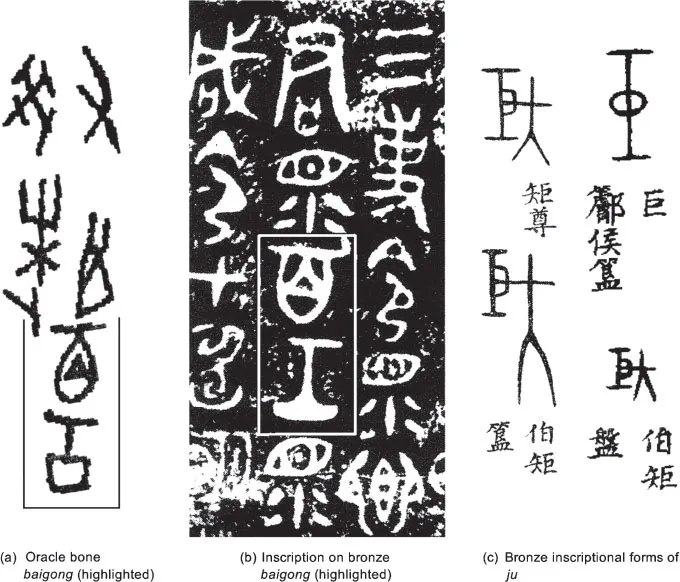
Figure 1.1 Inscriptions of baigong 百工 (the hundred artisans) and ju 矩 (carpenter’s square). (a) Oracle bone baigong of the Shang dynasty. From (detail, ZSKS 1980, 2525 (H65:2)). (b) Inscriptions of baigong on cover of the “Ling fangyi” of the Zhou dynasty. From (detail, Guo Moruo ([1957] 1999, Vol. 1, rubbing 3). (c) Bronze inscriptional forms of ju of the Western Zhou period. From Rong Geng (1985, no. 0731).
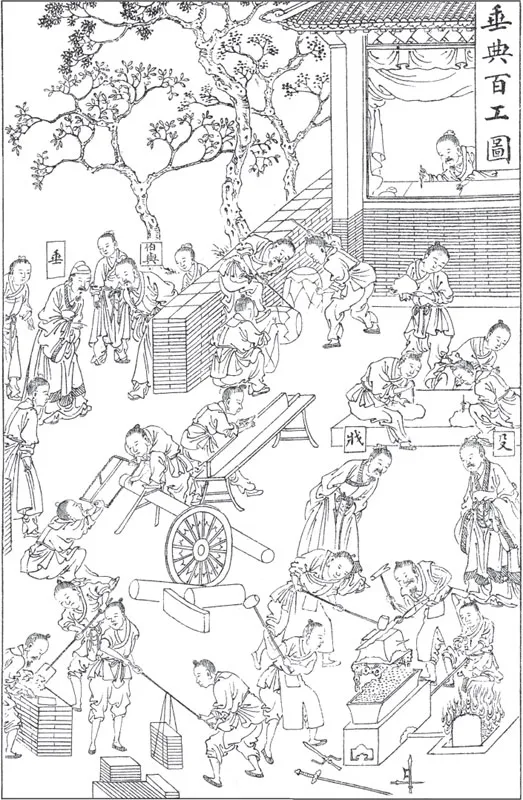
Figure 1.2 A late Qing representation of artisans at work managed by the first director Chui and his assistants. From Sun Jianai et al. (1905, ch. 2, 33a). The caption: Chui 垂 was managing the hundred artisans.
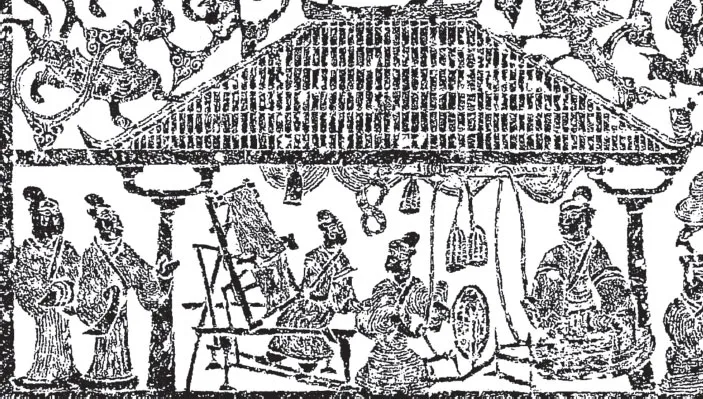
Figure 1.3 A stone relief with scene of people weaving on a treadle-loom at the left, quilling on a quilling-wheel at the center, and throwing of silk thread on a spooling-reel at the right, unearthed in 1956 from the Han grave in Honglou 洪樓 Tongshan 銅山, Jiangsu province. After Ouyang Moyi (2001, 32, Fig. 31), by courtesy of Ouyang Moyi.
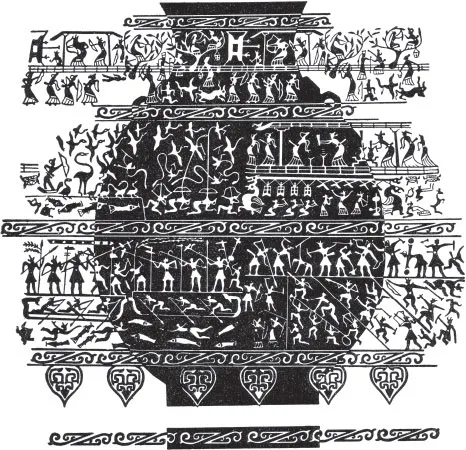
Figure 1.4 Line drawing of the décor on an inlaid bronze vase hu 壺 from the Warring States period, preserved in Shanghai Museum. Depictions show people engaged in such activities as warfare, hunting, boating, rituals, music making, picking of silkworm thorn leaves, bow making, archery, and food preparation. By courtesy of Shanghai Museum.
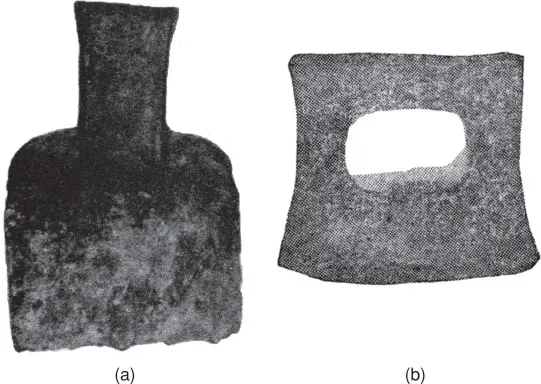
Figure 1.5 Bronze shovel of the Wu state and bronze hoe of the Yue state. (a) Bronze shovel unearthed in 1972 from a fifth century BCE tomb of Wu in Chengqiao 程橋, Liuhe 六合, Jiangsu province. Length 10.4 cm. Width 7 cm. After Jun Wenren (1988, Fig. 7a). (b) Bronze hoe of Yue. After Jun Wenren (1993, Fig. 1-2b).
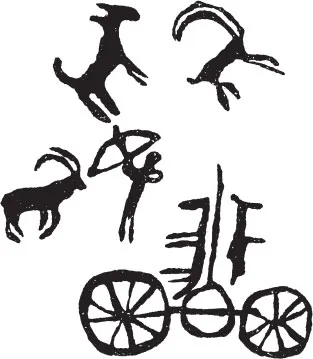
Figure 1.6 Rock carving of the bow and carriage in Yin 陰 Mountain, Inner...
Table of contents
- Cover Page
- Half Title page
- Series Page
- Title Page
- Dedication
- Contents
- List of illustrations
- Preface
- Background
- Part I
- Part II
- Appendix 1: Original Chinese text Kaogong ji 考工記 (the Artificers' Record)
- Appendix 2: A brief chronology of the dynasties in history of China
- Appendix 3: The equivalence of Chinese weights and measures in metric units: (From the Shang to Qin Dynasties)
- Glossary of Chinese characters
- Notes
- Abbreviations and bibliography
- A Chinese books before 1900
- Index
Trusted by 375,005 students
Access to over 1.5 million titles for a fair monthly price.
Study more efficiently using our study tools.
Frequently asked questions
Yes, you can cancel anytime from the Subscription tab in your account settings on the Perlego website. Your subscription will stay active until the end of your current billing period. Learn how to cancel your subscription
No, books cannot be downloaded as external files, such as PDFs, for use outside of Perlego. However, you can download books within the Perlego app for offline reading on mobile or tablet. Learn how to download books offline
Perlego offers two plans: Essential and Complete
- Essential is ideal for learners and professionals who enjoy exploring a wide range of subjects. Access the Essential Library with 800,000+ trusted titles and best-sellers across business, personal growth, and the humanities. Includes unlimited reading time and Standard Read Aloud voice.
- Complete: Perfect for advanced learners and researchers needing full, unrestricted access. Unlock 1.5M+ books across hundreds of subjects, including academic and specialized titles. The Complete Plan also includes advanced features like Premium Read Aloud and Research Assistant.
We are an online textbook subscription service, where you can get access to an entire online library for less than the price of a single book per month. With over 1.5 million books across 990+ topics, we’ve got you covered! Learn about our mission
Look out for the read-aloud symbol on your next book to see if you can listen to it. The read-aloud tool reads text aloud for you, highlighting the text as it is being read. You can pause it, speed it up and slow it down. Learn more about Read Aloud
Yes! You can use the Perlego app on both iOS and Android devices to read anytime, anywhere — even offline. Perfect for commutes or when you’re on the go.
Please note we cannot support devices running on iOS 13 and Android 7 or earlier. Learn more about using the app
Please note we cannot support devices running on iOS 13 and Android 7 or earlier. Learn more about using the app
Yes, you can access Ancient Chinese Encyclopedia of Technology by Jun Wenren in PDF and/or ePUB format, as well as other popular books in Social Sciences & Ethnic Studies. We have over 1.5 million books available in our catalogue for you to explore.