This influential study, originally published in 1921, develops aspects of Laski's theory of the state, ideas he introduced in his first important publication, Authority in the Modern State (1919). According to Laski, the state is not a supreme entity; it is one association among many that must compete for the people's loyalty and obedience.
eBook - ePub
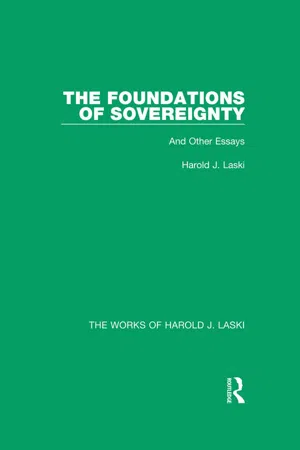
The Foundations of Sovereignty (Works of Harold J. Laski)
And Other Essays
- 332 pages
- English
- ePUB (mobile friendly)
- Available on iOS & Android
eBook - ePub
About this book
Information
The Early History of the Corporation in England*
DOI: 10.4324/9781315742670-5
Ours is a time of deep question about the state.1 Theories of corporate personality have challenged in decisive fashion its proud claim to preëminence.2 Its character of uniqueness seems hardly to have survived the acid test of skeptical inquiry. The groups it has claimed to control seem, often enough, to lead a life no less full and splendid than its own. The loyalty they can command, the fear they may inspire, are near enough to its own to seek comparison with it. Yet dogmas that are none the less fundamental because they are hardly old still haunt our speculations. It is barely a century and a half since Blackstone asserted in his emphatic fashion the right of the state to condition and control all corporate existence.3 Less than three centuries have elapsed since a civil war shocked the timid Hobbes4 into a repetition of Richard of Devizes’ anger at the danger of group-persons.5 We perhaps too little realize that a long history lies behind Blackstone’s incisive sentences; nor is the contemptuous phrasing of Hobbes an accurate index to the English attitude. For, as Maitland has pointed out,6 few countries have enjoyed a richer variety of group-life. Yet we have hardly come to ask the fundamental questions that richness suggests. A history of English state theory has still to be written.7 We have still to work out in detail the lines of their thought as to its juridical nature and of its relation to those groups of which they were so dramatically prodigal. Englishmen are a practical race, and they had discovered the benefits of fellowship long before they speculated upon their nature. Orcy of Dorsetshire had built for his brethren a gild-house long before the stern hand of the Norman conquerer had begun to effect the centralization of law;8 and the benefits of meat and drink in goodly fellowship were not unknown in Anglo-Saxon Cambridge.9
But where men meet to eat and drink and, mayhap, to pray, the subtleties involved in corporate existence hardly seem to emerge. Communitas, it is true enough, is the key to early English history; but it is a dangerous and ambiguous word. “It swallows up,” as Maitland has happily remarked,10 “both the corporation and the group of coöwners.” That, iijdeed, is intelligible enough; for in the nineteenth century a great Lord Chancellor could still be puzzled about the nature of corporate ownership.11 The abstractions of early jurisprudence are post-conquestual in origin; and we may even doubt whether the early communalism which has so much affected the economic speculation of our time is not in fact more truly individualist than we care to admit.12 We dare not base our speculations upon the evidence anterior to the time when the iron hand of Norman William fashioned a conquered kingdom to his own desire. Of corporateness we shall speak with some skepticism, though we shall recognize that its roots are there. For the court rolls from which our main knowledge of internal organization is drawn date only from the end of the thirteenth century; the records of the King’s Court are continuous only after the twelfth. Our earlier knowledge is rather of fields and farming methods, of taxation and military service, than of judicial or political unification. And where there is so dangerous an economy of words, our footsteps must needs go slowly.
II
Yet some sort of guesswork we may adventure. If corporateness be held in the balance the basis of it may at any rate be discovered. The theory of possession — the later turning point in corporate history — here helps us but little. It is to men that the land belongs. Our Anglo-Saxon village is full of freeholders.13 The men who drew up Domesday Book were not very certain whether St. Peter owns his church, or the priest who cares for it.14 The church will indeed hold land; and we may perhaps see therein a significant effort after a natural personification. Yet we shall put our trust in the mysticism of a superstitious time rather than the advanced ideas of an inquiring jurisprudence.15 The land of England, of a certainty, is the king’s, for William knew too well the dangers of continental feudalism to submit himself to its conflicts of allegiance.16 It is evidence enough that a corporate kingdom is not yet attained, for William at least is stout flesh and blood, and what he calls his own he uses for his purposes.17
‘Yet a certain attempt at noteworthy unification we deem not wanting. England is divided into townships; and we shall exaggerate the automatism of medieval life if we believe that its affairs went of themselves. A township court it seems clear that we must have.18 That court will pass by-laws,19 and, if need be, enforce them.20 There was joint liability in taxation,21 for the separate collection of geld from each individual was a task no administration could then have undertaken.22 The village will grow and divide into parts;23 surely the fact of division connotes the recognition of significant difference. The village is a police unit, and it will sometimes struggle against a forcible extinction.24 It is of real importance that our great geld-book should write of local duties and local privileges in township terms.25 The vill that farms its own dues has a healthy sense of its own individuality;26 and the men who could hold and sell their land “communiter” we may not easily pass by.27 Nor dare we minimize a waste land which, however vaguely, is yet the possession of the community.28
Table of contents
- Cover Page
- Half Title Page
- Title Page
- Copyright Page
- Title Page 01
- Frontmatter Page
- Dedication
- Preface
- Table of Contents
- The Foundations of Sovereignty
- The Problem of Administrative Areas
- The Responsibility of the State in England
- The Personality of Associations
- The Early History of the Corporation in England
- The Theory of Popular Sovereignty
- The Pluralistic State
- The Basis of Vicarious Liability
- The Political Ideas of James I
Trusted by 375,005 students
Access to over 1.5 million titles for a fair monthly price.
Study more efficiently using our study tools.
Frequently asked questions
Yes, you can cancel anytime from the Subscription tab in your account settings on the Perlego website. Your subscription will stay active until the end of your current billing period. Learn how to cancel your subscription
No, books cannot be downloaded as external files, such as PDFs, for use outside of Perlego. However, you can download books within the Perlego app for offline reading on mobile or tablet. Learn how to download books offline
Perlego offers two plans: Essential and Complete
- Essential is ideal for learners and professionals who enjoy exploring a wide range of subjects. Access the Essential Library with 800,000+ trusted titles and best-sellers across business, personal growth, and the humanities. Includes unlimited reading time and Standard Read Aloud voice.
- Complete: Perfect for advanced learners and researchers needing full, unrestricted access. Unlock 1.5M+ books across hundreds of subjects, including academic and specialized titles. The Complete Plan also includes advanced features like Premium Read Aloud and Research Assistant.
We are an online textbook subscription service, where you can get access to an entire online library for less than the price of a single book per month. With over 1.5 million books across 990+ topics, we’ve got you covered! Learn about our mission
Look out for the read-aloud symbol on your next book to see if you can listen to it. The read-aloud tool reads text aloud for you, highlighting the text as it is being read. You can pause it, speed it up and slow it down. Learn more about Read Aloud
Yes! You can use the Perlego app on both iOS and Android devices to read anytime, anywhere — even offline. Perfect for commutes or when you’re on the go.
Please note we cannot support devices running on iOS 13 and Android 7 or earlier. Learn more about using the app
Please note we cannot support devices running on iOS 13 and Android 7 or earlier. Learn more about using the app
Yes, you can access The Foundations of Sovereignty (Works of Harold J. Laski) by Harold J. Laski in PDF and/or ePUB format, as well as other popular books in Politics & International Relations & Communism, Post-Communism & Socialism. We have over 1.5 million books available in our catalogue for you to explore.