This volume, originally published in 1938 can be read by anyone with an interest in the evolution of the institution of government in England and how the workings of some parts of it particularly relate to the problems of the first half of the twentieth century.
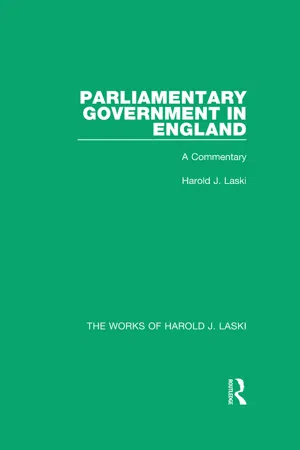
eBook - ePub
Parliamentary Government in England (Works of Harold J. Laski)
A Commentary
- 450 pages
- English
- ePUB (mobile friendly)
- Available on iOS & Android
eBook - ePub
About this book
Information
CHAPTER 1 Introductory
DOI: 10.4324/9781315742601-1
1.
No system of representative government has a history so continuous or so successful as that of Great Britain. It was born of a revolution which, in any real sense, may be said to have lasted almost fifty years. Yet if it was the deposit of a grim civil war, for two hundred and fifty years all its fundamental changes have since been effected by peaceful compromise. It has stood the strain of two wars of world importance; and it has been able to adapt itself to a condition in which the form of its political institutions has been successfully adapted to the substantive distribution of its economic power. In the century and a half of its modern history, the government of France has been reshaped by three violent revolutions; while the constitution of the United States was challenged, half-way in its evolution, by four years of civil war. If we date the history of representative government in Germany and Italy from 1870, the one lasted sixty-three, the other for fifty-two years.
The contrast is, on any showing, a striking one; and it is tempting to attribute it, as eulogists are wont to do, to some special British genius for the difficult art of self-government. That explanation, however, is an unsatisfactory one, since, obviously, it is a deduction from the history rather than a principle informing it. A passion for simplicity usually works havoc with political philosophers; and it is rare indeed for a phenomenon so complex as the success of the British government to be capable of explanation in terms of any single principle. Explanations which base themselves upon some supposed virtue in a national character rarely deceive any save those who are responsible for their making. Anyone who compares the impression produced by Englishmen upon Frenchmen in the seventeenth and eighteenth centuries respectively will recognize at once that judgments of national behaviour are always a dangerous enterprise. There is a presumption in them both of unity and objectivity which rarely coincide with the facts themselves.
The “prerequisites,” as Bagehot called them, of successful representative government are, indeed, both manifold and complex. It requires something more than intelligence and virtue. It presupposes a body of citizens who are fundamentally at one upon all the major objects of governmental activity; so fundamentally at one, it may be added, that the thought of conflict as a way of change is incapable of entering the minds of more than an insignificant portion of the nation. It requires, in the second place, a sense in the nation that no single class of any importance in the community is permanently excluded from power. For it has been not less true of the British than of other peoples, that the possession of power over a long period is corrupting in its nature; so that, in the long run, exclusion from power tends naturally to mean exclusion from benefit also. The rule of an aristocracy has always meant rule in the interest of that aristocracy; the rule of business men has always taken a narrow view of the interests both of agriculture and the poor. Unless a body of men who feel that their place in the society is, granted that they are numerous enough, either certain to receive consideration or, alternatively, that its refusal will jeopardize the position of those in office, they are unlikely, if the object involved is one to which they attach any profound consideration, to acquiesce at all easily in the maintenance of social peace.
A third condition of successful representative government is that it should be built upon widely diffused habits of tolerance throughout the nation. Men who are to live together peacefully must be able to argue together peacefully. They must not run to suppress criticism of things as they are; rather they must be willing, if pressed, to invite its examination. They must refrain from pressing upon a significant minority principles of legislation by which the latter is outraged. Without this tolerance there is no prospect in the society of compromise; and every subject of division then becomes a high-road to disruption.
It is, I think, historically obvious that the habits of tolerance are born of a sense of security. By that I mean that the members of the society are confident, above all in matters of economic constitution, that their established expectations will be fulfilled. For tolerance depends on the existence of a mood in which men are susceptible to rational argument; and nothing is so destructive of this temper as the fear that is born of the disturbance of a wonted routine. Political reform in England was postponed for forty years by the terror born of the French Revolution; and there was a moment when it seemed not unlikely that the compromise of 1832 would not be effected peacefully. Men cannot settle their differences by reason when the passion of fear hangs over their lives. It may be the outcome of defeat in war. It may come through a wholesale disruption of the currency. It may be the invasion of some custom or right held specially dear by those to whom it is denied. Whatever the causes, the deeper the disturbance of the atmosphere of security, the less likely will it be that a free system of representative government can be successfully maintained.
When, seventy years ago, Bagehot made his famous analysis of the English Constitution, he added two further conditions which he regarded as essential. The people, he thought, must, as a mass, have the habit of deference; and he regarded the institution of the monarchy as a “myth” which, by its magic influence, persuaded them to accept the rule of their betters. “They fancy,” he wrote, “they are governed by an hereditary queen, a queen by the grace of God, when they are really governed by a cabinet and a parliament—men like themselves, chosen by themselves. The conspicuous dignity awakens the sentiment of reverence, and men, often very undignified, seize the occasion to govern by means of it.”
We need not deny the influence of the monarch’s person in unifying the sentiment of a nation. But it is obvious enough that Bagehot’s myth, in fact, goes a very little way. For, historically, myths of this kind are only successful so long as, beneath their aegis, the “efficient” part of a constitution, as he termed it, is able to do its work successfully; and this, in its turn, depends upon the ability of the system, as it functions, to satisfy the legitimate expectation of citizens. Where it does not, as with Charles I or Louis XVI, or Nicholas II, the ability of the myth to do its work of conviction vanishes pretty rapidly. A successful myth operates only where a régime is secure; it collapses as that régime is undermined.
Underlying Bagehot’s insistence on the importance of the “dignified” part of a constitution, there was a deeper apprehension, hardly, perhaps, made fully articulate, which is more important. Bagehot, it must be remembered, wrote before the maturity of trade unions, before, also, the Education Act of 1870 had exercised any effect upon the population. He doubted the compatibility of representative government with universal suffrage. He was afraid of the ignorance of the multitude. The combination of the lower class might, he thought, drive their “betters” from power, and he urged a coalition of the aristocracy and the wealthy against this danger. It is clear enough that what he had in mind was a situation, like that of Chartism, or the French Revolution of 1848, in which the masses would use their political power to undermine respect for property. Particularly, he feared a situation in which the masses should find “two combinations of well-taught and rich men constantly offer to defer to their decision, and compete for the office of executing it. Vox populi will be vox diaboli if it is worked in that manner.” “A political combination of the lower classes,” he wrote, “as such and for their own objects, is an evil of the first magnitude; a permanent combination of them would make them (now that so many of them have the suffrage) supreme in the country; and their supremacy, in the state they now are, means the supremacy of ignorance over instruction, and of numbers over knowledge.”
That fear of the brute force of numbers is a characteristic of the generation in which Bagehot wrote. Mill and Maine and Lecky are all, in different degrees, pervaded by its influence in their writings. It is, of course, clear now that in some ways their fear was greatly exaggerated. They under-estimated the power of education to make men take long views; they under-estimated the influence of propaganda in maintaining ancient routines of thought. But, at least from one aspect, their fear of a democracy based on universal suffrage has a significance in which their warnings are of great importance.
For it is certain that in any society where men and women enjoy universal suffrage, there will be a persistent urgency to use their political power for the improvement of their material conditions. So long as the economic system is able continuously and measureably to respond to their demands, they are unlikely to discuss those foundations which, as Burke insisted, it is always dangerous to examine. They will want security, higher wages, shorter hours, better housing, more ample education and opportunity for their children. So long as the system is able to provide them with these things, so long, in Bagehot’s own phrase, as the “better” classes can “remove not only every actual grievance, but, where it is possible, every seeming grievance, too; they must willingly concede every claim they can safely concede,” all will be well. But the essential and central problem of representative democracy is the question of what the “better” classes can do when some claim is made which, in their judgment, they cannot “safely” concede. For Bagehot, no doubt, the idea of “safety” was an objective one; something, perhaps, that could logically be deduced from the postulates of that political economy of which he was so brilliant an exponent. Yet it is clear enough that those postulates were, in fact, the half-conscious assumptions of a class which had made them work and built its conceptions of “safety” upon the fact that it had come to think of no others as possible.
The real problem was one which was confronted in this period only by Tocqueville among Liberal, and by Marx and his disciples among Socialist thinkers. It was the consequences of the situation that might arise if the conception of “safety” in the granting of concessions was viewed differently, even antithetically, by the different parties to the political equation. Men would then be in disagreement about exactly those fundamentals unity upon which, as Bagehot saw, was the condition of successful government in representative democracy. “Our whole political machinery,” Lord Balfour has written, “presupposes a people so fundamentally at one that they can safely afford to bicker; and so sure of their own moderation that they are not dangerously disturbed by the never-ending din of political conflict.” It is that unity which explains the remarkable contrast between the political history of Great Britain and that of its continental neighbours.
It is a unity born of economic success, of success in war, of success in empire-building. Out of these came an expanding volume of wealth which permitted the policy of concessions which Bagehot recommended to be continuously applied. Moments of danger, like those of the Chartist movement, were transcended peacefully because each of them broadly synchronized with a great economic move forward which permitted the conference of increasing material benefit upon the masses. That conference, moreover, in nowise endangered, at least until the close of the war, the privileges or the security of the “better” classes; even so late as 1908 an eminent American observer could see no future for the Labour Party save as a minor partner in the Liberal alliance. It was widely held, until the outbreak of the war, that the capitalist foundations of society were not seriously in question. It was believed that the new socialized Liberalism of which, perhaps, T. H. Green was the most notable exponent, had built a philosophy of State-intervention which would safeguard in perpetuity at least the large outlines of the Victorian compromise. The main bulk of British Socialists themselves hardly doubted the validity of this view. Nourished, directly or indirectly, on the views of the Fabian school, they thought of the State-power as a neutral force which responded objectively to the will of an electoral majority. They had no doubt that reason was on their side; and they assumed that they had only to persuade that majority that they were right, to proceed to use the power of the State for the Socialist transformation of economic institutions.
This simple theory, no doubt, is still the predominant view in this country, though it has received some rude shocks in recent years. Its acceptance is built, in fact, upon a long series of assumptions none of which has been adequately tested. It believes, clearly, in the existence of an objective reason which compels men to peaceful acceptance of its conclusions whatever be their interest in the result of its application. It regards democracy as the supreme good; and it refuses to visualize the operation of democracy in the framework of the capitalist system to which it is so vitally related. It differentiates between the experience of continental countries, and that of Great Britain, on the ground that our national character and historic traditions create decisively different possibilities here; British capitalists, in view of that character and those traditions, will not, it is assumed, act like continental capitalists when their privileges are threatened. It is, moreover, a purely rationalist interpretation of political action; it hardly considers at all the degree to which, in politics, reason has its opportunity only where men have an equal interest in its findings. Above all, perhaps, it has never seriously examined the relation between economic power and political power, the degree, that is, to which the authority of the State is subordinated to the logic of the economic foundations upon which it rests.
As Bagehot and, indeed, most of his generation saw, the position is far more complicated. Constitutional principles and forms do not operate in a vacuum of abstract reason. They are a method intended to secure the triumph of certain ends; they are shaped to the purposes of those ends. The English State of the last two hundred and fifty years is the institutional expression of that Liberalism which received its first classical expression in Locke. It was the affirmation of the right of the property-owner to be protected against arbitrary interference in the enjoyment of his property. The business of the State was to find the terms upon which that enjoyment could be most amply protected. How narrow was the conception of the State’s function Adam Smith was not slow to admit; for him the main function of justice was the protection of property. “The affluence of the rich,” he wrote, “excites the indignation of the poor, who are often both driven by want and prompted by envy to invade their possessions. It is only under the shelter of the civil magistrate that the owner of that valuable property, acquired by the labour of many years, or perhaps many successive generations, can sleep a single night in security.” That the protection of property was the main end of the State was also the view of Burke. “To provide for us in our necessities,” he said, “is not in the power of government. It would be a vain presumption in statesmen to think they can do it…. It is in the power of government to prevent much evil; it can do very little positive good in this, or perhaps in anything else.” The underlying assumption of this attitude was, perhaps, put most clearly, if somewhat starkly, by Arthur Young. “Everyone but an idiot,” he wrote in 1771, “knows that the lower classes must be kept poor, or they will never be industrious.”
The English Liberalism of the last century has, in outward form, departed widely from that attitude. It has built a State in which freedom of speech and association, equality before the law, universal suffrage, compulsory education, and religious liberty, are postulates to which all parties give adherence. More: the police-State of the early nineteenth century has given place to the social service State of the twentieth. Upon a scale of which Bagehot could not have dreamed the State has used its supreme coercive power deliberately to mitigate, by its conscious intervention, some of the harsher consequences of economic inequality. The improvements in public health and education, in housing and the facilities for recreation since Bagehot’s day, are quite literally immense. The assumption made by most politicians is that there is no reason to assume any permanent suspension of this progress unless there supervenes some unlooked-for catastrophe. Social progress, no doubt, will have its ups and downs; we are not yet, for instance, the masters of the consequences inherent in the trade-cycle. But, given good will and patience, there is, it is argued, no inherent reason to suppose that our constitutional system is not elastic enough to provide for the peaceful achievement of any social transformation upon which the electorate has decisively made up its mind.
There is, I think, in that confidence an omission to pay due attention to the generalization Saint-Simon made in one of the most remarkable of his prophetic insights. “The law,” he wrote, “which constitutes the powers and the form of government is less important and has less influence on the happiness of nations than that which constitutes property and decides its use.” Our political system takes for granted the private ownership of the means of production; the consequences of that assumption cover every nook and cranny of the law. All the great categories of our jurisprudence are soaked in the traditions of individualism. They assume property-rights which, save in the absence of direct contrary prescriptions from Parliament, are to be safeguarded from invasion. They are based, not upon the collectivist and corporate habits of the twentieth century, but on the liberal-atomic principles worked out from the seventeenth to the mid-nineteenth century. They were the work of men who believed that, with the triumph of the business man, a term had been put to the need of revolutionary change. For, in their eyes, his victory ended the power of those barriers of race and birth and creed to prohibit his place in the sun. The true freedom was the freedom he had won—the freedom to acquire property and to be safeguarded in its acquisition. This was the magic that had turned sand into gold. This was what had brought the relations of production into harmony with the forces of production. Religion, ethics, political philosophy, all contributed to its sanctification. It was the “simple system of natural liberty” which had at long last enabled man to enter into his Kingdom.
The essence, at least, of this outlook was not touched by later changes. The concessions Bagehot recommended were made; they have not touched the class-relations of English society. Fundamentally, it still remains divided into the two nations of rich and poor. Fundamentally, also, any approach to equality of opportunity does not exist within its confines. Fundamentally, once more, the motive to production is not the need of the society but the ability of the owners of the instruments of production to make profit from their effort. Our society, as Mr. Keynes has insisted, has, upon this basis, become “absolutely irreligious, without internal union, without much public spirit, often, though not always, a mere congeries of possessors and pursuers.” The political constitution it built is, in form, one which leaves the substance of governmental action at the disposal of that party or parties which command a majority in the House of Commons. But it is vital to realize that all the pivotal positions in the judiciary, the civil service, the defence forces, the police, are occupied by members of the governing class. The rules and habits in which they have confidence are those which do not disturb the social order they dominate. Here, as elsewhere, right and wrong, wisdom and unwisdom in public action, are established in terms of the effect they have upon the existing social order. The question it raises is whether its framework, not seen abstractly, but in terms of the social order, of which it is the protective envelope, is elastic enough to admit changes which seek its basic transformation.
For, at this stage, both the method and the dynamic of change are different from anything known in the last two hundred and fifty years. Party government is still to-day, as it was in Bagehot’s time, the vital principle of representative government. But both the principles and the interests underlying party structure have undergone a radical change. On the one side, there stands a party which, broadly speaking, represents a faith in the private ownership of the means of production, on the other is a party committed to the view that the system of private ownership has broken down and that the socialization of those means is fundamental to national well-being. It is, of course, true that the first is willing to continue the policy of concessions in so far as, within the limits of the national economy, this appears a feasible adventure; and it is also true that their opponents are anxious to carry out the policy of socialization with the minimum detriment to existing interests. Each is anxious, in fact, to discover the maximum common ground because neither desires to pursue a policy which would be regarded by the other as a challenge to democracy. But neither has seriously confronted the issue of whether the uneasy marriage between capitalism and democracy is psychologically possible in the period of capitalism’s decline. While the party of the status quo remains in office, it is constantly outbid by its rival in what is offered to the electorate in return for its suffrages. Granted the nature of the party-system, the Opposition will one day become a Government. But it then meets a situation when the changes it will recommend are not such as can, in Bagehot’s phrase, be “safely” conceded by the party of property. That sense will inspire in business men a lack of confidence which may well go so deep as to provoke, as it provoked in 1931, a grave financial crisis. Can representative government work if one party to the political equation provokes by its policies a situation in which the economic stability of the society is threatened?
As the issues are now set, in fact, the problem that confronts us is the problem of whether our people is so “fundamentally at one,” as Lord Balfour put it, as to be able to “afford safely to bicker.” It is a test to which the parliamentary system has not had previously to submit. It threatens the general sense of security; thereby, it weakens the power of reason to maintain its e...
Table of contents
- Cover Page
- Half Title Page
- Title Page
- Copyright Page
- Title Page
- Copyright Page
- Dedication
- Preface
- Contents
- 1 Introductory
- 2 The Party System
- 3 The House of Lords
- 4 The House of Commons
- 5 The Cabinet
- 6 The Civil Service
- 7 Parliament and the Judiciary
- 8 The Monarchy
- Index
Trusted by 375,005 students
Access to over 1.5 million titles for a fair monthly price.
Study more efficiently using our study tools.
Frequently asked questions
Yes, you can cancel anytime from the Subscription tab in your account settings on the Perlego website. Your subscription will stay active until the end of your current billing period. Learn how to cancel your subscription
No, books cannot be downloaded as external files, such as PDFs, for use outside of Perlego. However, you can download books within the Perlego app for offline reading on mobile or tablet. Learn how to download books offline
Perlego offers two plans: Essential and Complete
- Essential is ideal for learners and professionals who enjoy exploring a wide range of subjects. Access the Essential Library with 800,000+ trusted titles and best-sellers across business, personal growth, and the humanities. Includes unlimited reading time and Standard Read Aloud voice.
- Complete: Perfect for advanced learners and researchers needing full, unrestricted access. Unlock 1.5M+ books across hundreds of subjects, including academic and specialized titles. The Complete Plan also includes advanced features like Premium Read Aloud and Research Assistant.
We are an online textbook subscription service, where you can get access to an entire online library for less than the price of a single book per month. With over 1.5 million books across 990+ topics, we’ve got you covered! Learn about our mission
Look out for the read-aloud symbol on your next book to see if you can listen to it. The read-aloud tool reads text aloud for you, highlighting the text as it is being read. You can pause it, speed it up and slow it down. Learn more about Read Aloud
Yes! You can use the Perlego app on both iOS and Android devices to read anytime, anywhere — even offline. Perfect for commutes or when you’re on the go.
Please note we cannot support devices running on iOS 13 and Android 7 or earlier. Learn more about using the app
Please note we cannot support devices running on iOS 13 and Android 7 or earlier. Learn more about using the app
Yes, you can access Parliamentary Government in England (Works of Harold J. Laski) by Harold J. Laski in PDF and/or ePUB format, as well as other popular books in Politics & International Relations & Communism, Post-Communism & Socialism. We have over 1.5 million books available in our catalogue for you to explore.