A valuable piece of intellectual history, readable in its own terms, this volume, beginning with the Renaissance and the Reformation, traces the growth of Liberal doctrine until the advent of the French Revolution. It shows the relation of Liberalism to the new economic system, and the impact of this upon science, philosophy and literature. The book explains how the same causes which produced the Liberal spirit also produced the reasons for the growth of Socialism.
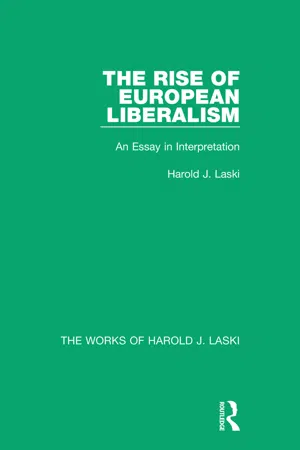
eBook - ePub
The Rise of European Liberalism (Works of Harold J. Laski)
An Essay in Interpretation
- 286 pages
- English
- ePUB (mobile friendly)
- Available on iOS & Android
eBook - ePub
The Rise of European Liberalism (Works of Harold J. Laski)
An Essay in Interpretation
About this book
Information
THE WORKS OF HAROLD J. LASKI
Volume 8
The Rise of European Liberalism
THE RISE OF EUROPEAN LIBERALISM CHAPTER ONE
The Background
DOI: 10.4324/9781315742618-1
I
I N the period between the Reformation and the French Revolution a new social class established its title to a full share in the control of the state. In its ascent to power, it broke down the barriers which, in all spheres of life save the ecclesiastical, had made privilege a function of status, and associated the idea of rights with the tenure of land. To achieve its end, it effected a fundamental change in the legal relationships of men.
Status was replaced by contract as the juridical foundation of society. Uniformity of religious belief gave way to a variety of faiths in which even scepticism found a right to expression. The vague medieval empire of jus divinum and jus naturale gave way to the concrete and irresistible power of national sovereignty. The control of politics by an aristocracy whose authority was built upon the tenure of land came to be shared with men whose influence was derived solely from the ownership of movable capital. The banker, the trader, the manufacturer, began to replace the landowner, the ecclesiastic, and the warrior, as the types of predominant social influence. The city, with its restless passion for change, replaced the countryside, with its hatred of innovation, as the primary source of legislation. Slowly, but, nevertheless, irresistibly, science replaced religion as the controlling factor in giving shape to the thoughts of men. The idea of a golden age in the past, with its concomitant idea of original sin, gave way to the doctrine of progress, with its own concomitant idea of perfectibility through reason. The idea of social initiative and social control surrendered to the idea of individual initiative and individual control. New material conditions, in short, gave birth to new social relationships; and, in terms of these, a new philosophy was evolved to afford a rational justification for the new world which had come into being.
This new philosophy was liberalism; and it is the purpose of these lectures to trace, in general outline, the history of the forces by which it was shaped into a coherent doctrine. The evolution, of course, was never direct and rarely conscious. The pedigree of ideas is never straightforward. Into the development of liberalism there have entered winds of doctrine so diverse in their origin as to make clarity difficult, and precision perhaps unattainable. To the evolution of liberalism have gone contributions of the first importance from men unacquainted with, often hostile to, its aims; from Machiavelli and Calvin, from Luther and Copernicus, from Henry VIII and Thomas More, in one century; from Richelieu and Louis XIV, from Hobbes and Jurieu, from Pascal and Bacon in another. The unconscious impact of events was at least as responsible as the deliberate effort of thinkers in shaping the mental climate which made it possible. The geographical discoveries, the new cosmology, technological invention, a renewed and secular metaphysic, above all, new forms of economic life, all made their contributions to the formation of its motivating ideas. It could not have become what it was without the theological revolution we call the Reformation; and this, in its turn, received much of its character from all that is implied in the revival of learning. Much of its character has been shaped by the fact that the breakdown of the medieval respublica Christiana divided Europe into a congeries of separate sovereign states each with its own special problems to solve and its unique experience to offer. Nor was its birth an easy one. Revolution and war presided over its emergence from the womb; and it is not beyond the mark to say that there was hardly a period until 1848 when its growth was not arrested by the challenge of violent reaction. Men fight passionately to retain those wonted habits in which their privileges are involved; and liberalism was nothing so much as a challenge to vested interests rendered sacred by the traditions of half a thousand years.
The change it effected was, on any showing, an immeasurable one. A society in which social position was usually definite, the market predominantly local, learning and science rather in society than of its essential texture, change usually unconscious and, as a general rule resented, habits dominated by religious precepts which few doubted at all and none successfully, in which there was little capital accumulation and production was dominated by the needs of a market for local use, slowly broke down. With the triumph of the new order in the nineteenth century, the church had given birth to the state as the institutional arbiter of human destiny. The claims of birth had been succeeded by the claims of property. The invention of invention had made change, instead of stability, the supreme characteristic of the social scene. A world-market had come into being, and capital had accumulated upon so immense a scale that its search for profit affected the lives and fortunes of societies to which European civilization had previously been without meaning. If learning and science were still the handmaids of property, their significance was appreciated by every class in society. If religious precepts still counted, their power to dominate the habits even of their votaries had disappeared.
Not, indeed, that liberalism, even in its triumph, was a clear-cut body of either doctrine or practice. It sought to establish a world-market; but the logic of that effort was frustrated by the political implications of the nationalism which surrounded its birth and flourished with its growth. It sought to vindicate the right of the individual to shape his own destiny, regardless of any authority which might seek to limit his possibilities; yet it found that, inherent in that claim, there was an inevitable challenge from the community to the sovereignty of the individual. It sought relief from all the trammels law might impose upon the right to accumulate property; and it found that the vindication of this right involved the emergence of a proletariat prepared to attack its implications. No sooner, in a word, had it achieved its end than it was compelled to meet a defiance of its postulates which seems certain to change the order it had brought into being.
What, then, is the liberalism we have here to discuss? It is not easy to describe, much less to define, for it is hardly less a habit of mind than a body of doctrine. As the latter, no doubt, it is directly related to freedom; for it came as the foe of privilege conferred upon any class in the community by virtue of birth or creed. But the freedom it sought had no title to universality, since its practice was limited to men who had property to defend. It has sought, almost from the outset of its history, to limit the ambit of political authority, to confine the business of government within the framework of constitutional principle; and it has tried, therefore, fairly consistently to discover a system of fundamental rights which the state is not entitled to invade. But, once more, in its operation of those rights, it has been more urgent and more ingenious in exerting them to defend the interests of property than to protect as claimant to their benefit the man who had nothing but his labour-power to sell. It has attempted, where it could, to respect the claims of conscience, and to urge upon governments the duty to proceed by rule rather than by discretion in their operations; but the scope of the conscience it has respected has been narrowed by its regard for property, and its zeal for the rule of law has been tempered by a discretion in the breadth of its application.
Liberalism has usually, by reason of its origins, been hostile to the claims of churches. It has tended, less perhaps to the Erastianism of Hobbes, than to view religious bodies as associations like any other within the community, entitled to tolerance so long as they do not threaten the existing social order. It has been favourable to representative self-government even when this has involved admitting the principle of universal suffrage. It has, in general, supported the idea of national self-determination. As a rule, though by no means universally, it has been tender to the claims of minority-groups, and to the right of free association. It has been suspicious of the control of thought and, indeed, of any effort, by government authority, to impede the free activity of the individual. I do not mean that its history is a conscious and persistent search for these ends. It is more accurate, I think, to say that these were the ends its more ultimate purposes caused it to serve; and I shall seek later to bring out the implications of this difference.
But liberalism, as I have urged, is hardly less a mood than a doctrine. Its tendency has been sceptical; it has always taken a negative attitude to social action. By reason of its origins, it has always regarded tradition as on the defensive; and, for the same reason, also, it has always preferred to bless individual innovation than to sanction the uniformities sought for by political power. It has always, that is, seen in both tradition and uniformity an attack upon the right of the individual to make of his own affirmations and insights a universal rule made binding not because authority accepts it, but because its inherent validity secures for it the free consent of others. There is, therefore, a flavour of romanticism about the liberal temper the importance of which is great. It tends to be subjective and anarchist, to be eager for the change which comes from individual initiative, to be insistent that this initiative contains within itself some necessary seed of social good. It has, accordingly, always tended to make an antithesis (as a rule an unconscious one) between liberty and equality. It has seen in the first that emphasis upon individual action for which it is always zealous; it has seen in the second the outcome of authoritarian intervention of which the result, in its view, is a cramping of individual personality. The outcome of this is important. For it has meant that liberalism, though it has expressed itself always as a universal, has, in its institutional result, inevitably been more narrow in its benefit than the society it sought to guide. For though it has refused to recognize any limit in theory, whether of class or creed, or even race, to its application, the historic conditions within which it has operated effected a limitation despite itself. It is the meaning of this limitation which is the key to the understanding of the liberal idea. Without it, we cannot explain either the triumphs or the failures in its record.
For what produced liberalism was the emergence of a new economic society at the end of the middle ages. As a doctrine, it was shaped by the needs of that new society; and, like all social philosophies, it could not transcend the medium in which it was born. Like all social philosophies, therefore, it contained in its birth the conditions of its own destruction. In its living principle, it was the idea by which the new middle class rose to a position of political dominance. Its instrument was the discovery of what may be called the contractual state. To make that state, it sought to limit political intervention to the narrowest area compatible with the maintenance of public order. It never understood, or was never able fully to admit, that freedom of contract is never genuinely free until the parties thereto have equal bargaining power. This, of necessity, is a function of equal material conditions. The individual liberalism has sought to protect is always, so to say, free to purchase his freedom in the society it made; but the number of those with the means of purchase at their disposal has always been a minority of mankind. The idea of liberalism, in short, is historically connected, in an inescapable way, with the ownership of property. The ends it serves are always the ends of men in this position. Outside that narrow circle, the individual for whose rights it has been zealous has always been an abstraction upon whom its benefits could not, in fact, be fully conferred. Because its purposes were shaped by owners of property, the margins between its claims and its performance have always been wide.
I do not mean that the triumph of liberalism did not represent a real and profound progress. The productive relations it made possible immensely improved the general standard of material conditions. The advance of science was only achieved through the mental climate it created. All in all, the advent of the middle class to power was one of the most beneficent revolutions in history. No doubt, also, its cost has been very great; through its coming, we lost the power to use certain medieval principles the recovery of which would, in my view, represent solid human gain. But no one can move from the fifteenth to the sixteenth, still more to the seventeenth, century, without the sense of wider and more creative horizons, the recognition that there is a greater regard for the inherent worth of human personality, a sensitiveness to the infliction of unnecessary pain, a zeal for truth for its own sake, a willingness to experiment in its service, which are all parts of a social heritage which would have been infinitely poorer without them. These were gains involved in the triumph of the liberal creed. They are not, of course, at any point gifts equally shared in the civilization to which they came; and their achievement was accompanied by its full meed of tragedy. But without the liberal revolution, the number of those whose demands upon life would have been satisfied, must have remained much smaller than it has been. That, after all, is the supreme test by which a social doctrine must be judged.
II
Liberalism came, then, as a new ideology to fit the needs of a new world. What entitles us to speak of novelty? There are the geographical discoveries. There is the breakdown of feudal economic relations. There is the establishment of new churches which no longer recognize the supremacy of Rome. There is a scientific revolution which altogether alters the perspective of men’s thought. There is a growing volume of technological invention which leads to new wealth and increased population. There is the discovery of printing with its inevitable implication of widespread literacy. There is the consolidation of vague and inchoate localisms into centralized and efficient national states. Born of all this, there is a new political theory which, as with Machiavelli and Bodin, makes the relation of man to man, instead of the relations of man with God, the foundation of social enquiry. There is the immense colonizing effort of Spain and Portugal, then of France and England. Out of all this were born new habits and new expectations. These came into conflict with a tradition of thought and practice which, in three centuries, they so reshaped that a society was born whose distinguishing characteristics would hardly have been recognizable to a medieval observer. It was a different society; and it knew that it was different. It had the sense of expansion, the feeling of spacious exhilaration, which come to men who know themselves to be engaged in the remaking of social foundation
What was the essence of this new society? Above all, I think, its re-definition of the productive relations between men. For they then discovered that, to exploit those new relations in all their fullness, they could use neither the institutio...
Table of contents
- Cover Page
- Table Of Contents
- The Rise of European Liberalism
- Notes
- Index
Trusted by 375,005 students
Access to over 1.5 million titles for a fair monthly price.
Study more efficiently using our study tools.
Frequently asked questions
Yes, you can cancel anytime from the Subscription tab in your account settings on the Perlego website. Your subscription will stay active until the end of your current billing period. Learn how to cancel your subscription
No, books cannot be downloaded as external files, such as PDFs, for use outside of Perlego. However, you can download books within the Perlego app for offline reading on mobile or tablet. Learn how to download books offline
Perlego offers two plans: Essential and Complete
- Essential is ideal for learners and professionals who enjoy exploring a wide range of subjects. Access the Essential Library with 800,000+ trusted titles and best-sellers across business, personal growth, and the humanities. Includes unlimited reading time and Standard Read Aloud voice.
- Complete: Perfect for advanced learners and researchers needing full, unrestricted access. Unlock 1.5M+ books across hundreds of subjects, including academic and specialized titles. The Complete Plan also includes advanced features like Premium Read Aloud and Research Assistant.
We are an online textbook subscription service, where you can get access to an entire online library for less than the price of a single book per month. With over 1.5 million books across 990+ topics, we’ve got you covered! Learn about our mission
Look out for the read-aloud symbol on your next book to see if you can listen to it. The read-aloud tool reads text aloud for you, highlighting the text as it is being read. You can pause it, speed it up and slow it down. Learn more about Read Aloud
Yes! You can use the Perlego app on both iOS and Android devices to read anytime, anywhere — even offline. Perfect for commutes or when you’re on the go.
Please note we cannot support devices running on iOS 13 and Android 7 or earlier. Learn more about using the app
Please note we cannot support devices running on iOS 13 and Android 7 or earlier. Learn more about using the app
Yes, you can access The Rise of European Liberalism (Works of Harold J. Laski) by Harold J. Laski in PDF and/or ePUB format, as well as other popular books in Politics & International Relations & Communism, Post-Communism & Socialism. We have over 1.5 million books available in our catalogue for you to explore.