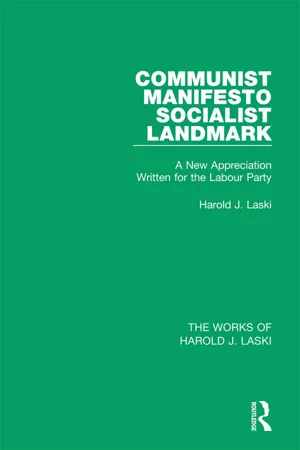
To mark the centenary of its first publication in 1848, the Labour Party issued this important special edition of the Communist Manifesto. In his (then) new historical introduction, Harold Laski discussed the authors of the Manifesto, their background and the development of their ideas. He outlined the history of the CommunistLeague, the struggles of the different sects and the emergence of Marx as a leader mandated to produce a programme. After surveying the genesis of the Manifesto, Laski discusses its contribution to world thought.
- 158 pages
- English
- ePUB (mobile friendly)
- Available on iOS & Android
eBook - ePub
About this book
Information
Introduction
THE Communist Manifesto was published in February, 1848. Of its two authors, Karl Marx was then in his thirtieth, and Friedrich Engels in his twenty-eighth, year. Both had already not only a wide acquaintance with the literature of socialism, but intimate relations with most sections of the socialist agitation in Western Europe. They had been close friends for four years; each of them had published books and articles that are landmarks in the history of socialist doctrine. Marx had already had a stormy career as a journalist and social philosopher; he was already sufficiently a thorn in the side of reactionary governments to have been a refugee in both Paris and Brussels. Engels, his military service over, and his conversion to socialism completed after he had accepted the view of Moses Hess that the central problem of German philosophy was the social question, and that it could only be solved in socialist terms, had already passed nearly fifteen months of his commercial training in his father’s firm in Manchester by the end of 1843. He had gained a deep insight into English conditions. He had come to understand the meaning of the conflict between the major political parties, the significance of Irish nationalism, then under the leadership of Daniel O’Connell, and all the stresses and strains within the Chartist Movement; he appreciated the meaning of Chartism, and he had joined its ranks. He realised how great had been both the insight and the influence of Robert Owen. He had been an eager reader of the Northern Star, and had been on friendly terms, after the summer of 1843, George Julian Harney, then, under Feargus O’Connor, the main influence on the paper, and one of the few Chartists aware of conditions and movements on the European Continent. He had written a good deal in Owen’s paper, The New Moral World, among his contributions being a very able essay on Carlyle’s Chartism, and a really remarkable attack on the classical political economy. In the months of his return to Barmen, from the autumn to the end of the winter of 1844–45, he had published his classic Condition of the Working Class in England,1 influenced, no doubt, by the earlier and interesting work of Buret,2 but with a freshness and a power of philosophic generalisation far beyond Buret’s grasp. He had already become certain that the antagonism between the middle classes and the proletariat was the essential clue to the history of the future.
No partnership in history is more famous than that of Marx and Engels, and the qualities of each were complementary to those of the other. Marx was essentially the thinker, who slowly, even with anguish, wrestled his way to the heart of a problem. At times a writer of remarkable brilliance, he was not seldom difficult and obscure because his thought went too fast or too deep for words. Erudite in an exceptional degree—his pre-eminence in scholarship was recognised by all the young Hegelians of his German years—he had something of the German gelehrte’s impractical nature, a passion for systematisation, not a little of that capacity for stormy ill-temper which often comes from the nervous exhaustion of a mind which cannot cease from reflection. He had fantastic tenacity of mind, a passion for leadership, a yearning, never really satisfied, for action; born of the difficulties he encountered from the outset of his career, he had too, a brooding melancholy, a thirst for recognition, which made him too often suspicious and proud, and, despite the noble self-sacrifice of his life, in a special way a self-centred personality who, outside his family, and a very small circle of friends of whom Engels was always the most intimate, found it, normally, much easier to give others his contempt or his hate than his respect and his affection. There were deeply lovable traits in Marx’s character; but they emerge much more clearly in his private life than in his capacity either as agitator or as social philosopher. All his immense power, moreover, both of diagnosis and of strategy, rarely enabled him to conceal his inner conviction of intellectual superiority, so as to remain on easy terms with the rank and file in each phase of the movement he was eager—mostly selflessly eager—to dominate.
Engels had a quick and ready mind. He was always friendly, usually optimistic, with great gifts both for practical action and for getting on with others. He knew early where he wanted to go, but he had the self-knowledge to recognise that he could neither travel alone, nor be the leader of the expedition. Widely read, with a very real talent for moving rapidly through a great mass of material, he was facile rather than profound. He was utterly devoid of jealousy or vanity. He had a happy nature which never agonised over the difficulties of thought. After a brief moment of doubt at their first meeting, he accepted the position of fidus Achates to Marx, and it never occurred to him, during a friendship of forty years, marked only by one brief misunderstanding, to question his duty to serve Marx in every way he could. He was a better organiser than Marx; he had a far more immediate sense of the practical necessities of a situation. He was far quicker in seeing what to do than to recognise the deep-rooted historical relations out of which the necessity for action had developed. If Marx showed him vistas of philosophy he had never realised, he explained to Marx economic realities with a first-hand insight Marx could otherwise hardly have obtained. Not least, he made Marx see the significance of Great Britain in the historical evolution of the mid-nineteenth century at a time when Marx still thought of Germany as the central factor in its development. Without him Marx would have been in any case a great social philosopher of the Left; with him it became possible for Marx to combine superb intellectual achievement with immense practical influence. Their partnership was made when the practitioners of socialism were incoherent groups of doctrine and of agitation. When it ended they had laid the foundations of a world movement which had a well-integrated philosophy of history, and a clear method of action for the future directly born of that philosophy.
When Marx and Engels, then, came to write the Communist Manifesto they were not only close friends, but they combined an insight built on firm philosophic foundations with a breadth and depth of historical and contemporary knowledge unequalled in their day in its relevance to the problems of social development. They had both been enchanted by the Hegelian dialectic; they had both been driven, almost from the moment of their original acquaintance with it, first to the Hegelian Left, and then beyond it to the point where, as Marx said, it was necessary to stand Hegel on his head. They both knew from intimate personal acquaintance the deep tyranny of the German princes, always dull, always petty, and always bureaucratic. They both saw that the state-power was used to maintain a special system of legal relations which were set in a given historical mode of production; and they had both realised that nothing could be expected from the aristocracy, and little from the middle classes, except what the proletariat became self-conscious enough to realise it must take. They both understood that, without this self-consciousness, nothing could prevent the exploitation of the wage-earners by their masters; and that every social agency, from the pietism of the Churches, through the pressure of the newspapers and the censorship exercised over them, to the brutal and deliberate use of the army and the police, would be employed to break any rebellion against this exploitation. They knew that every society was a class-society, that its education, its justice, its habits, were limited by their subordination to the demands of the class which owned the instruments of economic power. They had come to see, in the famous aphorism of Marx, that “the ruling ideas of an age were the ideas of its ruling class.” They had come to see also that freedom is never given from above, but must be taken from below; yet it can only be taken by men who have philosophy as well as habit. They had both seen through the hollowness of the official churches, and measured the gap between their actual and official practice. Not least, as Marx was later to add to his famous addition to the Theses on Feuerbach, they had both come to have an intensely practical view of the mission of philosophy. “Hitherto,” Marx was to write, “it was the mission of philosophers to interpret the world: now it is our business to change it.” It was to secure that change that their unique partnership had been formed.
Nor was the historical basis of their approach less ample in its survey when they came to write the Communist Manifesto. Marx was not merely a philosopher of competence and a jurist of considerable knowledge. He had read widely in German history. He had made a special and profound study of the eighteenth century in France, and, in quite special fullness, of 1789 and its consequences; and, with his usual omnivorous appetite, he had begun those remarkable studies of English economic history and theory which were to culminate, in 1867, the publication of the first volume of Capital.1 Engels knew the working-class movement in England from the end of the Napoleonic wars in massive detail. He knew the Chartist and trade union movements as one who had not only seen them from the inside, but with a perspective of historical knowledge and insight into contemporary European conditions that were hardly rivalled anywhere at the time. It is, in particular, important to emphasise that, apart from their specialised knowledge, both Marx and Engels, and especially Marx, had an extraordinarily wide general cultivation; each could say, with truth, that nihil a me alienum putat had been a choice of inner obligation. They were both polymaths; and one of the striking characteristics they shared, from an early age, was an appreciation of the significance of science in the context of each epoch in which its major developments influence human relations. Few eminent thinkers in social philosophy had, at their age, so superbly prepared themselves for the task which lay to their hand.
II
The composition of the Communist Manifesto is set in the background of the evolution into unity of a number of those groups of exiled revolutionaries which are the inevitable outcome of an age of repression and reaction. Though both the July Revolution of 1830 in France and the abortive Polish rebellion of 1831 had some influence in Germany, neither went deep enough to cause any serious concern. Yet a number of men remained not only profoundly dissatisfied, but eager to continue and further agitation. Among these was a young brushmaker, Johann Philip Becker (1809–84), who saw the need for something more than manifestos and meetings. With great courage, he organised groups of secret conspirators with a view to the preparation of an armed revolution; he himself, indeed, suffered imprisonment in 1833, for his activities. These groups were energetic and courageous. They attacked prisons, releasing their comrades. They distributed secretly-printed literature. They even attempted to seize the barracks at Frankfurt in order to secure arms. Some of the men who were thus aided to escape from prison, notably Karl Schapper and Theodore Schuster, fled to Paris. There, with other German exiles, they founded in 1833 a secret society to which they gave the name of the Society of the Exiles.
It did not long remain unified. Schuster fell under the influence of Blanqui, then the leading socialist revolutionary in Paris, and his energetic propaganda for Blanquism led to a split in the Society. Schuster and others left it to form a new organisation of their own, which they called the “League of the Just,” and this body took part in Blanqui’s rising in Paris in 1839. Its members were sent to prison; some of them on their release decided, under the guidance of Schapper, to emigrate to London, where the police were less hostile to foreigners engaged in political agitation. There they formed a new organisation to which they gave the name—perhaps for purposes of concealment—of the “Workers’ Educational Society,” in February, 1840. The old “League of the Just” seems simply to have disappeared as a society, and to have survived only in small groups of workers in a number of towns like London, Paris, Brussels and Geneva. Though they became familiar with Left groups in the places to which they emigrated, for the most part they were essentially groups of German exiles, arguing, in the natural fashion of the émigré, with ardour and energy among themselves.
One of the best-known members of the “League of the Just” was the German tailor, Wilhelm Weitling, who settled down in Paris in 1837, and became an eager disciple of Blanqui. It was under his influence that Weitling, in 1838, published a defence of revolutionary socialism in the form of a small pamphlet called “Mankind as it is and Ought to be.” Involved in Blanqui’s rising of 1839, he fled to Switzerland, where he settled down for some years, building up there groups of workers of his turn of mind. In 1842, Weitling published his Guarantees of Harmony and Freedom—a book in which his debt to Blanqui is outstanding. He rejected the idea that socialism can be achieved peacefully. He urged the need to provoke revolution; and he argued that the most reliable element upon which the making of a revolution can be built is the lumpenproletariat, the casually employed, the homeless, even the criminal classes, who have nothing to lose by participating in the overthrow of the existing order. It is interesting to note that while he was in Switzerland Weitling met Bakunin and was undoubtedly able seriously to influence the ideas of that remarkable Russian personality.
The publication of Weitling’s book led to his arrest and imprisonment, together with a number of his comrades, by the Swiss authorities. On his release he was expelled from Switzerland to Germany. There the conspicuous attentions of the police kept him moving from place to place, with the result that he decided, in the early autumn of 1844, to go to London.
His reputation there, even beyond German circles, was already considerable, and a large international gathering was arranged in his honour. Not merely French and German exiles, but English Chartists and trade unionists as well, took part in the celebration. The interest created was sufficient to enable Schapper to found, in October, 1844, “The Society of the Democratic Friends of all Nations,” which, it was hoped, would prove a rallying centre for all members of the Left who recognised the need for the revolutionary conquest of political power. Weitling, of course, in the early months of his sojourn in London had great influence in the new organisation. But this did not last long. There were others in the Society, especially Schapper and his friends, who not only knew the English Labour Movement far more fully, and had personal acquaintance with Robert Owen and the trade union leaders, but were deeply hostile to many of Weitling’s most cherished ideas. He looked to the poor outcasts of society, and especially to its criminal classes, to be the main architects of the revolution. He saw no special historical significance in the working class as such. Like a good pupil of Blanqui, he thought long-term propaganda and preparation for action largely effort thrown away. He believed in the sudden overthrow of organised government by a surprise attack from a small, but daring, band of reckless revolutionaries. These were at once to inaugurate a Communist order to be governed by a small committee of wise men, somewhat like the Guardians of Plato’s Republic. To hold the allegiance of the masses, he believed it indispensable for the new government to support religion. Christ was to be proclaimed as the founder of socialism, and the new church would preach a Christianity purified from all dogmas incompatible with its service to the poor and the suffering.
There is no sort of doubt either in Weitling’s ability or of his devotion; Heine’s testimony, after meeting him, is sufficient evidence of both. But there is also no doubt that, able though he was, Weitling had little sense of proportion, and that he looked upon criticism as a declaration of enmity. That is shown by his inability to decide whether Communism was more important than the creation of a universal language. Yet, with all his faults and eccentricities, he had made a great impression upon the European socialists. Even before he met Weitling, Marx wrote of his “fiery and brilliant debut”; and he and Engels saw a great deal of him in 1846 when Marx had taken refuge in Brussels after his exile from France. It is also clear that they considered the groups of which Weitling was the intellectual centre as of far more importance than any other, and that they had in mind building a kind of Socialist International around them; Engels tells us that Marx had begun to work out a scheme for a congress of the kind in 1845–46, to be held at Verviers.
But their good relations with, and interest in, Weitling were of brief duration. They were deeply divided, as Weitling himself tells us, on questions of method. Weitling still insisted that a revolution could be made at any moment, granted resolute...
Table of contents
- Cover
- Half Title
- Title Page
- Copyright Page
- Original Title Page
- Original Copyright Page
- Table of Contents
- Foreword
- Preface
- Introduction
- Manifesto of the Communist Party
Trusted by 375,005 students
Access to over 1.5 million titles for a fair monthly price.
Study more efficiently using our study tools.
Frequently asked questions
Yes, you can cancel anytime from the Subscription tab in your account settings on the Perlego website. Your subscription will stay active until the end of your current billing period. Learn how to cancel your subscription
No, books cannot be downloaded as external files, such as PDFs, for use outside of Perlego. However, you can download books within the Perlego app for offline reading on mobile or tablet. Learn how to download books offline
Perlego offers two plans: Essential and Complete
- Essential is ideal for learners and professionals who enjoy exploring a wide range of subjects. Access the Essential Library with 800,000+ trusted titles and best-sellers across business, personal growth, and the humanities. Includes unlimited reading time and Standard Read Aloud voice.
- Complete: Perfect for advanced learners and researchers needing full, unrestricted access. Unlock 1.5M+ books across hundreds of subjects, including academic and specialized titles. The Complete Plan also includes advanced features like Premium Read Aloud and Research Assistant.
We are an online textbook subscription service, where you can get access to an entire online library for less than the price of a single book per month. With over 1.5 million books across 990+ topics, we’ve got you covered! Learn about our mission
Look out for the read-aloud symbol on your next book to see if you can listen to it. The read-aloud tool reads text aloud for you, highlighting the text as it is being read. You can pause it, speed it up and slow it down. Learn more about Read Aloud
Yes! You can use the Perlego app on both iOS and Android devices to read anytime, anywhere — even offline. Perfect for commutes or when you’re on the go.
Please note we cannot support devices running on iOS 13 and Android 7 or earlier. Learn more about using the app
Please note we cannot support devices running on iOS 13 and Android 7 or earlier. Learn more about using the app
Yes, you can access Communist Manifesto (Works of Harold J. Laski) by Harold J. Laski in PDF and/or ePUB format, as well as other popular books in Politics & International Relations & Communism, Post-Communism & Socialism. We have over 1.5 million books available in our catalogue for you to explore.