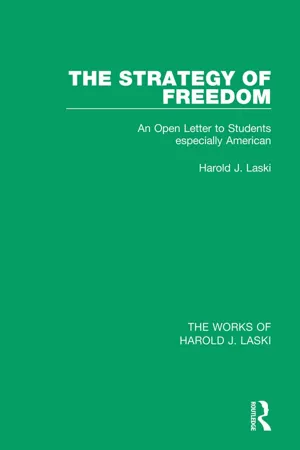
In this tract, Laski discusses the British case for the destruction of Hitler from the angle of the university student, especially from America, who had doubts about the complexities of the situation. He illustrates why all parties in Britain felt that future freedom of intelligence depended on victory.
eBook - ePub
The Strategy of Freedom (Works of Harold J. Laski)
An Open Letter to Students, especially American
- 122 pages
- English
- ePUB (mobile friendly)
- Available on iOS & Android
eBook - ePub
The Strategy of Freedom (Works of Harold J. Laski)
An Open Letter to Students, especially American
About this book
Information
One
ALL over the world, wherever there are free men and women, the desire for the defeat of Hitlerism and its allies is passionate and profound. Ordinary people who, in the normal course of things, hate war have recognised that if, in this conflict, Great Britain were to be defeated, something like a dark age would settle down upon mankind. What, they are convinced, is in hazard are certain fundamental principles of civilisation—the rule of law against the power of arbitrary discretion, the right to freedom of the mind against the power of outlaws to control the direction of thought, the co-operation of nations by way of free association instead of by coercive subordination. Each time a stand has been taken against the relentless tyranny of the dictators, whether it has been Matteoti in Rome or Dimitroff in Berlin, whether it has been Britain after the fall of France or Greece and Jugoslavia insisting on battle rather than upon surrender, the conscience of the whole free world has been lit by a new gleam of hope. Even in India, where an unresolved conflict between the British Government and the national leaders haunts the scene like a grim shadow, there is none of those leaders who does not admit that the defeat of Britain would end, for a long period to come, the hope of Indian freedom. For they know that a German victory in the West may spell Japanese domination in the East; and the history of China in the last eight years has revealed something of the price men have to pay for Japanese domination.
An Englishman is bound to note with pride the growth in the United States of sympathy with, and aid for, the cause for which our people are fighting. The call for that sympathy and aid has transcended all boundaries of class or creed or party; it has triumphed over historical misunderstandings and surviving scepticisms as deep as any in the modern world. Those who have sought to halt its full expression have been felt to misunderstand the central principles upon which the American way of life has been built. They have been felt to deny the creative role it is the duty of an America to play which hopes to retain for herself a civilisation assured of freedom and democracy. Sometimes their opposition has been the outcome of genuine intellectual error. Sometimes, humanly enough, it has been born of a pacifist philosophy to which the maintenance of freedom by the method of war is the supreme mistake in state policy. Sometimes it is the consequence of more sinister motives, directly born of the power of the dictators to purchase support for their evil ends.
I have an association which goes back over twenty-five years with American universities. I have taught in many of them; teachers and students in many have been among the closest of my friends. In the years of my own residence in the United States, if I had to make a criticism of American students, it would have been of regret at their aloofness from the political scene about them. Save at the dramatic moment of a Presidential election, it was rare for more than a small handful of them to realise that universities are not ivory towers, remote from the main stream of social life, but watch-towers which have no meaning save as they closely guard, and carefully register, the significance of a civilisation whose trends they are bound to express.
It was, therefore, to me an exciting thing when, about the time of the Great Depression in the United States, there was an unmistakable stirring on every university campus I have visited. Groups of students, growing ever larger as the years went by, began increasingly to understand how deeply they were involved in the crisis of our civilisation, how impossible it was for them not to demand that academic life should confront its implications with courage. It was a heartening thing to see them growingly determined to penetrate to the roots of this crisis. It was exhilarating to see them not only flock to the class-rooms of those teachers prepared to analyse its meaning without deference to the vested interests which feared the results of such analysis, but, even more, quick to defend those teachers when the vested interests sought their penalisation. Above all, between 1933 and 1939, the knowledge that the student body of American universities was wholeheartedly antagonistic to the philosophy of Fascism, whether in its German or in its Italian form, was to me one of the strongest proofs that none of the sporadic manifestations of that doctrine in America had taken deep root in the mental climate of the United States.
I felt that confidence most securely in the winter and spring after Munich, when I was on leave of absence from my own university in the United States. I travelled across the continent. Whether in Columbia or Harvard in the East, whether in Indiana or Illinois in the Middle West, whether in Washington or California on the Pacific coast, the general atmosphere among the students was broadly identical. It was felt that Munich was a disaster to freedom and democracy. It was felt that Britain had dishonoured itself in being an accomplice in the annihilation of Czecho-Slovakia. It was felt that it was the duty of any nation which claimed to express the common interests of civilisation to take a determined stand against the aggressive tyranny of Hitler and Mussolini. Especially was this felt with passion by students of Left opinions. They emphasised, everywhere, the difference between the British attitude of “appeasement” to the Fascist dictators, and the Soviet insistence on the need of a firm stand against them. They asked—I felt that they were entitled to ask—whether something had gone wrong with the British people that it did not insist to the Chamberlain Government upon the plain fact that each “dose” of “appeasement” merely stimulated the arrogance and the appetite of the Dictators. I found that, everywhere, there was sympathy with the hostility of the British Labour Party to the Chamberlain policy. Communists, in particular, urged upon me the importance of an alliance between the nations opposed to the Dictators; and it was their view that those in Britain who realised the menace of Hitlerism, like Mr. Churchill, for instance, should, despite all ultimate differences, combine their forces to make headway against the more urgent danger.
I was in full sympathy with these views. I knew that it is always perilous to embark upon the grim path of war. But I felt that the objectives Hitler and Mussolini had in view were incompatible with peace. I was convinced that nothing but a direct challenge would end their advance; and I was certain that, where they planted their feet, there all the main elements of civilised living were destroyed. I could explain, I could not defend, the motives of the Chamberlain Government. I insisted, arousing sometimes a faint scepticism, but, I think, always a strong approval, that a time would come when public opinion in Britain would demand from its Government that it would fight rather than co-operate in the erosion of European freedom. No one, I add, was more clear that this was the international duty of a power like Great Britain than students who belonged to, or sympathised with, the Communist Party.
At long last, after the annihilation of Czecho-Slovakia on March 15, 1939, British public opinion, led by Mr. Churchill on the Right and by the Labour Party on the Left, compelled Mr. Chamberlain to set limits to the “appeasement” which was endurable. The guarantees to Poland, Rumania and Greece were, obviously, given in haste, and without that full understanding with the Soviet Union which should have been their logical prelude. I admit fully that the absence of that understanding was the outcome of profound prejudice against the Soviet Union on the part of the Chamberlain Government; prejudice, further, which was bound to arouse the suspicion in the Soviet mind either that Mr. Chamberlain hoped that the guarantees would switch Hitler’s ambition to the possibilities of an attack upon the Soviet Union, or that their existence would compel Hitler to some accommodation he could accept. I do not know at what stage the minds of the rulers of the Soviet Union decided that their negotiations with the West offered less prospect of Soviet security than a treaty with Hitler; I understand fully why the attitude of the Chamberlain Government persuaded them that its prejudices against an understanding with Britain and France were too strong to be overcome. On a short-term view, the decision of the Soviet Union to safeguard itself against an attack by Hitler was, in the light of its situation, wholly intelligible. If “appeasement” was good enough for Mr. Chamberlain, it was obvious self-interest for Stalin and Molotoff. It gave them time to reinforce their strength. It safeguarded them against the danger that the full weight of the Nazi legions would be hurled immediately, as in 1914, against them. Their invasion of Finland was presently to display how deeply they felt that danger.
What, I think, they failed to understand was the temper of the British people. Once Mr. Chamberlain had been forced by public opinion to give his guarantees, no Government in Britain could have survived which sought to evade their implementation. That, I think, also, must have been clear to anyone who was in Britain in the five months before the outbreak of war; it is shown beyond a shadow of doubt by the debates in the House of Commons in the week which preceded its declaration. Grave as was the shock to the world when the German-Soviet agreement was suddenly announced—it was the obvious harbinger of conflict—it never deflected for one moment either the British people, or the parties of the Left, from their resolution to have done with “appeasement,” even at the price of war. They felt that a life passed under its perpetual threat was unendurable; and their conviction was profound that no civilised progress was possible in a world which permitted Hitler and his allies continually to brandish this threat as a means of extending the authority of the Fascist powers. It must be added that, at this stage, if the Communist Party of Great Britain regretted that it fell to the Chamberlain Government to conduct the war, it had no doubt whatever of the Tightness of the decision to fight. “To stand aside from this conflict,” wrote Mr. Harry Pollitt early in September, 1939, “to contribute only revolutionary-sounding phrases while the Fascist beasts ride roughshod over Europe, would be a betrayal of everything our forbears have fought to achieve in the course of long years of struggle against capitalism.” That was, I think, an almost universal opinion among British Socialists of every description; the small Independent Labour Party was the only organised Socialist body which was from the outset opposed to the war.
It is well known that, about a month after the outbreak of war, the British Communist Party, in conjunction with the other constituent parties of the Third International, reversed this attitude. Mr. Harry Pollitt was dismissed from his leadership of the party; and, under its new direction, a nation-wide campaign was organised to argue that, so far as Great Britain was concerned, this war was simply an “imperialist” war the continuance of which was contrary to the interests of the working class everywhere. It was insisted that the defeat of Poland (which by then had been divided between Hitler and the Soviet Union) ended any reason for its continuance; the duty of Socialists, it was argued, was to make peace with Hitlerite Germany. That attitude on the part of the British Communist Party was maintained with increasing emphasis until Hitler’s attack on the Soviet Union on June 22, 1941. What exactly the Communists meant by “peace” and what motives underlay their attitude they never succeeded in making clear even to their friends.
It was about this time that letters from the United States and articles in American journals began to make it clear that the issues of the war profoundly divided American student opinion. Some of it accepted the frank Communist view that the war was simply an “imperialist” war which working-class action must end at the earliest opportunity. Others argued that the war was a purely European affair, and a “phony” war at that; the duty of Americans was to stand aside from it and deal with their own grave social problems. Others, again, insisted that a negotiated peace was the only way to prevent that rising tide of national hatreds which, largely because of the weight of American intervention, had led to the disillusionment of 1919 and the inter-war years. The improbability was urged of a Government like the British measuring up to the implications of the war. All of this was exacerbated, first, by the depth of the divisions over the Soviet attack on Finland, and the belief, so long and so ardently proclaimed by the Communists, that it was the prelude to an attack, dreamed of for a generation by reactionary capitalism, against the Soviet Union—a policy, so the New Masses always insisted, of a British accommodation with Hitler at the expense of Moscow. After the fall of France, it was exacerbated again by the depth of the conviction among many students that modern war fascises the nation which embarks upon it; Mr. Kennedy and the Communists joined hands, though for very different reasons, to proclaim that British democracy was “finished.” The way for America to retain its democracy was to practise, both in mind and deed, wholehearted aloofness from the conflict.
I heard in letters from friends of how widespread these attitudes were on the American campus. By some, they were regarded with despair or indignation. They were the outcome, I was told, of a blindness to ideals on the part of students which augured ill for the future of American democracy. Others were dismayed at what they termed the “cynicism” of students; it was tragic that they could remain unmoved by the spectacle of freedom in danger. One eminent university figure told me that their cause was the “poison of Marxism” which had made masses of students indifferent to any questions save those of power. Mr. Mc-Leish, it will be remembered, thought that students had read the wrong books; it was Hemingway, Remarque and their like whose insidious influence had warped their clarity of vision. To Professor Mortimer Adler the situation was the outcome of a general decay of values which could only be arrested by a return to the philosophy of St. Thomas Aquinas.
I confess that none of these explanations moved me at all seriously. Though it is, through the war, almost two years since I was last in the United States, I could not believe that the mind of the American student was profoundly changed in the interval. I could believe that the immensity of the issues at stake brought with it a natural confusion. I could believe, also, that men and women to whom humanism was important were appalled at the prospect of a war involvement in which might bring the risks of a new age like the nineteen-twenties with its ardent hopes and massive disillusions. But my own knowledge of the American student convinces me that at no period in my own lifetime has he been so receptive to the call of great ideas when greatly stated. More than this. So far from the “poison of Marxism” being responsible for confusion of thought, profoundly as I differ from them, I know that there are no students in American colleges more devoted to the service of an idea, or more self-sacrificing in activity on its behalf, than members of the Communist Party. I think they set the ideas in wrong perspective; and much of the activity it evokes from them seems to me wrong as procedure and futile as objective. But if I had to find a comparison for their devotion, I should have to go back to the first missionaries of the Quaker gospel, who set out to preach their faith in a world as difficult and confused as our own, three hundred years ago.
The confusion of mind among American students has, I believe, one major and one minor cause. The major cause is the simple fact that the crisis in our civilisation is, naturally enough, reflected in the universities; it would be astonishing if this were not the case. The divisions among them are no more remarkable than the divisions in the Congress of the United States, which reflect the same crisis. They are the divisions which existed among the British students and in the Parliament of Great Britain until they were effaced by the profound realisation that our very existence as a free people was at stake in this war. The geographical position of the United States is, by itself, sufficient to account for what detachment there is from the impact of Nazism. It is necessary, it has been necessary here, for men to see the price it exacts for its expansion before they can measure with sober accuracy the magnitude of its threat to civilisation. One has only to remember how tragically the small European peoples clung to the fiction of their neutrality to grasp the compulsion which weighs on students three thousand miles away from the conflict to rationalise their fear of being sacrificed to its inexorable demands.
The minor cause is more subtle, but it is, I believe, none the less real for that. American universities have suffered, for at any rate half a century, from the excessive domination of wealth over their activities. To evade the incidents involved in that domination they have frowned upon those teachers who answered the challenge of our civilisation in an unorthodox way. In the social sciences, where, in this period, the real battle of doctrine has been fought, the governing bodies of universities have sought, at all costs, either for “safe” professors, or for those the burden of whose teaching did not arouse undue scepticism about the foundations of the American commonwealth. The result, in a considerable degree, has been the banishment from the class-room of fundamental discussion of the living issues of the day; or where, above all arrestingly, the discussion became fundamental, a presidential frown was the main reward which greeted the teachers who promoted it. Those who make it difficult for men like Veblen and Charles Beard to serve a university are not entitled to surprise if the mind of the student is confused about essential values. Understanding comes to those only who have been permitted to examine without penalty the clash of ideas in the market-place. If there free examination is denied, the price is always paid in an easy acceptance of naïve dogma. The student who is not permitted to think of the university as a temple of truth is the most certain victim of extreme philosophies. For not having been trained to the examination of all assumptions, he is too often helpless before any creed which offers him a confident pattern of the universe about him.
The students of this generation, on any showing, have been born into a difficult and complex world. The old certainties are gone; the old values are in the melting-po...
Table of contents
- Cover Page
- Half Title Page
- Title Page
- Copyright Page
- Original Title Page
- Original Copyright Page
- Dedication
- Table of Contents
- Chapter One
- Chapter Two
- Chapter Three
- Chapter Four
- Chapter Five
- Chapter Six
- Chapter Seven
- Chapter Eight
- Chapter Nine
Trusted by 375,005 students
Access to over 1.5 million titles for a fair monthly price.
Study more efficiently using our study tools.
Frequently asked questions
Yes, you can cancel anytime from the Subscription tab in your account settings on the Perlego website. Your subscription will stay active until the end of your current billing period. Learn how to cancel your subscription
No, books cannot be downloaded as external files, such as PDFs, for use outside of Perlego. However, you can download books within the Perlego app for offline reading on mobile or tablet. Learn how to download books offline
Perlego offers two plans: Essential and Complete
- Essential is ideal for learners and professionals who enjoy exploring a wide range of subjects. Access the Essential Library with 800,000+ trusted titles and best-sellers across business, personal growth, and the humanities. Includes unlimited reading time and Standard Read Aloud voice.
- Complete: Perfect for advanced learners and researchers needing full, unrestricted access. Unlock 1.5M+ books across hundreds of subjects, including academic and specialized titles. The Complete Plan also includes advanced features like Premium Read Aloud and Research Assistant.
We are an online textbook subscription service, where you can get access to an entire online library for less than the price of a single book per month. With over 1.5 million books across 990+ topics, we’ve got you covered! Learn about our mission
Look out for the read-aloud symbol on your next book to see if you can listen to it. The read-aloud tool reads text aloud for you, highlighting the text as it is being read. You can pause it, speed it up and slow it down. Learn more about Read Aloud
Yes! You can use the Perlego app on both iOS and Android devices to read anytime, anywhere — even offline. Perfect for commutes or when you’re on the go.
Please note we cannot support devices running on iOS 13 and Android 7 or earlier. Learn more about using the app
Please note we cannot support devices running on iOS 13 and Android 7 or earlier. Learn more about using the app
Yes, you can access The Strategy of Freedom (Works of Harold J. Laski) by Harold J. Laski in PDF and/or ePUB format, as well as other popular books in Politics & International Relations & Communism, Post-Communism & Socialism. We have over 1.5 million books available in our catalogue for you to explore.