Hume's Aesthetic Theory examines the neglected area of the development of aesthetics in empiricist thinking, exploring the link between the empiricist background of aesthetics in the eighteenth century and the work of David Hume.
This is a major contribution to our understanding of Hume's general philosophy and provides fresh insights into the history of aesthetics.
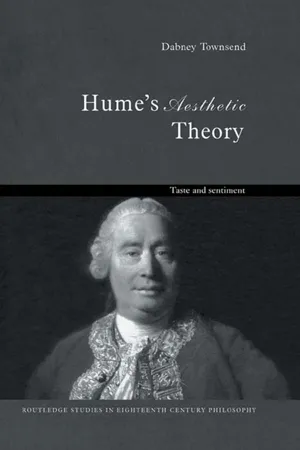
- 272 pages
- English
- ePUB (mobile friendly)
- Available on iOS & Android
eBook - ePub
About this book
Information
1
SHAFTESBURY AND HUME
To understand properly the use of the concept of sentiment as it developed in the first half of the eighteenth century in relation to aesthetic issues, it must be differentiated from contemporary forms of relativism and subjectivism that are based on a separation of psychological and epistemological evidence. Twentieth-century aesthetics accepts that separation as fundamental and divides its problems accordingly. So, for example, the emotional reaction to fictions is distinguished from the epistemological question of whether such reactions are coherent. Hume and other theorists of taste make no such separation. For them, the questions are posed in terms of individuals and universals, substance and accidence. Rejecting universals and substance shifts evidence to the individual and what appears to be accidental. The appeal to sentiment is part of accepting that shift. The problem then becomes how one is to avoid the charges from both theologians and rationalist philosophers that reason and judgment are lost – that the evidential baby has been thrown out with the metaphysical bath water.
The attacks on sentiment come from opposite sides, sometimes simultaneously. Theologically, sentiment is seen as conceding too much to human ability and leaving too little to divine grace and teleology. For the Calvinists and pietists, the primary threat is Ideological. God must be in control of every moment. So the only important sentiment will be religious inspiration, which has no need for reason. Those who are chosen will think rightly; those who are not can be controlled only by force. From the more orthodox Protestant and Catholic side, even that is too individualist. Control must be exercised hierarchically through the church and scripture, and the interpretations of both must be rigorously given, not left to individual whim. In either event, appeals to sentiment are forms of human hubris that must be subjected to ecclesiastical discipline.
The rationalist and Aristotelian objections to sentiment are different, but often they are combined with the theological objections. To both, appeals to sentiment fail a basic test for knowledge: sentiment is changeable while knowledge must be stable and the same for all. If everyone's sentiment rules, as the Earl of Shaftesbury acknowledged, then anything might be approved. Only clear and distinct ideas, governed by logical or self-evident rules, can provide the stability that knowledge must exhibit.1 The problem is not relativism or subjectivism but the absence of authority. That authority may indeed turn out to be located in the ego, as Descartes deduced, but only if it can be deduced, not it if must be felt emotionally.
In this disputation, a defense of sentiment in both moral and aesthetic contexts grew up. The third Earl of Shaftesbury, the Abbé Du Bos, and various Socinians and free-thinkers are the most prominent progenitors of the defense, but they soon acquire allies in more orthodox writers such as Francis Hutcheson and Friedrich Schleiermacher. In one direction, Rousseau becomes the second generation exponent of sentiment. It is my argument that Hume, in a much more deeply reasoned and defensible way, becomes the exponent from the side of an epistemological psychology and aesthetics.
The role of sentiment in moral philosophy is widely recognized. It was debated in many different forms in the course of the eighteenth century. I will argue that there is a close parallel between these debates and aesthetic issues (Chapter 4). Considerably less attention has been paid to the way that sentiment provides an epistemological basis for aesthetics. I want to focus specifically on the way that ‘beauty’ and ‘taste’ present special problems and are incorporated into the epistemology of writers such as Hume. Without an understanding of the way that sentiment can be used to save beauty and taste as epistemological concepts, they become easy targets for the charges of sentimentalism and subjectivism that eventually are leveled at them. I hope to show that Kant's transcendental idealism is not the only way that aesthetics might defend its epistemological legitimacy, though I will stop short of engaging the Kantian and post-Kantian forms of aesthetics directly.
Hume notes a special confusion in the relation of sentiment and reason: the ancients derive morals from sentiment, but affirm that virtue conforms to reason. Moderns derive morals from abstract principles, but speak of the beauty of virtue and the deformity of vice. Hume credits Anthony Ashley Cooper, the third Earl of Shaftesbury, with recognizing the distinction but falling into the same confusion. It is not clear just what Hume has in mind when he says that the ancients ‘seem to consider morals as deriving their existence from taste and sentiment’ (EPM 1, 134/170). Peter Jones places a heavy emphasis on Hume's reliance on Cicero.2 But while this is undoubtedly an important source for Hume's thought, the crucial insight concerns the kind of conformity of the mind to the world discussed in the dialogue toward the end of the Enquiry Concerning Human Understanding (Section XI). In the Treatise, Hume is clearly aware that he is proposing something very new and difficult to accept. His reference to Shaftesbury suggests that the issues are deeply embedded in the evolving eighteenth-century understanding of evidence and reasoning.
The reading that I offer of Hume on taste and sentiment does not stand alone, therefore. Without getting involved in questions of influence in the strictly historical sense, I think it is possible to see that the way that Hume understood taste and beauty is of a piece with earlier discussions that were influential and controversial. In other words, Hume is considering problems in a context that promoted sentiment to a controlling position. This has been widely recognized in the literature on Hume.3 What has not been so clearly seen is that beauty and taste in their relation to art are central to the way that sentiment is able to exercise that control without falling into the kind of subjective individuality typified by contemporary resistance to aesthetic judgments and standards. Therefore, I will try to understand Hume's positions in their aesthetic context. Hume advanced the role of sentiment in relation to beauty and taste considerably, but he was not simply an isolated figure. The locus classicus for this tradition is the work of Shaftesbury.4 Shaftesbury was not alone in turning to sentiment and ‘the affections’ for moral and aesthetic support, but his work provides one of the most significant extended developments of the position.
An Inquiry Concerning Virtue or Merit
Shaftesbury wrote only one truly systematic treatise, and it has a complex history. Sometime before 1699, while he was still in his twenties and before he had succeeded to the title, Shaftesbury wrote An Inquiry Concerning Virtue or Merit. John Locke, who was closely allied with the first earl and was indirectly responsible for Shaftesbury's education, is, perhaps, the one to whom Shaftesbury is addressing this work, at least in spirit. Shaftesbury was at that time involved both politically and intellectually with such ‘free-thinkers’ as Anthony Collins and John Toland. At the same time, he served in parliament from 1695 to 1698 as a part of the country Whig faction. His position as Lord Ashley and as a potential politician would have been sensitive. The manuscript of the Inquiry evidently circulated, but it was far too intemperate in its religious opinions to be safely published. Nevertheless, John Toland obtained a copy from Collins and published it in 1699, evidently to the embarrassment and without the permission of Shaftesbury, who, according to his son, attempted to buy up all of the copies. If one considers the political and religious climate and Shaftesbury's position, the situation appears to be confused at best. There is no way to know how Shaftesbury really felt about the appearance of his work. He eventually broke with Toland, but apparently not over this incident. In 1701, he endorsed a translation by Pierre des Maizeaux of the 1699 version and desired that it be sent to Pierre Bayle.5 He certainly did not repudiate the work itself, and in 1711 revised it for inclusion as the Fourth Treatise in Characteristics. There are substantial stylistic differences between the later version and the 1699 version, and there is a subtle shift in emphasis.6 The earlier version stresses system and in a more strictly Lockean way avoids references to ‘qualities’ in things and abstract entities such as the soul. The revision is less concerned with such matters. It is more cautious in the way it presents virtue as relative to a system, though it in no way repudiates the idea that what determines the virtue of a creature is the good of the system to which it belongs. On the other hand, the revisions make much more use of beauty, harmony, and order as moral qualities and aesthetic analogies. Shaftesbury's language had become much more conventionally neo-Platonic. Nevertheless, the systematic positions remain consistent and show how sentiment can be given a place in normative judgments, both in the arts and in morals.
The Inquiry begins instrumentally. ‘Good’ is understood in terms of the system to which a creature belongs. Moreover, it is clearly good in terms defined by the system. Shaftesbury is thinking along natural lines. A system will be harmed by what is irregular to that system or what tends to destroy that system. There is an interlocking hierarchical arrangement of systems, and good is system-relative. If there is a universal system that includes all others – and Shaftesbury clearly presumes that there is – its good will be the highest good.
‘System’ should be understood in terms of the classical forms of order and harmony. Regularity is itself a holistic value. Individuals are to be located in relation not just to a cosmos, but as contributing constituents:
Now, if by the natural constitution of any rational creature, the same irregularities of appetite which make him ill to others, make him ill also to himself, and if the same regularity of affections which causes him to be good in one sense, causes him to be good also in the other, then is that goodness by which he is thus useful to others a real good and advantage to himself.(IVM, I, 243–244)
The appeal to affections and passions depends on regularity. In turn, order and harmony contribute to produce affections that are positive (IVM, I, 279). Shaftesbury does not make system an end in itself apart from its effects. The affections, which are the center of the system, are justified by the system, but they are also self-justifying in their effects.
There are two sources of system. One is natural and holistic. It is as close as Shaftesbury comes to a teleology, but he does not rest much on it. The other is an interior harmony of motion that produces pleasure (IVM, I, 314). Organic wholeness and pleasure are linked because the mind itself takes pleasure in its exercise. In other writers, the emphasis shifts to the pleasure of the imagination and the exercise of the mind as sources of pleasure. Shaftesbury has a more ‘moral’ version of exercise. Social affections are the product of natural affections, and natural affections are moral because they contribute to a whole.
Virtue arises because the individual is related to the system in such a way that the individual can benefit or harm the whole. So a necessary condition for virtue is good relative to a society where that good includes the individual's own good. An animal eaten by a man is not virtuous by benefiting the human system, but a man who takes as his own good the good of society is virtuous. Locke proposed a two part ethic: our knowledge of situations can only come from experience, but knowledge of right and wrong is deductively certain – like mathematics. Shaftesbury echoes this (IVM, I, 336).7 But according to Locke, the ethical premises are not matters of sense; they must be derived from authority by the rational faculty (e.g. reflection on what is given in Biblical revelation.) Locke was careful in most cases (at least for public consumption) to wall off religion and morality from his epistemology. Shaftesbury replaced that religious root of morality with a natural source – the good of a kind – and he refers certainty ultimately to what passes within ourselves. This is the significance of his separation of virtue from religion at the beginning. His purpose is to inquire
What honesty or virtue is, considered by itself, and in what manner it is influenced by religion; how far religion necessarily implies virtue; and whether it be a true saying that it is impossible for an atheist to be virtuous, or share any real degree of honesty or merit.8(IVM, I, 238)
In this sense, the Inquiry is a direct consequence of Shaftesbury's association with Locke but also bears out his rejection of Locke's careful avoidance of giving offense to traditional Christianity and his disagreement with Locke over the innateness of moral behavior. It becomes understandable in this light how Shaftesbury might have proceeded very cautiously – concealing the depth of his disagreement – and how he might have used the more impetuous and less vulnerable Toland to expose his work while providing deniability.
The initial argument of the Inquiry focuses on what is needed to convert individual good to the good of a kind in such a way as to constitute virtue. This is the role of affection. Since what defines ‘good’ is instrumental to the system, a good affection is one that is instrumentally good to the system. If the affection the creature feels is good in this sense, then the individual's affection is a reliable sign of the system's good, and the individual is virtuous by virtue of the affection that he or she feels (IVM, I, 247).9 Affections thus become the evidential source and require careful analysis (IVM, I, 247). They are divided into natural affections and social affections, and they are distinguished on the basis of whether the affections themselves are good or not. Not all affections are good. Affections are distinguished in two ways. If they are ‘unsocial’ they are bad (IVM, I, 254). Shaftesbury gives as an example the worship of animals. Since cats are not in fact deities, this misapprehension produces a belief that is blamable and an affection that is both irregular and unsocial since it disrupts a natural and useful relation between individuals and the state. It is thus ‘wrong’ in terms of its systematic effect, though a whole society may have learned to worship cats and feel an affection for them. Other examples would include admiration for pirates etc. Affections are also bad if they are essentially selfish. Self-interest is not in itself bad because it normally contributes to a unified whole. There is, in the nature of things, a cooperation between self and society that is mutually beneficial. But immoderate self-interest is bad (IVM, I, 329–330). Selfishness is the root of all evil for Shaftesbury. It produces both misery for the self and a bad character. It is defined not as self-interest but as an excess of self-affections. Shaftesbury clearly does not treat affections uncritically or unsystematically. Their evidentiary value is only possible because of the way that they contribute to the good of a system that is defined by the system, not by the raw feel of the affection.
Shaftesbury sought to provide stability not by a direct analysis of specific passions but by an analysis of their contribution to a stable ‘character.’ Hume shares the assignment of virtue to character, not to actions. Affections constitute the temper of the creature, and only temper determines virtue.
Nothing therefore being properly either goodness or illness in a creature, except what is from natural temper, ‘A good creature is such a one as by the natural temper or bent of his affections is carried primarily and immediately, and not secondarily and accidentally, to good and against ill;’ and an ill creature is just the contrary, viz. ‘One who is wanting in right affections of force enough to carry him directly towards good, and bear him out against ill; or who is carried by other affections directly to ill and against good.’10(IVM, I, 250)
Hume uses similar language: ‘’tis not the present sensation alone or momentary pain or pleasure, which determines the character of any passion, but the whole bent or tendency of it from the beginning to the end’ (T 2.2.9, 381).11 Shaftesbury was thinking in terms of an individual as an instance of a species, but he tends toward the formation of a substantive character for each individual. Hume drops the species but ‘human nature’ plays that role. It is both the evidence by which one knows a temper, and the means by which a temper is formed.
For Shaftesbury, temper is funda...
Table of contents
- Cover
- Half Title
- ROUTLEDGE STUDIES IN EIGHTEENTH CENTURY PHILOSOPHY
- Full Title
- Copyright
- Dedication
- CONTENTS
- Acknowledgments
- Abbreviations
- Introduction
- 1 Shaftesbury and Hume
- 2 Taste
- 3 Hume's appeal to sentiment
- 4 The aesthetic/moral analogy
- 5 Rules
- 6 The problem of a standard of taste
- Notes
- Bibliography
- Index
Trusted by 375,005 students
Access to over 1.5 million titles for a fair monthly price.
Study more efficiently using our study tools.
Frequently asked questions
Yes, you can cancel anytime from the Subscription tab in your account settings on the Perlego website. Your subscription will stay active until the end of your current billing period. Learn how to cancel your subscription
No, books cannot be downloaded as external files, such as PDFs, for use outside of Perlego. However, you can download books within the Perlego app for offline reading on mobile or tablet. Learn how to download books offline
Perlego offers two plans: Essential and Complete
- Essential is ideal for learners and professionals who enjoy exploring a wide range of subjects. Access the Essential Library with 800,000+ trusted titles and best-sellers across business, personal growth, and the humanities. Includes unlimited reading time and Standard Read Aloud voice.
- Complete: Perfect for advanced learners and researchers needing full, unrestricted access. Unlock 1.5M+ books across hundreds of subjects, including academic and specialized titles. The Complete Plan also includes advanced features like Premium Read Aloud and Research Assistant.
We are an online textbook subscription service, where you can get access to an entire online library for less than the price of a single book per month. With over 1.5 million books across 990+ topics, we’ve got you covered! Learn about our mission
Look out for the read-aloud symbol on your next book to see if you can listen to it. The read-aloud tool reads text aloud for you, highlighting the text as it is being read. You can pause it, speed it up and slow it down. Learn more about Read Aloud
Yes! You can use the Perlego app on both iOS and Android devices to read anytime, anywhere — even offline. Perfect for commutes or when you’re on the go.
Please note we cannot support devices running on iOS 13 and Android 7 or earlier. Learn more about using the app
Please note we cannot support devices running on iOS 13 and Android 7 or earlier. Learn more about using the app
Yes, you can access Hume's Aesthetic Theory by Dabney Townsend in PDF and/or ePUB format, as well as other popular books in Philosophy & Aesthetics in Philosophy. We have over 1.5 million books available in our catalogue for you to explore.