Despite growing concern over environmental issues and the sustainability of economic growth, industrialization is still generally associated with progress and development. This is particularly true of developing countries where industrialization is often the nation's top priority.
Industrializing Malaysia presents a critical analysis of the experience of industrialization in Malaysia, examining the role, impact and efficacy of post-independence industrialization policies. The author refocuses attention on some major intended as well as unintended implications and consequences of policies and performance. A wide range of issues is covered: in addition to general historical commentaries and sectoral studies, there are analyses of direct foreign investment, technology, linkages, free trade zones, industrial estates, and rural development.
- 372 pages
- English
- ePUB (mobile friendly)
- Available on iOS & Android
eBook - ePub
About this book
1
MALAYSIAN INDUSTRIALISATION IN HISTORICAL PERSPECTIVE
In 1989, the net output of the manufacturing sector accounted for just over a quarter of the gross domestic product of Malaysia, and manufacturing employment accounted for 17 per cent of total employment (see Table 1.1). Since independence in 1957,1 the rate of growth in manufacturing output has been rapid, with the share of manufacturing in total gross domestic product rising from less than 10 per cent in the late 1950s to 26 per cent thirty years later. The average annual growth rate of manufacturing output consistently exceeded 10 per cent in the decade 1970–80, averaging 11.6 per cent during 1971–5 and 13.5 per cent during 1976–80, before declining to an average of 4.9 per cent during 1981–5, and then rising to 12.6 per cent during 1986–9 (see Table 1.2).
Table 1.1 Manufacturing's share of gross domestic product and employment, 1947–91
Year | Manufacturing value added as % of total GDP | Manufacturing employment (W0) | Manufacturing employment as % of total employment |
1947a | 5.7 | 126 | 6.7 |
1957a | 6.3 | 136 | 6.4 |
I960a | 8.7 | n.a. | n.a. |
1965a | 10.4 | 217 | 8.4 |
1970 | 13.1 | 448 | 11.4 |
1975 | 16.4 | n.a. | n.a. |
1980 | 19.6 | 802 | 15.8 |
1985 | 19.7 | 836 | 15.1 |
1986 | 20.9 | 818 | 14.7 |
1987 | 22.5 | 921 | 15.7 |
1988 | 24.4 | 1,013 | 16.6 |
1989 | 25.5 | 1,171 | 18.4 |
1990 | 26.9 | 1,290 | 19.5 |
1991 | 28.2 | 1,374 | 20.1 |
Note:a 1947–65 figures refer to Peninsular Malaysia only.
Sources: L. Hoffman and S.E. Tan, Industrial Growth, Employment and Foreign Investment in Malaysia, Oxford University Press, Kuala Lumpur, 1980, Appendix AII.l; Malaysia, Fourth Malaysia Plan, 1981–85, Kuala Lumpur, Table 4-6; Malaysia, Fifth Malaysia Plan, 1986-90, Kuala Lumpur, Table 3-5; Bank Negara Malaysia, Annual Report, Kuala Lumpur, various years; Ministry of Finance, Economic Report, Kuala Lumpur, various years; and Malaysian Industrial Development Authority, MIDA Report 1987, MIDA, Kuala Lumpur.
Table 1.2 Average annual growth rates of manufacturing value added and manufacturing exports, 1971–89
Growth (% pa) of | ||
Year | Manufacturing value added | Manufacturing exports |
1971–75a | 11.6 | 27.5 |
1976–80 | 13.5 | 24.9 |
1981-85 | 4.9 | 14.3 |
1986 | 7.5 | 23.0 |
1987 | 13.4 | 32.5 |
1988 | 17.6 | 32.1 |
1989b | 13.0 | 36.5 |
Notes:
a Average annual growth rates before 1970 are not shown because the system of calculating National Accounts was changed from 1969.
b Preliminary.
Sources: MID A, MI DA Report 1987, Kuala Lumpur; Bank Negara Malaysia, Annual Report, Kuala Lumpur, various years.
Manufacturing has come to play a bigger role as a foreign exchange earner in line with the government's intention of reducing Malaysia's dependence on primary exports (see Table 1.3). Manufacturing's share of Malaysia's gross commodity exports rose rapidly from just 12 per cent in 1970 to more than 20 per cent in 1980 to more than half in 1988, although, of course, these figures are somewhat misleading because of the relatively high import content of manufactured exports.
Nevertheless, the average annual growth rate of manufactured exports has been impressive, averaging 26 per cent during the 1970s, declining to 15 per cent from 1980 to 1985 before rising again to 31 per cent from 1985 to 1988. The decline in the growth rate in the early 1980s can be attributed partly to Malaysia's rising real effective exchange rate over that period and partly to the recession in the international economy.
Besides manufacturing's growing contribution to total GDP and to export earnings, it has also accounted for an expanding share of employment. Prior to Independence, manufacturing was a minor source of employment, accounting for under 7 per cent of the country's labour force in both 1947 and 1957. Even by 1965, the manufacturing sector was employing only a little over 8 per cent of the workforce. With the advent of more labour-intensive industries in the late 1960s and in the 1970s, manufacturing employed more than 15 percent of the total labour force by 1980, but the share remained the same in 1985, before rising again to more than 17 per cent in 1989 (see Table 1.1). The average annual manufacturing employment growth rate of 7.6 per cent during the decade 1970–80 was considerably higher than the 4.1 per cent recorded for the economy as a whole.
Table 1.3 Exports of manufactured goods, 1970–91
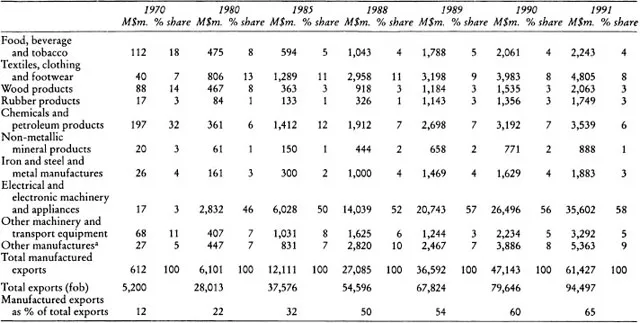
Note:a Includes paper and pulp products, scientific instruments, etc.
Source: Ministry of Finance, Economic Report, various years.
In spite of its rapid rate of growth since Independence, the Malaysian manufacturing sector in the 1980s was still considered marginally underdeveloped, given the level of its national income (or more precisely its gross domestic product) per capita. This is shown in Figure 1.1, from which it can be seen that the proportion of Malaysia's GDP contributed by manufacturing was slightly under 20 per cent, whereas it ‘should’ have been over 20 per cent to accord with a supposedly ‘normal’ pattern of development. Malaysia's less-than-20 per cent of GDP in manufacturing is in sharp contrast with the 30 per cent of South Korea – a country with roughly the same level of GDP per capita (but with a bigger population).
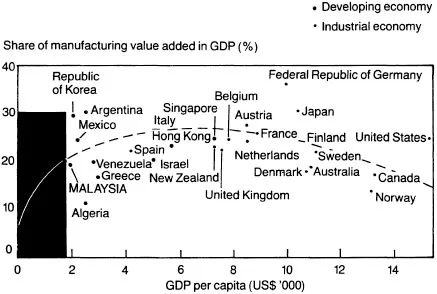
Figure 1.1 Relationship between GDP per capita and the share of manufacturing value added in GDP in selected economies, 1984
Source: World Bank (1987: 51).
This ‘backwardness’ of industry is in spite of considerable incentives granted to the manufacturing sector in post-colonial Malaysia. But Malaysia was a late starter. The encouragement since Independence in the late 1950s has contrasted sharply with the lack of encouragement under British colonial rule. The British were reluctant, for two reasons, to give any preference to domestically produced manufactured goods. Not only would the substitution of imported manufactures by protected domestic production reduce the import duty revenue to the government, but it was also likely to raise the prices of some of the goods consumed by plantation workers on the (mostly) British-owned rubber estates, thereby adding to the upward pressure on wages, and reduction of profits, on the estates (see Edwards, 1975:288, 315).
Thus, manufacturing was not very significant in the Malaysian economy during the colonial era, when plantation rubber agriculture and tin mining dominated. British colonial economic policies shaped much of the nature and extent of industrial development in the colonies. With emphasis given to export-oriented raw materials production and British manufactured imports, local industry w...
Table of contents
- Front cover
- Title Page
- Copyright
- Contents
- List of Figures
- List of Tables
- Notes on Contributors
- Acknowledgments
- List of Abbreviations
- INTRODUCTION
- 1 MALAYSIAN INDUSTRIALISATION IN HISTORICAL PERSPECTIVE
- 2 LABOUR FLEXIBILITY IN THE MALAYSIAN MANUFACTURING SECTOR
- 3 DIRECT FOREIGN INVESTMENT IN THE MALAYSIAN INDUSTRIAL SECTOR
- 4 FREE TRADE ZONES AND INDUSTRIAL DEVELOPMENT IN MALAYSIA
- 5 MALAYSIAN MANUFACTURING SECTOR LINKAGES
- 6 MALAYSIAN RURAL INDUSTRIALISATION STRATEGIES IN NATIONAL PERSPECTIVE
- 7 TECHNOLOGY TRANSFER IN THE MALAYSIAN MANUFACTURING SECTOR: BASIC ISSUES AND FUTURE DIRECTIONS
- 8 ELECTRONICS AND INDUSTRIALISATION: APPROACHING THE 21ST CENTURY
- 9 TEXTILES AND CLOTHING: SUNRISE OR SUNSET INDUSTRY?
- 10 MADE-IN-MALAYSIA: THE PROTON PROJECT
- 11 PROSPECTS FOR MALAYSIAN INDUSTRIALISATION IN LIGHT OF EAST ASIAN NIC EXPERIENCES
- 12 STATE INTERVENTION AND INDUSTRIALISATION IN SOUTH KOREA: LESSONS FOR MALAYSIA
- 13 POLICY OPTIONS FOR MALAYSIAN INDUSTRIALISATION
- Statistical Appendix
- Bibliography of unpublished official sources
- Index
Trusted by 375,005 students
Access to over 1.5 million titles for a fair monthly price.
Study more efficiently using our study tools.
Frequently asked questions
Yes, you can cancel anytime from the Subscription tab in your account settings on the Perlego website. Your subscription will stay active until the end of your current billing period. Learn how to cancel your subscription
No, books cannot be downloaded as external files, such as PDFs, for use outside of Perlego. However, you can download books within the Perlego app for offline reading on mobile or tablet. Learn how to download books offline
We are an online textbook subscription service, where you can get access to an entire online library for less than the price of a single book per month. With over 1.5 million books across 990+ topics, we’ve got you covered! Learn about our mission
Look out for the read-aloud symbol on your next book to see if you can listen to it. The read-aloud tool reads text aloud for you, highlighting the text as it is being read. You can pause it, speed it up and slow it down. Learn more about Read Aloud
Yes! You can use the Perlego app on both iOS and Android devices to read anytime, anywhere — even offline. Perfect for commutes or when you’re on the go.
Please note we cannot support devices running on iOS 13 and Android 7 or earlier. Learn more about using the app
Please note we cannot support devices running on iOS 13 and Android 7 or earlier. Learn more about using the app
Yes, you can access Industrializing Malaysia by K. S. Jomo in PDF and/or ePUB format, as well as other popular books in Business & Business General. We have over 1.5 million books available in our catalogue for you to explore.