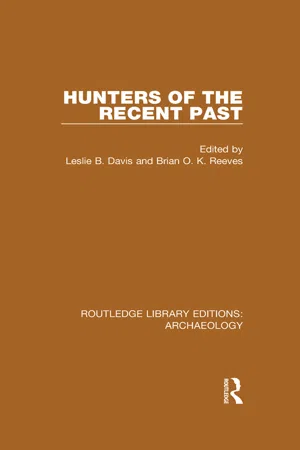
One of a series of more than 20 volumes resulting from the World Archaeological Congress, September 1986, which brought together archaeologists and anthropologists from many parts of the world, academics from contingent disciplines, and non-academics from a wide range of cultural backgrounds. This book considers prehistoric and more recent manifestations of human hunting behaviour, with a general emphasis on communal hunting. It demonstrates that the combination of archaeological, ethnographic and ethnohistorical approaches provides a researched basis for consideration of the topic on worldwide, regional, and local scales. It includes theoretical and methodological issues, within a context of enquiry, original data presentation, and discussion. It is of interest to archaeologists, anthropologists and ethnohistorians.
eBook - ePub
Hunters of the Recent Past
- 430 pages
- English
- ePUB (mobile friendly)
- Available on iOS & Android
eBook - ePub
Hunters of the Recent Past
About this book
Information
1 Meat in due season: the timing of communal hunts
Introduction
In order to understand the ways in which prehistoric peoples utilized the environment it is necessary, in most parts of the world, to consider the effects of seasonally changing conditions on subsistence strategies. In some cases the impact of seasonality is fairly obvious – timing of spring planting on agriculturalists; the effect of ice break-up on Arctic hunting. In other cases the effects of seasonality may be more difficult to detect for an outside observer – the quality of animal hides at different seasons or the likelihood of finding game at a particular location. Since Flannery’s (1968) paper, archaeologists have considered human subsistence in terms of scheduling and seasonality, concepts that have been incorporated as major aspects of archaeological and anthropological applications of optimal foraging theory and linear programming (Keene 1981, Winterhaider & Smith 1981).
In this chapter, I isolate seasonality as a factor in the organization of communal hunting strategies and explore the extent to which seasonality plays a role in determining whether a communal hunt will take place. In addition, by studying seasonality as a factor in communal hunting, it may be possible to isolate regularities in systems of communal hunting; such regularities may help explain why communal hunting is practiced.
Because seasonality of kills can be determined in the archaeological record, this topic is of more than theoretical interest to archaeology. If one can demonstrate regularities in the seasonality of communal hunting for modern societies, one may be able to explain why certain archaeologically known communal hunts were conducted at particular times of the year. Furthermore, communal hunting is not a universal trait of hunter-gatherer or agricultural societies, and analysis of why and when the method is used will contribute to our understanding of human ecology.
Communal hunting
For the purposes of this chapter, I consider communal hunting to be characterized by the following traits:
(a) Participation by more than two hunters (usually many more than this).
(b) Active cooperation between hunters such that they work together, as opposed to passive cooperation in which hunters agree not to interfere with each other’s activities.
(c) A system of hunting that requires all hunters to participate in a previously conceived plan.
Documenting the presence of communal hunting in the archaeological record is difficult. The best indicators of the method are the structures associated with animal entrapment, such as those known for a variety of species from the Northwestern Plains of North America (Frison 1978, Brink & Rollans, Ch. 9, this volume), although dense concentrations of animal bones in natural ‘traps’ or at the base of jumps’ are also good indicators. However, many communal hunts known from the ethnographic period were achieved without the use of structures that would survive archaeologically and animal bones might not be deposited in locations conducive to their preservation. For this reason, direct archaeological evidence for communal hunting is generally rare. Another possible indicator could be faunal assemblages at habitation sites that exhibit kill-off patterns typical of catastrophic, rather than attritional, mortality, but such assemblages are only indirect evidence for communal hunting.
It should be noted that communal hunting is not defined by the numbers of animals hunted or killed. Communal hunting for moose among the Kutchin is directed towards a single animal (Nelson 1973), as were communal whale hunts in many areas. Conversely, an individual salmon fisherman could net dozens of salmon, while a modern boreal forest trapper may obtain hundreds of animals throughout the winter. Communal hunting is distinguished by the organization of hunters into groups that are often larger than normal hunting parties and often involve the temporary aggregation of groups of people much larger than normally seen. Communal hunting was widespread throughout the world before European influence extensively modified subsistence strategies (Forbis 1978). Communal hunting was not restricted to hunter-gatherers; it was not confined to any particular types of environment, although it may have been a more common strategy in regions where meat was of major dietary importance and where resource diversity was low (Hayden 1981, p. 368). Surveys of hunting methods (e.g. Anell 1969, Forbis 1978) show that a wide range of techniques was used. These included driving game towards hunters, traps, snares, corrals, nets, water, and jumps; surrounding them with beaters, horsemen, or fire; and ambushes in a variety of natural culs de sac. Communal hunting was not usually a year-round pursuit. Instead, it was often confined to a particular season or seasons.
Seasonality: general considerations
Human behavior used to obtain meat seems to depend on three variables: the organization of the humans, the nature of the prey, and variables in the environment external to humans and prey. None of these variables remains constant, mainly because of annual cyclical patterns of natural events. These patterns are not inevitable, but, in the long run, they are regular and expectable and related to the Earth’s tilt. In virtually all areas of the world human and animal physiology and behavior have a seasonal component; thus, in the complex relationship that hunting entails, the effect of seasonality cannot be neglected.
Humans are affected seasonally in various ways. Group size tends to vary seasonally in hunter-gatherer societies since groups split into nuclear families when resources are scattered and aggregate when resources are clumped. Group size can even vary in agricultural or pastoral societies, for example, if the village splits into smaller groups for the purposes of transhumance or to spend extended periods at remote fields. Because different foods become available seasonally, scheduling decisions to exploit one resource may preclude exploitation of a second resource. As communal hunting requires relatively large numbers of hunters (and sometimes entire populations), it is likely that other activities would sometimes stand in the way of organizing a communal hunt.
Communal hunting also requires that the prey species exhibit certain characteristics for the hunt to stand a chance of being successful. Frequently, it is desirable that the location of animals be predictable, that animal behavior dictate certain hunting techniques and that the physiological condition of the animal make communal hunting worthwhile. Many of the larger game animals display pronounced seasonal variations in habitat, migration, population density, meat quality, and social behavior. All these factors affect the ability of a group of hunters to secure an adequate return for the large expenditure of energy that frequently accompanies communal hunts.
Finally, one should note that factors external to humans and prey may vary seasonally. For example, weather conditions will certainly affect the outcome of a hunt and, away from the equator, changes in length of day may have a similar effect.
Seasonality in large mammals
A review of the very extensive literature on large mammal ecology is not possible here. However, it demonstrates that most large mammals display seasonal variations in behavior and physiology. For hunters, the most important variation must rest in those factors that make animals easier or harder to procure, or in the palatability and nutritional qualities of the meat. I will emphasize these factors here.
Seasonal changes in animal condition affect meat quality. As has been stressed by a number of researchers, fat content is important in terms of the nutritional quality of meat, and also in terms of palatability (Speth & Spielmann 1983). The cycle of fat production in mammals of temperate and arctic areas of the Northern Hemisphere is attested by many studies. Generally, all animals enter the summer with very little fat as a result of low-quality forage in the winter, although males are sometimes in better condition than females. During the summer males tend to accumulate fat faster than females. However, during the rut in late summer or fall, males lose much of the fat accumulated in summer, while females continue to add fat. Generally, females enter the winter in better condition than breeding males, but these reserves are soon depleted in pregnant females, which sometimes end the winter in worse condition than males. This pattern has been documented for most temperate and arctic mammals, including caribou (Kelsall 1968, p. 41), elk (Flook 1970, pp. 41–2), bison (Speth 1983, pp. 104–5), and saiga (Bannikov et al. 1961, pp. 128–30). The pattern is less pronounced in animals living closer to the equator, but fat cycles can be seen in some species, such as wildebeest (Sinclair 1977, pp. 188–91).
Another major seasonal characteristic of many large game animals is migration. This is also more common in temperate and arctic large mammals than in species living in the tropics. Migration is generally undertaken in response to food or water availability, although sheltering conditions may also be sought in extreme environments. Particularly well-known migrations are those of caribou and reindeer (Kelsall 1968), but migrations also occur in most other higher latitude species, including bison (Chisholm et al. 1986), elk (Adams 1982), and mountain sheep (Geist 1971). In lower latitudes migratory behavior is less pronounced. For example, the very diverse herbivore population of sub-Saharan Africa includes species that undertake major predictable migrations, such as wildebeest and zebra in Serengeti, and species that do not make major annual movements of any distance, such as buffalo (Leuthold 1977, Sinclair 1977). In tropical forests, migratory behavior appears to be very rare indeed. One important aspect of migration is that it tends to concentrate animals for short times in relatively high densities. As will be seen, this behavior is often cited as a reason for undertaking communal hunts.
Many other aspects of the behavior and physiology of large mammals are seasonally variable. In the majority of species, reproduction is seasonally controlled, although this is not always the case in tropical species such as the giraffe (Dagg & Foster 1976, p. 132) or some impala (Leuthold 1977, p. 230). Breeding behavior may affect the size of herds and the vulnerability of herds to predation. Seasonal reproduction also means that certain animals (e.g. mature males) are in their prime condition at approximately the same time. Some higher latitude species develop summer and winter coats that exhibit different characteristics. Social behavior also varies seasonally, as does group size and composition.
In summary, we would expect seasonal variation in animal behavior and physiology to affect the time at which a species was hunted and how it was hunted. This should be more pronounced in northerly latitudes where seasons are better defined and where winter is a period of critical food shortage. However, any environment with marked seasonality in climate is likely to include large mammals with seasonal cycles.
Ethnographic data
Since communal hunting methods were widespread, this chapter does not attempt to cover all the literature on the subject. Many subsistence-oriented economies practiced some form of communal hunting (at least before the introduction of modern firearms and game control regulations), although this was not always hunting for large land mammals, the subject of this book. Unfortunately, ethnographies are often uninformative about seasonality of communal hunting, and are even less informative about why hunts are organized at certain times of the year. Table 1.1 presents data for seasonality of communal hunting episodes from a sample of societies derived from a wide range of latitudes. While the sample is not representative, an attempt was made to cover as wide a range of latitudes as possible because of observations that hunter-gatherer subsistence patterns vary latitudinally (Lee 1968). It should be noted that many of the societies selected are not hunter-gatherers, and that some hunter-gatherer societies included in Table 1.1 do not rely primarily on communal hunting of large mammals for subsistence.
Analysis of hunting practices in relation to broad latitudinal zones (Table 1.2) demonstrates some regularities in the season of the hunt and in reasons for selecting a particular season. In latitudes away from the equator (farther than 40° N or S), the three major reasons for seasonality of communal hunting are to take advantage of animals concentrated during migration, to utilize animals when fat content is highest, and to obtain high-q...
Table of contents
- Cover
- Half Title
- Title Page
- Copyright Page
- Original Title Page
- Original Copyright Page
- Foreword
- Table of Contents
- Preface
- Introduction
- 1 Meat in due season: the timing of communal hunts
- 2 Corralling: evidence from Upper Paleolithic cave art
- 3 Mammoth hunting in the New World
- 4 Paleoindians and proboscideans: ecological determinants of selectivity in the southwestern United States
- 5 Taphonomic provenience and mammoth bone modification
- 6 Was early man in North America a big game hunter?
- 7 Alternative hunting strategies in Plains Paleoindian adaptations
- 8 The Maple Leaf site: implications of the analysis of small-scale bison kills
- 9 Thoughts on the structure and function of drive lane systems at communal buffalo jumps
- 10 Communal bison hunters of the Northern Plains
- 11 Prehistoric game drive systems in the Rocky Mountains and High Plains areas of Colorado
- 12 Prehistoric mountain sheep hunting in the central Rocky Mountains of North America
- 13 A late prehistoric model for communal utilization of pronghorn antelope in the Northwestern Plains region, North America
- 14 World Rangifer Communal Hunting
- 15 Communal hunting as a prerequisite for caribou (wild reindeer) as a human resource
- 16 Moa procurement: communal or individual hunting?
- 17 Pre-Hispanic mammal exploitation and hunting strategies in the eastern Pampa subregion of Argentina
- 18 Fuego-Patagonian bone assemblages and the problem of communal guanaco hunting
- 19 Humans and terrestrial and sea mammals at Península Mitre, Tierra del Fuego
- Index
Trusted by 375,005 students
Access to over 1.5 million titles for a fair monthly price.
Study more efficiently using our study tools.
Frequently asked questions
Yes, you can cancel anytime from the Subscription tab in your account settings on the Perlego website. Your subscription will stay active until the end of your current billing period. Learn how to cancel your subscription
No, books cannot be downloaded as external files, such as PDFs, for use outside of Perlego. However, you can download books within the Perlego app for offline reading on mobile or tablet. Learn how to download books offline
Perlego offers two plans: Essential and Complete
- Essential is ideal for learners and professionals who enjoy exploring a wide range of subjects. Access the Essential Library with 800,000+ trusted titles and best-sellers across business, personal growth, and the humanities. Includes unlimited reading time and Standard Read Aloud voice.
- Complete: Perfect for advanced learners and researchers needing full, unrestricted access. Unlock 1.5M+ books across hundreds of subjects, including academic and specialized titles. The Complete Plan also includes advanced features like Premium Read Aloud and Research Assistant.
We are an online textbook subscription service, where you can get access to an entire online library for less than the price of a single book per month. With over 1.5 million books across 990+ topics, we’ve got you covered! Learn about our mission
Look out for the read-aloud symbol on your next book to see if you can listen to it. The read-aloud tool reads text aloud for you, highlighting the text as it is being read. You can pause it, speed it up and slow it down. Learn more about Read Aloud
Yes! You can use the Perlego app on both iOS and Android devices to read anytime, anywhere — even offline. Perfect for commutes or when you’re on the go.
Please note we cannot support devices running on iOS 13 and Android 7 or earlier. Learn more about using the app
Please note we cannot support devices running on iOS 13 and Android 7 or earlier. Learn more about using the app
Yes, you can access Hunters of the Recent Past by Leslie B. Davis, Brian O.K. Reeves, Leslie B. Davis,Brian O.K. Reeves in PDF and/or ePUB format, as well as other popular books in Social Sciences & Archaeology. We have over 1.5 million books available in our catalogue for you to explore.