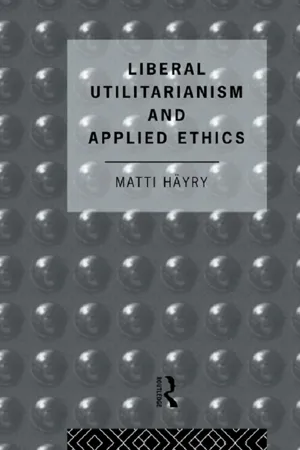
Liberal Utilitarianism and Applied Ethics explores the foundations of early utilitarianism and, at the same time, the theoretical bases of social ethics and policy in modern Western welfare states. Matti Hayry sees the main reason for utilitarianism's growing disrepute among moral philosophers is that its principles cannot legitimately be extended to situations where the basic needs of the individuals involved are in conflict. He is able to formulate a solution to this fundamental problem by arguing convincingly that by combining a limited version of liberal utilitarianism and the methods of applied ethics, we are able to define our moral duties and rights.
Liberal Utilitarianism and Applied Ethics will appeal to students and teachers of philosophy who are interested in the doctrine of utilitarianism or in ethical decison-making.
- 224 pages
- English
- ePUB (mobile friendly)
- Available on iOS & Android
eBook - ePub
Liberal Utilitarianism and Applied Ethics
About this book
Information
1
UTILITARIANISM AND THE BRITISH TRADITION
The classical utilitarianism presented in introductory courses of moral philosophy is usually said to derive from the work of Jeremy Bentham and John Stuart Mill. The original statement of the utilitarian doctrine is attributed to Bentham’s An Introduction to the Principles of Morals and Legislation (1789), which is thought to centre on the following three principles:
1 The greatest happiness principle.
An act, omission, rule, law, policy or reform is the right one if and only if it produces, or can be reasonably expected to produce, at least as much happiness as any other alternative which is open to the agent or decision-maker at the time of the choice.
2 The hedonistic principle.
‘Happiness’ means the pleasure and absence of pain of sentient living beings. The qualities of different kinds of pleasure and pain are irrelevant to the happiness calculation—the only variables to be considered are the intensity, duration, probability, closeness, continuity and purity of the pleasures and pains in question, and the number of individuals who experience them.
3 The principle of impartiality.
In the happiness calculation, the pleasures and pains of each sentient living being shall be weighed equally: the relationship of the individual in question with the agent or decision-maker or primary beneficiary or burden-bearer for the chosen course of action or inaction shall not increase or decrease the value to be attached to its or her or his experiences.
Mill’s contribution to classical utilitarianism is normally taken to be twofold. On the one hand, he amended the utilitarian axiology by stating that the quality of pleasures and pains should, contrary to Bentham’s view, play a definite role in the happiness calculation. Mill’s oft-quoted words on the matter in Utilitarianism (1861) are: ‘It is better to be a human being dissatisfied than a pig satisfied; better to be Socrates dissatisfied than a fool satisfied.’1 On the other hand, Mill also tried to soften the harsh paternalism implied by Bentham’s theory by stating that legal regulations should not be extended to people’s private affairs. As he put the matter in On Liberty (1859): ‘The only part of the conduct of any one, for which he is amenable to society, is that which concerns others. In the part which merely concerns himself, his independence is, of right, absolute.’2 With the addition of these two elements to the Benthamite teaching, classical utilitarianism is supposed to have reached its most complete expression.
This view of utilitarianism is, however, oversimplified and problematic on many accounts—as, of course, most introductory summaries tend to be. To begin with, although Bentham presumably accepted the three principles mentioned above, it is less than obvious that he could be regarded as their author. The greatest happiness principle, which Bentham himself seems to have found in the later eighteenth-century writings of Cesare Beccaria and Claude-Adrien Helvétius,3 was first formulated by Francis Hutcheson as early as 1725: ‘[T]hat action is best, which procures the greatest happiness for the greatest numbers.’4 As for the hedonistic principle, Bentham was hardly the first to hold that the only intrinsic good is pleasure and the only intrinsic evil is pain. Hedonism has been one of the major theories of value at least since Epicurus (341–270BC).5 Besides, although Bentham explicitly founded his axiology on the balance of pleasure over pain, he also stated that ‘pleasure’ in the context of ethics is equal to benefit, advantage, utility and good.6 These equations confuse the ultimate basis of his theory. And even the status of impartiality in Bentham’s theory is uncertain. Mill referred to the slogan ‘everybody to count for one, nobody for more than one’ as Bentham’s dictum,7 but no unambiguous formulation of this principle can be found in the original works. On the contrary, there are passages in Bentham’s writings which are clearly directed against absolute impartiality between individuals.8
Granted that Bentham was not the first to employ the principles of happiness, pleasure and impartiality, defenders of the orthodox textbook view could argue that he was at least the first to combine these three principles into a unified doctrine. But this, as already noticed by Mill, was not the case.9 Throughout the eighteenth century, religious conservatism had been defended by obviously utilitarian arguments, although the name of the doctrine had not yet been invented. And William Godwin, rather than Bentham, was the first secular utilitarian to gain wide recognition for his radical application of the three principles.10
Similar remarks apply to Mill’s amendments to the classical doctrine. The importance of the quality of pleasures in utility calculations was evident to most eighteenth-century utilitarians, and respect towards people’s private affairs can be found in the seventeenth-century writings of John Locke. From the historical viewpoint, Mill’s authorship of these ideas is questionable. Even more seriously, however, there are theoretical discrepancies in the amended doctrine which cannot be accounted for within the orthodox view. First, it is impossible to accept both Bentham’s hedonistic theory of value and Mill’s alterations to it, since the two axiologies are mutually incompatible. One cannot, at the same time, state that qualitative factors must and must not be taken into account in utility calculations. Second, it is equally impossible to combine absolute impartiality with the non-regulation of private affairs by law. Strict impartiality in legislation would entail, among other things, that individuals ought to be protected against their own potentially harmful choices, whereas respect for privacy would lead to the rejection of such authoritarian forms of control.
What these remarks amount to is that there is in fact no original and privileged form of utilitarianism which could be exclusively attributed to the joint work of Bentham and Mill. Both historical considerations and theoretical reflections seem to support this conclusion. For the sake of convenience, the name ‘classical utilitarianism’ can be employed to refer to the straightforward application of the principles of happiness, pleasure and impartiality as these were understood by Bentham. But Mill’s amendments to the Benthamite theory should not be regarded as alternative or additional features of the classical view. The accurate description is, rather, that new forms of utilitarianism emerge when the Millian alterations are assumed. On the one hand, Mill’s axiological remarks give rise to a theory which has been called in the literature ‘ideal utilitarianism’. This theory rejects crude hedonism and instead emphasizes the value of knowledge, virtue, cultural achievement and human perfection in general. Mill’s respect for individual freedom, on the other hand, brings about a view which can be called ‘liberal utilitarianism’. This latter view stresses the importance of protecting people’s privacy against the authoritarian implications of absolute impartiality.
THE HISTORICAL FORMS OF UTILITARIANISM
Even granted that Mill’s amendments cannot be reconciled with Bentham’s views, it can still be argued that the classical doctrine constitutes the original and privileged form of utilitarianism. The argument for this view rests upon an assumption which I have already rejected, although parenthetically, namely that Bentham was indeed the first to profess utilitarian ideals. If the assumption were tenable, all later developments of the doctrine could perhaps be ignored as distorted and inferior versions of the classical view.
But as I have noted above, the assumption is not tenable. At least three types of utilitarianism, or, to employ Henry Sidgwick’s term,11 ‘universalistic hedonism’, can be distinguished within the British tradition preceding Bentham. These three views are psychological utilitarianism, theological utilitarianism and radical utilitarianism.
Psychological utilitarianism states that human beings either inherently are, or can be educated to be, universally benevolent towards their fellow beings. Bishop Richard Cumberland in his critique of Thomas Hobbes was one of the first to express this view,12 and the theory was further developed by Anthony Ashley Cooper (3rd Earl of Shaftesbury),13 Francis Hutcheson14 and David Hume.15
Psychological considerations are also relevant to the development of utilitarianism in an indirect way. The associationist school of psychology, set in motion by John Locke16 and established by David Hartley17 and James Mill,18 cleared the path for secular theories of ethics by arguing that the so-called ‘moral intuitions’ which constitute the basis of most traditional moralities are not innate ideas planted into people’s minds by God or Nature. According to the associationist view of Locke, for instance, ‘innate moral ideas’ are no more than perverted combinations of primary ideas which before the ‘association’ have no empirical or logical connection with each other.
Theological utilitarianism assumes that human beings are by nature egoistic, and can only be motivated into doing something by threats of punishment and promises of reward. It is the existence of a benevolent and almighty God, who by religious sanctions regulates our lives, that makes it in fact rational for every human being to act benevolently towards others. Bishop George Berkeley opted for this view in a sermon on ‘passive obedience’,19 and it was held in one form or another by, for instance, John Gay,20 John Brown,21 Abraham Tucker,22 William Paley23 and James Fitzjames Stephen.24
Radical utilitarianism, finally, is the application of the requirements of altruism and benevolence to reforms in legislation and in political life. The theoretical foundation of this doctrine varied from descriptive altruism to psychological egoism, but the central position was invariably occupied by the three principles attributed to Bentham at the beginning of this chapter. The first acknowledged proponent of radical utilitarianism was William Godwin, whose uncompromising applications of the utilitarian calculus gave the view the bad name it still has in many quarters.25 Other proponents of the theory included Jeremy Bentham, James Mill and John Stuart Mill.
Let us examine these types of utilitarianism one by one in their proper historical context.
UNIVERSAL ALTRUISM
The first version of British utilitarianism, descriptive universal altruism, emerged during the late seventeenth century as a reaction against the moral, social and political thought of Thomas Hobbes.26 In his work, Hobbes was the first to bridge the gap between self-interest and virtue, which had become an acute problem for Western ethics by his time. In Greek philosophy there had been no gap between people’s own good and their morality, since personal happiness had been seen as one of the qualities of a virtuous individual, and virtue had been seen as an ingredient of true happiness. But Christianity had rejected this view, and claimed instead that worldly pleasures and joys ought to be abandoned in the name of morality. The difficulty with the Christian doctrine was, as shown in the early sixteenth century by Niccolò Macchiavelli27 and Thomas More,28 that its application seemed to produce disastrous results both at the level of government and at the level of everyday life. Moralities which emphasize the absolute nature of virtues but fail to recognize people’s need to further their own best interest often fail to move people to right action.
Hobbes bridged the gap between self-interest and morality by distinguishing between the descriptive (physiological) causes of human behaviour and the normative (prudential) reasons which ought to guide it.29 From the physiological viewpoint, all human beings are, according to Hobbes, motivated only by their own short-term self-interest. People try to stay alive, and they try to obtain as much power as possible over other people. But since the universal and uncontrolled urge for power can only lead to widespread violence and chaos—to what Hobbes called the state of nature30 —rational human beings who care about their own long-term well-being cannot tolerate ‘natural’ behaviour in other people. This is why it would be prudential for them to enter a contract, or act as if they had entered a contract, which prevents individuals from violating the basic rights of other individuals. Granted that the contract could be enforced, it would guarantee unity and peace within the nation, and security among its population.31 Egoism and self-interest, moderated by reason and prudence, are the basic forces which, according to Hobbes, ought to make people respect each other’s rights and liberties in a civilized society.
The psychological egoism of Hobbes’ theory was widely rejected by his contemporaries. Among the first to attack his views were Ralph Cudworth, Henry More and Samuel Clarke—the first two members of the seventeenth-century philosophico-religious group called the Cambridge Platonists. The group denied the relevance of human desires and religious revelation in ethics, and stressed the primacy of reason in judgements concerning right and wrong. Cudworth asserted that moral truths are similar to mathematical truths in two respects: they are both objective truths, and they can both be grasped intuitively by human reason.32 Cudworth’s intuitionist ideas were then employed by More, who argued—among other things—that the moral truth of universal altruism is self-evident. More’s statement of the view is simple and appealing: ‘If it be good that one man should be supplied with the means of living well and happily, it is mathematically certain that it is doubly good that two should be so supplied, and so on.’33 Whatever the difficulties of this view, it does offer an alternative way of filling the gap between self-interest and morality. If moral choices are guided by reason, as Cudworth and More believed, the evil effects of egoism can be avoided by purely intellectual processes, without having to resort to contracts dictated by mutual distrust and the universal fear of death.
Clarke accepted the ideas of Cudworth and More, but he also added to them an axiom of equity, or impartiality. In the spirit of the Christian Golden Rule, he wrote: ‘Whatever I judge reasonable or unreasonable for another to do for me; that, by the same judgement, I declare reasonable or unreasonable, that I in the like case should do for him.’34 Granted that people would like other people to act benevolently towards them, Clarke’s axiom points in the same direction as More’s moral arithmetic: in the direction of universal altruism. In their opposition to Hobbes, the Cambridge Platonists came close to becoming the first utilitarian moral philosophers. The fact that they have, however, escaped the label is primarily due to their rigid commitment to intuitionism. Although Cudworth, More and Clarke did count the principles of benevolence and equity among their ethical axioms, the ultimate criterion of moral goodness for them was conformity to reason, not universal altruism.
The first philosopher to devise a distinctly utilitarian view of morality was Richard Cumberland, a dissenting member of the Cambridge Platonists and, later on, the Bishop of Peterborough. In his book De Legibus Naturae (1672) Cumberland introduced and defended two poin...
Table of contents
- Cover
- Halftitle
- Title
- Copyright
- Dedication
- Contents
- Preface
- Introduction
- 1. Utilitarianism and the British Tradition
- 2. The Development of Modern Utilitarianism
- 3. From Classical to Liberal Utilitarianism
- 4. Ethical Theory and Practice
- Summary and Conclusions
- Further Reading
- Notes
- Bibliography
- Index
Trusted by 375,005 students
Access to over 1.5 million titles for a fair monthly price.
Study more efficiently using our study tools.
Frequently asked questions
Yes, you can cancel anytime from the Subscription tab in your account settings on the Perlego website. Your subscription will stay active until the end of your current billing period. Learn how to cancel your subscription
No, books cannot be downloaded as external files, such as PDFs, for use outside of Perlego. However, you can download books within the Perlego app for offline reading on mobile or tablet. Learn how to download books offline
Perlego offers two plans: Essential and Complete
- Essential is ideal for learners and professionals who enjoy exploring a wide range of subjects. Access the Essential Library with 800,000+ trusted titles and best-sellers across business, personal growth, and the humanities. Includes unlimited reading time and Standard Read Aloud voice.
- Complete: Perfect for advanced learners and researchers needing full, unrestricted access. Unlock 1.5M+ books across hundreds of subjects, including academic and specialized titles. The Complete Plan also includes advanced features like Premium Read Aloud and Research Assistant.
We are an online textbook subscription service, where you can get access to an entire online library for less than the price of a single book per month. With over 1.5 million books across 990+ topics, we’ve got you covered! Learn about our mission
Look out for the read-aloud symbol on your next book to see if you can listen to it. The read-aloud tool reads text aloud for you, highlighting the text as it is being read. You can pause it, speed it up and slow it down. Learn more about Read Aloud
Yes! You can use the Perlego app on both iOS and Android devices to read anytime, anywhere — even offline. Perfect for commutes or when you’re on the go.
Please note we cannot support devices running on iOS 13 and Android 7 or earlier. Learn more about using the app
Please note we cannot support devices running on iOS 13 and Android 7 or earlier. Learn more about using the app
Yes, you can access Liberal Utilitarianism and Applied Ethics by Matti Hayry in PDF and/or ePUB format, as well as other popular books in Philosophy & Philosophy History & Theory. We have over 1.5 million books available in our catalogue for you to explore.