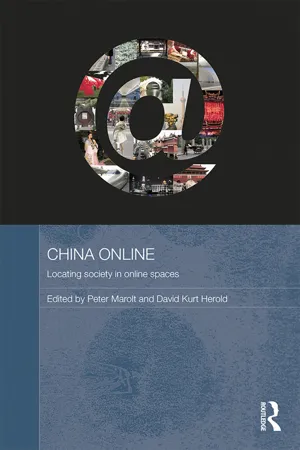
The Chinese internet is driving change across all facets of social life, and scholars have grown mindful that online and offline spaces have become interdependent and inseparable dimensions of social, political, economic, and cultural activity. This book showcases the richness and diversity of Chinese cyberspaces, conceptualizing online and offline China as separate but inter-connected spaces in which a wide array of people and groups act and interact under the gaze of a seemingly monolithic authoritarian state. The cyberspaces comprising "online China" are understood as spaces for interaction and negotiation that influence "offline China". The book argues that these spaces allow their users greater "freedoms" despite ubiquitous control and surveillance by the state authorities. The book is a sequel to the editors' earlier work, Online Society in China: Creating, Celebrating and Instrumentalising the Online Carnival (Routledge, 2011).
- 186 pages
- English
- ePUB (mobile friendly)
- Available on iOS & Android
eBook - ePub
About this book
Information
Deliberating online spaces
1
Grounding online spaces
The Chinese Internet has emerged as a growing field of research, and scholars have grown mindful that public spaces and activities in cyberspace are intrinsic to understanding social issues that exist offline, and vice versa. Online and offline spaces are increasingly recognized and rendered as interdependent and inseparable dimensions of political, economic and socio-cultural activity, and their interrelationship is driving change across all facets of social life. Continuing from our first co-edited book (Herold & Marolt, 2011), this volume carries on our investigations into the intricate specificities of the Chinese-language Internet, by illuminating phenomena and specificities of the Internet in China.
This volume emphasizes the connections between cyber and physical place-worlds and the people (a.k.a. ‘netizens’) who concurrently inhabit and perform in both these worlds. Online and offline China are conceptualized as inter-connected spaces in which human and institutional actors interact under the gaze of the – only seemingly monolithic – authoritarian state. The cyberspaces that comprise ‘Online China’ are understood as spaces for interaction that influence ‘Offline China’ and can be described as ‘spaces of autonomy’ (cf. Castells, 2012) in that they allow their users greater ‘freedoms’ despite the ubiquitous control and surveillance by state authorities. In a blend of online and offline contexts, China’s online practitioners, as individuals or in groups, are creating and shaping autonomous spaces in which they engage in myriad social interactions, express ideas, produce shared meanings, etc.
The volume at hand presents and reflects upon the diversity of social and cultural practices and events taking place in China’s online spaces and beyond. Contributors analyze how various actors utilize the Internet to create and re-create meaningful spaces, institutions and movements in their quest to shape their lives, and how these spaces propel or hinder the transformation of societal structures. Taken together, the chapters in the volume deconstruct the notion of the all-powerful and monolithic party-state while also avoiding to cast Chinese Internet users in a primarily ‘political’ role. Chinese cyberspace is home to many different users, groups, events, happenings, movements, artifacts, etc., and their goals and purposes are rarely ‘political’ in a narrow sense – even if they have an effect on politics. In the same way, ‘the Chinese state’ consists of many individuals, groupings, institutions, etc. that have different views on multiple aspects of ‘Online China’, often at odds with each other. China’s netizens are faced with contradictory, ever shifting regulations and ‘harmonizing’ state interventions that require constant choices, compromises, and great flexibility, in negotiating the boundaries of permissible online and offline behavior and action.
A less dichotomous re-conceptualization of both online and offline China and their diverse practices and networks of relationships allows for a deeper understanding of the importance of the Internet in today’s China (and beyond). In this volume, we have integrated empirical findings and conceptual imaginings of the ways in which ‘Online China’ invokes the re-making of ‘Offline China’ (and vice versa) and how people create new, blended socio-cultural spaces in today’s China. We found that the diverse practices that comprise the ‘Chinese Internet’ have profound implications beyond personal space: fostering self-expression, improving one’s critical apparatus, broadening one’s views, taking other people’s thoughts and ideas seriously, forging relationships, etc. Slowly but surely, Online China thereby changes the country and the world as we know it, one micro-interaction at a time. This book is significant in that it examines the various ways in which Chinese netizens discover and live out their individuality despite the palpable atmosphere of political repression.
Framing and situating this volume
The relationship between information technology and societal transformation is multi-faceted, ever-changing and of unprecedented complexity. It is therefore hardly surprising that contemporary Chinese society changes far more rapidly than the capacity of scholars to record and interpret that change. There is a fast-growing scholarly literature confirming that the Chinese-language Internet is home to a growing sphere of free speech, that blogs and microblogs create an independent space for discourse, and how this aids the development of a civil society in China. Associated academic discourses have tended to portray Chinese people as passive victims of either China’s party-state or globalizing economic forces. What results is limited by a control versus freedom paradigm in which, in a highly questionable practice (and practically by design), ‘cyber-activist’ becomes a synonym for ‘cyber-dissident’, without acknowledging (and still less engaging with) the various ways and degrees to which one can be active in cyberspace.
Another adaptation of these paradigmatic master narratives represent those who are not ‘cyber-activists’ as being all about entertainment and play. This may be in line with the preferred storyline (and political agenda) of the Chinese party-state, but the statistical fact that China’s media, including the Internet, are dominated by entertainment does not mean that political debate or social transformation are absent. The widespread academic consensus about the Chinese Internet being all about entertainment that leads to some form of ‘mindless escapism’ or even addiction has to be taken with more than one grain of salt. Isn’t it exactly such ‘mindless’ entertainment that creates the playful mood through which creative fountains of ideas can flourish? Since Wittgenstein, we know that “[h]umor is not a mood, but a way to observe the world”, and Bakhtin (see Lachmann, Eshelman, & Davis, 1988) tells us that subversion of hierarchy and authority often happens by the means of “grotesque realism” and “carnival” – again mainly through humor. This suggests that the prevailing representations of netizens as entertainment-loving beings are merely imposed notions geared towards redefining their role as assisting those in power in reaching their goals. In a similar manner, larger social concepts such as capitalism or democracy may be useful as hermeneutic devices in understanding politics and the world, but they often create a fatal indifference towards the empirical; nor are they very helpful when it comes to grasping the complexity of a society and culture in which huge numbers of individuals are thinking very differently from what their governments say or do.
The terms of conventional scholarly debate of the ‘Chinese Internet’ are all-toooften framed as control versus freedom, domination versus resistance, or autocracy versus democracy. Perhaps for this reason, surprisingly little is known about the ways in which the ‘online’ and the ‘offline’ are related in everyday China, about aspirations and opinions of China’s netizens, their levels of self-reflection and political maturity, or urban China’s current status and future trajectories in the processes of social learning and transformation.
It is therefore of crucial importance to avoid reductionist perspectives and acknowledge the complex ways in which people support, oppose or ignore impositions of power and control. We cannot afford to lose sight of “people’s ability to actively resist such impositions, and to carve out new, meaningful spaces for themselves” (Hil & Bessant, 1999, p. 41). This volume emerged out of a desire to heed these guidelines, as an attempt to provide a balancing ‘view from below’ that stresses the importance of empirical detail and diversity. In the process, we have found that grasping the existence and significance of specific events and particularistic resistances that are rooted in local identities and experiences is contingent upon learning about the everyday realities of the people involved. Judging the Chinese Internet merely on the basis of its content is just as misleading as focusing solely on censorship or the Internet’s imagined emancipatory potential. The Internet should also be explored for specific conscious and intentional efforts and unintentional side effects at work at altering societal structures from below.
There is an upsurge of recent scholarship on Chinese new media that is slowly transcending the dichotomy of control vs. freedom. While appreciating that structural forces continue to exert strong pressures on social practices, these scholars point out that such morphological factors “neither wholly control nor wholly predict the outcome” (Williams 1974, p. 130; cited in Zhao 2008, p. 354). This recognition allows them to conclude and seek corroboration that “human agency and historical contingencies remain important” (Zhao 2008, p. 354). Nevertheless, apart from a few notable exceptions (Esarey & Xiao, 2008; Kluver, 2008; MacKinnon, 2008; Yu, 2006, 2007; Zhao, 2008; Zhou, 2005, 2006; also see Giese, 2006; Goldman, 2005; Qiu, 2004), Chinese Internet studies have yet to realize that agency can only be recognized if we are prepared to see it. We should thus embrace everyday life as a useful theoretical construct that helps us to get away from thinking in terms of what media do to people, and toward how people actually use these media. For example, Haiqing Yu examines digital media practices in the context of everyday politics in China. She affirms that the Internet has become an integral part of the daily lives of urban Chinese and that new media empowers people to narrate their own stories and make themselves heard, thus becoming “active participants in the production of symbolic values by being part of a culture of circulation” (Yu, 2007, p. 428). Yu concludes that “the seemingly apolitical media practices of the consumer masses turned out to be political in the end as they influenced the way people think about politics” (p. 424).
When people express themselves and thereby reveal their differences and distinctions, the resulting diversity creates a capacity for critical reflection and action (Arendt, 2001; Debord, 1967; Foucault, 1980; Goldfarb, 1998; Lefebvre, 1991). Furthermore, once people have created a shared public space for speech based upon different opinions, they become empowered to share a sense of the factual world, engage in a common course of action, and eventually re-create public life through social transformation. However, although the Internet provides opportunities for expanding the space for political participation in China, the actual realization of such a public civil sphere depends on intentional human action that move from a virtual ‘e-sphere’ into physical everyday realities. As the chapters in this volume show, such an emphasis on agency and space allows us to recognize qualitative changes in the ways people conduct and perceive politics, by demonstrating that the Internet and its various social media are an essential source of consciousness, expression, and action, and by examining related interactive links between cyberspace (imagined spaces) and city space (physical places). Through various ‘media events’, we can thereby catch a glimpse of the ways in which changing conceptions of politics create new spaces of expression and autonomy that are imbued with a potential of yielding shared meanings and political action different from traditional political forms and their institutional manifestations.
In the context of China, yet another difficulty arises: Qualitative research often wrongly assumes that research participants will tell you what most concerns them, and thus emphasizes the overt and seemingly obvious over the tacit, the implicit, and the liminal. However, in a context where many, if not most, important meanings and processes are not expressed openly, we need to “learn the logic of the experience we study, not to impose our logic on it” (Charmaz, 2004, p. 982). In order to do this we need to bracket our own views of reality and rationality and recognize that participants’ views – as well as our own – are always relative to place, time, context, situation, and society (p. 982). In other words, we should always give first attention to the phenomena themselves, adapting our methods if necessary (Goffman, 1989).
Partly due to these complications, partly due to sheer size, there is very little grounded evidence about how the Chinese-language Internet is affecting peoples’ everyday lives and larger cultural and social practices. Moreover, there is a clear dividing line in studies of cyber-culture between structural literature that favors abstraction in theories of cyberspace, and post-structural literature that examines closely the experiences of participants. Contesting current realities of knowledge production, I am convinced that grappling with the complexities of culture mediated in and through cyberspace requires us to do more than merely choose sides: it compels us to develop alternative ways of seeing and conceptual models that help us make sense of people’s idiosyncratic experiences and everyday perceptions of lives led in specific environments. By sharing netizens’ thoughts on these effects and offering novel perspectives that make sense of them conceptually, this volume is conceived to fill some of this gap. After all, the expressions of its netizens may contain the only mature response to China’s contemporary quandary, in the sense that their thoughts and ideas evoke and facilitate the envisioning of living spaces that are worth living in, in a civil sphere they can feel comfortable in. Bringing these expressions to the fore involves conscious (and thus observable) thoughts and ideas that can be linked to the vanguard of societal change and that open up our ways of seeing towards the less structural and monolithic aspects of social science. Remaining wary of an over-preoccupation with theory that overlooks (or ignores) the diversity present in the empirical realm and the individuality of Chinese people, what follows is hoped to reassert and invigorate the academic debate of the socio-political implications of the Chinese Internet. Along similar lines, Tai (2006) has found that the Internet has emerged as an emancipatory and empowering tool for Chinese civil society and has opened new opportunities for the revitalization of civil society forces. Even though the state still maintains a formidable presence in Chinese cyberspace, there are indications that the Internet marks a dramatic departure from previous types of communication technologies” (Tai, 2006, p. 289).
This trend suggests that we need to focus our attention on cyber-urban spaces and practices of ‘performing place’, on specific new modes of individual and shared agency, and on the ‘spaces of autonomy’ (Castells, 2012) in and through which these two come into focus, meet and augment each other. This edited volume is conceived around these issues.
The self and place: ‘performing place’ in the cyber-urban place-world
As cities, in China and elsewhere, increasingly “defy efforts to be classified into types, reduced to essential characteristics, and fixed by boundaries (intellectual or otherwise)” (Cherot & Murray, 2002, p. 432), we need new ways of seeing heterogeneous urban realities. What many Chinese urbanites face is not a deep structure and normative purity bu...
Table of contents
- Cover Page
- Half Title Page
- Series Page
- Title Page
- Copyright Page
- Contents
- Editors and authors
- Part I Deliberating online spaces
- Part II Defining online spaces
- Part III Claiming online spaces
- Part IV Enjoying online spaces
- Part V Shaping online spaces
- Index
Trusted by 375,005 students
Access to over 1.5 million titles for a fair monthly price.
Study more efficiently using our study tools.
Frequently asked questions
Yes, you can cancel anytime from the Subscription tab in your account settings on the Perlego website. Your subscription will stay active until the end of your current billing period. Learn how to cancel your subscription
No, books cannot be downloaded as external files, such as PDFs, for use outside of Perlego. However, you can download books within the Perlego app for offline reading on mobile or tablet. Learn how to download books offline
Perlego offers two plans: Essential and Complete
- Essential is ideal for learners and professionals who enjoy exploring a wide range of subjects. Access the Essential Library with 800,000+ trusted titles and best-sellers across business, personal growth, and the humanities. Includes unlimited reading time and Standard Read Aloud voice.
- Complete: Perfect for advanced learners and researchers needing full, unrestricted access. Unlock 1.5M+ books across hundreds of subjects, including academic and specialized titles. The Complete Plan also includes advanced features like Premium Read Aloud and Research Assistant.
We are an online textbook subscription service, where you can get access to an entire online library for less than the price of a single book per month. With over 1.5 million books across 990+ topics, we’ve got you covered! Learn about our mission
Look out for the read-aloud symbol on your next book to see if you can listen to it. The read-aloud tool reads text aloud for you, highlighting the text as it is being read. You can pause it, speed it up and slow it down. Learn more about Read Aloud
Yes! You can use the Perlego app on both iOS and Android devices to read anytime, anywhere — even offline. Perfect for commutes or when you’re on the go.
Please note we cannot support devices running on iOS 13 and Android 7 or earlier. Learn more about using the app
Please note we cannot support devices running on iOS 13 and Android 7 or earlier. Learn more about using the app
Yes, you can access China Online by Peter Marolt,David Kurt Herold in PDF and/or ePUB format, as well as other popular books in Social Sciences & Ethnic Studies. We have over 1.5 million books available in our catalogue for you to explore.