Human Landscapes in Classical Antiquity shows how today's environmental and ecological concerns can help illuminate our study of the ancient world. The contributors consider how the Greeks and Romans perceived their natural world, and how their perceptions affected society. The effects of human settlement and cultivation on the landscape are considered, as well as the representation of landscape in Attic drama. Various aspects of farming, such as the use of terraces and the significance of olive growing are examined. The uncultivated landscape was also important: hunting was a key social ritual for Greek and hellenistic elites, and 'wild' places were not wastelands but played an essential economic role. The Romans' attempts to control their environment are analyzed.
This volume shows how Greeks and Romans worked hand in hand with their natural environment and not against it. It represents an outstanding collaboration between the disciplines of history and archaeology.
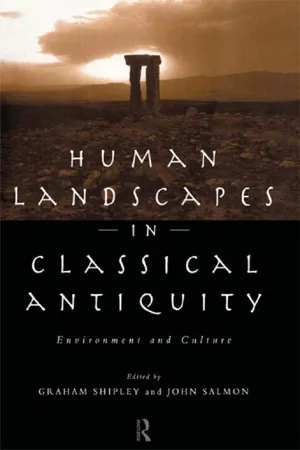
eBook - ePub
Human Landscapes in Classical Antiquity
Environment and Culture
- 368 pages
- English
- ePUB (mobile friendly)
- Available on iOS & Android
eBook - ePub
Human Landscapes in Classical Antiquity
Environment and Culture
About this book
1
Ancient history and landscape histories
Graham Shipley
A natural concern?
A larger proportion of the world's population now lives in cities than at any time in history; yet interest in the ‘natural world’ is greater than ever.
A consciousness that society is inextricably situated within, and dependent upon, its non-constructed environment is far from new. In Eurocentric culture it goes back most directly to the Romantic movement (witness the writings of Goethe, Wordsworth, and many others) and beyond. In the nineteenth century the politics of reform and revolution emphasized bad living conditions in industrial towns, while before long people learned to make excursions back into a countryside they had left when it no longer offered them a livelihood, but which was now seen as healthy and a public good. In the late nineteenth century steps were taken to improve public access to the countryside, such as by the foundation of the National Trust in England and Wales, precisely one hundred years ago at the time of writing (1995).
More recently, environmental issues have been in the forefront of politics for different reasons. Since the early 1970s, pressure groups have campaigned to curb the environmental pollution caused by industry and the internal combustion engine; and politics at the ‘grass roots’ (telling phrase!) is increasingly informed by a ‘green’ consciousness that transcends party loyalties. The public has probably never been so well informed about ‘nature’, thanks to a rich diet of programmes about wild life and news items about environmental issues in the media.
Since the 1970s there has been increasingly wide concern at the effects of industrial development on the ‘third world’, motivated by compassion for human suffering, anxiety at the destruction of other species or their habitats, and fear of permanent damage to the global environment. In the later Cold War years anti-nuclear campaigners found common ground with the environmental movement, stressing the global catastrophe a nuclear war might bring and, more controversially, pointing to nuclear power stations as a menace to the health of humans and other species. The fall of the Soviet bloc brought new knowledge of environmentally destructive industries in some eastern countries. In Britain, ‘green’ consciousness is widely believed to have peaked in 1989 with a 19 per cent vote for the Green Party at the European Parliamentary elections, at a time when the media were constantly featuring environmental issues. In the late 1980s and 1990s, recycling facilities sprang up all over Europe, some industrialists declared themselves environmentally friendly, and for a time non-destructive household goods were prominent on supermarket shelves. A prime concern of British environmentalists in recent years has been to urge governments to slow down road-building and promote public transport and less environmentally damaging forms of transport, particularly the bicycle. Appropriately for one of the hosts of this seminar series, Leicester is now dubbed ‘Britain's First Environment City’.
During the space missions of the late 1960s and early 1970s we first saw the image of the Earth from afar, floating, as it were, in the black sea of empty space – a cultural icon often credited with having promoted the rise of the ‘green’ movement (though, for example, the role of motor traffic in London smogs and the effect of dangerous pesticides on the land had been appreciated many years earlier). Our environment is commonly seen as fragile; for some, including those influenced by the Gaia theory (Lovelock 1979; 1988), the human species even represents a threat to all life on earth (cf. Collard 1988, arguably taking an extreme position).
This environmental awareness is not the same as the Romantics’ love of nature. Rather than stressing the spiritual benefit to humankind of awareness of, and contact with, nature (though that view is also widely put forward), it proclaims the mutuality inherent in any ecological system and the responsibility we have to keep our surroundings fit for ourselves, our descendants, and other creatures. Just as the Romantic movement reflected the social and economic situation of the writers of the day, so present-day concern for ‘the environment’ reflects the unprecedented conditions of industrialized society (the fashionable term ‘post-industrial’ seems premature), with increasing public access to sources of information, much of it based on current scientific understanding; a society in which for many people, by choice or through force of circumstance, the periods defined as ‘leisure’ are getting longer; and a society in which great importance is placed on individuals cultivating their own path through life and expressing their personality. Democratic politics seems to operate more at the level of individual voices than ever before, and with ever more sophisticated telecommunications (notably the InterNet, the global computer network of the 1990s) it is possible for individuals to make themselves heard.
I enumerate these aspects of modern environmental concern in order to emphasize that the points of contact with a pre-industrial, largely agricultural society such as the ancient Mediterranean are close to zero. We should be wary of assuming, simplistically, that in the ancient world there were, even mutatis mutandis or allowing for differences of scale, any comparable threats to the environment, or any similar awareness of human responsibilities, unless we find evidence to support such a claim. For ancient Greece, Oliver Rackham, in the second chapter in this volume, seeks to correct a number of myths and misconceptions about both the modern landscape and what it can tell us about the ancient one. While landscape change is evident today, he argues, ‘the big changes took place long before there were writers to put them on record’, and human activity in the classical period made little long-term difference to the Greek countryside. Thus ‘there was no particular need for them [the Greeks] to be explicitly ecologically minded’.
Ancient history: old and new
Living in an industrial society we tend to see the primary landscape division as between country and town. This is one stimulus for the current volume: in what ways did political societies that saw themselves as town-based (the Greek politês, citizen, is a ‘polis man’), but were inextricably linked to rural production, control and modify their rural surroundings?
The new environmental concerns of modern society, too, legitimately raise provocative questions about Greek and Roman antiquity that could scarcely have been formulated a generation ago. People are keen to know whether the Greeks and Romans were in any sense ‘environmentally conscious’: for example, have we anything to learn from them about how to live in a productive landscape without damaging it? Did ancient society (as is all too often claimed) accelerate, or even initiate, detrimental changes in Mediterranean landscapes that we are still coping with? Were ancient farmers more empathetic to the landscape, and to other living species, and did they take better care of their surroundings? Several of the authors in this volume give carefully nuanced answers to these questions.
A generation ago it was rare for British scholars writing about ancient history to bring the landscape into play alongside political accounts of antiquity. Greek and Roman history, for mid-twentieth-century scholars, seems to have been political history – ‘the Long March to democracy and the Roman road back from it’, as Robin Lane Fox puts it below (ch. 6) – not surprisingly, perhaps, in view of the experience of those generations, many of whose lives were shaped by war in Europe and the struggles of democracy, communism, and fascism. Reading some textbooks of that era, one can sometimes almost forget that Spartans and Athenians depended almost entirely for their survival upon a farming economy, while Roman political history, even of the Gracchi, seems at times curiously lacking in any roots in the real Italian landscape.
The potential for a different approach was always there: earlier generations of scholars had not separated the study of ancient history so completely from the Mediterranean landscapes. To cite a few examples at random: the fundamental work on ancient population geography, still cited today, was by a late nineteenth-century German scholar, K. J. Beloch (1886); early twentieth-century British scholars had explored the Peloponnese for rural forts and settlements;1 and authors like Alfred Zimmern (1911) were sensitive to the importance of the landscape in early Greek society and, in some cases, to the reality of the Greek countryside. Max Cary, himself the author of many pages of political history, wrote a book on the geography of the Mediterranean (Cary 1949); and classical teachers and scholars contributed extensively to the geographical handbooks on Greece, Italy, the Dodecanese, and other lands produced by the British Admiralty during the two world wars, whose second series, produced in the 1940s, is continually referred to by scholars even today.2 There were exceptions after the war, too, including historians and archaeologists who had seen wartime service in the Mediterranean (A. R. Burn, Antony Andrewes) or who spent time in Greece or Italy before or after the war (L. F. Fitzhardinge, W. G. Forrest, J. B. Ward-Perkins).3
Meanwhile, archaeology was a growing discipline. After the second world war, Roman historians were perhaps quicker to realize the implications of new techniques – not surprisingly, given the long tradition of excavating Roman sites in Britain and western Europe, and the higher frequency with which organic remains were found. K. D. White's work on Roman farming was, however, largely based on literary evidence (White 1977). At the same time, classical scholars studied representations of nature from literary or artistic vantage-points (e.g. Toynbee 1973).
More innovatively still, with the rise of a distinctively French ‘school’ of ancient history that emphasized religion and myth, initially under the influence of the anthropologists Gernet and Lévi-Strauss, nature once more began to be seen as one of the sites of meaning that could help us penetrate the ancient psyche (one thinks of works by Vidal-Naquet, Vernant, and Detienne). Technical studies of particular aspects of society's relation to the natural world were being produced in English; but reading Meiggs (1982) on trees or Scullard (1974) on elephants one feels they laboured under a certain unease and were not ready to claim that the interaction of ancient society with the natural world could be talked of in the same breath as explanations in terms of imperialism, trade, or political systems (despite Meiggs's articulate and persuasive claims for the historical importance of timber in antiquity).
We all know that classics has ‘declined’ for a hundred years, at least if measured by the number of those learning Greek and Latin; so it may seem perverse to claim that its trajectory has in fact been an upward one for several decades. Yet public interest in ancient civilizations is probably keener than ever; and in terms of the sympathetic understanding of ancient society (one might almost say wie es eigentlich gewesen), scholars have come a long way from the narrowly political chapters (in general) of the first edition of the Cambridge Ancient History or the drily narrative textbooks of the mid-century. One reason may be the fundamental changes in the society from which scholars themselves are drawn; another may be that, once classics lost its pre-eminent position in the education of the élite and became a specialist subject, it was forced (partly stimulated by seeing how the subject was taught in North America) to seek a wider audience: first, by offering classics and ancient history in translation; second – and most importantly for the present discussion – by reaching out in research to engage with other, more modern disciplines such as anthropology, sociology, literary theory, gender studies, and above all archaeology. Anthropology, for example, shows its influence in studies by Forbes and others.1 The real effects of the changes in Roman elite land ownership in the middle Republican period became apparent with the sociologically grounded work of Hopkins and others.
With the increasing availability of air travel, the growth of higher education in the UK and other countries, and the rise of archaeological departments, there were opportunities for students and scholars to visit Greek and Roman lands more often and in greater numbers. It can be no coincidence that there was a resurgence of historical writings that sought to illuminate the political and economic history through an awareness of the geographical setting.1 These were part of a movement towards regional studies linking landscapes with history more integrally.2 Aspects of the ancient economy were increasingly studied through a combination of literary, documentary, and archaeological evidence.3
This being the period, too, when the environmental movement became clearly defined, it is perhaps unsurprising that archaeology seems to have been preoccupied for a time with how the geology, geography, and productive capacities of a territory may have influenced, or even determined, the development of a society.4 Thiessen polygons, central place theory, and environmental carrying capacities were all the rage, and archaeologists were keen to move outside traditional focuses of classical archaeology, such ...
Table of contents
- Front Cover
- Half Title
- Title Page
- Copyright
- Contents
- List of figures
- Notes on contributors
- Preface
- List of abbreviations
- 1 Ancient history and landscape histories
- 2 Ecology and pseudo-ecology: the example of ancient Greece
- 3 Feeling the earth move: cultivation techniques on steep slopes in classical antiquity
- 4 The uses of the uncultivated landscape in modern Greece: a pointer to the value of the wilderness in antiquity?
- 5 The countryside in classical Greek drama, and isolated farms in dramatic landscapes
- 6 Ancient hunting: from Homer to Polybios
- 7 Where was the ‘wilderness’ in Roman times?
- 8 Rome and the management of water: environment, culture and power
- 9 First fruit? The olive in the Roman world
- 10 Barren fields? Landscapes and settlements in late Roman and post-Roman Italy
- 11 Nature and views of her landscapes in Pliny the Elder
- 12 Cosmic sympathies: nature as the expression of divine purpose
- Index
Trusted by 375,005 students
Access to over 1.5 million titles for a fair monthly price.
Study more efficiently using our study tools.
Frequently asked questions
Yes, you can cancel anytime from the Subscription tab in your account settings on the Perlego website. Your subscription will stay active until the end of your current billing period. Learn how to cancel your subscription
No, books cannot be downloaded as external files, such as PDFs, for use outside of Perlego. However, you can download books within the Perlego app for offline reading on mobile or tablet. Learn how to download books offline
Perlego offers two plans: Essential and Complete
- Essential is ideal for learners and professionals who enjoy exploring a wide range of subjects. Access the Essential Library with 800,000+ trusted titles and best-sellers across business, personal growth, and the humanities. Includes unlimited reading time and Standard Read Aloud voice.
- Complete: Perfect for advanced learners and researchers needing full, unrestricted access. Unlock 1.5M+ books across hundreds of subjects, including academic and specialized titles. The Complete Plan also includes advanced features like Premium Read Aloud and Research Assistant.
We are an online textbook subscription service, where you can get access to an entire online library for less than the price of a single book per month. With over 1.5 million books across 990+ topics, we’ve got you covered! Learn about our mission
Look out for the read-aloud symbol on your next book to see if you can listen to it. The read-aloud tool reads text aloud for you, highlighting the text as it is being read. You can pause it, speed it up and slow it down. Learn more about Read Aloud
Yes! You can use the Perlego app on both iOS and Android devices to read anytime, anywhere — even offline. Perfect for commutes or when you’re on the go.
Please note we cannot support devices running on iOS 13 and Android 7 or earlier. Learn more about using the app
Please note we cannot support devices running on iOS 13 and Android 7 or earlier. Learn more about using the app
Yes, you can access Human Landscapes in Classical Antiquity by John Salmon, Graham Shipley, John Salmon,Graham Shipley in PDF and/or ePUB format, as well as other popular books in History & Ancient History. We have over 1.5 million books available in our catalogue for you to explore.