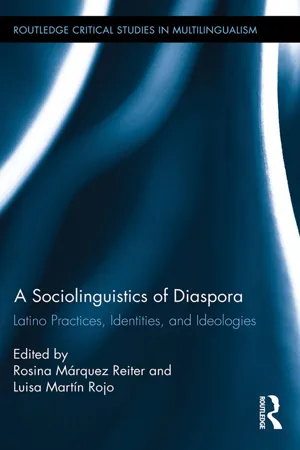
This volume brings together scholars in sociolinguistics and the sociology of new media and mobile technologies who are working on different social and communicative aspects of the Latino diaspora. There is new interest in the ways in which migrants negotiate and renegotiate identities through their continued interactions with their own culture back home, in the host country, in similar diaspora elsewhere, and with the various "new" cultures of the receiving country. This collection focuses on two broad political and social contexts: the established Latino communities in urban settings in North America and newer Latin American communities in Europe and the Middle East. It explores the role of migration/diaspora in transforming linguistic practices, ideologies, and identities.
eBook - ePub
A Sociolinguistics of Diaspora
Latino Practices, Identities, and Ideologies
- 208 pages
- English
- ePUB (mobile friendly)
- Available on iOS & Android
eBook - ePub
A Sociolinguistics of Diaspora
Latino Practices, Identities, and Ideologies
About this book
Information
Part I
Established Communities
1 Ethnolinguistic Identities and Ideologies among Mexicans, Puerto Ricans, and "MexiRicans" in Chicago
Kim Potowski
Introduction
The US Census of 2010 reported 50.5 million “Hispanics”,1 of whom 36.9 million said they spoke Spanish at home. If the estimated 9.4 million undocumented Latin Americans living in the country (Pew Hispanic Center, 2013) are added to this figure, the result is a total of 46.3 million Spanish speakers. This then makes the United States the fourth largest Spanish-speaking nation in the world after Mexico (112.3 million), Colombia (47.7), and Spain (47.3 million). Yet several factors differentiate the United States from other Spanish-speaking nations in important ways. First, it is not Spanish but rather English that predominates at all levels of society and, in fact, 80% of Census respondents say they speak only English at home. Its status as a minority language in the United States has important consequences for the structure and intergenerational transmission of Spanish, as well as for the identity constructions of its speakers.
Another important factor that makes the United States unique is that its Spanish-speaking population comes from a wide variety of countries. The most numerous groups are Mexican (63% of all US Latinos), Puerto Rican (9%), Cuban (3.5%), and Dominican (2.8%), but there are speakers from all national dialect backgrounds across the country. This diversity is particularly evident in larger cities, although many of them have traditionally been associated with one particular group. For example, people usually think of New York as Puerto Rican, Los Angeles as Mexican, and Miami as Cuban, but the 2010 Census showed the following diversity: New York’s Hispanics were 31% Puerto Rican, 30% “other”, and 25% Dominican; Los Angeles’s Latinos were 66% Mexican but 14% “other” and 13% Salvadoran; Miami’s Hispanic population was 49% Cuban, 32% “other”, and 10% Nicaraguan; and in Chicago, the focus of this chapter, the Hispanic population was 74% Mexican, 13% Puerto Rican, and 10% “other”. Although all four cities had a single Latino group that outnumbered the others—not, however, by much in New York—the particularly large percentages of “other” groups in New York, Los Angeles, and Miami point to increasingly heterogeneous Hispanic populations.
This increasing diversity is theoretically interesting for at least two reasons. The first is linguistic: interaction among these different dialect groups can lead to potential linguistic cross-influences on their varieties of Spanish. In fact, Spanish dialect contact is occupying an increasingly important position in studies of US Spanish (Aaron & Hernández, 2007; Otheguy & Zentella, 2012; Schreffler, 1994; Zentella, 1990 ). Second, this contact presents a new set of variables for scholarly work on latinidad. Latinidad is defined as a sense of panethnic unity resulting from shared experiences of economic, political, and cultural marginalization (Aparicio & Chávez-Silverman, 1997). Scholars working within this framework examine the complexities involved in recognizing shared aspects of Latino identity while simultaneously attending to the uniqueness of members of different Latino groups in their histories, culture, and positionings within US society. Group identities are executed via a dual process of claiming who the group is and also differentiating the group from “others”. That these groups are increasingly sharing social space forces new examinations of their interactions and identities as they coexist with increasingly more diverse groups of “others” from whom to differentiate themselves—or with whom to align themselves. Thus, the growth in Latino heterogeneity can simultaneously lead to a degree of linguistic accommodation, making the Spanish of different groups more similar to one another’s while at the same time causing members of the groups to articulate more clearly an identity as different from the other groups.
Further complicating language- and identity-based studies are the experiences of “intra-Latinos”: those whose parents belong to different Latino groups. Owing to the heterogeneity just outlined, such individuals are becoming more common in the United States. In New York City, for example, 1991 marriage records reveal a high rate of unions between Hispanics across different national origins (Gilbertson, Fitzpatrick, & Yang, 1996; Lee, 2006). The mixed-ethnicity children that result from these unions offer interesting loci to examine both linguistic and identity - oriented outcomes. That is, the possibly hybridized characteristics of the Spanish of intra-Latino individuals, combined with their unique linguistic and intergroup ideologies and their concepts of self-identity, broaden the spectrum of latinidad.
This chapter explores the following aspects of Latino heterogeneity in Chicago, Illinois, a city of almost 3 million people located in the Midwestern United States. First, I present a summary of social and linguistic outcomes of contact between Mexicans and Puerto Ricans in the city. This provides a necessary background to understanding the experiences of “MexiRican” individuals—those raised by one Mexican parent and one Puerto Rican parent. The two principal questions I address are: How do Mexicans and Puerto Ricans sharing social space in Chicago position each other socially and linguistically? And, given this backdrop, how do MexiRicans construct ethnic identities?
Mexicans and Puerto Ricans in Chicago
Chicago has emerged as a major Latino metropolis, with a 2010 Censusestimated Latino population of 778,862 that constitutes 29% of the city’s residents. The city has more Mexicans than Veracruz and more Puerto Ricans than Arecibo; the relatively large number of Mexicans (578,100)2 and Puerto Ricans (102,703) makes it an ideal site to study inter-Latino contact. In fact, according to Pérez (2003), Chicago is the only city where Mexicans and Puerto Ricans have been sharing community space for generations; it may very well be the first US city in which substantial numbers of different Latino groups have done so.
This section explores one of the particularities of Chicago as a Latino urban space, that of how Mexicans and Puerto Ricans coexist therein. This, in turn, will provide some context for situating and understanding the experiences of MexiRicans.
Sociocultural Relationships
The first studies of contact between Mexican (hereafter “MX”) and Puerto Rican (“PR”) residents in Chicago were sociological. Padilla (1947) explored early interactions between these two groups in the city, fostered by events organized by steel foundries to encourage socializing between male MX braceros and female PR recruited laborers. Almost 30 years later, Padilla (1985), largely credited with coining the term latinidad, examined it from an institutional perspective, studying how Chicago MXs and PRs put aside differences in order to fight for collective benefits. He argued that these two groups forged a “Latino” identity in order to mobilize politically despite their substantial ethnic and cultural boundaries. A more recent manifestation of MX-PR collaboration for political purposes is the participation of PRs—who by birth are US citizens—in Chicago’s pro-immigrant rights movement, summed up in the chant by a group of 2007 demonstrators:¡ Borica y mexicano, luchando mano a mano! (“Puerto Rican and Mexican, struggling hand in hand!”; Rodríguez Muñiz, 2010).
However, in other work examining day-to-day interactions, members of these groups have been found more likely to position themselves as fundamentally different from each other. Focusing on gendered experiences, for example, Pérez (2003) found that PR women accused MX women of being sufridas (long-suffering) at the hands of abusive husbands, yet the MX women considered patience and forgiveness among their virtues. The MX women found PR women too rencorosas (unforgiving), yet the PR women were proud of their independence and knowledge of their rights.
The most in-depth exploration, to date of MX-PR contact DeGenova and Ramos Zayas (2003), who examined how these two groups in Chicago understood and reproduced differences between them and how those differences were linked to a “larger social framework of racialized inequalities of power and opportunity” (p. 2). Racialization here is understood as the discursive production of identities that ascribe dehumanizing race-based meanings to a previously racially unclassified relationship, social practice, or group. A range of factors emerged as significant in how MXs and PRs positioned themselves in relation to one another, including US citizenship, participation in federal welfare assistance programs, gender and family ideologies, and perceived levels of modernity. Specifically, MXs were accused by PRs of being illegal immigrants, “taking” all of the jobs, and being too docile, “backward”, or excessively traditional. PRs were criticized by MXs for being lazy (principally for accepting government welfare benefits despite enjoying legal work status) as well as for not maintaining intact families, not attending church, and being too loud and brash. Thus, it is unfortunately the case that these groups, in addition to being racialized and negatively stereotyped by the hegemonic Anglo majority, also engage in racializing and negatively stereotyping each other. These authors claim that MXs and PRs in Chicago articulate their identities in large part through discourses that clearly distinguish them from each other.
In addition to these racialized stereotypes, the Spanish language was found to be “an especially salient object around which to produce difference” (DeGenova & Ramos Zayas, 2003, p. 145). They also found that first-generation MXs expected that all MXs should know Spanish, including those raised in the United States, and expressed a sense of betrayal when they did not. They also characterized PR Spanish as inferior to MX Spanish, a value judgment that many PRs had apparently internalized: many PRs agreed that they themselves did not speak “proper” Spanish, which presented a challenge to their notions of cultural authenticity. And although many first-generation PRs expressed concerns about their children’s retention of Spanish, the trend was for “urbanized bilingual PRs . . . [to demonstrate] greater wherewithal to successfully adapt to the social order of white supremacy and Anglo hegemony in the U.S.” (DeGenova & Ramos-Zayas, 2003, p. 161). In fact, despite MX discourses to the contrary, what PRs and MXs had in common was that they were “drawn together by a latinidad that actually derived not from shared Spanish language but rather a shared erosion of Spanish” (p. 168). Potowski (2004) documented precisely such a shift from Spanish to English across three generations among more than 800 Latino youth in the city.
In summary, despite the common fate of shift to English, these two groups employed highly divergent discourses of language to fortify the racialized differences between them—about spoken accents, particular words and idiomatic expressions, and perceived “correctness” of Spanish, with MX Spanish emerging on top of the hierarchy. In her ethnography of a Chicago high school, Ghosh Johnson (2005), too, found animosity between MX and PR high school students, who held linguistic...
Table of contents
- Cover
- Title
- Copyright
- Contents
- List of Figures
- List of Tables
- Introduction: Exploring Latin American Communities across Regions and Communicative Arenas
- PART I Established Communities
- PART II Emergent Communities
- PART III Virtual Communities
- Afterword: The Sociolinguistics of Latino Diasporas
- List of Contributors
- Index
Trusted by 375,005 students
Access to over 1.5 million titles for a fair monthly price.
Study more efficiently using our study tools.
Frequently asked questions
Yes, you can cancel anytime from the Subscription tab in your account settings on the Perlego website. Your subscription will stay active until the end of your current billing period. Learn how to cancel your subscription
No, books cannot be downloaded as external files, such as PDFs, for use outside of Perlego. However, you can download books within the Perlego app for offline reading on mobile or tablet. Learn how to download books offline
Perlego offers two plans: Essential and Complete
- Essential is ideal for learners and professionals who enjoy exploring a wide range of subjects. Access the Essential Library with 800,000+ trusted titles and best-sellers across business, personal growth, and the humanities. Includes unlimited reading time and Standard Read Aloud voice.
- Complete: Perfect for advanced learners and researchers needing full, unrestricted access. Unlock 1.5M+ books across hundreds of subjects, including academic and specialized titles. The Complete Plan also includes advanced features like Premium Read Aloud and Research Assistant.
We are an online textbook subscription service, where you can get access to an entire online library for less than the price of a single book per month. With over 1.5 million books across 990+ topics, we’ve got you covered! Learn about our mission
Look out for the read-aloud symbol on your next book to see if you can listen to it. The read-aloud tool reads text aloud for you, highlighting the text as it is being read. You can pause it, speed it up and slow it down. Learn more about Read Aloud
Yes! You can use the Perlego app on both iOS and Android devices to read anytime, anywhere — even offline. Perfect for commutes or when you’re on the go.
Please note we cannot support devices running on iOS 13 and Android 7 or earlier. Learn more about using the app
Please note we cannot support devices running on iOS 13 and Android 7 or earlier. Learn more about using the app
Yes, you can access A Sociolinguistics of Diaspora by Rosina Márquez Reiter,Luisa Martín Rojo in PDF and/or ePUB format, as well as other popular books in Languages & Linguistics & Linguistics. We have over 1.5 million books available in our catalogue for you to explore.