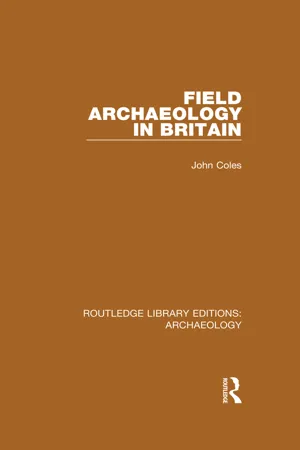
A practical guide to the various modern methods of discovery, excavation and recording of the remains left by prehistoric man in Britain. It stresses the vital role played by the amateur rescuing evidence of man's past behaviour in these islands, and is illustrated by maps, site plans and sections, and drawings of equipment and surveying procedures. Originally published in 1972.
- 280 pages
- English
- ePUB (mobile friendly)
- Available on iOS & Android
eBook - ePub
Field Archaeology in Britain
About this book
Information
IV Excavation
1 The organization of excavation
Excavations of prehistoric sites in Britain are the choice and responsibility of government agencies, national and local archaeological societies and museums, training colleges, university departments of archaeology and student societies, and purely private individuals (p. 243). Their depth of commitment depends on the interest of the particular site, the inclination of the archaeologists concerned, and the financial and other support available. Excavations are not generally simple operations, and the initiation of one is not merely an ad hoc decision on the part of an individual. No excavation, on whatever scale, should be attempted unless all of the known archaeological problems have been considered, and an approach to the answers suggested. The problems are not purely ‘excavational’, but include also legal matters as well as those of financial and staff support.
Permission
In Britain, a number of ancient sites are protected by governmental legislation. Some are under guardianship (p. 247), and others are merely ‘listed’ as worthy of preservation (p. 247). Responsibility for the conservation of both types lies with the Minister of the Environment, on the advice of the Ancient Monuments Board. No interference with such sites is allowed, unless permission has been granted by the Chief Inspector of Ancient Monuments. A list of sites selected as of national importance is made available by H.M.S.O.
Many sites, of equal potential importance but often of less imposing appearance, are not so protected, and control over their fate is in the hands of the landowner concerned. Permission to excavate must be obtained from the owner, and the archaeologist must be prepared to make out a clear case for excavation; few landowners automatically take kindly to the idea of disturbance of their property, unless the eventual gain, in knowledge, can be impressed upon them. The ownership of the finds has already been noted (p. 46). It is unquestionably to the advantage of both parties that any agreement to excavate should be written and signed. Such an agreement should indicate the following:
(1) area of excavation (precise position and size, with allowance for extension if necessary);
(2) dates of commencement and termination of work (with allowance);
(3) protection of site during work (arrangements for fencing, access route for workers and visitors);
(4) restoration of the land (back-filling, re-seeding etc.);
(5) compensation for damage to land and crop (explicit with regard to scale of compensation and nature of crop);
(6) ownership and, if possible, ultimate disposal of finds (with permission for excavator temporarily to retain all finds for study).
The interests of the tenant must also be considered, and these should be protected by any agreement between archaeologist and landowner; by their mutual consent, items 1–5 should also be settled with the tenant.
Finance
The financing of excavations in Britain tends to vary greatly, and it is the duty of the archaeologist to ensure that his financial support will not dry up and will sustain him through the entire course of work including the study and publication of the site.
At a private level, purely personal finance has been the sole source for many small-scale excavations in this country. An excavation at weekends, with local help, with equipment stored on the site and notes and finds at home, can cost very little money, if no problems arise; the problems, however, are generally unforeseeable and may involve the archaeologist in considerable expense. For example, the site may suddenly require a far greater excavation than is possible on a shoe-string budget. The labour force may dwindle through boredom, delays and weather, and fresh incentives may have to be offered by the director. Material may be found that needs expert collection and treatment (p. 209), or which can involve unexpected expense in such matters as dating. The other cost of small-scale excavations of this kind is in the potential loss of evidence through delays during the excavation (p. 210), and through lack of time and energy in the study and publication of what may turn out to be an uninspiring and unexciting site to the excavator. Nevertheless, the basis of much knowledge about early Britain, particularly in distributions of sites and finds, has been established through this kind of work, often conducted under considerable difficulties. The archaeologist should be aware of the problems that occur in such operations, without being entirely frightened off. In Britain it is generally true to say that any such site that yielded, or promised to yield, exceptional information, would attract extra support from local or national museums or other interested bodies.
Financial support for excavations in Britain is sometimes available from local, county and national archaeological societies, from museums, from government agencies and from specially constituted bodies. The sums available from societies are liable to be small, generally in the £25–50 range, but occasionally an excavation project will appeal sufficiently to gain much greater support; these projects, however, are likely to be those devised and directed by professional archaeologists on known sites. Information about local society funds are generally available through local museums where the activities of such societies are often housed.
Museums, controlled by county or town councils, may also have funds available for excavations. These are generally aimed at the acquisition of material, and the archaeologist should be aware of the implications of such support in his applications to the museum and to the landowner. Occasionally the financial support from these sources is considerable, but many small museums have no such funds. National museums, on the other hand, are able, from time to time, to finance large research projects or other excavations designed to yield important material for study and display; again, these funds are liable to go to professional archaeologists. Information about potential museum support is obtainable at the museum itself, and the archaeologist should be aware of the limited resources of the majority of museums in Britain. Lack of financial support does not necessarily mean lack of interest.
Government finance for excavations in Britain is generally restricted to those sites that have been scheduled and which are threatened by agricultural, building or road-making activities. Full support is provided, and helpers at all levels are paid at standard rates. The directors of such excavations are generally professional archaeologists or others who have had considerable experience.
Occasionally, special projects of research or rescue excavation will find finance through specially constituted committees, set up to raise money for this one particular issue. The research excavations at South Cadbury and the rescue excavations at Winchester are examples of the value of such bodies; again, the director of such projects is likely to be a professional archaeologist, either working from a teaching post, or appointed as a full-time director.
In making an approach to any body for funds for an excavation, the archaeologist in charge is generally asked to provide the following information:
(1) name of the site and precise position;
(2) nature of the site, its age and extent;
(3) importance of the site in yielding new data;
(4) name of archaeologist responsible for the work;
(5) date and duration of the work, and size of excavation team;
(6) name of landowner, and assurance of permission to excavate;
(7) eventual disposal of the finds, and publication plans;
(8) detailed costing of the work;
(9) other sources of finance.
Not all of these items can always be assessed, but an honest attempt should be made. In particular, the costing of the work must be accurate, and other sources of finance (applications or promises) clearly stated. The panel that allocates funds will include excavators who probably know the site and can themselves estimate the probable cost.
Recruitment of staff
The excavation team must have a director, preferably only one, whose role (p. 156) includes the appointment of supervisors and workers of various kinds (p. 160). The ways by which such a team is formed can vary. Probably the most satisfactory procedure, from the director’s point of view, is to invite individuals known to him or recommended to him by professionals. There is much to be said for a team composed of people who have worked together in the past for the director, and the worker who finds himself on such a team can have a particularly enjoyable time. Excavation is a scientific technique to be learned by experience and application, but there is no reason why it should not be fun at the same time. The only way by which the archaeologist can obtain admission to such a select group is through experience on other excavations where his own contribution can be observed, assessed and (hopefully) recorded. Most directors of excavations will ask for information about previous experience, and follow up the references given (see below).
The sources of information about excavations in Britain are more accessible than those of most countries. The agency for this is the Newsletter and Calendar issued by the Council for British Archaeology, and obtainable from the Council at 7 Marylebone Road, London, N.W.I; the cost of a year’s subscription to this is £2.50. The Calendar appears monthly from March to August, and a summary of the excavations conducted is published at the end of the year. The details of the excavations listed include the size of the team, duration of work, accommodation and financial help for workers.
Other sources of information about excavations in Britain are local societies, local museums and university departments, particularly Extra-Mural departments. These excavations are generally not publicized, other than details appearing on notice boards in the relevant institutions.
Many excavations are designed not only to yield new information about a site but also to provide training of potential archaeologists. Instruction is provided in surveying, photography and other aspects, as well as actual digging techniques. Details of these courses, often on Roman sites, generally appear in the Calendar of Excavations. Other instruction courses, similarly announced, deal with particular aspects such as surveying, area studies, sampling and conservation.
A final source of information about archaeological excavation is in the personal columns of national newspapers, and often these yield surprising results.
Applications for permission to attend as a worker on an excavation should be addressed to the director and should provide the following basic data, in addition to any other information requested:
(1) name, full postal address;
(2) sex and age;
(3) excavation experience, with full details of sites and directors, year and duration of work on each site;
(4) particular qualifications possibly of use, such as surveying, drawing, photography;
(5) availability for work, with dates of arrival and departure;
(6) financial help required (if any);
(7) preference for accommodation (hotel, farm house, caravan, tent).
This information will probably save correspondence time but the applicant may have to wait for an outright acceptance or refusal. The director will think first of his site, and must choose the best available help on the evidence he has before him; he is likely to wait some time before deciding his list of workers from the applications received, and he may wish to interview some applicants.
The popularity of archaeology in Britain tends to have the effect that many excavations are over-subscribed. Yet it is also true that many excavations end up being understaffed. This apparent contradiction can be explained by two facts. First, directors tend to overestimate the amount of work they can get through, and particularly the amount that they can delegate to their site supervisors; the result is an excavation team under increasing pressure, lacking time and therefore vigilance (p. 133). Second, of less moment, successful applicants to a team do not always appear on the site when as...
Table of contents
- Cover
- Half Title
- Title Page
- Copyright Page
- Original Title Page
- Original Copyright Page
- Table of Contents
- Preface
- I Prehistoric archaeology
- II Discovery of the evidence
- III Recording of sites
- IV Excavation
- V Understanding the evidence
- VI The organization of prehistoric archaeology in Britain
- Index
Trusted by 375,005 students
Access to over 1.5 million titles for a fair monthly price.
Study more efficiently using our study tools.
Frequently asked questions
Yes, you can cancel anytime from the Subscription tab in your account settings on the Perlego website. Your subscription will stay active until the end of your current billing period. Learn how to cancel your subscription
No, books cannot be downloaded as external files, such as PDFs, for use outside of Perlego. However, you can download books within the Perlego app for offline reading on mobile or tablet. Learn how to download books offline
Perlego offers two plans: Essential and Complete
- Essential is ideal for learners and professionals who enjoy exploring a wide range of subjects. Access the Essential Library with 800,000+ trusted titles and best-sellers across business, personal growth, and the humanities. Includes unlimited reading time and Standard Read Aloud voice.
- Complete: Perfect for advanced learners and researchers needing full, unrestricted access. Unlock 1.5M+ books across hundreds of subjects, including academic and specialized titles. The Complete Plan also includes advanced features like Premium Read Aloud and Research Assistant.
We are an online textbook subscription service, where you can get access to an entire online library for less than the price of a single book per month. With over 1.5 million books across 990+ topics, we’ve got you covered! Learn about our mission
Look out for the read-aloud symbol on your next book to see if you can listen to it. The read-aloud tool reads text aloud for you, highlighting the text as it is being read. You can pause it, speed it up and slow it down. Learn more about Read Aloud
Yes! You can use the Perlego app on both iOS and Android devices to read anytime, anywhere — even offline. Perfect for commutes or when you’re on the go.
Please note we cannot support devices running on iOS 13 and Android 7 or earlier. Learn more about using the app
Please note we cannot support devices running on iOS 13 and Android 7 or earlier. Learn more about using the app
Yes, you can access Field Archaeology in Britain by John Coles in PDF and/or ePUB format, as well as other popular books in Social Sciences & Archaeology. We have over 1.5 million books available in our catalogue for you to explore.