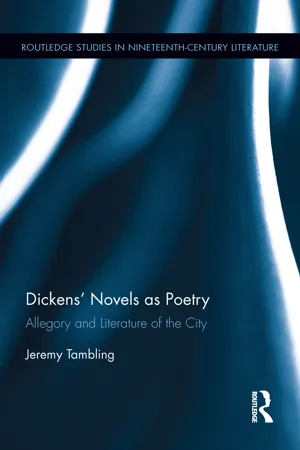
Focusing on the language, style, and poetry of Dickens' novels, this study breaks new ground in reading Dickens' novels as a unique form of poetry. Dickens' writing disallows the statement of single unambiguous truths and shows unconscious processes burrowing within language, disrupting received ideas and modes of living. Arguing that Dickens, within nineteenth-century modernity, sees language as always double, Tambling draws on a wide range of Victorian texts and current critical theory to explore Dickens' interest in literature and popular song, and what happens in jokes, in caricature, in word-play and punning, and in naming. Working from Dickens' earliest writings to the latest, deftly combining theory with close analysis of texts, the book examines Dickens' key novels, such as Pickwick Papers, Martin Chuzzlewit, Dombey and Son, Bleak House, Little Dorrit, Great Expectations, and Our Mutual Friend. It considers Dickens as constructing an urban poetry, alert to language coming from sources beyond the individual, and relating that to the dream-life of characters, who both can and cannot awake to fuller, different consciousness. Drawing on Walter Benjamin, Lacan, and Derrida, Tambling shows how Dickens writes a new and comic poetry of the city, and that the language constitutes an unconscious and secret autobiography. This volume takes Dickens scholarship in exciting new directions and will be of interest to all readers of nineteenth-century literary and cultural studies, and more widely, to all readers of literature.
- 238 pages
- English
- ePUB (mobile friendly)
- Available on iOS & Android
eBook - ePub
About this book
Information
Writing Styles: Romantic and Baroque
1 Dickens’ Reading
How did Dickens’ reading impact upon his poetic language? How does his reading appear in his writing? An old, patronising dismissal of the idea of Dickens as an intense reader, however partially remedied, still works, one source being Lewes’ hostile review of Forster’s Life of Dickens, cited earlier. When Lewes first met ‘Boz’ in 1837, he could only see on his bookshelves:
three-volume novels and books of travel, all obviously the presentation copies from authors and publishers, with none of the treasures of the bookstall, each of which has its history, and all giving the collection its individual physiognomy. A man’s library expresses much of his hidden life. I did not expect to find a bookworm, or even a student, in the marvellous ‘Boz’, but nevertheless, this collection of books was a shock.
(Lewes, 1971: 69–70)
Two years later, Lewes met Dickens again: ‘The well-known paper-boards of the three-volume novel no longer vulgarised the place; a goodly array of standard works, well-bound, showed a more respectable and conventional ambition, but there was no physiognomy in the collection. ... He remained completely outside philosophy, science and higher literature’ (Lewes, 1971: 70).
Yet Dickens was changing rapidly.1 He met Wordsworth in 1839 (Letters 1.639), and could have supplemented his knowledge of him, as of Crabbe, from Lord Jeffrey, editor of the Edinburgh Review (1803–1829), whom he knew after 1841, and from T.N. Talfourd. He met Carlyle (1795–1881) in 1840. He could have known Peacock, who submitted ‘Recollections of Childhood’ to Bentley’s Miscellany in 1837 (Letters 1.224n). After 1839, he knew Crabb Robinson; he knew Monckton Milnes – both, incidentally, aware of Blake (Wilkinson published an edition of Blake’s Songs in 1839). Milnes authored the first Keats biography in 1847. He read Cobbett; he took much from De Quincey. His speeches showed plentiful awareness of Hazlitt, who completed the Memoirs of Thomas Holcroft (1745–1809) (Speeches 75, 89; Letters 4.653). Lewes, with his awareness of the Germans, ‘widely criticised his contemporaries for their lack of culture, their provincialism’ (Greenhut, 1948: 136). He objected to spontaneous combustion in Bleak House, in a commitment to scientific realism whose best development was George Eliot but which was opposite to Dickens’ mode of writing (Bodenheimer, 2007: 3–14). Hence Dickens’ Bleak House Preface invoking ‘the romantic side of familiar things’ shows Hawthorne’s influence. Forster records Dickens’ critique of The Scarlet Letter (1850), following his liking Mosses from an Old Manse and other Hawthorne stories. The Scarlet Letter ‘falls off sadly after that fine opening scene. The psychological part of the story is very much overdone, and not truly done, I think’. This is an early use of ‘psychological’ and suggestive for Dickens’ interests. Hawthorne opens The House of the Seven Gables (1851) saying that if a writer calls his work a Romance:
it need hardly be observed that he wishes to claim a certain latitude, both as to its fashion and material, which he would not have felt himself entitled to assume, had he professed to be writing a Novel. The latter form of composition is presumed to aim at a very minute fidelity, not merely to the possible, but to the probable and ordinary course of man’s experience. The former – while as a work of art, it must rigidly subject itself to laws, and while it sins unpardonably, so far as it may swerve aside from the truth of the human heart – has fairly a right to present that truth under circumstances, to a great extent, of the writer’s own choosing or creation.
(Hawthorne, 1991: 1)
‘Romance’ associates with Hawthorne’s interest in allegory. If a familiar is a ghost or the Devil (in Hard Times, Tom ‘sat down on a terrace-parapet, plucking buds and picking them to pieces; while his powerful Familiar [James Harthouse] stood over him’. HT 2.7.203), Dickens writes on the romantic side of diabolism, the hidden topic of American literature, as noted by Melville and Lawrence. Dickens’ reading in American literature must include Washington Irving for The Sketch-Book (Letters 2.267–269), Dana (see Letters 2.38–39n), and Poe (Letters 3.106–107 and 3.384–385). Though Poe was not published in an English edition until 1852, it seems Dickens knew his work well.
Dickens’ writing is less imagination than vision, less like Coleridge or Wordsworth than Blake, whom Lewes mentions for comparison, saying that Dickens had told him:
that every word said by his characters was distinctly heard by him; I was at first not a little puzzled to account for the fact that he could hear language so utterly unlike the language of real feeling, and not be aware of its preposterousness; but the surprise vanished when I thought of the phenomena of hallucination.
(Lewes, 1971: 66)
Lewes is sure of what is ‘real’ and how Dickens lays claim to more reality; when ‘I sit down to my book, some beneficient power shows it all to me, and tempts me to be interested, and I don’t invent it – really do not – but see it, and write it down’ (Letters 2.411 and note). In Part IV, I will consider hallucinatory thinking; here I concede to Lewes, limitations in Dickens, which are those of English ideology, the insularity which Lewes, like George Eliot, challenged: a non-European formation which placed profound obstacles against understanding nationalism or imperialism, class, revolution, or gender, or art, or even the city. But he took much from what was available to him, as a check from the cultural and urban references in a very early text shows: ‘The Boarding House’ (1834, then in Sketches by Boz). Here Mr Tibbs is called the ‘wandering Jew of Joe Millerism’, the second of these allusions referring to a wit (1684–1738) whose name was used for a popular collection called Joe Miller’s Jests (1739). Mr Septimus Hicks reads Don Juan and nothing else, and he quotes the text liberally, as the classic of Regency literature. Dickens’ antipathy to the Byron of Childe Harold (Letters 2.154), as opposed to Don Juan, follows Carlyle (Sartor Resartus, Book 11 Chapter 9). Mr Simpson’s dress is compared to ‘the distinguished unknown who condescends to play the “swell” in the pantomime at “Richardson’s Show”’, the ‘swell’ being a Regency literary and theatrical type, and his hair is likened to that ‘surmounting the waxen images in Bartellot’s window in Regent Street’, which evokes new commodity-culture. Mr Carlton says that ‘Tom Moore is my poet’, with reference to ‘The Fire Worshippers’ and ‘Paradise and the Peri’ (Lalla Rookh). Dickens’ novels make over thirty allusions to Thomas Moore (1779–1852), friend of Byron and writer of love songs (Letters 3.506, note). Lord Chesterfield’s Letters are mentioned, as are Punch, Hamlet, and Hogarth. There is satire of the classical address spoken at the installation of the Duke of Wellington as Chancellor at Oxford (January 1834). Mr Tibbs is a ‘journeyman Giovanni’, a nice assonance. Mr O’Bleary’s ‘appearance reminded one of Orson’. One of the boarders, the aristocratic Mr Wisbottle, whistles ‘The Light Guitar’, a song by H.S. Van Dyke, composed by John Barnett, and then ‘Di piacer’ from Rossini’s The Thieving Magpie. He is opposed by a radical, nicely named Mr Evenson, who talks about demand and supply. Tibbs eats watercress like a Nebuchadnezzar. Tomkins is a connoisseur of paintings and shows off his ‘wonderful eye for the picturesque’ which he employs in relation to the urban scene: ‘Do you see how splendidly the light falls upon the left side of that broken chimney pot at no. 48?’ He plans a ride to Richmond and a return by steamer to observe the light and shade on the Thames, the play of blue and yellow. This makes Wisbottle hum ‘Flow on, thou shining river’ from Moore’s National Airs (1815) where, Michael Slater says, it is called ‘Portuguese Air’, set to music as a duet by Sir J.A. Stevenson (J1 563). O’Bleary, who constantly alludes to Dublin, tries reading Horace and has been to Vauxhall Gardens; a spectacle of the Polar Regions by the Arctic explorer Sir John Ross (1777–1856) is on view there. Mrs Tibbs at night is like ‘the ghost of Queen Anne in the tent scene in Richard’.
Such references indicate urban awareness. The specific area of the Tibbs’ house is Great Coram Street, ‘in that partially explored tract of country which lies between the British Museum and Somers Town’. Mr Tibbs recollects doing army exercises in 1806 ‘on the ground where the London University now stands’ and the new St Pancras church is mentioned, as is Newington Butts and Walworth. Mrs Bloss lodges in the next room to Mr Gobler, and her comment on this is ‘how very promiscuous’, her favourite malapropism, one responding to the urban environment where things are mixed up together indisciminately and all happen by chance. The word had, however, gained its sexual sense by 1804, according to OED, so making the use of it more difficult to discriminate as the city is the place to mix up meanings. In Pickwick Papers, promiscuity gets mixed up with permission and becomes the Joycean ‘permiscuous’ (PP 33.457).
‘The Boarding House’ reflects an intense knowledge of ‘high’ culture; its allusions are surprisingly many and literary, requiring much from the reader, as with the unexplained malapropism of ‘a shocking unitarian’ for ‘valetudinarian’ (J1 290).2 But the cultural referencing is inseparable in quality from the class values being maintained, from the maintenance of petit bourgeois standards. This is a place where a couple runs the business and young ladies may be expected to stay, which makes the difference from Balzac’s otherwise comparable Maison Vauquer in Père Goriot (1835). There is the sense of an intensely known and shared urban and popular culture, inseparable from the literary references which rise out of it and are not imposed on it. That appears in the allusions to the picturesque, which are not simply ironic; to Vauxhall; to Gobler ‘bursting out of the back drawing room, like the dragon at Astley’s – only without the portable gas in his countenance’ (SB 359), one of several theatrical references.
Dickens’ literary references are often half-concealed. Pip calls the Avenger (his servant) the ‘monster’ he has made (GE 2.8.218), and in comparing himself to ‘the imaginary student pursued by the misshapen creature he had impiously made’ (GE 3.1.339), he neither names the student as Frankenstein, nor explains the references, nor openly connects them. Yet the allusion prompts readings; Magwitch, returning, is an avenger – for Pip, unconsciously, and on Compeyson (who also made Magwitch). If Pip’s imagination creates Magwitch as a monster at this moment in the text, Magwitch is also a Frankenstein who has created Pip. Mary Shelley’s Frankenstein (1818) would have been topical for Pip; Great Expectations takes place during the years when it appeared. Yet Dickens leaves readers to make what they can from the casual reference. And perhaps the Avenger suggests Caleb Williams (Letters 3.107, note). Forster notes of Dickens’ seaside residences of the late 1840s and early 1850s that there ‘his reading was considerable and very various at such intervals of labour’ including, one year, Voltaire, Paul de Kock, Ruskin’s Lamps of Architecture (published 1849), ‘and a surprising number of books of African and other travel for which he had insatiable relish; but there was never much notice of his reading in his letters’ (Life 2.57).
Bleak House evokes Romantic poets. Mr Boythorn is Landor, who compared Dickens and Shakespeare almost from the beginning. Leigh Hunt (Mr Skimpole) and Samuel Rogers (1763–1865), dedicatee of The Old Curiosity Shop and perhaps inspiration for Smallweed, also appear.3 Moore comes in Bleak House, first when, as a delaying tactic when Ada is about to go to bed, ‘Mr Skimpole went to the piano, and rattled, hilariously, that the best of all ways to lengthen our days, was to steal a few hours from Night, my dear!’ (BH 6.99). Skimpole is singing, and sending up, ‘The Young May Moon’ from Irish Melodies. Moore reappears perhaps for Skimpole’s reference to ‘a sort of Young Love among the thorns’ (BH 15.253), part of an improbable description of Gridley, and again when Mr Bucket says that Bleak House ‘puts a man in mind of the country house in the Woodpecker-tapping, that was known by the smoke which so gracefully curled’ (BH 57.874). Again the context is Skimpole. Bucket also sings, to the Bagnets and Mr George, before arresting the latter, ‘Believe me if all those endearing young charms’, from Irish Melodies. This was ‘his most powerful ally in moving the heart of Mrs Bucket, when a maiden, and inducing her to approach the altar’ (BH 49.763). His diction has become Moore-like. The police and Skimpole share the same sentimentality; Skimpole sings ‘The Peasant Boy’, a ballad by the Welsh composer John Parry (1776–1851) (BH 31.497).
And what of Dickens’ relationship to Wordsworth, most hegemonic of Romantic poets? In A Christmas Carol’s party scene:
there were more children there, than Scrooge in his agitated state of mind could count, and, unlike the celebrated herd in the poem, they were not forty children conducting themselves like one, but every child was conducting himself like forty.
(CB1.81)
Wordsworth’s ‘Written in March’ is wittily inverted, since pastoral becomes a Christmas party, and what in Wordsworth is solitary becomes social, turning unity into multiplicity, riot, and a casual pluralising of identities. Forster shows Dickens’ distance from Wordsworth when speaking of his enjoyment of the landscape around Lausanne: ‘Dickens had little love for Wordsworth, but he was himself an example of the truth the great poet never tired of enforcing, that Nature has subtle helps for all who are admitted to become free of her wonders and mysteries’ (Life 2.418). But Dickens found Wordsworth’s ‘We are Seven’ ‘one of the most striking examples of his genius’ (Letters 3.57, note; Letters, 1.610, 2.129, 3.211). What did he like? The representation of the child? The verse’s simplicity? The sense of overcoming death? The trick whereby no counting system seems complete, and adult and child cannot agree on a number, even seven? Such counting games mark Dickens.
Wordsworth’s ‘Intimations’ Ode is parodied in Dombey and Son when Mrs Skewton hears music, ‘so much heart [a loaded word in this novel] in it – undeveloped recollections of a previous state of existence – and all that – which is so truly charming’ (DS 21.370). If Mrs Skewton satirises Wordsworth, so does the citation of ‘On the Projected Kendal and Windermere Railway’ in ‘not a rood of English ground’, commenting on how Staggs’s Gardens has been cut up ‘root and branch’ (DS 15.290). Wordsworth is evoked for ‘Our School’ (18 October 1851), which draws on Dombey and Son and on the Creakle sections of David Copperfield, ‘So fades and languishes, grows dim and dies/All that this world is proud of’ (The Excursion 7.976, 978; J3 42). The writer of Grasmere and Rydal Mount has been carried over into a London context, and the poetic insights are changed, for constructing a railway in Kendal and Windermere is not the same as starting one in London, where it replaces pre-existent urban squalor.
If Childe Harold takes David Copperfield to the Alps, Wordsworth keeps him there: The Prelude appeared the year that David Copperfield was completed (1850). And the young Copperfield had Wordsworth-like memories when at the Blue Bull or the Blue Boar, saying: ‘I sat looking at the parcels, packages and books, and inhaling the smell of stables (ever since associated with that morning). ...’ (DC 5.83). This is the vocabulary of eighteenth-century ‘associationism’, with an added urbanism; similarly, aloes outside Dr Strong’s school ‘(looking as if they were made of painted tin) have, ever since, by association, been symbolical to me of silence and retirement’ (DC 16.237). Hints of sentimental idealism are modified by the strangeness of the tin image; Copperfield misses out the more usual association of aloes with bitterness. Dr Strong’s lustreless eye reminds Copperfield of ‘a long forgotten blind old horse’ in Blunderstone graveyard (DC 16.236), so awakening a past in Copperfield which was not recorded in its place. The text seems aware that the narrative as given cannot contain everything Copperfield experiences. That association of ideas is antithetical to the Lockean associationism instilled into the young Gradgrinds, ‘coursed, like little hares’ into a sense of the mind’s passivity: ‘The first object with which they had an association, or of which they had a remembrance, was a large blackboard with a dry ogre chalking ghastly white figures on it’ (HT 1.3.53–4). They are like skeletons or the dance of death (OED figure sb.16: a dance), and the image puts the idea of the tabula rasa into quite...
Table of contents
- Cover Page
- Half Title page
- Series
- Title Page
- Copyright Page
- Contents
- Notes on Texts
- Acknowledgements
- Introduction
- Part I Writing Styles: Romantic and Baroque
- 1 Dickens' Reading
- 2 Dickens, Hogarth, And Caricature
- 3 The Old Curiosity Shop
- Part II Poetry and the City
- 4 Pickwick Papers: Jingle and Weller
- 5 ‘Bragian Words': Martin Chuzzlewit
- 6 Stopping Growing: Dombey and Son
- Part III Opening Words
- 7 Naming: Dombey and Son to Bleak House
- 8 ‘The Insistence of the Letter': Bleak House
- 9 Staring in Little Dorrit
- 10 Novels of the 1860s
- Part IV Dickens and the Poetry of Dreams
- 11 The Mask
- 12 The ‘Waking Dream': Oliver Twist
- 13 The Tempest in David Copperfield
- 14 ‘Scattered Consciousness': The Mystery of Edwin Drood
- References
- Index
Trusted by 375,005 students
Access to over 1.5 million titles for a fair monthly price.
Study more efficiently using our study tools.
Frequently asked questions
Yes, you can cancel anytime from the Subscription tab in your account settings on the Perlego website. Your subscription will stay active until the end of your current billing period. Learn how to cancel your subscription
No, books cannot be downloaded as external files, such as PDFs, for use outside of Perlego. However, you can download books within the Perlego app for offline reading on mobile or tablet. Learn how to download books offline
Perlego offers two plans: Essential and Complete
- Essential is ideal for learners and professionals who enjoy exploring a wide range of subjects. Access the Essential Library with 800,000+ trusted titles and best-sellers across business, personal growth, and the humanities. Includes unlimited reading time and Standard Read Aloud voice.
- Complete: Perfect for advanced learners and researchers needing full, unrestricted access. Unlock 1.5M+ books across hundreds of subjects, including academic and specialized titles. The Complete Plan also includes advanced features like Premium Read Aloud and Research Assistant.
We are an online textbook subscription service, where you can get access to an entire online library for less than the price of a single book per month. With over 1.5 million books across 990+ topics, we’ve got you covered! Learn about our mission
Look out for the read-aloud symbol on your next book to see if you can listen to it. The read-aloud tool reads text aloud for you, highlighting the text as it is being read. You can pause it, speed it up and slow it down. Learn more about Read Aloud
Yes! You can use the Perlego app on both iOS and Android devices to read anytime, anywhere — even offline. Perfect for commutes or when you’re on the go.
Please note we cannot support devices running on iOS 13 and Android 7 or earlier. Learn more about using the app
Please note we cannot support devices running on iOS 13 and Android 7 or earlier. Learn more about using the app
Yes, you can access Dickens' Novels as Poetry by Jeremy Tambling in PDF and/or ePUB format, as well as other popular books in Literature & English Literary Criticism. We have over 1.5 million books available in our catalogue for you to explore.