This well researched book provides an interesting study of the development of fever hospitals and fever nursing, mainly in nineteenth and twentieth century Britain. It provides new insights into the development of nursing roles and nurse education and looks at the lives of key figures at that time.
The text examines how this once important branch of the nursing profession emerged in the nineteenth century, only to be discarded in the second half of the following century. Drawing on the work of Goffman and Foucault, the study shows how, aided by medical advances, fever nurses transformed their custodial duties into a therapeutic role and how training schemes were implemented to improve the recruitment and retention of nurses. As standards of living improved and patient's chances of recovery increased, many fever hospitals became redundant and fever nurses were no longer required. The wisdom of creating fever hospitals and then disbanding them is questioned in the light of changing disease patterns, international travel and the threat posed by biological warfare.
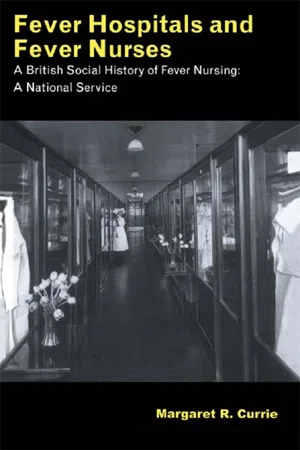
eBook - ePub
Fever Hospitals and Fever Nurses
A British Social History of Fever Nurses: A National Service
- 242 pages
- English
- ePUB (mobile friendly)
- Available on iOS & Android
eBook - ePub
Fever Hospitals and Fever Nurses
A British Social History of Fever Nurses: A National Service
About this book
Information
1 Introduction
The zymotic [infectious] diseases replace each other; and when one is rooted out is apt to be replaced by others which can ravage the human race indifferently wherever the conditions of healthy life are wanting. They have this property in common with weeds and other forms of life; as one species recedes, another advances. By improving the hygienic conditions in which men live, you fortify them against infection; and further, by isolating the infected, the chances of attack are diminished.William Farr (1872)1
The warlike metaphors in the above quotation epitomise and emphasise the fear which accompanied epidemics of infectious disease in nineteenth-century Britain. The increasing importance of a sanitary environment to individuals, and isolation measures to protect Victorian society, were fundamental to the nation’s health and efficiency. Those most intimately involved with the isolation of patients in hospitals were fever nurses. Fever nursing now seems a particularly quaint term, its one-time importance almost forgotten, its history inextricably bound together with fever hospitals; both evolved slowly over two centuries and yet, by the 1970s, both had virtually disappeared.2 However, this study continues beyond then, due to international concern about bioterrorism in relation to the possible wilful dissemination of the smallpox virus. It is necessary to include this issue, and how British society is coping with the challenges posed by different forms of fever, such as new viruses, drug-resistant organisms and new strains of old infectious diseases because, as William Farr observed in 1872, ‘as one species recedes, another advances’.3
General nursing and most specialist branches of nursing have been well documented, but fever nursing has, for some reason, been avoided; this book, therefore, essays to fill the gap. Two methodological tools were used in this book. Historical research was carried out using mainly primary sources, and empirical studies were undertaken using a descriptive case study approach. These methods enabled the collection of quantitative and qualitative data and helped to determine both the final content and the form in which the research was presented. They enabled the drawing together of apparently disparate elements into a cohesive study. It draws on archival sources, the work of contemporary scholars, medical, nurse and social historians, journals, books, newspapers, doctoral theses and web pages. Local examples are included, as they illustrate how central government measures were applied to local situations. The book mainly covers the nineteenth and twentieth centuries, except Chapter 4, which is specific to the period 1921–71. Chapter 5 begins in the eighteenth century, earlier than other chapters, while Chapter 8 continues into the twenty-first century. The establishment of fever hospitals and the development of fever nursing in Britain includes the whole of Ireland, despite partition in 1922. Although independence was gained by Southern Ireland then, it was still thought relevant to include what is now known as the Irish Republic. What happened in fever nursing in Ireland is important to understanding the development and decline of the specialism. The Introduction now continues with the concept and effects of fever, the locus of care and the development of the fever nurse’s role.
The concept and effects of fever
The word ‘fever’ derives from the Latin febris; its etymology is obscure and it was not in use until c. AD 1000. As late as 1933, the Oxford English Dictionary, defined it as ‘A morbid condition of the system, characterised by undue elevation of the temperature, and excessive change and destruction of the tissues’. It also noted that it was a generic term for a group of diseases with the above characteristics, each of which have distinctive names: ‘intermittent, puerperal, scarlet, typhoid, yellow, etc’. Although fever hospital/ nest/patient/ward are mentioned, the term ‘fever nurse’ does not appear. Nevertheless, it is reasonable to assume that those who cared for patients with fevers became known as fever nurses.
Fever is then, associated with heat, hence the Latin ferveo, I burn, and from Greek origins, pyrexia, also meaning fever. Both are broad general terms, until associated with a particular infectious disease; in many cases, the fever is only secondary to the diseased state of the body. Fevers have existed since classical times. Wherever, and whenever, they occurred, the community was affected personally, but also nationally, because catastrophic epidemics reduced population levels. Thomas Malthus (1766-1834), in his Essay on the Principle of Population (1798), deduced that the Black Death, or ‘Great Pestilence’ (plague) in 1348–49, resulted in a loss of 30–45 per cent of the population. He regarded ‘excesses of all kinds, the whole of train of common diseases and epidemics, wars, plague, and famine’ as ‘positive checks’ on population.4
Factors known to have increased the incidence of infectious diseases were the immigration of people to Britain, the movement of the population within the country and urbanisation, which did not occur in Ireland. In the census of 1851, it was found that more people lived in towns than in rural areas in England and Wales. The living conditions of the poor in Britain were, at that time, often appalling. Inadequate sanitation and overcrowded houses exacerbated the spread of infectious diseases such as cholera, typhoid, relapsing fever, typhus and smallpox, but they were not confined to the poor: they could affect anyone. By 1860, Florence Nightingale had recognised that epidemics in children originated in schools.5 Compulsory elementary education for children aged 5–10 years, introduced in England and Wales in 1880, intensified the problem, so that measles, scarlet fever, diphtheria and other conditions, such as ringworm, became even more widespread. Although most infectious diseases could be fatal and premature death was common, the classical infectious diseases, which mostly affected younger age groups, waned to such an extent over the twentieth century that, by 1988, they accounted for only 1 per cent of all deaths in Britain and in all developed societies.6 It had taken many years, however, to reach this stage, due to ignorance.
Theories of infection causation differed before the late-nineteenth-century bacteriological advances. Various terms were used and meanings shifted. In medieval times, doctors adopted the Hebrew ritual of making lepers outcasts; it then became customary for certain groups of patients, such as those with rashes, to be isolated.7 Because the causation of infection was so poorly understood, it was attributed to a number of causes. For instance, in 1641, the causes of pestilence were declared as:
1 Sin, which ought to be repented of
2 an infected and corrupted air, which should be avoided
3 an evill diet, which should be amended
4 evill humours heaped together in the body, being apt to putrifie, and beget a Fever, which must be taken away by convenient medicines.8
Due to the connotation of ‘sin’, infectious diseases were often regarded as divine retribution. Consequently, those affected were looked at askance, distanced and often stigmatised. Miasmas, the noxious vapours from organic matter, particularly human and animal waste, the wrong diet and the Galenic humours were also considered possible causes. Galen (AD 129-c.216) deduced that fever could result from an excess of yellow bile, black bile, phlegm or blood. Instead of the earlier Hippocratic treatment of fevers by starvation (feed a cold and starve a fever), Galen advocated energetic blood letting by venesection, to remove such excesses and restore humoral balance, not only when a fever was present, but also prophylactically.9 In 1963, Michel Foucault, drawing on Herman Boerhaave’s Aphorisms (1709), observed that the eighteenth-century concept of fever was not so much a sign of the disease, but resistance to it. Fever has, therefore, a salutary value, ‘an excretory movement, purifactory in intention’.10
Infectious diseases were clearly different, but most continued to be known generically as fever diseases until the mid-nineteenth century; for instance, it was not until 1855 that diphtheria and scarlet fever were recognised as different conditions.11 In the 1870s, some doctors were still using the term ‘typhus’ to describe all types of fever. To avoid confusion, the term ‘enteric’ was frequently employed from the mid-1870s, instead of typhoid, as it sounded so similar to typhus.12
Until the late nineteenth century, almost all epidemics were thought to arise through transmission from person to person, generated from, usually, filthy, local conditions. Notions of ‘contagion’ and ‘miasma’, of a more or less undefined kind, were combined with ‘stench’, commonly thought to be at the root of disease.13 The bacteriological revolution is usually credited with changing medical thought and the dawn of a new modern age. For instance, in 1864, Louis Pasteur (1822-96) announced his germ theory of disease, which finally disproved the idea of disease causation through spontaneous generation, given the right circumstances. Robert Koch (1843-1910) demonstrated the existence of specific disease-causing organisms: anthrax in 1876, the tubercle bacillus in 1882 and cholera in 1883. A combination of careful observation and new scientific techniques advanced medicine. Observation of living patients at the bedside had resulted in diagnosis of some infectious diseases earlier, because they had particular identities and characteristics; those of diphtheria were published in 1826, typhoid in 1837 and typhus in 1849,14 but they were not proved scientifically until later in the nineteenth century.
The pathological significance of heat in fevers may have been known since classical times, but little progress was made in calibrating body temperatures until the eighteenth century, when Gabriel Fahrenheit (1686-1736) developed an alcohol, then a mercury thermometer (1714), based on earlier models. His temperature scale ranged from a freezing point of 32° to 212°F boiling point. Despite the work of some continental scientists, there was little interest in the measurement of temperature until the mid-nineteenth century, when Carl Wunderlich (1815-77) published his manual of thermometry in 1868, The Temperature in Diseases, which was particularly useful in the differential diagnosis of fevers. Normal temperature (98.4°F) signified health and fluctuations indicated disease. Although the temperature had to be recorded at least twice daily, absolute accuracy was not essential: ‘nurses and even relatives could take temperatures’.15 However, as will be seen in Chapter 2, this was not necessarily wise in the mid-nineteenth century when nurses were drawn from the, often uneducated, servant class.16
Locus of care
During the nineteenth century, the term ‘fever hospital’ gradually evolved into ‘isolation hospital’, and in some cases a ‘hospital for infectious diseases’. In this book, these terms are used synonymously. Such nomenclature highlighted the disease aspect and, because of its associated stigma, hindered isolation. It was for this reason that Dr Thorne Thorne, Medical Officer to the Local Government Board (LGB), advocated in 1881 that hospital names referring to diseases should be avoided.17 Despite this advice, a confusing variety of names continued to be used for such institutions; smallpox hospitals, however, seldom had alternative names. As will be seen in Chapter 2, early fever hospitals were often hastily constructed temporary buildings, before necessity and legislation resulted in more permanent structures, particularly when workhouse fever wards could not cope in epidemics. Smallpox was different. The origins of institutions, specifically for this one disease, and the care that patients received is discussed in Chapter 5.
Hospitals in Britain were founded for different reasons. In some ways, the charitably endowed voluntary hospitals provided a model for municipal isolation hospitals, for example, in the medicalisation of care and the development of specialist roles for doctors and nurses. Before the Anatomy Act, 1832, acquisition of medical knowledge through dissection was strictly limited,18 but it could be gained from living bodies. This was one of the reasons many voluntary hospitals were established in the eighteenth century, followed by specialist and children’s hospitals, although their foundation also gave rein for the charitable impulse.19 In the eighteenth century, the submission of a body could be regarded as ‘docile’ if it was committed to a medical institution, in much the same way as to a military, educational or industrial establishment. It might then be ‘subjected, used, transformed and improved’.20 Thus, docility came to be regarded as a prerequisite of patients, who were expected to accept meekly whatever care was available.
Access to patients’ bo...
Table of contents
- Front Cover
- Fever Hospitals and Fever Nurses
- Dedication
- Title Page
- Copyright
- Contents
- List of illustrations
- Foreword
- Preface
- Acknowledgements
- Abbreviations and common terms
- 1 Introduction
- 2 Institutions and the evolution of nursing care
- 3 State registration to the decline of fever nursing
- 4 The reality of fever nursing, 1921–71
- 5 Smallpox nursing
- 6 Fever Nurse Cavell in the 1890s
- 7 Two influential fever nurses
- 8 The aftermath of fever and smallpox nursing
- 9 Conclusion
- Appendix 1 Notifiable diseases in England and Wales (with the date each was made notifiable under current or similar nomenclature)
- 2 The first Governing Body of the Fever Nurses’ Association, 1908
- 3 Advertisements for probationers for fever hospitals in England and Wales, 1919
- 4 Certificates
- Bibliography
- Index
Trusted by 375,005 students
Access to over 1.5 million titles for a fair monthly price.
Study more efficiently using our study tools.
Frequently asked questions
Yes, you can cancel anytime from the Subscription tab in your account settings on the Perlego website. Your subscription will stay active until the end of your current billing period. Learn how to cancel your subscription
No, books cannot be downloaded as external files, such as PDFs, for use outside of Perlego. However, you can download books within the Perlego app for offline reading on mobile or tablet. Learn how to download books offline
Perlego offers two plans: Essential and Complete
- Essential is ideal for learners and professionals who enjoy exploring a wide range of subjects. Access the Essential Library with 800,000+ trusted titles and best-sellers across business, personal growth, and the humanities. Includes unlimited reading time and Standard Read Aloud voice.
- Complete: Perfect for advanced learners and researchers needing full, unrestricted access. Unlock 1.5M+ books across hundreds of subjects, including academic and specialized titles. The Complete Plan also includes advanced features like Premium Read Aloud and Research Assistant.
We are an online textbook subscription service, where you can get access to an entire online library for less than the price of a single book per month. With over 1.5 million books across 990+ topics, we’ve got you covered! Learn about our mission
Look out for the read-aloud symbol on your next book to see if you can listen to it. The read-aloud tool reads text aloud for you, highlighting the text as it is being read. You can pause it, speed it up and slow it down. Learn more about Read Aloud
Yes! You can use the Perlego app on both iOS and Android devices to read anytime, anywhere — even offline. Perfect for commutes or when you’re on the go.
Please note we cannot support devices running on iOS 13 and Android 7 or earlier. Learn more about using the app
Please note we cannot support devices running on iOS 13 and Android 7 or earlier. Learn more about using the app
Yes, you can access Fever Hospitals and Fever Nurses by Margaret Currie in PDF and/or ePUB format, as well as other popular books in Medicine & Health Care Delivery. We have over 1.5 million books available in our catalogue for you to explore.