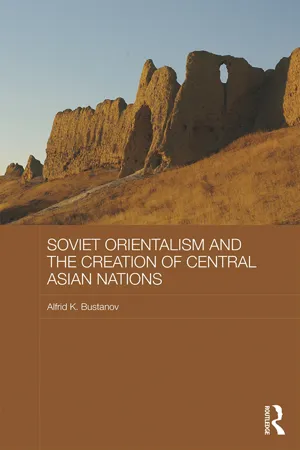
Orientalism – the idea that the standpoint of Western writers on the East greatly affected what they wrote about the East, the "Other" – applied also in Russia and the Soviet Union, where the study of the many exotic peoples incorporated into the Russian Empire, often in quite late imperial times, became a major academic industry, where, as in the West, the standpoint of writers greatly affected what they wrote. Russian/Soviet orientalism had a particularly important impact in Central Asia, where in early Soviet times new republics, later states, were created, often based on the distorted perceptions of scholars in St Petersburg and Moscow, and often cutting across previously existing political and cultural boundaries. The book explores how the Soviet orientalism academic industry influenced the creation of Central Asian nations. It discusses the content of oriental sources and discourses, considers the differences between scholars working in St Petersburg and Moscow and those working more locally in Central Asia, providing a rich picture of academic politics, and shows how academic cultural classification cemented political boundaries, often in unhelpful ways.
- 144 pages
- English
- ePUB (mobile friendly)
- Available on iOS & Android
eBook - ePub
Soviet Orientalism and the Creation of Central Asian Nations
About this book
Information
1
The Leningrad connection
Oriental projects of source editions
Classical Oriental studies and Soviet politics
With the establishment of the Asiatic Museum in St. Petersburg in 1818, a new center of Russian Oriental studies emerged. This center would become famous for its rich manuscript collection and its historical and philological studies of written sources. Even after the transfer of the academic Institute of Oriental Studies from Leningrad to Moscow in 1950, the center of manuscript studies remained in its former place as the Leningrad Branch of the Institute of Oriental Studies, which continued to be regarded as a school of classical, nonpolitical, philological Oriental studies. The perceived “nonpoliticization” of classical Orientalists is associated with the image of the Leningrad intelligentsia in general, which has been described as devoted to high ideals and values and not interested in politics. However, my argument is that since the 1917 Revolution, the Leningrad Orientalists found themselves in a situation in which involvement in politics became unavoidable.
I would like to analyze here several philological projects conducted mostly by Leningrad Orientalists in the 1930s–70s. These projects deservedly became a matter of pride for Soviet scholarship. Even though the source studies of Leningrad Orientalists remained remote from the most dogmatic ideology of the state and party, the publication projects in the field of Oriental studies were instigated and directed by political demand and were later used as the main sources for the official historical narratives, especially in the new Soviet meta-histories of the individual Soviet republics of Central Asia. As for the Leningrad source publications of the 1930s, after WWII they were taken as the basis for comprehensive republican histories meant to demonstrate continuity from ancient times to the mid-20th century.
Traditionally, scholars explain the allegedly nonpolitical image of the St. Petersburg/Leningrad school of Oriental studies through the obvious influence of German Orientology, which has been commonly understood as less connected to colonial politics than Oriental studies in Britain and France. Many prominent Russian Orientalists of the early 20th century were of German origin and represented the German model of textological Oriental studies,1 focused mainly on ancient texts.2
Toward the new scholarship: planning and collective work
Throughout the 1920s, the Soviet government paid serious attention to the foreign Orient as an object of exporting the Bolshevik Revolution.3 At that time, the government was already paying attention to the study of the Soviet Orient, but the civil war, the disorder of institutions, and the government’s difficult relations with the Tsarist intelligentsia made serious and large-scale investigation programs impossible. The Bolsheviks decided to intervene directly in scientific structures and management. They understood the power of institutions and of large-scale research organizations through which it would be possible to organize thorough and broad investigations. Unfortunately for the Bolsheviks, there were many scientific institutions from the Tsarist time in Leningrad, and these institutions had very few employees and could not solve the issues most pressing to the Bolsheviks. In response, the government tried to organize its own, parallel institutional network. The significance accorded to the Soviet Orient as a scientific topic of state priority resulted in the establishment of the Communist University of the Workers of the East (Kommunisticheskii universitet trudiashchikhsia Vostoka, KUTV) in Moscow in 1921.
The large scholarly institution that was to become a bridgehead for the Soviet system of scientific work was, however, the Academy of Sciences, the central organization in the development of Soviet Oriental studies. The Bolsheviks reconstructed and redirected this old institution. Its location in Leningrad made it difficult to control. In the Tsarist time, the Academy consisted of a tight circle of privileged intellectuals rather than a collective of scientific workers. In Soviet parlance, such an institution was regarded as a remnant of the bourgeois past. In the late 1920s, the government decided to undertake efforts to achieve the so-called Sovietization of the Academy.4 The Sovietization of the Academy of Sciences started in 1928 with the anti-Academic campaign in the newspaper Leningradskaia Pravda, in which the Academy was called a center for people of the Tsarist past.5
The authorities changed the social composition of its members and the way the work was organized. Soviet scholarship introduced a planned character (planirovanie) of academic research: every five years a given scientific institution received official orders (direktivy) from the Presidium of the Academy of Sciences that pointed out the crucial areas of research and gave general instructions for how to organize work. It was on 3 October 1930 that the general meeting of the Academy of Sciences accepted the system of five-year plans.6 In the same year, the Soviets also set up a number of new scientific Institutes that were to provide a new structure to the USSR Academy of Sciences as a whole, with the Presidium as its leading organ. Each Institute in the framework of the Academy included several thematically orientated subdivisions (groups, sectors). The introduction of planning had a long-lasting effect on Soviet scientific production. Scholars were given orders as to which scientific topics held importance for the state, because the Academy of Sciences was a state-sponsored institution and all its employees were on state service. Research tasks were to be fulfilled within a particular period of time, and the personal research interests of individual scholars were mainly ignored by the administrative management. The system of scientific plans forced generations of Orientalists to work in an established framework and to regularly publish papers on a given topic, leaving aside their own pursuits and agendas.
Already in 1930, the administration of the Institute of Oriental Studies, at that time led by academician Sergei F. Ol’denburg (1863–1934), was obliged to compile its first plan. Academician Ol’denburg was a renowned organizer of science in his position as permanent secretary of the Russian Academy of Sciences (1904– 1929) as well as director of the Asiatic Museum (1916–1930) and of its successor, the Institute of Oriental Studies (1930–1934).7 In the Archive of Orientalists in St. Petersburg, there are detailed documentations of each of the five-year plans (piatiletka) of the period 1930–1970, which describe research topics, the scholars attached to them, and the time schedules. The first document of this kind, prepared by the Presidium of the Academy of Sciences, goes back to the year 1930.
The instructions for drawing the first work plan of the Institute of Oriental Studies, produced in the Academy’s Presidium, contain an introduction and three paragraphs with headings on networks, scientific staff, and financial/material support of the projects. The introduction states the general scientific goals that mirrored the state’s demands: the first one was to connect scientific works with tasks of economic and cultural development and the second to centralize studies in order to “speed up the building of socialism.”8 The section on networks contained an order to set up a scientific plan that would cover the whole network of scientific institutions in Oriental studies from all over the Soviet Union. The projected work had to be coordinated with other institutions in order to avoid duplication; therefore, each institution should have a clear specialization. The authors of the document suggested the establishment of big scientific centers, which were to be provided with competent staff and material support. These centers were obliged to adapt their scientific production to the political demand. Such an adaptation is not surprising given that the Academy was directly subordinated to the Council of the People’s Commissars and had lost its former independence.9
On the basis of the previously mentioned document, administrators of the former Asiatic Museum (since 1930 the Institute of Oriental Studies) formulated The Work Plan of the Asiatic Museum in 1930–1934. The anonymous author (most probably the director of the Institute, Sergei Ol’denburg) formulated the general task of the Institute as follows: to collect, keep, and study Oriental books and manuscripts and European literature related to academic Oriental studies. At the same time, Orientalists had to work on the history, art, and literature of the Soviet Orient.10
The status of classical Orientology, however, remained ambiguous. In the early 1930s, the official press openly turned against the “old” philological Oriental studies.11 Due to the pressure inside and outside of the Academy of Sciences, many Orientalists decided to cooperate with the regime and fulfill the state requirements. While before 1917 some scholars dreamed that their research might gain more influence on the exercise of political power,12 the opposite occurred after the “Sovietization” of the Academy: scholarly work was put under close political control.
Beginning in the early 1930s, the study of the Soviet Orient was carried out in the framework of joint projects and large scholarly teams. Next to the imposition of planning, the collective form of Soviet Oriental studies united the forces of individual scholars in research groups and became one of the main features of its development. Already in 1933, Sergei F. Ol’denburg in close collaboration with his colleagues at the Institute projected the Institute’s second five-year plan, in which he argued for enlarging the academic staff of the Institute: “The scientific staff should be trained under the organizational leadership and with financial support of the Institute of Oriental Studies, but also of the national republics which are interested in scientific employees and can pay for that.”13 A strategic goal to establish local centers of scholarship is evident in the 1933 document: “An important place in the process of training the new staff should be given to the advanced training of national employees under the directorship of the Institute of Oriental Studies and through conferences, academic exchange trips for specific subjects, and through participation in joint projects.”14 This envisaged a close collaboration of the center of Orientology in Leningrad with local centers in the republics.
The system of scholarships (stazhirovka), conferences, and work groups was established already in 1930 and remained common practice until the end of the Soviet Union. These scholarships pressupposed the training of national scientific personnel under supervision of the Institute of Oriental Studies. Scholarships also ensured the collective character of academic work. The work groups in the five-year plan comprised a large number of scholars, which has to do with an attempt at social engineering in the management of Soviet scholarship. As Ol’denburg’s document explained, “science cannot be a privilege of a narrow circle of scholars; even an unprofessional employee deprived of an Oriental studies background can do some scientific work. For that reason it is necessary to work in collectives (brigady). The group work will help to share the experience and to support the participation of employees without professional education.”15 By suggesting the creation of heterogeneous academic collectives, the document proposed the solution of a social task: “to dilute” self-sufficient circles of scholars by including persons (“nonprofessionals”) from the proletariat and to avoid the “harmful” individualization of academic life. This system became very common for the Soviet Oriental projects: the self-organization of scholars in private circles (such as the circles for Altaic and Arabic studies in Leningrad16) was replaced by the concentration of specialists at official academic institutions.
The document of 1933 also highlights the main goal for the emergence of source-edition projects: “In the context of the new tasks [of Soviet scholarship], the work of sectors dealing with the Soviet Orient should be intensified. It is necessary to set up a Sector for the Soviet Orient.”17 This special sector in the Institute of Oriental Studies in Leningrad was organiz...
Table of contents
- Cover
- Title
- Copyright
- Contents
- Acknowledgments
- List of abbreviations
- Introduction
- 1 The Leningrad connection: Oriental projects of source editions
- 2 Nationalism and regionalism: dividing and integrating Soviet Central Asia in meta-histories
- 3 The establishment of Kazakh Orientology
- 4 General conclusion
- Index
Trusted by 375,005 students
Access to over 1.5 million titles for a fair monthly price.
Study more efficiently using our study tools.
Frequently asked questions
Yes, you can cancel anytime from the Subscription tab in your account settings on the Perlego website. Your subscription will stay active until the end of your current billing period. Learn how to cancel your subscription
No, books cannot be downloaded as external files, such as PDFs, for use outside of Perlego. However, you can download books within the Perlego app for offline reading on mobile or tablet. Learn how to download books offline
Perlego offers two plans: Essential and Complete
- Essential is ideal for learners and professionals who enjoy exploring a wide range of subjects. Access the Essential Library with 800,000+ trusted titles and best-sellers across business, personal growth, and the humanities. Includes unlimited reading time and Standard Read Aloud voice.
- Complete: Perfect for advanced learners and researchers needing full, unrestricted access. Unlock 1.5M+ books across hundreds of subjects, including academic and specialized titles. The Complete Plan also includes advanced features like Premium Read Aloud and Research Assistant.
We are an online textbook subscription service, where you can get access to an entire online library for less than the price of a single book per month. With over 1.5 million books across 990+ topics, we’ve got you covered! Learn about our mission
Look out for the read-aloud symbol on your next book to see if you can listen to it. The read-aloud tool reads text aloud for you, highlighting the text as it is being read. You can pause it, speed it up and slow it down. Learn more about Read Aloud
Yes! You can use the Perlego app on both iOS and Android devices to read anytime, anywhere — even offline. Perfect for commutes or when you’re on the go.
Please note we cannot support devices running on iOS 13 and Android 7 or earlier. Learn more about using the app
Please note we cannot support devices running on iOS 13 and Android 7 or earlier. Learn more about using the app
Yes, you can access Soviet Orientalism and the Creation of Central Asian Nations by Alfrid K. Bustanov in PDF and/or ePUB format, as well as other popular books in Social Sciences & Ethnic Studies. We have over 1.5 million books available in our catalogue for you to explore.