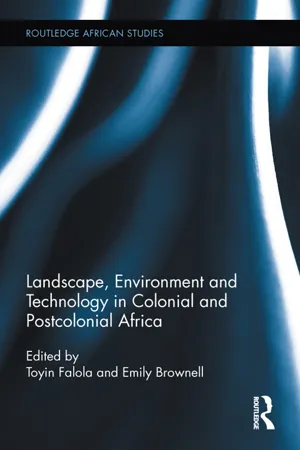
This volume seeks to identify and examine two categories of colonial and postcolonial knowledge production about Africa. These two broad categories are "environment" and "landscape," and both are useful and problematic to explore. Discussions about African environments often concentrate on Africans as perpetrators of their own land, causing degradation from lack of knowledge and technology. "Landscape" defines the category of knowledge produced by foreigners about Africa, where Africans remain part of the scenery and yield no agency over their surroundings. To flesh out these categories and explore their creation and how they have been deployed to shape colonial and postcolonial discourses on Africa, this volume investigates the "technological pastoral," the points of convergence and conflict between Western notions of pastoral Africa and the introduction of colonial technology, scientific ideas and commodification of land and animals.
eBook - ePub
Landscape, Environment and Technology in Colonial and Postcolonial Africa
- 342 pages
- English
- ePUB (mobile friendly)
- Available on iOS & Android
eBook - ePub
Landscape, Environment and Technology in Colonial and Postcolonial Africa
Part I
Commodifying Nature and Constructing Landscapes
1 Chimpanzees in the Colonial Maelstrom
Struggles over Knowledge, Race and Commodities in the Gabonese Primate Trade, c. 1850–1940
Apes and monkeys are central elements in constructions of central Africa in the Western imagination. From Paul Du Chaillu’s tales of gorilla ram-pages in the mid-nineteenth century to the monkeys and apes displayed on the July and August 2008 covers of National Geographic, these animals have become objects of Western knowledge and pleasure. Tamara Giles-Vernick and Stephanie Rupp have forcefully noted how stories of these animals in equatorial African communities articulate “claims about control over human productive and reproductive labor; access to forest resources, spaces, and wealth; racial and ethnic relations; and the boundary between life and death.”1 Debates over land rights and conservation agencies often hinge on presentations of apes and monkeys as symbols of nature in need of protection. Like many other stories of animals in colonized settings, the genealogy of attitudes towards monkeys and apes within Europeans and African communities alike has long remained obscure.
Over the course of the nineteenth and early twentieth centuries, gorillas, chimpanzees and other monkeys also constituted merchandise to be sold to European and American buyers. The growth of zoos in the Americas and Europe created a market for these creatures. William Hornaday, head of the Bronx Zoo in the early twentieth century, expressed a common opinion in 1915: “Undoubtedly the highest desire of every zoological garden and park, and of every showman, is to own and exhibit a real live gorilla of a size sufficiently large to compel both admiration and awe.”2 Live animals were more prized, but very few survived the long trip by sea to transatlantic destinations.3 A small group of enterprising foreigners traded with Gabonese communities for live and dead primates. Whereas this trade apparently never became a mainstay of the Gabonese economy, it remained legal to hunt and sell primates until French authorities banned their sale in 1936.
Primates were not merely sold abroad. European and American settlers kept chimpanzees and gorillas as pets. European and American domestication of primates also fit with historian Kathleen Kete’s views: “Is not pet keeping, then, another way to hide from ourselves the real violence between humans and animals beneath an image of sensibility, or even as a means to deflect us from awareness of the violence between ourselves and others in an age of class conflict and global domination?”4 Foreign residents of Gabon employed primates as a means of representing themselves as kind parents, while disparaging the humanity of Africans.
Whether primates were kept as pets or exported abroad, their purchase brought together Westerners with Gabonese people. European writers and colonial officials created names for ethnic communities in the late nineteenth century that eventually replaced the range of local terms based on clan identity.5 The same phenomenon occurred as North American and European settlers renamed the fauna and geography of Gabon. However, collectors seeking out chimpanzees and gorillas needed Gabonese sources to find these animals. Whereas historians have treated the social backgrounds of European and American suppliers of animals to zoos, they rarely have examined the activities of primate collectors in colonial settings.6 This commerce thus gave Gabonese hunters and traders a fair amount of leverage in their dealings with American and European buyers. Furthermore, the ability of Gabonese people to profit from this trade changed with broader economic and political changes. The establishment of concessionary companies and the strengthened hold of the French government over rural Gabon from the 1890s to the 1930s increased the advantages of European buyers over African vendors.
Sources about the primate trade generally come from scattered travel accounts. Neither colonial administrators nor missionaries wrote much about apes. Most available accounts are not written in French, although French zoo archives may contain information as well. Instead, evidence on primate trading comes from the work of figures largely ignored in the historiography of colonial Gabon. The major exception to this neglect remains Paul Du Chaillu. The controversy surrounding his accounts of gorillas in the 1850s and 1860s inspired other travelers and settlers to write about and obtain Gabonese gorillas and chimpanzees.7 However, Englishmen like Richard Burton also wrote about the primate trade in their visits to Gabon in the 1860s. Sources in German, to date entirely ignored in Gabonese history, provide crucial evidence on changes in primate trading. American Richard Lynch Garner’s writings between 1893 and 1919 constitute the most detailed sets of narratives regarding the primate trade before French officials began to regulate it after World War I. Admittedly, such sources are shaped by the prejudices of their authors towards Africans. They do not allow for even a rough estimation of the volume of primates exported and killed in Gabon. However, they indicate the motivations and strategies of Gabonese men seeking to profit from the new demand for primates. These sources show how the encroachment of the colonial state limited the ability of Gabonese people to control the terms of the primate trade.
The examination of primate ownership in Gabon also furnishes new material on changing ideas about pets in the nineteenth and twentieth centuries. Harriet Ritvo, Kathleen Kete and Katherine Greer have all noted how middle-class families in Western Europe and North America in the late nineteenth century considered the treatment of pets to be a sign of refined emotional sensibility.8 A few foreign owners of gorillas and chimpanzees sometimes claimed their kind treatment of primate pets to show how they were more caring than Africans. However, most owners preferred to mock how their animals could only imperfectly copy human behavior, just as they derided coastal Africans for failing to successfully copy European dress and language. Only in the 1920s did Europeans like hunter Georges Trial and Albert Schweitzer assert the kindness and loving nature of these animals, who they argued needed protection from cruel European and African hunters. Such trends also coincide with paternal attitudes towards Gabonese people in the 1920s onward as people in need of missionary and state supervision.
This chapter considers the rise and fall of the primate trade. By the 1860s, gorillas and chimpanzees had become commodities. Gabonese people employed the same strategies in trading primates as they did in selling rubber or ivory. African traders offered primate hunting opportunities as to Americans and Europeans as a means of establishing more durable commercial alliances. Such acts of hospitality fit with other practices of hosting Europeans that developed in the slave trade. American and European buyers often used the acquisition and domestication of primates as a means of critiquing African sensibilities and understandings of family life. When colonial officials set up concessionary companies in the late 1890s, Gabonese people began to lose their ability to freely trade animals. In the 1920s and 1930s, the colonial government implemented laws to limit primate hunting. Also, a new sense of bourgeois domesticity and paternal love for animals developed among European settlers in Gabon between the wars. By constructing chimpanzees and gorillas as innocent and caring creatures in need of benevolent protection, they sought to correct the excesses of colonialism. Europeans could obtain gun and hunting permits thanks to their privileged place in the colonial order. Most Gabonese people lacked the money to pay for government licenses, and turned to European hunters to defend their fields from gorillas.
PRIMATES AS COMMODITIES IN GABON, 1851–1914
Gabon slowly became an exporter of chimpanzees and gorillas after 1840? French naval officers forced Omyènè-speaking Mpongwe clans in Libreville to accept colonial occupation by 1845. French administrators gradually defeated other Omyènè groups such as the Orungu monarchy on the mouth of the Ogooué River and the Nkomi kingdom on the Fernan Vaz lagoon, who remained independent until the 1870s and 1890s, respectively.9 Further inland, big men from a wide variety of different linguistic backgrounds struggled for access to foreign trade and slaves. Fighting between rival clans and the intermittent efforts of French officials to force clans to submit to French rule made Gabon a very violent place.10 French officials only slowly managed to force their leaders to accept European rule from the 1880s to World War I. Even as colonial administrators struggled, commerce in ivory and rubber flourished as English and German traders slowly entered the interior of Gabon.
The connection between slavery, ivory trading and hunting rights emerged in Thomas Savage’s account of how he received a gorilla skull in 1846 from John Leighton Wilson, a Presbyterian minister stationed in Libreville. Wilson informed Savage that a slave hunter owned by a Mpongwe master had shot a gorilla while searching for elephants. Savage reported, “This act, unheard of before, was considered almost superhuman. This man’s freedom was immediately granted to him, and his name proclaimed abroad as the king of hunters.”11 Wilson managed to purchase the skull, after the hunter brought the corpse of the animal to Libreville to show off his achievement. The animal attracted attention for its novelty, rather than for its potential financial value. But only a decade later, gorillas and chimpanzees had become targets of hunters seeking merchandise.
The travel accounts of Paul Du Chaillu and a series of Englishmen like Richard Burton and Winwood Reade in the 1850s and 1860s show the willingness of Gabonese entrepreneurs to trade in primates. In 1856 and 1857, Du Chaillu tried with little success to shoot gorillas in modern Equatorial Guinea and Gabon. He passed through territories controlled by Fang-, Akélé-, Séké-, Omyènè- and Gisir-speaking clans.12 Men from these disparate communities never expressed any surprise that Du Chaillu wished to hunt, even when no other Europeans or Americans had ever passed through their villages. Likewise, English writers Richard Burton, H. A. Leveson and Winwood Reade passed through Fang, Nkomi and Séké territories with no opposition.13
The valuable trade goods which Du Chaillu paid porters and guides offers a possible explanation, especially amongst inland communities who had to pay high prices for imported merchandise that passed from European traders through coastal Omyènè middlemen. Village leaders and other entrepreneurs also could offer hunting expertise to help establish commercial alliances. Male chiefs and traders in coastal Gabonese Omyènè clans had long offered foreign guests a range of amenities, from wine served with European-style meals to female sexual partners.14 It is likely that Spanish, Sao Tomean, and Brazilian slave dealers who spent months living in Gabones...
Table of contents
- Cover
- Halftitle
- Title
- Copyright
- Contents
- List of Figures
- List of Tables
- Introduction: Landscapes, Environments and Technology—Looking Out, Looking Back
- PART I. Commodifying Nature and Constructing Landscapes
- PART II. Colonized Environments: Domestication, Medicine and Technology
- PART III. Cultivation and Conservation: Contested Theory and Practice in Colonial Encounters
- PART IV. Postcolonial African Landscapes: Locating Africa in the Global Environmental Crisis
- Contributors
- Index
Trusted by 375,005 students
Access to over 1.5 million titles for a fair monthly price.
Study more efficiently using our study tools.
Frequently asked questions
Yes, you can cancel anytime from the Subscription tab in your account settings on the Perlego website. Your subscription will stay active until the end of your current billing period. Learn how to cancel your subscription
No, books cannot be downloaded as external files, such as PDFs, for use outside of Perlego. However, you can download books within the Perlego app for offline reading on mobile or tablet. Learn how to download books offline
Perlego offers two plans: Essential and Complete
- Essential is ideal for learners and professionals who enjoy exploring a wide range of subjects. Access the Essential Library with 800,000+ trusted titles and best-sellers across business, personal growth, and the humanities. Includes unlimited reading time and Standard Read Aloud voice.
- Complete: Perfect for advanced learners and researchers needing full, unrestricted access. Unlock 1.5M+ books across hundreds of subjects, including academic and specialized titles. The Complete Plan also includes advanced features like Premium Read Aloud and Research Assistant.
We are an online textbook subscription service, where you can get access to an entire online library for less than the price of a single book per month. With over 1.5 million books across 990+ topics, we’ve got you covered! Learn about our mission
Look out for the read-aloud symbol on your next book to see if you can listen to it. The read-aloud tool reads text aloud for you, highlighting the text as it is being read. You can pause it, speed it up and slow it down. Learn more about Read Aloud
Yes! You can use the Perlego app on both iOS and Android devices to read anytime, anywhere — even offline. Perfect for commutes or when you’re on the go.
Please note we cannot support devices running on iOS 13 and Android 7 or earlier. Learn more about using the app
Please note we cannot support devices running on iOS 13 and Android 7 or earlier. Learn more about using the app
Yes, you can access Landscape, Environment and Technology in Colonial and Postcolonial Africa by Toyin Falola,Emily Brownell in PDF and/or ePUB format, as well as other popular books in History & African History. We have over 1.5 million books available in our catalogue for you to explore.