The San Francisco System and Its Legacies
Continuation, Transformation and Historical Reconciliation in the Asia-Pacific
- 290 pages
- English
- ePUB (mobile friendly)
- Available on iOS & Android
The San Francisco System and Its Legacies
Continuation, Transformation and Historical Reconciliation in the Asia-Pacific
About this book
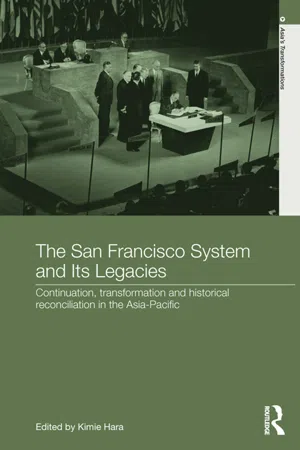
In September 1951, Japan signed a peace treaty with forty-eight countries in San Francisco; in April 1952, the treaty came into effect. The San Francisco Peace Treaty is an international agreement that in significant ways shaped the postâWorld War II international order in the Asia-Pacific. With its associated security arrangements, it laid the foundation for the regional structure of Cold War confrontation: the "San Francisco System" fully reflected the strategic interests and policy priorities of the peace conference's host nation, the United States. The treaty fell far short of settling outstanding issues in the wake of the Pacific War or facilitating a clean start for the "post-war" period. Rather, critical aspects of the settlement were left equivocal, and continue to have significant and worrisome implications for regional international relations.
This book examines the key developments of the contentious political and security issues in the Asia-Pacific that share a common foundation in the post-war disposition of Japan, particularly the San Francisco Peace Treaty. These include both tangible and intangible issues, such as disputes over territories and "history" problems. Taking the San Francisco System as its conceptual grounding, the authors examine how these issues developed and have remained contentious long after the San Francisco arrangements. To provide bases for producing solutions, the chapters offer comprehensive accounts that explain and deepen our understanding of these complex regional issues and the San Francisco System as a whole.
By closely and systematically examining the legacy and various ramifications of the San Francisco System, this fascinating book adds to our understanding of current and growing tensions in the region. As such, it will be of great interest to students and scholars of Asian studies, history, international relations and politics.
Frequently asked questions
- Essential is ideal for learners and professionals who enjoy exploring a wide range of subjects. Access the Essential Library with 800,000+ trusted titles and best-sellers across business, personal growth, and the humanities. Includes unlimited reading time and Standard Read Aloud voice.
- Complete: Perfect for advanced learners and researchers needing full, unrestricted access. Unlock 1.4M+ books across hundreds of subjects, including academic and specialized titles. The Complete Plan also includes advanced features like Premium Read Aloud and Research Assistant.
Please note we cannot support devices running on iOS 13 and Android 7 or earlier. Learn more about using the app.
Information
Table of contents
- Cover
- Half Title
- Title Page
- Copyright Page
- Table of Contents
- List of illustrations
- Notes on contributors
- Acknowledgments
- Introduction: the San Francisco System and its legacies in the Asia-Pacific
- 1 Korea and Japan: the Dokdo/Takeshima problem
- 2 Russia and Japan: the algorithm of the Kuriles/Northern Territories problem
- 3 Japan and China: Senkaku/Diaoyu and the Okinawa/Liuqiu problems
- 4 The South China Sea disputes: a review of history and prospects for dispute settlement
- 5 The San Francisco Peace Treaty and âKoreaâ
- 6 Taiwanâs sovereignty status: the neglected Taipei Treaty
- 7 The San Francisco System at sixty: the Okinawa angle
- 8 The Japanese military âcomfort womenâ issue and the San Francisco System
- 9 The Cold War, the San Francisco System, and Indigenous peoples
- 10 From the margins and beyond: racism, the San Francisco System and Asian Canadians
- 11 The San Francisco System: past, present, future in United StatesâJapanâChina relations
- 12 Historical legacies and regional integration
- 13 Preparing ideas for the future: envisioning a multilateral settlement
- Epilogue: the San Francisco System and geopolitical conflict in the Asia-Pacific in the new millennium
- Index