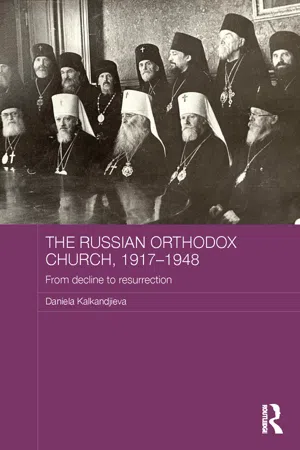
This book tells the remarkable story of the decline and revival of the Russian Orthodox Church in the first half of the twentieth century and the astonishing U-turn in the attitude of the Soviet Union's leaders towards the church. In the years after 1917 the Bolsheviks' anti-religious policies, the loss of the former western territories of the Russian Empire, and the Soviet Union's isolation from the rest of the world and the consequent separation of Russian emigrés from the church were disastrous for the church, which declined very significantly in the 1920s and 1930s. However, when Poland was partitioned in 1939 between Nazi Germany and the Soviet Union, Stalin allowed the Patriarch of Moscow, Sergei, jurisdiction over orthodox congregations in the conquered territories and went on, later, to encourage the church to promote patriotic activities as part of the resistance to the Nazi invasion. He agreed a Concordat with the church in 1943, and continued to encourage the church, especially its claims to jurisdiction over émigré Russian orthodox churches, in the immediate postwar period. Based on extensive original research, the book puts forward a great deal of new information and overturns established thinking on many key points.
- 392 pages
- English
- ePUB (mobile friendly)
- Available on iOS & Android
eBook - ePub
About this book
Information
1 The dissolution of the Russian Orthodox Church (1917–1939)
Church separatism and schisms in the Soviet lands (1917–1927)
Church separatism (1917–1921)
At the beginning of the twentieth century, the Russian Orthodox Church was not simply a state or national religious institution, but an organization of international significance. Its canonical authority spread far beyond the borders of the Russian Empire, embracing an archdiocese in North America, parishes in Western Europe and missions in the Middle and the Far East. No other Orthodox Church could compare with it. The February and October revolutions in 1917, however, called the very existence of the Russian Orthodox Church into question.
The February Revolution resulted in the abdication of Emperor Nikolay II and the collapse of Russian monarchy. It provoked centrifugal tendencies that threatened not only the unity of the Russian state but also that of its Orthodox Church. In March 1917, the Georgians rejected the jurisdiction of the Russian Synod and revived their ancient autocephalous patriarchate. This act was also supported by the Provisional Government of Georgia, in whose view this new church status was in harmony with the restored political sovereignty of the country.1 Moreover, in light of the disputed abolishment of the Patriarchate of Georgia in 1811, its revival was perceived as an act of historical justice.
In the spring of 1917, however, the Georgian defiance seemed to be a temporary problem. The Russian Synod was much more upset by the disrupted status quo in church-state relations. The February Revolution brought to power the first secular government in Russian history, and the Church had to accommodate its activities to the new conditions. The change required not only a reassessment of the mode of church-state relations but also an overall ecclesiastical reorganization. These tasks had to be undertaken by the Great All-Russian Ecclesiastical Sobor. It was the first such council convoked after a 217-year hiatus. Opened on August 28, 1917, the Sobor was attended by 564 delegates (73 bishops, 192 priests and 217 laymen).2 The delegates voted on proposals on the basis of thorough analyses presented by church experts, and after broad public debate.
The Sobor’s main achievement was the adoption of statutes that liberated the Russian Orthodox Church from its previous status of state appendage. They abandoned the Petrine model of a state-appointed synod and diocesan hierarchs and introduced the principle of elected bishops.3 They also restored the Russian Orthodox Church’s patriarchal dignity. Despite some concerns that this reform would turn the Church into a monarchy, it was supported by the majority of deputies. According to the Sobor’s view, if Russia was to be ruled by a secular government, the patriarchate was necessary as a guarantee of church autonomy.4 At the same time, the statutes restricted the patriarch’s role in church government. They introduced the principle of separation of powers into the Russian Orthodox Church: Executive power was entrusted to the Supreme Church Government, a collective body that consisted of the patriarch, the Holy Synod, and the Supreme Church Council, while the legislative was the province of the All-Russian Ecclesiastical Sobor.5
The Bolshevik revolution consolidated the champions of the patriarchate. On November 10, 1917, the Great All-Russian Ecclesiastical Sobor organized the first patriarchal elections in two centuries.6 A week later, the name of Metropolitan Tikhon (Belavin) was chosen by lot among those of the three Russian hierarchs who had received the highest number of votes in these elections.7 On December 4, he was enthroned as “Patriarch of Moscow and all Rossia.”8 Afterward, the work of the ecclesiastical forum continued under his chairmanship. The Sobor was closed on September 20, 1918, with an intention to convoke another in 1921.9
Meanwhile, the newly restored Moscow Patriarchate was experiencing the first effects of the Bolshevik antireligious policy. Although the new rulers of Russia believed in the ultimate extinction of religion, they found it necessary to speed up this process through a series of measures. On January 23, 1918, they decreed the separation of church from state and of school from church.10 The decree deprived the Orthodox Church of a series of rights, including the right to own private property. Religious instruction in public and private schools was also prohibited. On January 25, anticipating new problems, the Great Ecclesiastical Sobor asked Patriarch Tikhon (see Figure 1.1) to nominate several locum tenentes to take his duties in case of his sickness, death, or arrest. Should this happen, they were to assume these duties in order of their seniority.11 The civil war, however, postponed the Bolshevik assault against the Orthodox Church. Under these new conditions, the Red commissars softened their antireligious zeal and granted freedom of religious as well as antireligious propaganda in the first Soviet Constitution, adopted on July 10, 1918.
No less damaging to the Church was Russia’s defeat in World War I, which stimulated the growth of church separatism on national grounds. This tendency was especially strong in Ukraine. The constant change of ruling powers there (Bolsheviks, Germans, Ukrainians), however, did not allow for the establishment of long-lasting autocephaly. To placate the Ukrainian drive for church independence, the Great All-Russian Ecclesiastical Sobor granted broad autonomy to their Orthodox Church. As a result, on July 9, 1918, a local Ukrainian sobor elected Antonii (Khrapovitskii) as Metropolitan of Kiev and declared the Ukrainian Orthodox Church an autonomous exarchate of the Moscow Patriarchate.12 In 1919, however, power in Kiev was seized by Symon Petlyura, who rejected this autonomy and proclaimed the establishment of an autocephalous Ukrainian Orthodox Church. This Church did not outlive Petlyura’s rule.

Figure 1.1 Patriarch Tikhon of Moscow and All Rossia.
In October 1921, a small group of believers made an attempt to revive Ukrainian autocephaly. No Orthodox bishop, however, agreed to bless their initiative. Therefore, the dissenters invented a special procedure to meet the canonical requirement for an episcopate. At their founding meeting, the laymen put their hands on the shoulders of the attending priests, who in their turn put their hands on the head of the defrocked priest Vasilii Lipkivsky and proclaimed him bishop. Then, he alone ordained other bishops. For this reason, the Moscow Patriarchate refers to Lipkivsky’s Church as “self-blessed.” In 1929, its activities were suspended by the Soviets.13
Decree no. 362: Church unity through decentralization
The processes of disintegration in the Russian Orthodox Church were also stimulated by the military campaigns during the civil war. The front lines interrupted communication between the patriarchal see in Moscow, which remained under Bolshevik rule, and the dioceses under the control of the White Guard government and the Allied interventionists. Having no connection with the central church authorities, the isolated hierarchs organized local religious life according to conditions on the ground. In some places, they set up temporary higher church governments. In November 1918, such a body was established in Siberia under the leadership of Archbishop Sil’vestr (Ol’shanskii) of Omsk. In May 1919, Archbishop Mitrofan (Simashkevich) of Don organized another temporary church government in Southern Russia.14 All of these acknowledged Patriarch Tikhon as their archpastor and “considered themselves to be responsible before a future All-Russian Sobor after the liberation of Russia from the atheist regime.”15
In its turn, the patriarchal administration in Moscow also took measures to guarantee church unity. On November 20, 1920, together with the Holy Synod and the Supreme Church Council, Patriarch Tikhon issued Decree No. 362, aimed at overcoming the Russian Orthodox Church’s physical disintegration. The decree offered provisional solutions for structures that were cut off from church headquarters in Moscow by the front line. It allowed them to establish temporary bodies of church self-government. More specifically, their bishops were authorized to resolve local problems on their own authority until the restoration of normal relations with the central church administration. The decree explicitly states that it was issued to respond to “the eventuality of the cessation of the functioning of the Diocesan Councils.”16 It also instructed the Russian bishops how to proceed in case of termination of the Moscow Patriarchate. Meanwhile, Article 1 of the same decree provided guarantees for the Russian Orthodox Church’s canonical unity. It reads:
In case the Holy Synod and the Supreme Ecclesiastical Council should for some reason cease their functioning, the diocesan Bishop shall, by the rules of the supreme ecclesiastical administration, directly ask the Most Holy Patriarch, or such person or establishment as indicated by him, for all guidance and decisions.17
Following this logic, Article 10 postulates that all acts undertaken by hierarchs during their isolation had to be evaluated and confirmed by the central church administration after the normalization of religious life in Russia. In addition, Decree No. 362 turned out to have important international aspects. According to it...
Table of contents
- Cover
- Half Title
- Title Page
- Copyright Page
- Table of Contents
- List of illustrations
- Acknowledgments
- List of abbreviations
- Introduction
- 1 The dissolution of the Russian Orthodox Church (1917–1939)
- 2 The Sergian Church in the annexed territories (September 1939–June 1941)
- 3 The holy war of the Sergian Church
- 4 The Sergian Church and Western Christianity
- 5 The Moscow patriarchate restored
- 6 The growth of Moscow’s jurisdiction (1945–1946)
- 7 The Russian émigré churches beyond Stalin’s grasp (1945–1947)
- 8 The Moscow Patriarchate and the autocephalous Orthodox Churches outside the Soviet Union (1944–1947)
- 9 Toward an eighth ecumenical council (1944–1948)
- Conclusion
- Bibliography
- Index
Trusted by 375,005 students
Access to over 1.5 million titles for a fair monthly price.
Study more efficiently using our study tools.
Frequently asked questions
Yes, you can cancel anytime from the Subscription tab in your account settings on the Perlego website. Your subscription will stay active until the end of your current billing period. Learn how to cancel your subscription
No, books cannot be downloaded as external files, such as PDFs, for use outside of Perlego. However, you can download books within the Perlego app for offline reading on mobile or tablet. Learn how to download books offline
Perlego offers two plans: Essential and Complete
- Essential is ideal for learners and professionals who enjoy exploring a wide range of subjects. Access the Essential Library with 800,000+ trusted titles and best-sellers across business, personal growth, and the humanities. Includes unlimited reading time and Standard Read Aloud voice.
- Complete: Perfect for advanced learners and researchers needing full, unrestricted access. Unlock 1.5M+ books across hundreds of subjects, including academic and specialized titles. The Complete Plan also includes advanced features like Premium Read Aloud and Research Assistant.
We are an online textbook subscription service, where you can get access to an entire online library for less than the price of a single book per month. With over 1.5 million books across 990+ topics, we’ve got you covered! Learn about our mission
Look out for the read-aloud symbol on your next book to see if you can listen to it. The read-aloud tool reads text aloud for you, highlighting the text as it is being read. You can pause it, speed it up and slow it down. Learn more about Read Aloud
Yes! You can use the Perlego app on both iOS and Android devices to read anytime, anywhere — even offline. Perfect for commutes or when you’re on the go.
Please note we cannot support devices running on iOS 13 and Android 7 or earlier. Learn more about using the app
Please note we cannot support devices running on iOS 13 and Android 7 or earlier. Learn more about using the app
Yes, you can access The Russian Orthodox Church, 1917-1948 by Daniela Kalkandjieva in PDF and/or ePUB format, as well as other popular books in Social Sciences & Ethnic Studies. We have over 1.5 million books available in our catalogue for you to explore.