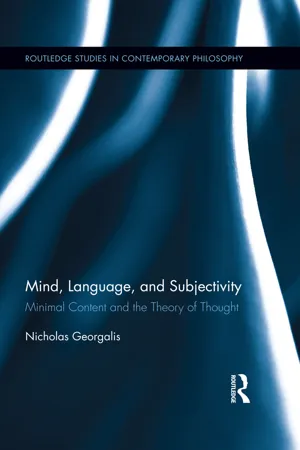
In this monograph Nicholas Georgalis further develops his important work on minimal content, recasting and providing novel solutions to several of the fundamental problems faced by philosophers of language. His theory defends and explicates the importance of 'thought-tokens' and minimal content and their many-to-one relation to linguistic meaning, challenging both 'externalist' accounts of thought and the solutions to philosophical problems of language they inspire. The concepts of idiolect, use, and statement made are critically discussed, and a classification of kinds of utterances is developed to facilitate the latter. This is an important text for those interested in current theories and debates on philosophy of mind, philosophy of language, and their points of intersection.
eBook - ePub
Mind, Language and Subjectivity
Minimal Content and the Theory of Thought
- 260 pages
- English
- ePUB (mobile friendly)
- Available on iOS & Android
eBook - ePub
About this book
Trusted by 375,005 students
Access to over 1.5 million titles for a fair monthly price.
Study more efficiently using our study tools.
Information
Topic
PhilosophySubtopic
Linguistics1
Minimal Content and Intentionality
1.1 Introduction
I begin with four commonplaces: We have thoughts. We use and understand language. Language can be used to express our thoughts as well as the way the world is or could be. Both thoughts and sentences have content.
Frequently, a common analysis of both thought and linguistic content is sought. Though there is some point to doing this, typically it results in overlooking a crucial aspect of thinking, one whose accommodation is required for an adequate theory of thought. The neglect of this aspect leads to deep difficulties and apparently unsolvable problems.1 My support for these claims begins in this chapter, continues in the next two, and is applied throughout to various problems.
Thoughts and sentences exhibit intentionality, aboutness. We will see that a proper explanatory account of the latter is a delicate matter. I will argue that there is a subjective aspect to intentionality that is necessary for an adequate theory of intentionality. This subjective aspect will be presently identified as minimal content. It will be extensively discussed in this and the next chapter and applied throughout this book. Moreover, while we rightly may, and often do, simply speak of thought or sentence content without mention of minimal content, I hope to establish that the very possibility of coherently doing so presupposes it. Thus, I argue for the primacy of thought over language and that a specific subjective aspect of thought, minimal content, is fundamental to the very possibility of determinate language, hence of language itself.2 These are grand claims. The defense of them begins in this chapter and continues through the remainder of this book.
Minimal content plays two broad roles in my theory. In this chapter I will argue that it is essential to giving an adequate account of intentionality. In chapters 11 and 12 I will argue that minimal content is required for a sentence to have particular content. Absent securing particular content, talk of content is meaningless, and without minimal content there can be no particular content, or so I argue. With regard to these claims, the role played by minimal content is foundational. There is a second role that the subjective concept of minimal content plays in discourse which is not foundational, though it is also required for an adequate explanatory account; it is more conspicuously manifested than the first. For now, it may be intuitively suggested by the locution “what the speaker means” as distinct from the semantic or linguistic meaning of the speaker’s utterance.3
Any theory of intentionality must confront two striking features, which appear to conflict:
- (I) There is an asymmetry between oneself and others with regard to access to the contents of our thoughts.4
- (II) An individual may neither know nor be in a better position than someone else to ascertain what his own thought is about.
The resolution of this apparent conflict turns on the recognition that a correct analysis of intentional states involves not only two kinds of content but two kinds of methodology. I will argue that the first-person perspective plays an indispensable role in uncovering a non-qualitative kind of narrow content, minimal content. The first-person perspective is indispensable here because minimal content is demonstrably invisible to a strictly third-person methodology, yet it is a content that plays a fundamental role in intentionality. The other sense of content, objective content, is what saves the second feature and requires a third-person methodology. Both contents (to be defined below) are required for an adequate account of intentionality. Excluding either one is a debilitating mistake. Minimal content was introduced and extensively argued for throughout my 2006. I will recapitulate here some of my arguments for it.
It is worth mentioning that though I insist on the necessity of a first-person methodology in the study of intentionality and, more generally of thought, I do not use, as some have, the what-it-is-like operator to establish this. For too long it has been implicitly assumed that what-it-is-like exhausted the ways the first-person perspective may be deployed.5 My deployment of first-person methodology is different. My deployment of it is by way of conjuring up a situation in thought and asking you to project yourself into that situation and consider it from your own first-person perspective. In the situations described, qualitative features are not the issue. You will not be asked to consider “what it is like”. You will be asked to consider yourself to be in the situation described and determine what the subject of your thought would then be as you would conceive it. As this involves projecting yourself into some imagined situation, it is different from the more usual first-person appeal to what-it-is-like. I will call this different first-person methodology the projection method.6
In what follows, I ask my readers to realize that at times they must adopt this method, to think the situation described as though they themselves were in the situation. Where I am not explicit, I let the context of my discussion serve as clues as to whether the first- or third-person perspective is the appropriate one to adopt. This is necessary because if I am right about minimal content, it is, as I have said, invisible from the third-person perspective; so, my interlocutor must at least temporarily assume the first-person perspective, if she is to fairly criticize what I say. My arguments for it cannot even be comprehended unless one assumes that perspective on the cases I develop. This is a harmless request since temporary adoption of the first-person perspective should not in itself beg any questions against opposing views.
1.2 Privileged Access and Minimal Content
The asymmetrical access we have to our own thoughts is sometimes referred to as privileged access. Many different conceptions of the latter have been advanced, but two general reasons why privileged access is held in disrepute by some are that exaggerated claims have been made on its behalf, and that it has kept company with dualism. However, privileged access is not necessarily connected to dualism, and certain alleged features (such as complete transparency and incorrigibility) may be dropped, while still preserving an important point about the special access we have to some of our states. The special access at issue amounts to no more than one’s ability to non-inferentially know the content, in some sense, of at least some of one’s thoughts. I argue that we have non-inferential knowledge and asymmetrical access to our own minimal contents. It is in some such limited guise that privileged access remains a compelling doctrine.7 Unfortunately, this limited asymmetrical access has not been adequately recognized, though I hope to demonstrate to you that its consequences are great.8
As the kind of privileged access that I endorse is so strictly limited as compared to how it is usually understood, I offer some further remarks regarding its scope. The privileged access that I argue for only depends on the fact that we sometimes know without inference part of what our thoughts are about in some sense. It is not that we know all of it in this way. It is not that we always non-inferentially know part of it. It is not even that we need explicitly entertain what that content is. To make my case, it is enough if the agent has been, or could become, non-inferentially aware of part of the content of thought.
Nor is the claim that we have special access to our own minimal contents to be confused with maintaining a private language or anything like that. The special access is not due to the “privacy” of minimal contents; others are not precluded from having knowledge of another’s minimal contents. It is just that one’s knowledge of another’s minimal content must be inferential, whereas one’s access to one’s own minimal contents can be non-inferential. These points will be further clarified in the discussion of one’s forming of an image or drawing of a diagram and other cases discussed below.9
Let no one worry that by allowing this privileged access all the work necessary for understanding intentionality is (mysteriously) done. Frankly, the access that the first-person perspective provides does not explain anything; still, it is what exposes the content to which we have special access and which is invisible to a strictly third-person methodology. Privileged access and this content are central features that must be explained or shown to be a mere appearance.10 They cannot be ignored.
To illustrate the kind of access in question, consider an example.11 Suppose you ask me to form an image of my grandmother. On informing you that I have done so, you inquire how I know it is an image of her, and not someone else. For such an inquiry to make sense, it must be possible that I could be mistaken when I think the image I formed is an image of my grandmother. But as I formed it expressly to be of my grandmother, such a possibility must be ruled out: It is constitutive of the forming of the image that it is of her.
There is room for error on the agent’s part of a sort, one that is harmless to the point here, as it concerns external matters. For example, the woman whom I have come to think of as my grandmother may really be an impostor. In that case, however, I would not be making a mistake about whom my image is of; rather, it is a mistake about my blood-relationship to her. Another kind of case that may be put aside is one where some image randomly comes to my mind. Here, although the image is mine, I would be in no privileged position to ascertain of whom it is; indeed, it would appear to be no more of anything than are the “stars” I experience on receiving a blow to the head. If one were to maintain that it was of someone in particular, the criteria for deciding would be at best unclear. In any case, I certainly would not be in any privileged position to know this in such a case.
So, while I can be wrong about images of mine in some ways, I cannot err in identifying whom my image is of when I deliberately form it to be of some particular individual. I cannot err in the latter simply because the possibility of error in these circumstances does not make any sense, not because I have some special mental powers or because I am cognizant of a special kind of entity. That it is of the particular individual in question is a constitutive element of the very act of forming the image. It could not be that act if it were not of that very individual. Given this, plus the fact that the content at issue is only part of the content of a thought, such “infallibility” is not to be confused with the Cartesian kind.
Someone might think there is a possibility of error here because they hold some “resemblance” criterion for what an image is an image of. Thus, suppose the image I formed is in fact a rather poor resemblance of my grandmother. The image itself may even be an excellent resemblance of someone other than my grandmother, say, your neighbor; nevertheless, the degree of visual faithfulness to her is irrelevant. It is, after all, the image I deliberately formed to be of my grandmother. The criterion determining who, or what, it is an image of cannot be based on what it is the most (visually) similar to. It is not as if I conjured up an image and then began to wonder who it depicts; the image was conjured precisely to be an image of her.
Resemblance could be relevant in a very different kind of case: Were I to find a photograph of someone, I might well wonder who is depicted in the photo and use resemblance as one criterion for deciding. In this case resemblance would be appropriate because of the different circumstances and causal relations involved in producing the photo. The relevant circumstances and causal relations are radically different in the case of a deliberately formed image, however, since here resemblance is totally irrelevant as a factor in the determination of the individual represented by the image. The formed image is a direct result of my act of producing, not simply an image, but an image of a certain individual. That being a constitutive element of the act, I cannot perform the act without the result being of that particular individual; otherwise, it would be a different act.
The same point could be made with a sketch, which has the advantage of being publicly observable. If you ask me to sketch my grandmother, the result may indeed look more like your neighbor than my grandmother, and we may even agree on this. But a poorly drawn sketch of my grandmother is still a sketch of her. That is why it is said to be poorly drawn; it is not said to be a (well-drawn) sketch of whomever it most closely resembles. In parallel to the imagery, and in contrast to the photo case, I neither have to infer nor is there any possibility of error on my part as to whom my deliberately drawn sketch is of. There is a possibility of error in your judging whom my sketch is of, and your judgment will be based on inference and may rely on resemblance, but my judgment does neither. That difference is just a manifestation of the asymmetry of access.
I examine another example12 to illustrate further both the kind of privileged access at issue and the kind of content to which we have this special access. Suppose I make a diagram while lecturing on the battle of Borodino. I make Xs to mark the location of Napoleon’s troops, and Os to mark Kutuzov’s. Though there are countless errors I may make in my lecture as well as in the accuracy of my diagram, it makes no sense to ask me how I know the Xs represent Napoleon’s rather than Kutuzov’s troops. Since the diagram is mine, the Xs cannot fail to represent what I intend them to represent. Suppose, on looking at my diagram, I have the thought that Napoleon had too heavy a concentration of troops in the northeast. On having this thought, I non-inferentially know that an X represents (a certain number of) Napoleon’s troops. I kn...
Table of contents
- Cover
- Title
- Copyright
- Contents
- Preface
- 1 Minimal Content and Intentionality
- 2 More on Minimal Content and Related Issues
- 3 Thinking Differently About Thought and Language
- 4 The Superiority of the New Theory to Frege’s
- 5 Kripke’s Puzzle About Belief Solved
- 6 Use, Idiolect, and Statement Made
- 7 Speaker’s Referent
- 8 Speaker’s Referent and the Referential/Attributive Distinction
- 9 Proper Names
- 10 Solutions to Classic Problems
- 11 Securing Determinate Meaning—Part I: Against Kripkenstein
- 12 Securing Determinate Meaning—Part II: Against Quine
- Bibliography
- Index
Frequently asked questions
Yes, you can cancel anytime from the Subscription tab in your account settings on the Perlego website. Your subscription will stay active until the end of your current billing period. Learn how to cancel your subscription
No, books cannot be downloaded as external files, such as PDFs, for use outside of Perlego. However, you can download books within the Perlego app for offline reading on mobile or tablet. Learn how to download books offline
Perlego offers two plans: Essential and Complete
- Essential is ideal for learners and professionals who enjoy exploring a wide range of subjects. Access the Essential Library with 800,000+ trusted titles and best-sellers across business, personal growth, and the humanities. Includes unlimited reading time and Standard Read Aloud voice.
- Complete: Perfect for advanced learners and researchers needing full, unrestricted access. Unlock 1.5M+ books across hundreds of subjects, including academic and specialized titles. The Complete Plan also includes advanced features like Premium Read Aloud and Research Assistant.
We are an online textbook subscription service, where you can get access to an entire online library for less than the price of a single book per month. With over 1.5 million books across 990+ topics, we’ve got you covered! Learn about our mission
Look out for the read-aloud symbol on your next book to see if you can listen to it. The read-aloud tool reads text aloud for you, highlighting the text as it is being read. You can pause it, speed it up and slow it down. Learn more about Read Aloud
Yes! You can use the Perlego app on both iOS and Android devices to read anytime, anywhere — even offline. Perfect for commutes or when you’re on the go.
Please note we cannot support devices running on iOS 13 and Android 7 or earlier. Learn more about using the app
Please note we cannot support devices running on iOS 13 and Android 7 or earlier. Learn more about using the app
Yes, you can access Mind, Language and Subjectivity by Nicholas Georgalis in PDF and/or ePUB format, as well as other popular books in Philosophy & Linguistics. We have over 1.5 million books available in our catalogue for you to explore.